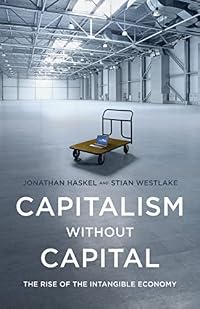
Capitalism without Capital: The Rise of the Intangible Economy
by Jonathan Haskel, Stian Westlake
On This Page
Description
"Early in the twenty-first century, a quiet revolution occurred. For the first time, the major developed economies began to invest more in intangible assets, like design, branding, R & D, and software, than in tangible assets, like machinery, buildings, and computers. For all sorts of businesses, from tech firms and pharma companies to coffee shops and gyms, the ability to deploy assets that one can neither see nor touch is increasingly the main source of long-term success. But this is not show more just a familiar story of the so-called new economy. Capitalism without Capital shows that the growing importance of intangible assets has also played a role in some of the big economic changes of the last decade. The rise of intangible investment is, Jonathan Haskel and Stian Westlake argue, an underappreciated cause of phenomena from economic inequality to stagnating productivity. Haskel and Westlake bring together a decade of research on how to measure intangible investment and its impact on national accounts, showing the amount different countries invest in intangibles, how this has changed over time, and the latest thinking on how to assess this. They explore the unusual economic characteristics of intangible investment, and discuss how these features make an intangible-rich economy fundamentally different from one based on tangibles. Capitalism without Capital concludes by presenting three possible scenarios for what the future of an intangible world might be like, and by outlining how managers, investors, and policymakers can exploit the characteristics of an intangible age to grow their businesses, portfolios, and economies."-- show lessTags
Recommendations






Member Reviews
'Capitalism Without Capital' falls into that droll sub-genre, 'biting critiques of capitalism by orthodox economists'. The authors argue that the increase in intangible investment by companies, which is often recorded in the form of expenses rather than investment, sheds light on many features of developed world economies, job markets, and political fractures. Like so many economics books, at times it frustrated me with unquestioned reductive assumptions, for example that GDP growth is a desirable policy aim per se. I also scoffed at certain graphs showing seemingly weak correlations with no r^2 or p-value. If you're going to be academic enough to include in-text citations, it's only polite to show a bit more of your quantitative work. show more Nonetheless, there is a lot of interesting material, generally explained clearly and qualified as appropriate. Moreover, the book is very well structured, something I particularly appreciate. At first I suspected the authors were ignoring the elephant in the room of surveillance capitalism, then came to realise that their analysis sheds further light on the phenomenon without focusing upon it.
The initial chapters define intangible capital and discuss how it can be measured. This is useful context without being especially interesting. The compelling material comes later, with chapters on the distinctive features and implications of intangible investment. The former can be summarised as scalability, sunk costs, spillovers, and synergies. (I hate the word synergy, but have to admit that it is appropriate in this case.) Arising from these, it seems, are increasing uncertainty and contestedness, which all seemed plausible to me. The really interesting parts, though, are the theorised linkages between these characteristics and trends in total investment, productivity, and inequality. Much as I love to simply blame things on neoliberal capitalism, more sophisticated attempts at explanation can be more satisfying. 'Capitalism without Capital' doesn't set out to indict neoliberalism, but still manages to rather neatly. The sections about inequality between firms are particularly helpful in explaining the continued dominance of the big 5 tech firms:
I also thought this point particularly significant:
Industries dominated by a small number of huge firms and relatively unfettered by regulation inevitably turn to rent-seeking, because it is profitable. The authors discuss rent-seeking in a slightly broader manner than I think is traditionally used in economics, in terms of displacing existing investment rather than adding to the economy-wide total. Surely this covers 'disrupting' a sector with an app that centralises the service onto a platform and fragments actual service providers into self-employment: the Uber, AirB&B, and Just Eat model. Such firms are rent-seeking with their apps and behavioural data, I suppose. The authors also note the link between spending on lobbying and increased stock valuations, another can of worms.
The chapter on inequality proved more multifaceted than I expected, which was a very pleasant surprise. It considered not only income, wealth, and inter-firm inequality, but also inequality of esteem, a term I hadn't previously come across for a very important phenomenon:
While I'm not wholly convinced by explanation for how intangibles exacerbate inequality of esteem advanced here, it's still a suggestion worth thinking about. This centres upon the personality traits of those likely to support Trump and Brexit, who apparently tend to score low on, 'openness to experience' measures as they are of a more traditionalist bent. According to the authors, those who score high on this trait are likely to be more highly valued as employees in an intangible economy. I think there must be much more to it than that, especially as elsewhere in the same chapter it is pointed out that intangibles reinforce hierarchies both between and within firms. That suggests a stifling of economic and social upward mobility, which could cause resentment amongst those who consider they have narrower opportunities than in the past. Another suggested reason for income inequality seems calculated to make people angry: 'Where talented employees are able to some extent to help firms make the best of this uncertainty, it becomes easier to create a cult of talent that can be exploited by people at the top of firms to demand higher pay'. Another section links the rise of intangible investment with property price inflation and thus wealth inequality, likewise depressingly plausibly.
I was struck by this point about the two organisational structures likely to prosper on the basis of intangibles:
Obviously it's more complicated than that and the two could also be different parts of the same firm, such as the warehouse workers and product developers at Amazon. The potential for worsening income, job security, and employment experience inequality are nonetheless evident should those two models predominate.
The book concludes by stressing the importance of government policy and clear legal frameworks to avoid intangible investment essentially destabilising capitalism. Yet it is clear that the most successful firms systematically use lobbying to deter regulation they perceive as against their financial interests, so there is no reason to assume this will occur. The points about debt, equity funding, and venture capital are less eye-catching than the inequality chapter, but argue convincingly that tax reform is needed to deal with the new face of investment. I was amused by the inclusion of a point about increasing university research funding. That certainly shows little sign of happening, as Brexit will reduce access to research funds. The mentions of urban planning are rather simplistic, although there is some validity to them. In the final chapter, the summary of arguments advanced also states which are more speculative and acknowledges the potential for other explanatory factors, which is very sensible.
'Capitalism without Capital' has an excellent title, which certainly got my attention. When read after [b:The Age of Surveillance Capitalism: The Fight for a Human Future at the New Frontier of Power|26195941|The Age of Surveillance Capitalism The Fight for a Human Future at the New Frontier of Power|Shoshana Zuboff|https://i.gr-assets.com/images/S/compressed.photo.goodreads.com/books/1521733914l/26195941._SY75_.jpg|46170685], it implies that without capital, capitalism could be reduced to just ism, whatever that might turn out to be. show less
The initial chapters define intangible capital and discuss how it can be measured. This is useful context without being especially interesting. The compelling material comes later, with chapters on the distinctive features and implications of intangible investment. The former can be summarised as scalability, sunk costs, spillovers, and synergies. (I hate the word synergy, but have to admit that it is appropriate in this case.) Arising from these, it seems, are increasing uncertainty and contestedness, which all seemed plausible to me. The really interesting parts, though, are the theorised linkages between these characteristics and trends in total investment, productivity, and inequality. Much as I love to simply blame things on neoliberal capitalism, more sophisticated attempts at explanation can be more satisfying. 'Capitalism without Capital' doesn't set out to indict neoliberalism, but still manages to rather neatly. The sections about inequality between firms are particularly helpful in explaining the continued dominance of the big 5 tech firms:
Firms that can create and manipulate intangibles can reap outsize benefits. In a world where intangible investment is very important, we would expect to see the 'best' firms - that is, those firms that a) own valuable scalable intangibles, and b) are good at extracting the spillovers from other businesses - being highly productive and profitable, and their competitors losing out.
[...]
The scalability and synergies of intangible investments also play a role in making leading firms more willing to invest. Leaders are more likely to be larger and grow faster and, therefore, to be able to take advantage of the scalability of intangibles. [...] They are more likely to possess other valuable intangibles that are synergistic with new investments they make.
I also thought this point particularly significant:
We should consider the possibility that the true nature of intangible investment has changed. Maybe it conceals rent-seeking activities that superficially look like they increase productivity but actually do nothing of the sort.
Industries dominated by a small number of huge firms and relatively unfettered by regulation inevitably turn to rent-seeking, because it is profitable. The authors discuss rent-seeking in a slightly broader manner than I think is traditionally used in economics, in terms of displacing existing investment rather than adding to the economy-wide total. Surely this covers 'disrupting' a sector with an app that centralises the service onto a platform and fragments actual service providers into self-employment: the Uber, AirB&B, and Just Eat model. Such firms are rent-seeking with their apps and behavioural data, I suppose. The authors also note the link between spending on lobbying and increased stock valuations, another can of worms.
The chapter on inequality proved more multifaceted than I expected, which was a very pleasant surprise. It considered not only income, wealth, and inter-firm inequality, but also inequality of esteem, a term I hadn't previously come across for a very important phenomenon:
The divides revealed by the UK's Brexit referendum and the election of Donald Trump also point to a different form of inequality, one that economists typically focus on little, if at all. This is inequality of esteem The reasons for the rise of populist political movements around the world, from the supporters of Donald Trump in the United States, to Britain's UK Independence Party, to the Five Star Movement in Italy are many and varied. But one thing many of their supporters repeatedly invoke is their anger at being patronised and disrespected by what they perceive as an out-of-touch, technocratic, even degenerate Establishment. Some of the supporters of these movements are are undoubtedly also poor in income or wealth terms - but not all. The inequality that fuels their anger seems to be as much about regard as money.
While I'm not wholly convinced by explanation for how intangibles exacerbate inequality of esteem advanced here, it's still a suggestion worth thinking about. This centres upon the personality traits of those likely to support Trump and Brexit, who apparently tend to score low on, 'openness to experience' measures as they are of a more traditionalist bent. According to the authors, those who score high on this trait are likely to be more highly valued as employees in an intangible economy. I think there must be much more to it than that, especially as elsewhere in the same chapter it is pointed out that intangibles reinforce hierarchies both between and within firms. That suggests a stifling of economic and social upward mobility, which could cause resentment amongst those who consider they have narrower opportunities than in the past. Another suggested reason for income inequality seems calculated to make people angry: 'Where talented employees are able to some extent to help firms make the best of this uncertainty, it becomes easier to create a cult of talent that can be exploited by people at the top of firms to demand higher pay'. Another section links the rise of intangible investment with property price inflation and thus wealth inequality, likewise depressingly plausibly.
I was struck by this point about the two organisational structures likely to prosper on the basis of intangibles:
Different types of organisation will emerge, matched to the parts of the intangible economy they specialise in. Are you creating intangible assets (writing software, doing design, producing research)? If so, you probably want a flat organisation with more autonomy, fewer targets, and more access to the boss. That will cost you time on influence activities, but will build an organisation that allows information to flow, helps serendipitous interactions, and keeps the key talent. Are you using intangible assets (say, the routines in the Starbucks franchise book)? Then you probably want more control and authority to use the asset to its advantage and stop influence activities.
Obviously it's more complicated than that and the two could also be different parts of the same firm, such as the warehouse workers and product developers at Amazon. The potential for worsening income, job security, and employment experience inequality are nonetheless evident should those two models predominate.
The book concludes by stressing the importance of government policy and clear legal frameworks to avoid intangible investment essentially destabilising capitalism. Yet it is clear that the most successful firms systematically use lobbying to deter regulation they perceive as against their financial interests, so there is no reason to assume this will occur. The points about debt, equity funding, and venture capital are less eye-catching than the inequality chapter, but argue convincingly that tax reform is needed to deal with the new face of investment. I was amused by the inclusion of a point about increasing university research funding. That certainly shows little sign of happening, as Brexit will reduce access to research funds. The mentions of urban planning are rather simplistic, although there is some validity to them. In the final chapter, the summary of arguments advanced also states which are more speculative and acknowledges the potential for other explanatory factors, which is very sensible.
'Capitalism without Capital' has an excellent title, which certainly got my attention. When read after [b:The Age of Surveillance Capitalism: The Fight for a Human Future at the New Frontier of Power|26195941|The Age of Surveillance Capitalism The Fight for a Human Future at the New Frontier of Power|Shoshana Zuboff|https://i.gr-assets.com/images/S/compressed.photo.goodreads.com/books/1521733914l/26195941._SY75_.jpg|46170685], it implies that without capital, capitalism could be reduced to just ism, whatever that might turn out to be. show less
Brilliant! So many things to learn and so many things to think about.
Even though it's a little dense and not for people mildly interested in economics, it's a book that keeps you wanting to learn more and what's next.
I love books that change or broaden my perspective of the world and this book certainly does that.
Even though it's a little dense and not for people mildly interested in economics, it's a book that keeps you wanting to learn more and what's next.
I love books that change or broaden my perspective of the world and this book certainly does that.
An intriguing title but this review is actually of the Blinkist summary of the original book. So not totally fair to the original author. However, I’m reading the summary to give me an idea of whether it’s worth reading the original.
Understand how the nature of our economy is changing.
Increasingly, the most important investments and assets in our economy are nonphysical–or, in other words, intangible. Today, the true value of companies like Microsoft, Apple, Google or even Starbucks lies in intangible assets, be it software, research capabilities, branding or organizational development. And that matters, because companies built around intangible assets behave differently from those reliant on physical goods. For one, they can show more scale up faster and grow bigger. They are also riskier for investors, and easier for competitors to exploit.
[I might say, that these concepts are not new to me. I was the project manager for a major study into the service sector and service exports by the Australian Government which really changed attitudes towards intangibles and the service side of the economy in government ....and probably much wider. And I’ve been a lead speaker at international conferences on trade in services.....so much of the thrust of the book...emphasising the significance of intangibles, was, in my case, preaching to the converted].
The focus of our economy is shifting from physical assets to intangible assets.
For centuries, the process of assessing value–of a business, a town or even a country–has involved measuring, counting and valuating physical, tangible things, like buildings, machinery or computers. What’s changed for supermarkets is the incredible growth of intangible assets. Consider the rise of barcodes. They not only sped things up at the checkout, making it unnecessary for a worker to manually enter prices. They also enabled management to see, with the help of computer systems, a whole host of statistics about their stock etc. This development greatly increased the productivity of supermarkets and enabled more complex and more profitable pricing systems.
When Microsoft hit a market valuation of $250 billion in 2006 and became the most valuable company in the world at the time, the value of its traditional physical assets was a mere $ 3 billion–just 1 percent of its overall value.
The trend toward an intangible economy is now clear, even if it has only been recorded very recently.
The modern concept of gross domestic product, or GDP, was invented in the 1930s as a way to measure how much production had fallen during the Great Depression.
But it ignored any investments that weren’t physical, so a car factory’s new machines counted as investment, but the money spent employing designers to research a new car model did not. [I’ve actually seen proposals for redefining our economic statistics in terms of services. For example, the automotive industry has design, HR, legal services, patent management, accounting services, management services, storage, transportation, construction, assembly, packaging, marketing, public relations etc. etc.,.....all of which are services and can be recorded as such. And in other industries, such as the film industry there are accounting companies who only work with the film industry so are they part of the accounting industry or part of the film industry? Ideally, we need to be able to capture the statistics from both these perspectives to give us greater insights into making industry policies]. In the United States, for example, money spent developing computer software has only been counted in official statistics as an investment since 1999. Its inclusion added 1.1 percent to GDP, which reflects its significant value. In the United States, investment in intangibles overtook investment in physical assets in the mid-1990s. In the United Kingdom, that crossover happened a little later, in the late 1990s.
But the overall picture is clear. Developed economies are slowly but surely investing more and more in intangible assets.....Businesses operating with intangibles will behave differently, and an economy reliant on such businesses will have different characteristics.
Intangible assets are highly scalable, meaning we should get used to seeing some businesses grow very large, very quickly.
A key intangible asset for Starbucks is its operating manual. Once that’s been written in, say, Chinese, it can be used in every single Starbucks branch in the country at the same time.
The game, “Angry Birds”, can be spread over a huge number of downloads–more than three billion at the time of writing......This scalability means that we may increasingly see intangible-intensive businesses that can grow incredibly large. It also means that new entrants trying to break into markets dominated by the owners of scalable assets face a major challenge. In a market with high scalability, there are few rewards for the runner-up.
Clearly, industry concentration is something we may have to get used to.
Intangible investments are sunk costs, which has implications for financing and may make future financial crashes worse.
Intangible assets are the opposite of immobile assets. By their very nature, they tend to be sunk costs–costs that a business or investor has already incurred and which can no longer be recovered. This means that the costs of investing in them are complicated and very difficult to calculate and recover if things go wrong. Property valuers can place an accurate market value on things like the factory buildings. And in today’s economy, there are established secondary markets for almost all used equipment. By contrast, there are no established markets for brands or corporate processes.......banks are generally unwilling to invest against assets that can’t be seized or sold.
With bubbles based around sunk, intangible assets, with no secondary markets to sell them in, there is a risk that the assets will have no value at all.
Spillover effects, where businesses benefit from the ideas of other businesses, are increasingly common.
Your competitors can easily steal your intangible assets. Invest in a bus, and only you can use it. [Though one should not lightly dismiss the value tied up in licences to service particular routes, existing contracts, trained drivers and administrators, maintenance workshops and technicians and so on]. Invest in an idea or concept, and it can be easily commandeered by your competitors. [Though some protection may be offered by copyright and brand/design registration].
Apple certainly benefited by creating the iPhone. The device now accounts for two-thirds of the company’s revenue. But it also had a spillover effect, which benefited other phone manufacturers, or at least those savvy enough to keep up......Every time a good employee leaves one knowledge-based company and goes to work for another, she takes her training and experience with her......This points to a positive flipside to spillovers: the potential of synergies in an intangible economy.
In an intangible economy, ideas can fuse together, creating valuable synergies and new ways of doing things.
Microwave ovens were invented just after WWII but microwaves were a flop domestically until Raytheon bought a white goods manufacturer, Amana, in the 1960s. Combining Raytheon’s technical microwave expertise and Amana’s knowledge of kitchen appliances and what households wanted led to a microwave oven that was safe and easy to use.
Most innovations are the result of synergies: the fusion of a taxi-like network with new, sophisticated smartphone software–an intangible asset–was a major development. It enabled Uber to build a hugely valuable system.......A business’s innovations in research or production processes are more valuable when other local businesses are also coming up with great ideas, because it will be easier to find synergies.
Economic inequality is exacerbated by the growth of the intangible economy.
Inequality has certainly been rising in major economies. As well as income inequality, there has also been a rise in wealth inequality, as the value of rich people’s assets, like that of their houses, have grown faster than those of poorer people.......The nature of intangible businesses means that they generate high-paid jobs.....because intangible businesses tend to be scalable, they can afford to pay more than their nonscalable competitors. Google can afford to pay a product manager considerably more than a traditional manufacturer can pay its factory manager.
The rise of the intangible economy requires new thinking on education and finance.
With the advent of electricity, suddenly every machine could have its own motor, a great step forward in productivity (over the single motor driving every machine via belts). However, by the early twentieth century, almost 40 years after electrical power was introduced, only half of the factory capacity had been electrified. This slow adoption shows how it can sometimes take a long time for societies and economies to adjust to the new realities of innovations,
Governments should consider the future of adult education. As we shift to an economy based on ideas and knowledge. It’s hard to say with confidence what skills children should learn today to prepare them to join tomorrow’s workforce. Perhaps, soon, coding will become automated. [This seems to be a strange attitude...don’t teach the kids coding because we don’t know if it will be automated in the future. I’m more inclined to think that kids should be educated both in ways of thinking critically, scientifically and creatively as well as with practical skills like working with metal, and, yes, coding etc.] Adult education however, provides adults with immediate options to diversify. [Yes but lets not neglect chjild-education].
Second, economies will need to change their approach to financing. As we’ve seen, intangible assets are by nature “sunk,” so they are not easy to value or recover if things go wrong. There are some potential solutions. In Singapore and Malaysia, governments have begun to subsidize bank loans made against intellectual property, hoping to kick-start confidence in loans in the intangible economy. Approximately 16 percent of registered patents have been used as collateral against bank loans at some point.
Public investment in research and development will offer increasing benefits in an intangible economy.
Perhaps the greatest risk for the future intangible economy is the risk of underinvestment.
Businesses like Facebook, or Google, are happy to provide financial backing for start-up clusters in major tech hot spots like London or Berlin. And a company like Google is also big and diverse enough to reap some benefits for itself, as it uses or simply acquires new ideas generated by the start-up cluster it has invested in......But this is unlikely to fill the entire investment gap.
Governments should themselves consider scaling up their investments in research and development. Research conducted by one of the authors found that increased UK government investment in university research led to an increase in national productivity of around 20 percent.
Policy makers face a choice. They can either recognize that an intangible economy has different characteristics than a tangible one and proactively pursue policies that nourish its growth or they can ignore this new reality. Those that acknowledge the new reality will reap the rewards for years to come.
Yes, I think that this is a significant book...even though I was familiar with most of the ideas presented. And the author did not even touch on the field that I was most interested in: international trade in services (or intangibles). Generally I found myself in agreement with all the arguments put forward (though some issues were ignored or not developed or, maybe, not understood). But four stars from me. show less
Understand how the nature of our economy is changing.
Increasingly, the most important investments and assets in our economy are nonphysical–or, in other words, intangible. Today, the true value of companies like Microsoft, Apple, Google or even Starbucks lies in intangible assets, be it software, research capabilities, branding or organizational development. And that matters, because companies built around intangible assets behave differently from those reliant on physical goods. For one, they can show more scale up faster and grow bigger. They are also riskier for investors, and easier for competitors to exploit.
[I might say, that these concepts are not new to me. I was the project manager for a major study into the service sector and service exports by the Australian Government which really changed attitudes towards intangibles and the service side of the economy in government ....and probably much wider. And I’ve been a lead speaker at international conferences on trade in services.....so much of the thrust of the book...emphasising the significance of intangibles, was, in my case, preaching to the converted].
The focus of our economy is shifting from physical assets to intangible assets.
For centuries, the process of assessing value–of a business, a town or even a country–has involved measuring, counting and valuating physical, tangible things, like buildings, machinery or computers. What’s changed for supermarkets is the incredible growth of intangible assets. Consider the rise of barcodes. They not only sped things up at the checkout, making it unnecessary for a worker to manually enter prices. They also enabled management to see, with the help of computer systems, a whole host of statistics about their stock etc. This development greatly increased the productivity of supermarkets and enabled more complex and more profitable pricing systems.
When Microsoft hit a market valuation of $250 billion in 2006 and became the most valuable company in the world at the time, the value of its traditional physical assets was a mere $ 3 billion–just 1 percent of its overall value.
The trend toward an intangible economy is now clear, even if it has only been recorded very recently.
The modern concept of gross domestic product, or GDP, was invented in the 1930s as a way to measure how much production had fallen during the Great Depression.
But it ignored any investments that weren’t physical, so a car factory’s new machines counted as investment, but the money spent employing designers to research a new car model did not. [I’ve actually seen proposals for redefining our economic statistics in terms of services. For example, the automotive industry has design, HR, legal services, patent management, accounting services, management services, storage, transportation, construction, assembly, packaging, marketing, public relations etc. etc.,.....all of which are services and can be recorded as such. And in other industries, such as the film industry there are accounting companies who only work with the film industry so are they part of the accounting industry or part of the film industry? Ideally, we need to be able to capture the statistics from both these perspectives to give us greater insights into making industry policies]. In the United States, for example, money spent developing computer software has only been counted in official statistics as an investment since 1999. Its inclusion added 1.1 percent to GDP, which reflects its significant value. In the United States, investment in intangibles overtook investment in physical assets in the mid-1990s. In the United Kingdom, that crossover happened a little later, in the late 1990s.
But the overall picture is clear. Developed economies are slowly but surely investing more and more in intangible assets.....Businesses operating with intangibles will behave differently, and an economy reliant on such businesses will have different characteristics.
Intangible assets are highly scalable, meaning we should get used to seeing some businesses grow very large, very quickly.
A key intangible asset for Starbucks is its operating manual. Once that’s been written in, say, Chinese, it can be used in every single Starbucks branch in the country at the same time.
The game, “Angry Birds”, can be spread over a huge number of downloads–more than three billion at the time of writing......This scalability means that we may increasingly see intangible-intensive businesses that can grow incredibly large. It also means that new entrants trying to break into markets dominated by the owners of scalable assets face a major challenge. In a market with high scalability, there are few rewards for the runner-up.
Clearly, industry concentration is something we may have to get used to.
Intangible investments are sunk costs, which has implications for financing and may make future financial crashes worse.
Intangible assets are the opposite of immobile assets. By their very nature, they tend to be sunk costs–costs that a business or investor has already incurred and which can no longer be recovered. This means that the costs of investing in them are complicated and very difficult to calculate and recover if things go wrong. Property valuers can place an accurate market value on things like the factory buildings. And in today’s economy, there are established secondary markets for almost all used equipment. By contrast, there are no established markets for brands or corporate processes.......banks are generally unwilling to invest against assets that can’t be seized or sold.
With bubbles based around sunk, intangible assets, with no secondary markets to sell them in, there is a risk that the assets will have no value at all.
Spillover effects, where businesses benefit from the ideas of other businesses, are increasingly common.
Your competitors can easily steal your intangible assets. Invest in a bus, and only you can use it. [Though one should not lightly dismiss the value tied up in licences to service particular routes, existing contracts, trained drivers and administrators, maintenance workshops and technicians and so on]. Invest in an idea or concept, and it can be easily commandeered by your competitors. [Though some protection may be offered by copyright and brand/design registration].
Apple certainly benefited by creating the iPhone. The device now accounts for two-thirds of the company’s revenue. But it also had a spillover effect, which benefited other phone manufacturers, or at least those savvy enough to keep up......Every time a good employee leaves one knowledge-based company and goes to work for another, she takes her training and experience with her......This points to a positive flipside to spillovers: the potential of synergies in an intangible economy.
In an intangible economy, ideas can fuse together, creating valuable synergies and new ways of doing things.
Microwave ovens were invented just after WWII but microwaves were a flop domestically until Raytheon bought a white goods manufacturer, Amana, in the 1960s. Combining Raytheon’s technical microwave expertise and Amana’s knowledge of kitchen appliances and what households wanted led to a microwave oven that was safe and easy to use.
Most innovations are the result of synergies: the fusion of a taxi-like network with new, sophisticated smartphone software–an intangible asset–was a major development. It enabled Uber to build a hugely valuable system.......A business’s innovations in research or production processes are more valuable when other local businesses are also coming up with great ideas, because it will be easier to find synergies.
Economic inequality is exacerbated by the growth of the intangible economy.
Inequality has certainly been rising in major economies. As well as income inequality, there has also been a rise in wealth inequality, as the value of rich people’s assets, like that of their houses, have grown faster than those of poorer people.......The nature of intangible businesses means that they generate high-paid jobs.....because intangible businesses tend to be scalable, they can afford to pay more than their nonscalable competitors. Google can afford to pay a product manager considerably more than a traditional manufacturer can pay its factory manager.
The rise of the intangible economy requires new thinking on education and finance.
With the advent of electricity, suddenly every machine could have its own motor, a great step forward in productivity (over the single motor driving every machine via belts). However, by the early twentieth century, almost 40 years after electrical power was introduced, only half of the factory capacity had been electrified. This slow adoption shows how it can sometimes take a long time for societies and economies to adjust to the new realities of innovations,
Governments should consider the future of adult education. As we shift to an economy based on ideas and knowledge. It’s hard to say with confidence what skills children should learn today to prepare them to join tomorrow’s workforce. Perhaps, soon, coding will become automated. [This seems to be a strange attitude...don’t teach the kids coding because we don’t know if it will be automated in the future. I’m more inclined to think that kids should be educated both in ways of thinking critically, scientifically and creatively as well as with practical skills like working with metal, and, yes, coding etc.] Adult education however, provides adults with immediate options to diversify. [Yes but lets not neglect chjild-education].
Second, economies will need to change their approach to financing. As we’ve seen, intangible assets are by nature “sunk,” so they are not easy to value or recover if things go wrong. There are some potential solutions. In Singapore and Malaysia, governments have begun to subsidize bank loans made against intellectual property, hoping to kick-start confidence in loans in the intangible economy. Approximately 16 percent of registered patents have been used as collateral against bank loans at some point.
Public investment in research and development will offer increasing benefits in an intangible economy.
Perhaps the greatest risk for the future intangible economy is the risk of underinvestment.
Businesses like Facebook, or Google, are happy to provide financial backing for start-up clusters in major tech hot spots like London or Berlin. And a company like Google is also big and diverse enough to reap some benefits for itself, as it uses or simply acquires new ideas generated by the start-up cluster it has invested in......But this is unlikely to fill the entire investment gap.
Governments should themselves consider scaling up their investments in research and development. Research conducted by one of the authors found that increased UK government investment in university research led to an increase in national productivity of around 20 percent.
Policy makers face a choice. They can either recognize that an intangible economy has different characteristics than a tangible one and proactively pursue policies that nourish its growth or they can ignore this new reality. Those that acknowledge the new reality will reap the rewards for years to come.
Yes, I think that this is a significant book...even though I was familiar with most of the ideas presented. And the author did not even touch on the field that I was most interested in: international trade in services (or intangibles). Generally I found myself in agreement with all the arguments put forward (though some issues were ignored or not developed or, maybe, not understood). But four stars from me. show less
A thought provoking book on the changing nature of companies and innovation, where intangibles and networks are gaining in value in comparison with 'real' assets like land, buildings, and so on.
My take: a good first summary about how intangibles are taking over the economy, but disappointingly little that is radically new. If you’re looking for a provocative and perhaps non-intuitive take, this isn’t it.
Methodically progressing to its conclusion - policy recommendations for fostering the intangible economy. I can't find a fault with it. It tries to limit itself to what can be argued with facts so it doesn't propose many explanatory theories making it less thought provoking and more explanatory. No controversy here.
I skimmed it. It embodies many of the characteristic vices of the magazine article padded into book genre...
Members
- Recently Added By
Author Information

2 Works 273 Members
1 Work 247 Members
Classifications
Statistics
- Members
- 247
- Popularity
- 130,955
- Reviews
- 7
- Rating
- (3.47)
- Languages
- English, French, Portuguese
- Media
- Paper, Audiobook, Ebook
- ISBNs
- 8
- ASINs
- 2