On This Page
Description
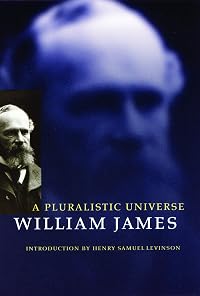
Craving an intellectually stimulating read? Dive into A Pluralistic Universe by William James, an influential thinker and psychologist who also happened to be the brother of acclaimed novelist Henry James. This lucid, gripping account outlines some of James' critiques of standard methods of reasoning. It's definitely challenging, but much more appealing to a general audience than most philosophical tracts..
Tags
Recommendations

















Member Reviews
Williams James gave these lectures when aged around 66, just two years before he died. They are a remarkably franked and earnest account of what he believed and how he saw philosophical enquiry. The argument is intriguing, and well-worth reading particularly since it is reasonably short. What other author would present his own work as a paralogism?
James sees individual humans as being the component cells of a greater yet still finite unified living entity. This whole explains and justifies its parts rather than vice versa. Because he is not a reductionist, he is content for the capabilities of this divine whole not to be emergent properties. Thus this whole has a greater mind limited in space and time rather than something grander and show more less intimate. Indeed this divine whole is one of many in a pluralistic community possessing greater minds, extending throughout the cosmos.
He explained this viewpoint in a series of eight lectures. He notes that traditional philosophy is groundless and it is tied up in self-imposed knots. Philosophers use personal preference to deliver supposed foundations from analogues of experiential features of the universe. Thus philosophical terms are normally ill defined, abstruse and easily misinterpreted. Philosophers often are uncomfortable with mathematics and nearly always show an aversion to the indeterminate, indefinite or infinite.
William James argues in favour of arguments using a revealed empiricism. He asserts that our subjective sometimes-delusional experiences are incommensurate with logic. Therefore, in such circumstances, he suggests we ought to suspend the use of logic. Furthermore he claims that all concepts and definitions are artificial suppositions and therefore can safely be ignored whenever they contradict either subjective experience or deeply felt belief. Thus most scientific knowledge is deemed superficial and misleading.
Hence he justifies the inconsistently fickle use of how or when logic is applied by philosophers. Logic is a support act that is entertained only when it gives pleasing results. Life itself is said to violate logic. How can we learn and grow old, and yet still be the same person? Indeed the everyday concepts of rational argument are said to introduce unnecessary barriers. They subdivide reality into concepts perhaps only appropriate to a snapshot in time not the flow of time. They leave the holistic wood obscured by the individual trees. show less
James sees individual humans as being the component cells of a greater yet still finite unified living entity. This whole explains and justifies its parts rather than vice versa. Because he is not a reductionist, he is content for the capabilities of this divine whole not to be emergent properties. Thus this whole has a greater mind limited in space and time rather than something grander and show more less intimate. Indeed this divine whole is one of many in a pluralistic community possessing greater minds, extending throughout the cosmos.
He explained this viewpoint in a series of eight lectures. He notes that traditional philosophy is groundless and it is tied up in self-imposed knots. Philosophers use personal preference to deliver supposed foundations from analogues of experiential features of the universe. Thus philosophical terms are normally ill defined, abstruse and easily misinterpreted. Philosophers often are uncomfortable with mathematics and nearly always show an aversion to the indeterminate, indefinite or infinite.
William James argues in favour of arguments using a revealed empiricism. He asserts that our subjective sometimes-delusional experiences are incommensurate with logic. Therefore, in such circumstances, he suggests we ought to suspend the use of logic. Furthermore he claims that all concepts and definitions are artificial suppositions and therefore can safely be ignored whenever they contradict either subjective experience or deeply felt belief. Thus most scientific knowledge is deemed superficial and misleading.
Hence he justifies the inconsistently fickle use of how or when logic is applied by philosophers. Logic is a support act that is entertained only when it gives pleasing results. Life itself is said to violate logic. How can we learn and grow old, and yet still be the same person? Indeed the everyday concepts of rational argument are said to introduce unnecessary barriers. They subdivide reality into concepts perhaps only appropriate to a snapshot in time not the flow of time. They leave the holistic wood obscured by the individual trees. show less
Ratings
Members
- Recently Added By
Author Information

137+ Works 14,628 Members
William James, oldest of five children (including Henry James and Alice James) in the extraordinary James family, was born in New York City on January 11, 1842. He has had a far-reaching influence on writers and thinkers of the nineteenth and twentieth centuries. Broadly educated by private tutors and through European travel, James initially show more studied painting. During the Civil War, however, he turned to medicine and physiology, attended Harvard medical school, and became interested in the workings of the mind. His text, The Principles of Psychology (1890), presents psychology as a science rather than a philosophy and emphasizes the connection between the mind and the body. James believed in free will and the power of the mind to affect events and determine the future. In The Will to Believe (1897) and The Varieties of Religious Experience (1902), he explores metaphysical concepts and mystical experiences. He saw truth not as absolute but as relative, depending on the given situation and the forces at work in it. He believed that the universe was not static and orderly but ever-changing and chaotic. His most important work, Pragmatism (1907), examines the practical consequences of behavior and rejects the idealist philosophy of the transcendentalists. This philosophy seems to reinforce the tenets of social Darwinism and the idea of financial success as the justification of the means in a materialistic society; nevertheless, James strove to demonstrate the practical value of ethical behavior. Overall, James's lifelong concern with what he called the "stream of thought" or "stream of consciousness" changed the way writers conceptualize characters and present the relationship between humans, society, and the natural world. He died due to heart failure on August 26, 1910. (Bowker Author Biography) show less
Awards and Honors
Notable Lists
Series

Belongs to Publisher Series
Work Relationships
Common Knowledge
- Canonical title*
- Todellisen moneus
- Original title
- A Pluralistic Universe
- Original publication date
- 1909
- Important places
- Harris Manchester College, University of Oxford, Oxford, Oxfordshire, England, UK
- Original language*
- englanti
*Some information comes from Common Knowledge in other languages. Click "Edit" for more information.
Classifications
Statistics
- Members
- 153
- Popularity
- 214,907
- Reviews
- 1
- Rating
- (3.81)
- Languages
- 6 — English, Finnish, French, German, Spanish, Swedish
- Media
- Paper, Audiobook, Ebook
- ISBNs
- 34
- ASINs
- 9