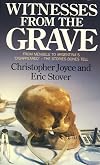
Witnesses from the Grave: The Stories Bones Tell
by Christopher Joyce
On This Page
Description
Adventures of Norman, Oklahoma-based forensic anthropologist Clyde C. Snow. Cases include Josef Mengele, remains of the Battle of the Little Big Horn, John Wayne Gacy, Oklahoma outlaw turned funhouse mummy Elmer McCurdy, and the victims of Argentine repression.Tags
Recommendations

















Member Reviews
Christopher Joyce was the U.S. editor of New Scientist and Eric Stover was a freelance writer and a consultant and consultant to Physicians for Human Rights and Human rights Watch. He organized and participated in the first forensic investigations into the fate of Argentina's disappeared.
They discuss the history of forensic anthropology and techniques of investigation using Clyde Snow as an example. Snow investigated the evidence beneath the battleground at the Little Bighorn, the bodies of the serial killer John Wayne Gacy, the skeletal remains of Nazi doctor Josef Mengele and the disappeared from the 1970's war in Argentina.
This book is exceptional because the authors go into a lot of detail and the book is over 300 pages but it show more never drags. show less
They discuss the history of forensic anthropology and techniques of investigation using Clyde Snow as an example. Snow investigated the evidence beneath the battleground at the Little Bighorn, the bodies of the serial killer John Wayne Gacy, the skeletal remains of Nazi doctor Josef Mengele and the disappeared from the 1970's war in Argentina.
This book is exceptional because the authors go into a lot of detail and the book is over 300 pages but it show more never drags. show less
Christopher Joyce and Eric Stover use the career of Clyde Snow to reveal how anthropology has been used forensically to identify individuals from only a few bones and little other evidence in Witnesses from the Grave: The Stories Bones Tell.
Snow's forensic career began when he worked for the FAA. His job was to investigate plane crashes in order to improve airline safety. His fame soon spread as medical examiners learned he could assist them in identifying decomposed bodies. His training in anthropology and his innate curiosity were of inestimable value.
One of the earliest recorded examples of forensic science is the apocryphal tale of Nero's mistress, who demanded proof that the emperor's wife was indeed dead. The wife's head was show more brought to her on a platter and a discolored tooth was used to verify its identity. Paul Revere, who was a practicing dentist as well as night-rider, was called upon to identify the body of General Joseph Warren in a similar manner.
Boston was the first city to license medical examiners in 1918 and licensing did not become widespread until the mid-20th century.
The investigation of George Parkman's murder was the first documented case of an multidisciplinary team cooperating to piece together and identify a skeleton to solve a murder.
A Frenchman, Alphonse Bertillon, developed the first scientific technique of positive identification. His system was based on 11 precise measurements taken at various locations on the body. He calculated there was only a 1 in 2,000,000 chance of two individuals having the same 11 measurements. After he was able to identify several French criminals operating under assumed names he became famous, only to be upstaged by the fingerprinting process invented in England but not popularized until an Argentinean policeman used it to identify and convict a child murderer.
Snow investigated many major disasters, including the crash of the DC-10 at O'Hare in 1979. The difficulty of identifying bodies, even when the victims are known, is astonishing. One startling fact: ten of the DC-10 crash victims were identified from previous gunshot wounds!
Sometimes a victim's relatives may not be happy with the identification process or the consequences. One family was notified and asked to provide X-rays of Mrs. X who was traveling with her husband. Both had been killed. The investigating team was startled to learn that Mrs. X was alive and well. Her husband was evidently traveling with a "good friend" posing as Mrs. X.
One dentist was reluctant to turn over dental records to verify the identity of a wealthy traveler with a mouth full of gold fillings. When they finally received the dental records, investigators discovered why. The dentist had been reporting far less work than he had actually performed so he could claim less income on his tax forms. Twenty of the victims were never identified positively.
Not all research was as gruesome as aircraft accidents or John Wayne Gacy's basement. During the filming of an episode of "The Six Million Dollar Man" at an amusement park's horror ride, a dummy was discovered hanging from the ceiling in a corner. When the film technicians went to move it an arm bone fell out. Further examination by the police revealed a well-preserved mummy whose original "owner" had been shot, the bullet passing from head to pelvis. A murder investigation resulted. Snow was able to use his anthropological skills and historical knowledge of the Oklahoma territory to identify the mummy as Elmer McCurdy, an outlaw known by several aliases, who had been killed during a shootout with a posse following an abortive train robbery in 1911. The local undertaker had embalmed the body and put it on review for a small fee. Ironically, the mummy/dummy had been once sold for $1,000 making poor Elmer worth more dead than alive.
During his years at the FAA, Snow developed a distaste for the arcane procedures and methods of bureaucracy, and he wrote several memos which became quite famous in the halls of the FAA. One such memo, dated August 14, 1970, is representative. (The officials' names have been expunged.)
I have been informed that, during a recent meeting in Washington, a great deal of time was consumed in an argument between you [a senior FAA official] and Dr. --- concerning whether sharks are attracted to their victims by smell or by taste.
After pondering the question, it occurred to me that it could be easily and economically settled by a simple experiment. This would entail placing you and Dr. --- in the survival tank, introducing a large shark to the tank, and observing its behavior.
If the shark attacks Dr. --, it will be evidence that it cannot smell; if it goes for you, it will be equally obvious that it has poor taste. In either event, the experiment would answer an important scientific question with very little expense to the government.
If you concur, I will be happy to prepare a form 1750 for this project. show less
Snow's forensic career began when he worked for the FAA. His job was to investigate plane crashes in order to improve airline safety. His fame soon spread as medical examiners learned he could assist them in identifying decomposed bodies. His training in anthropology and his innate curiosity were of inestimable value.
One of the earliest recorded examples of forensic science is the apocryphal tale of Nero's mistress, who demanded proof that the emperor's wife was indeed dead. The wife's head was show more brought to her on a platter and a discolored tooth was used to verify its identity. Paul Revere, who was a practicing dentist as well as night-rider, was called upon to identify the body of General Joseph Warren in a similar manner.
Boston was the first city to license medical examiners in 1918 and licensing did not become widespread until the mid-20th century.
The investigation of George Parkman's murder was the first documented case of an multidisciplinary team cooperating to piece together and identify a skeleton to solve a murder.
A Frenchman, Alphonse Bertillon, developed the first scientific technique of positive identification. His system was based on 11 precise measurements taken at various locations on the body. He calculated there was only a 1 in 2,000,000 chance of two individuals having the same 11 measurements. After he was able to identify several French criminals operating under assumed names he became famous, only to be upstaged by the fingerprinting process invented in England but not popularized until an Argentinean policeman used it to identify and convict a child murderer.
Snow investigated many major disasters, including the crash of the DC-10 at O'Hare in 1979. The difficulty of identifying bodies, even when the victims are known, is astonishing. One startling fact: ten of the DC-10 crash victims were identified from previous gunshot wounds!
Sometimes a victim's relatives may not be happy with the identification process or the consequences. One family was notified and asked to provide X-rays of Mrs. X who was traveling with her husband. Both had been killed. The investigating team was startled to learn that Mrs. X was alive and well. Her husband was evidently traveling with a "good friend" posing as Mrs. X.
One dentist was reluctant to turn over dental records to verify the identity of a wealthy traveler with a mouth full of gold fillings. When they finally received the dental records, investigators discovered why. The dentist had been reporting far less work than he had actually performed so he could claim less income on his tax forms. Twenty of the victims were never identified positively.
Not all research was as gruesome as aircraft accidents or John Wayne Gacy's basement. During the filming of an episode of "The Six Million Dollar Man" at an amusement park's horror ride, a dummy was discovered hanging from the ceiling in a corner. When the film technicians went to move it an arm bone fell out. Further examination by the police revealed a well-preserved mummy whose original "owner" had been shot, the bullet passing from head to pelvis. A murder investigation resulted. Snow was able to use his anthropological skills and historical knowledge of the Oklahoma territory to identify the mummy as Elmer McCurdy, an outlaw known by several aliases, who had been killed during a shootout with a posse following an abortive train robbery in 1911. The local undertaker had embalmed the body and put it on review for a small fee. Ironically, the mummy/dummy had been once sold for $1,000 making poor Elmer worth more dead than alive.
During his years at the FAA, Snow developed a distaste for the arcane procedures and methods of bureaucracy, and he wrote several memos which became quite famous in the halls of the FAA. One such memo, dated August 14, 1970, is representative. (The officials' names have been expunged.)
I have been informed that, during a recent meeting in Washington, a great deal of time was consumed in an argument between you [a senior FAA official] and Dr. --- concerning whether sharks are attracted to their victims by smell or by taste.
After pondering the question, it occurred to me that it could be easily and economically settled by a simple experiment. This would entail placing you and Dr. --- in the survival tank, introducing a large shark to the tank, and observing its behavior.
If the shark attacks Dr. --, it will be evidence that it cannot smell; if it goes for you, it will be equally obvious that it has poor taste. In either event, the experiment would answer an important scientific question with very little expense to the government.
If you concur, I will be happy to prepare a form 1750 for this project. show less
Christopher Joyce was the U.S. editor of New Scientist and Eric Stover was a freelance writer and a consultant and consultant to Physicians for Human Rights and Human rights Watch. He organized and participated in the first forensic investigations into the fate of Argentina's disappeared.
They discuss the history of forensic anthropology and techniques of investigation using Clyde Snow as an example. Snow investigated the evidence beneath the battleground at the Little Bighorn, the bodies of the serial killer John Wayne Gacy, the skeletal remains of Nazi doctor Josef Mengele and the disappeared from the 1970's war in Argentina.
This book is exceptional because the authors go into a lot of detail and the book is over 300 pages but it show more never drags. show less
They discuss the history of forensic anthropology and techniques of investigation using Clyde Snow as an example. Snow investigated the evidence beneath the battleground at the Little Bighorn, the bodies of the serial killer John Wayne Gacy, the skeletal remains of Nazi doctor Josef Mengele and the disappeared from the 1970's war in Argentina.
This book is exceptional because the authors go into a lot of detail and the book is over 300 pages but it show more never drags. show less
story of Clyde Snow who helped ID J. Menegle
Ratings
Members
- Recently Added By
Author Information
3 Works 120 Members
Awards and Honors
Awards
Common Knowledge
- Original publication date
- 1991
- Epigraph
- "Death has two faces. One is nonbeing; the other is the terrifying material being that is the corpse." -Milan Kundra, The Book of Laughter and Forgetting
And finally
when
the day
comes when they ask you
to identify the body
and you see me
and a voice says
we killed him
the poor bastard died
he's dead,
when they tell you
that I am
completel... (show all)y absolutely definitely
dead
don't believe them,
don't believe them,
don't believe them.
-Ariel Dorfman, "Last Will and Testament, from Missing -Poems of Ariel Dorfman. - Dedication
- For the disappeared
- First words
- On a warm October morning in 1989, Clyde Collins Snow, his straw cowboy hat pulled low over this forehead, stood on a bluff overlooking the valley of Granja de Espejos in central Bolivia. Parrots flashed through the undergrow... (show all)th near the escarpment. He could hear troops of monkeys chattering in noisy confrontation somewhere on the ridge behind him. Gazing down at the valley, he imagined this place, with its silver-braided streams and semi-tropical forests, as a kind of Eden. But as he had learned over the past few days, for the eighty or so men who lived in the whitewashed longhouses below it was more like Hell. -Prologue
By the time he was six years old, Sonny Snow had shared a bed with most of the kids in Crosby County. An only child of a country doctor in the 1930s, he was nonetheless on roughhousing terms with most of the boys in this Texa... (show all)s county, and he knew the names of the girls' dolls and their pets and which kids got switched or not. He knew more than the local telephone operator about what went on in the townsfolk's' parlors and kitchens, about their joys and squabbles and their dust-bowl misfortunes. -Chapter 1, Lessons in the Bone Trade - Canonical DDC/MDS
- 614.1
- Canonical LCC
- GN69.J69
Classifications
- Genres
- Anthropology, Nonfiction, General Nonfiction, Science & Nature
- DDC/MDS
- 614.1 — Applied science & technology Medicine & health Epidemics, Poisons, Alternative Medicine Forensic medicine
- LCC
- GN69 .J69 — Geography, Anthropology and Recreation Anthropology Anthropology Physical anthropology. Somatology Human variation
- BISAC
Statistics
- Members
- 98
- Popularity
- 328,820
- Reviews
- 4
- Rating
- (3.92)
- Languages
- English, German
- Media
- Paper
- ISBNs
- 7