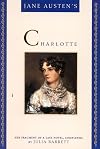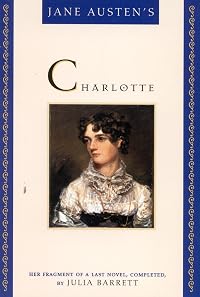
Jane Austen's Charlotte: Her Fragment of a Last Novel, Completed by Julia Barrett
by Julia Barrett
On This Page
Description
In completing Jane Austen's last novel, Julia Barrett has emerged with a literary treasure, holding true to the characters and theme designed by Ms. Austen. Set in the developing seaside town of Sanditon, it portrays a young woman from the countryside who is exposed to the sophistication and cynicism of resort life. Her name is Charlotte. With disarming charm and wit, she observes for us the array of quirky characters who reside in the booming resort-to-be. The innocent but keen-witted show more Charlotte quickly finds herself rather deeply involved in this uproarious little town. She can't help but get swept up in the antics of the Parkers and Denhams, even while she is vexed and perplexed by the droll Sidney Parker. But even the best efforts of this charming young lady may not be enough to save the budding resort town. show lessTags
Recommendations




Member Reviews
An unfortunate carriage accident introduces the Parkers to the large Heywood family. Mr. Parker, who has speculated on the success of Sanditon becoming a prominent seaside resort, invites Charlotte Heywood to accompany himself and his wife back to Sanditon for a stay. Here, Charlotte meets an array of interesting characters, including Mr. Parker’s younger brother, the intriguing Sidney Parker.
Near her death, Jane Austen began a final book about a seaside resort town begin to blossom. Original named The Brothers, it was never completed past chapter 11. The Brothers was later dubbed Sanditon by her family, and several authors have attempted to finish this fragment of a book. In Charlotte, Julia Barrett attempts to tackle the same feat, show more with very limited success.
The Austen-written parts of the book are great; she shines with her usual witty style and a great cast of characters (a family of hypochondriacs, a zealous sea resort speculator, the "romantic hero" who models himself on stories and quotes poetry with great feeling but little understanding, etc.). However, the transition from Austen to Barrett is palpable. Unfortunately the longer of the two, Barrett’s part drags in large sections, is wordy with obtuse sentences, and in general is nowhere near as good as Austen’s. There’s great potential with these wonderful characters but under Barrett’s direction, these characters are turned into rather dull beings who don’t quite follow in the path set out for them. (Barrett seems to not only change them from their original characterizations but also can’t seem to stay put with one characterization for each after that. They each in turn seem to do something out of character at various points in the book.) The book suffers from the author “telling” rather than “showing” – she chooses to use long-winded descriptions to talk about the characters and their motivations instead of letting their actions and dialogue speak for them, as Austen would do. However, I did get the occasional chuckle here and there with the characterizations after Barrett took over, and the last chapter actually felt a bit Austenesque.
A couple of pet peeves I had with this book were:
- If Barrett chose to rename the novel Charlotte, I would have thought we would see more this character but we really don’t. I didn’t feel like I got to know – or for that matter, care – about her much.
- The book is by and large about the sea town of Sanditon, so why the love song for London? I understand that often Austen would often re-locate her characters throughout her novels so this is not without precedence, but having so much set in London seemed odd, especially with the lengthy descriptions of all the hubbub about London.
For the most part, I found this book rather dull. The rambling plot doesn’t really seem to go anywhere and the ending just ties things up with a neat bow for the sake of doing so, not because the plot seemed to thrust that way. I give the book only two stars, and in large part that's only for Austen’s introduction to Sanditon and its inhabitants. show less
Near her death, Jane Austen began a final book about a seaside resort town begin to blossom. Original named The Brothers, it was never completed past chapter 11. The Brothers was later dubbed Sanditon by her family, and several authors have attempted to finish this fragment of a book. In Charlotte, Julia Barrett attempts to tackle the same feat, show more with very limited success.
The Austen-written parts of the book are great; she shines with her usual witty style and a great cast of characters (a family of hypochondriacs, a zealous sea resort speculator, the "romantic hero" who models himself on stories and quotes poetry with great feeling but little understanding, etc.). However, the transition from Austen to Barrett is palpable. Unfortunately the longer of the two, Barrett’s part drags in large sections, is wordy with obtuse sentences, and in general is nowhere near as good as Austen’s. There’s great potential with these wonderful characters but under Barrett’s direction, these characters are turned into rather dull beings who don’t quite follow in the path set out for them. (Barrett seems to not only change them from their original characterizations but also can’t seem to stay put with one characterization for each after that. They each in turn seem to do something out of character at various points in the book.) The book suffers from the author “telling” rather than “showing” – she chooses to use long-winded descriptions to talk about the characters and their motivations instead of letting their actions and dialogue speak for them, as Austen would do. However, I did get the occasional chuckle here and there with the characterizations after Barrett took over, and the last chapter actually felt a bit Austenesque.
A couple of pet peeves I had with this book were:
- If Barrett chose to rename the novel Charlotte, I would have thought we would see more this character but we really don’t. I didn’t feel like I got to know – or for that matter, care – about her much.
- The book is by and large about the sea town of Sanditon, so why the love song for London? I understand that often Austen would often re-locate her characters throughout her novels so this is not without precedence, but having so much set in London seemed odd, especially with the lengthy descriptions of all the hubbub about London.
For the most part, I found this book rather dull. The rambling plot doesn’t really seem to go anywhere and the ending just ties things up with a neat bow for the sake of doing so, not because the plot seemed to thrust that way. I give the book only two stars, and in large part that's only for Austen’s introduction to Sanditon and its inhabitants. show less
Barrett does research, and has some interesting ideas as to where the book was heading. Personally, I don't agree with her. I feel that Barrett changed some of the characters too drastically too fast, and while certain parts of her storyline seem accurate, many of them do not, to me.
The manner in which this book is packaged, however, led me to believe that Julia Barrett's writing is supposed to resemble that of Ms. Austen's. The transition from Austen's writing to Barrett's is not at all seamless, but is instead rather abrupt. Furthermore, Austen's writing is a lot more compact. Barrett's writing seems to wander a lot, in a kind of stream of consciousness manner that is much too modern.
While I congratulate Barrett on her thorough show more research, and for the mere fact that she attempted to complete a novel by such a famous author, I do not think that this book does justice to the story that Ms. Austen's fragment begins. show less
The manner in which this book is packaged, however, led me to believe that Julia Barrett's writing is supposed to resemble that of Ms. Austen's. The transition from Austen's writing to Barrett's is not at all seamless, but is instead rather abrupt. Furthermore, Austen's writing is a lot more compact. Barrett's writing seems to wander a lot, in a kind of stream of consciousness manner that is much too modern.
While I congratulate Barrett on her thorough show more research, and for the mere fact that she attempted to complete a novel by such a famous author, I do not think that this book does justice to the story that Ms. Austen's fragment begins. show less
I have read worse books. That being said, this came nowhere near to living up to my expectations. The transition between authors hits you with all the subtlety of a brick wall. Normally I could forgive this since we're comparing the genius Jane Austen to a relatively unknown 20th century author. What I cannot forgive is the complete disregard for characterizations that Austen had already set forth.
The most obvious of these indiscretions is found in Lady Denham's character. In the space of a few paragraphs she transforms from a reluctant and perhaps overly cautious spendthrift into a precipitate speculator who has no qualms about making extravagant expenditures. Sidney Parker's character seems quite at odds with the original intent as show more well. Though we have only a glimpse of Sidney in Austen's section of narrative, we are lead to expect a quick-witted and light-hearted man who never takes anything too seriously (in short, a lovable rogue). While Ms. Barrett tells us that this is how her characters see him (presumably in some part of the narrative that is not recorded), she only shows us an introspective and somewhat moody young man who could barely be considered the hero in the eyes of any respectable heroine.
And speaking of Charlotte, I still have no idea who she actually is. The book, which bears her name as its title, only concerns itself with her for maybe a third of the narrative. I started out thinking that Charlotte was a shrewd observer who could detach herself from any situation in order to properly appreciate it. Somewhere along the narrative though, she seems to become a bit of a wide-eyed innocent with merely a better sense of propriety than most of the characters surrounding her. The lack of character development for her is frankly alarming.
My other complaints about the novel can be summed up as the lack of a centralized plot, Ms. Barrett's tendency to TELL what is going on rather than SHOW it, and an abundance of awkward and confusing sentences that make proper reading difficult. As I said before, I've read worse books, but this is one I certainly won't be recommending to any of my friends. show less
The most obvious of these indiscretions is found in Lady Denham's character. In the space of a few paragraphs she transforms from a reluctant and perhaps overly cautious spendthrift into a precipitate speculator who has no qualms about making extravagant expenditures. Sidney Parker's character seems quite at odds with the original intent as show more well. Though we have only a glimpse of Sidney in Austen's section of narrative, we are lead to expect a quick-witted and light-hearted man who never takes anything too seriously (in short, a lovable rogue). While Ms. Barrett tells us that this is how her characters see him (presumably in some part of the narrative that is not recorded), she only shows us an introspective and somewhat moody young man who could barely be considered the hero in the eyes of any respectable heroine.
And speaking of Charlotte, I still have no idea who she actually is. The book, which bears her name as its title, only concerns itself with her for maybe a third of the narrative. I started out thinking that Charlotte was a shrewd observer who could detach herself from any situation in order to properly appreciate it. Somewhere along the narrative though, she seems to become a bit of a wide-eyed innocent with merely a better sense of propriety than most of the characters surrounding her. The lack of character development for her is frankly alarming.
My other complaints about the novel can be summed up as the lack of a centralized plot, Ms. Barrett's tendency to TELL what is going on rather than SHOW it, and an abundance of awkward and confusing sentences that make proper reading difficult. As I said before, I've read worse books, but this is one I certainly won't be recommending to any of my friends. show less
Another finished version of Sanditon. Which I actually enjoyed reading, and liked the characters, though the relationships were different, again, in this variation.
Fragment of a novel by Jane Austen and finished by the author. Not anywhere near as good as Austen's work. Too wordy and the characters are not likeable.
This book dragged quite a bit. I suffered through to a relatively nice ending, but I wouldn't recommend it.
Ratings
Members
- Recently Added By
Talk Discussions
Past Discussions
Charlotte: The Unfinished Novel in I Love Jane Austen (September 2007)
Author Information
4 Works 604 Members
All Editions
Common Knowledge
- People/Characters
- Charlotte Heywood; Sidney Parker; Tom Parker; Mary Parker; Lady Denham; Clara Brereton (show all 20); Sir Edward Denham; Esther Denham; Diana Parker; Susan Parker; Arthur Parker; Mrs. Griffiths; Miss Lambe; Augusta Beaufort; Letitia Beaufort; Lord Collinsworth; Mr. Heywood; Mrs. Emmeline Turner; Mr. Henry Heywood; Mr. Matthew Dawson
- Important places
- Sanditon; Willingden; London, England, UK
- Original language
- English
Classifications
Statistics
- Members
- 116
- Popularity
- 280,587
- Reviews
- 6
- Rating
- (2.42)
- Languages
- English, Hungarian
- Media
- Paper, Audiobook
- ISBNs
- 10