On This Page
Description
A wide-eyed teenager during most of the Revolutionary War, Joseph Plumb Martin left his grandfather's farm in Connecticut in 1775 and spent much of the next eight years with the Continental Army, crisscrossing the mid-Atlantic states and returning north after the British surrender at Yorktown. His notes, penned when he was seventy, recount in grim detail his harrowing experiences during the conflict-the staggering losses in human life, the agony of long marches, constant gnawing hunger, show more bitter cold, and the fear of battle, as well as a warts-and-all view of military leaders. Balancing these brutal wartime experiences are lively accounts of hunting, fishing, and other diversions--including an occasional encounter with a "saucy miss." The fullest existing description of the Revolutionary War by an enlisted man, and a rediscovered gem of American history, Martin's recollections brim with telling anecdotes that reveal a great deal about American life during this era. An invaluable memoir from an ordinary man in extraordinary times. show lessTags
Recommendations





Member Reviews
I was a little worried this book would be difficult to read, but it was surprisingly well-written, funny, and had a lot of attitude! (Of course I realize much of it had to have been "edited" for spelling and the like.)
Having spent the last few years reading biographies of our Founding Fathers, books on the Constitution, and books on the Revolution in general, it was clear that this book is heavily referenced by other authors, certainly when it comes to the plight of the Continental soldier. And what a plight it was. I've no doubt that much of what Martin describes is accurate, most especially when it comes to the lack of "victuals," clothing, and shelter from which these men suffered.
The anecdotes Martin offers are both harrowing and show more amusing. He's not above poking fun at himself when he's done something questionable (like climb up a shear mountain face only to get hundreds of feet up before realizing he can't reach the summit).
If you've avoided this book because you're afraid of its perceived 18th century language differences or that it would be boring, I assure you that's not the case at all. show less
Having spent the last few years reading biographies of our Founding Fathers, books on the Constitution, and books on the Revolution in general, it was clear that this book is heavily referenced by other authors, certainly when it comes to the plight of the Continental soldier. And what a plight it was. I've no doubt that much of what Martin describes is accurate, most especially when it comes to the lack of "victuals," clothing, and shelter from which these men suffered.
The anecdotes Martin offers are both harrowing and show more amusing. He's not above poking fun at himself when he's done something questionable (like climb up a shear mountain face only to get hundreds of feet up before realizing he can't reach the summit).
If you've avoided this book because you're afraid of its perceived 18th century language differences or that it would be boring, I assure you that's not the case at all. show less
I've had this book for awhile, but was inspired by a recent Father's Day trip (thanks to my children!) to the Museum of the American Revolution in Philadelphia to read it. The museum has a rare first edition of the book, as well as a life-size figure of the author on display.
The author was 16 years old when he enlisted in a Connecticut regiment, and he stayed for the duration of the war (1776-1783). This book gives a very fine story of the life of a private (later a sergeant) in the Revolutionary War. He did not perform any notable heroics or deeds, and doesn't write about the history of the battles that he participated in. He only gives a story of what he saw and did. When Joseph was 70, he wrote this book from a journal that he kept show more (sadly, now lost). His story is filled with humor, sarcasm, sadness, and heroics. At times he does silly (and dangerous) things, but remember, he was a teenager at the time.
Reading the book, you wonder why the soldiers stayed with the army. Only paid a couple of times throughout the war, hardly given any clothing, treated poorly, going days without food, and when fed given bad food that wouldn't even be considered enough to live on. Marching for hours on end. And then facing battles! Sadly too, the soldiers were never given the pay they earned, nor the 100 acres of land that they were promised when enlisting.
It was interesting to me when Joseph traveled through my home state (Delaware), and mentions towns and places that I am familiar with. And surprisingly he encounters a multiracial family in Wilmington (DE), something he had never seen before (and I'm sure very unusual at that time). A funny event-when at Yorktown (near the end of the war) he meets George Washington, but doesn't recognize him! It is dark, and Washington is just walking by himself talking to the soldiers. Not until some officers address Washington does he realize who it is!
This book is now considered a classic memoir of the war. There are many histories of the American Revolution, but not very many from a soldiers point-of-view. It is well written, very enjoyable, interesting, and is not dated. And you don't have to be a hard-core history buff to enjoy it.
Note: Do not buy a "CreateSpace" edition, like I did. There are typos, and one chapter ends in the middle of a sentence.
And if you live near Philadelphia, make it a point to visit the Museum of the American Revolution-it is well worth it! show less
The author was 16 years old when he enlisted in a Connecticut regiment, and he stayed for the duration of the war (1776-1783). This book gives a very fine story of the life of a private (later a sergeant) in the Revolutionary War. He did not perform any notable heroics or deeds, and doesn't write about the history of the battles that he participated in. He only gives a story of what he saw and did. When Joseph was 70, he wrote this book from a journal that he kept show more (sadly, now lost). His story is filled with humor, sarcasm, sadness, and heroics. At times he does silly (and dangerous) things, but remember, he was a teenager at the time.
Reading the book, you wonder why the soldiers stayed with the army. Only paid a couple of times throughout the war, hardly given any clothing, treated poorly, going days without food, and when fed given bad food that wouldn't even be considered enough to live on. Marching for hours on end. And then facing battles! Sadly too, the soldiers were never given the pay they earned, nor the 100 acres of land that they were promised when enlisting.
It was interesting to me when Joseph traveled through my home state (Delaware), and mentions towns and places that I am familiar with. And surprisingly he encounters a multiracial family in Wilmington (DE), something he had never seen before (and I'm sure very unusual at that time). A funny event-when at Yorktown (near the end of the war) he meets George Washington, but doesn't recognize him! It is dark, and Washington is just walking by himself talking to the soldiers. Not until some officers address Washington does he realize who it is!
This book is now considered a classic memoir of the war. There are many histories of the American Revolution, but not very many from a soldiers point-of-view. It is well written, very enjoyable, interesting, and is not dated. And you don't have to be a hard-core history buff to enjoy it.
Note: Do not buy a "CreateSpace" edition, like I did. There are typos, and one chapter ends in the middle of a sentence.
And if you live near Philadelphia, make it a point to visit the Museum of the American Revolution-it is well worth it! show less
Joseph Plumb Martin wrote one of the few soldier's accounts of the American revolution. Written some forty years after the war ended from his home Maine, Martin's record is a surprising account of his experiences as a Continental regular. Though he was present at the defense of Fort Mifflin in 1778, fought at Monmouth and Yorktown, it is not his battle experiences that are most engaging. Rather, it is his vivid accounts of the soldiers' day to day struggle to survive. Though food was hard to come by under most circumstances, due to an ineffective commissary system and badly depreciated currency, the undernourished army reached starvation conditions during the winters. Martin is particularly eloquent regarding the condition of the army show more during the Valley Forge winter, and the disastrous Morristown winter of 1780.
I highly recommend this book to anyone interested in an inside glance at life inside the Continental Army. It is written with humor, is a quick read, and has the merit of being inexpensive. show less
I highly recommend this book to anyone interested in an inside glance at life inside the Continental Army. It is written with humor, is a quick read, and has the merit of being inexpensive. show less
This book appealed to me as it was a rare available narrative by a common soldier from the American Revolution. Having read several narratives from Civil War era privates, some of which were excellent, I was quite disappointed with this work.
Mr. Martin's account focuses almost exclusively on mundane or trivial matters which soon become so repetitious than the reader's interest wanes. Perhaps worse, Mr. Martin provides no insights or commentary on any battles or events of importance. In short, after reading this narrative I had no better insights into the War than before I began.
Mr. Martin's account focuses almost exclusively on mundane or trivial matters which soon become so repetitious than the reader's interest wanes. Perhaps worse, Mr. Martin provides no insights or commentary on any battles or events of importance. In short, after reading this narrative I had no better insights into the War than before I began.
Mr. Martin's experience was that of many; cold, hunger and little pay. Those who stayed, like Martin, know the British were just one obstacle. His testimony is remarkably clear. I love to read about the revolution, its causes, battles and personalities. This book is in a class by itself and gives context to all the others.
A classic must-read for any Rev. War enthusiast. It provides great insight to what a soldier endured throughout the war.
It's a diary of an enlisted man. He's either cold or wet, and always hungry. His fellow soldiers do stupid stuff. While it has footnotes to provide context, it could use a rewriting to make it more readable.
Members
- Recently Added By
Lists

French and Indian War through the War of 1812 (non-fiction)
31 works; 3 members

Books Read in 2012
816 works; 34 members

1964 Project
114 works; 1 member
Author Information

3 Works 1,090 Members
All Editions
Some Editions
Awards and Honors
Series

Belongs to Publisher Series
Common Knowledge
- Alternate titles
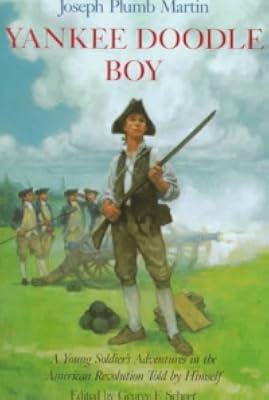
- Yankee Doodle Boy: A Young Soldier's Adventures in the American Revolution; Private Yankee Doodle: Being a Narrative of Some of the Adventures, Dangers, and Sufferings of a Revolutionary Soldier
- People/Characters
- Joseph Plumb Martin
- Important events
- Georgian Era (1714 | 1837); American Revolution (1775 | 1783)
Classifications
Statistics
- Members
- 988
- Popularity
- 26,699
- Reviews
- 11
- Rating
- (3.94)
- Languages
- English
- Media
- Paper, Audiobook, Ebook
- ISBNs
- 22
- ASINs
- 22