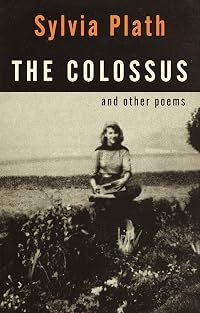
The Colossus and Other Poems
by Sylvia Plath 
On This Page
Description
With this startling, exhilarating book of poems, which was first published in 1960, Sylvia Plath burst into literature with spectacular force. In such classics as "The Beekeeper's Daughter," "The Disquieting Muses," "I Want, I Want," and "Full Fathom Five," she writes about sows and skeletons, fathers and suicides, about the noisy imperatives of life and the chilly hunger for death. Graceful in their craftsmanship, wonderfully original in their imagery, and presenting layer after layer of show more meaning, the forty poems in The Colossus are early artifacts of genius that still possess the power to move, delight, and shock. show lessTags
Recommendations












Member Reviews
The Colossus
I shall never get you put together entirely,
Pieced, glued, and properly jointed.
Mule-bray, pig-grunt and bawdy cackles
Proceed from your great lips.
It's worse than a barnyard.
Perhaps you consider yourself an oracle,
Mouthpiece of the dead, or of some god or
other.
Thirty years now I have labored
To dredge the silt from your throat.
I am none the wiser.
Scaling little ladders with glue pots and pails
of lysol
I crawl like an ant in mourning
Over the weedy acres of your brow
To mend the immense skull plates and clear
The bald, white tumuli of your eyes.
A blue sky out of the Oresteia
Arches above us. O father, all by yourself
You are pithy and historical as the Roman
Forum.
I open my lunch on a hill of black cypress.
Your fluted bones and show more acanthine hair are
littered
In their old anarchy to the horizon-line.
It would take more than a lightning-stroke
To create such a ruin.
Nights, I squat in the cornucopia
Of your left ear, out of the wind,
Counting the red stars and those of plum-
color.
The sun rises under the pillar of your tongue.
My hours are married to shadow.
No longer do I listen for the scrape of a keel
On the blank stones of the landing. show less
I shall never get you put together entirely,
Pieced, glued, and properly jointed.
Mule-bray, pig-grunt and bawdy cackles
Proceed from your great lips.
It's worse than a barnyard.
Perhaps you consider yourself an oracle,
Mouthpiece of the dead, or of some god or
other.
Thirty years now I have labored
To dredge the silt from your throat.
I am none the wiser.
Scaling little ladders with glue pots and pails
of lysol
I crawl like an ant in mourning
Over the weedy acres of your brow
To mend the immense skull plates and clear
The bald, white tumuli of your eyes.
A blue sky out of the Oresteia
Arches above us. O father, all by yourself
You are pithy and historical as the Roman
Forum.
I open my lunch on a hill of black cypress.
Your fluted bones and show more acanthine hair are
littered
In their old anarchy to the horizon-line.
It would take more than a lightning-stroke
To create such a ruin.
Nights, I squat in the cornucopia
Of your left ear, out of the wind,
Counting the red stars and those of plum-
color.
The sun rises under the pillar of your tongue.
My hours are married to shadow.
No longer do I listen for the scrape of a keel
On the blank stones of the landing. show less
The Colossus was the only collection of poems published in Sylvia Plath’s lifetime. It’s also the title of one of three poems in the volume that deal with the early loss of her father. In it, he is depicted as a ruined statue that his daughter is heroically but unsuccessfully trying to preserve. In “Full Fathom Five,” he is the old man of the sea, Neptune; the speaker, his daughter, is a mermaid, choking on air; she would rather breathe water. The mermaid imagery turns up again in the collection. The third is “The Beekeeper’s Daughter.” Her father was an entomologist, and Plath herself tried her hand at beekeeping. Yet it contains the oppressive line: “My heart under your feet, sister of a stone.”
Family relations also show more turn up in poems that treat the ambivalent experience of pregnancy, such as the poem that opens the collection, “The Manor Garden.”
Many of the poems record observations from nature, juxtaposing life and death. “Water Colour of Grandchester Meadows,” for instance, updates Tennyson’s “red in tooth and claw.” However, the poet’s observation of nature is faulty in one case. In “The Ghost’s Leavetaking,” a powerful description of the departure of a dream upon waking, she speaks of the “new moon’s curve,” but that is visible in the west just after sunset, not in the east just before dawn. Picky, you might think; bear with me on a pet peeve. A surprising number of otherwise excellent writers evoke the moon, but inaccurately.
The language throughout is elevated. It seems there was one word I needed to look up in nearly every poem. In only one case, the latinate “palustral” in “Frog Autumn,” did I feel she was trying too hard for enriched vocabulary. There are also some beautiful neologisms, such as “lapsing” in “The Lorelei” to describe the sound of waves at the shore (in “The Winter Ship,” the speaker tells us “the water slips and gossips in its loose vernacular”). Whether set in the U. S. or in England, the seacoast is a recurrent source of inspiration.
It’s all too easy to read these poems in the wake of the author’s suicide; death does indeed haunt many of them. Had she resisted the urge to end her life, the reader might take equal note of the will to live that is also present. Back in university, long ago, Plath’s recently-publish posthumous collection, Ariel, was the lodestone for more than one aspiring poetess in my acquaintance. Perhaps that’s why, at the time, I only read some of her most famous poems, such as “Daddy.” I’m glad enough time has passed that I can read and appreciate these. show less
Family relations also show more turn up in poems that treat the ambivalent experience of pregnancy, such as the poem that opens the collection, “The Manor Garden.”
Many of the poems record observations from nature, juxtaposing life and death. “Water Colour of Grandchester Meadows,” for instance, updates Tennyson’s “red in tooth and claw.” However, the poet’s observation of nature is faulty in one case. In “The Ghost’s Leavetaking,” a powerful description of the departure of a dream upon waking, she speaks of the “new moon’s curve,” but that is visible in the west just after sunset, not in the east just before dawn. Picky, you might think; bear with me on a pet peeve. A surprising number of otherwise excellent writers evoke the moon, but inaccurately.
The language throughout is elevated. It seems there was one word I needed to look up in nearly every poem. In only one case, the latinate “palustral” in “Frog Autumn,” did I feel she was trying too hard for enriched vocabulary. There are also some beautiful neologisms, such as “lapsing” in “The Lorelei” to describe the sound of waves at the shore (in “The Winter Ship,” the speaker tells us “the water slips and gossips in its loose vernacular”). Whether set in the U. S. or in England, the seacoast is a recurrent source of inspiration.
It’s all too easy to read these poems in the wake of the author’s suicide; death does indeed haunt many of them. Had she resisted the urge to end her life, the reader might take equal note of the will to live that is also present. Back in university, long ago, Plath’s recently-publish posthumous collection, Ariel, was the lodestone for more than one aspiring poetess in my acquaintance. Perhaps that’s why, at the time, I only read some of her most famous poems, such as “Daddy.” I’m glad enough time has passed that I can read and appreciate these. show less
Not every poem in this collection captured my attention, but it did give me a glimpse into her life. The way Plath perceived the obligation that is motherhood, her thoughts on existence and death. If you do pick up any of her poetry, you have to listen to her reading it. It’s an entirely different experience and makes everything that much more enjoyable. Just type up on youtube “Sylvia Plath reads”.
Out of the collection, the following were my absolute favorites!
Two Views of a Cadaver Room
The first half about an autopsy, similar to Esther and Buddy’s excursion in chapter 6 of The Bell Jar. The second half of the poem is all about a painting by Bruegel. A poem which speaks of death and love and their inseparable show more coexistence.
Lorelai
A poem of sirens calling men to their doom. The strong allure of death. The poem begins “ It is no night to drown in.” and ends “ Stone, stone, ferry me down there.”
The Ghost’s Leavetaking
A poem about dreaming. About a life we lead outside our realm of reality and one we must depart each morning, like a ghost fading in daylight. show less
Out of the collection, the following were my absolute favorites!
Two Views of a Cadaver Room
The first half about an autopsy, similar to Esther and Buddy’s excursion in chapter 6 of The Bell Jar. The second half of the poem is all about a painting by Bruegel. A poem which speaks of death and love and their inseparable show more coexistence.
Lorelai
A poem of sirens calling men to their doom. The strong allure of death. The poem begins “ It is no night to drown in.” and ends “ Stone, stone, ferry me down there.”
The Ghost’s Leavetaking
A poem about dreaming. About a life we lead outside our realm of reality and one we must depart each morning, like a ghost fading in daylight. show less
Oh Sylvia... So much pain, and darkness! Poems about a wave-rocked corpse (suicide, of course) and an ode to a streetwalker. Still, maybe I am old-fashioned or some unevolved poetry reader, but I yearn for rhythm and rhyme. Also, Plath's twenty-five cent words for me take more away from the poem than add (and I feel I have a large vocabulary) such as in the tile piece: "acanthine hair" and "Oresteia". Unclear verbiage in a poem interrupts like a footnote.
Lonely. Gray. Intellectual. Think of a young woman walking along the shore in the northeast, finding dead things, and writing poems about them or her wandering thoughts.
Plath does have a rich vocabulary and her poems are deeply personal, speaking of honesty and truth, which is of course a positive. In “The Colossus”, for example, she likens her father who died when she was nine to the Colossus at Rhodes, fallen, and someone whom she will “…never get you put together entirely”, and later: “Perhaps you consider yourself an oracle, / Mouthpiece of the dead, or of some god or other. / Thirty years now I have labored / To dredge the silt from your throat. / I am none the wiser.”
There is also occasional beauty in her words, such show more as in ‘Spinster’: “How she longed for winter then! … And heart’s frosty discipline / Exact as a snowflake.”. And later: “… Let idiots / Reel giddy in bedlam spring: / She withdrew neatly.”
“The Ghost’s Leavetaking”, about that time in the early morning between half-sleeping and half-waking, is a nice poem, and the closing poem, The Stones”, about her hospitalization, with a reference to ECT, and concluding with “My mendings itch. There is nothing to do. / I shall be good as new.” … given her ultimate suicide, is poignant.
I suppose the reason for the somewhat average rating is that the collection was uneven for me, and at times it felt as though she was trying too hard. However, wow, when she hits, she hits. The one poem I extract in its entirety had my skin tingling, as its living with demons from a young age, disillusionment with a parent, and holding all of one’s feelings within hit home:
The Disquieting Muses
Mother, mother, what illbred aunt
Or what disfigured and unsightly
Cousin did you so unwisely keep
Unasked to my christening, that she
Sent these ladies in her stead
With heads like darning-eggs to nod
And nod and nod at foot and head
And at the left side of my crib?
Mother, who made to order stories
Of Mixie Blackshort the heroic bear,
Mother, whose witches always, always
Got baked into gingerbread, I wonder
Whether you saw them, whether you said
Words to rid me of those three ladies
Nodding by night around my bed,
Mouthless, eyeless, with stitched bald
head.
In the hurricane, when father’s twelve
Study windows bellied in
Like bubbles about to break, you fed
My brother and me cookies and Ovaltine
And helped the two of us to choir:
“Thor is angry: boom boom boom!
Thor is angry: we don’t care!”
But those ladies broke the panes.
When on tiptoe the schoolgirls danced,
Blinking flashlights like fireflies
And singing the glowworm song, I could
Not lift a foot in the twinkle-dress
But, heavy-footed, stood aside
In the shadow cast by my dismal-headed
Godmothers, and you cried and cried:
And the shadow stretched, the lights
went out.
Mother, you sent me to piano lessons
And praised my arabesques and trills
Although each teacher found my touch
Oddly wooden in spite of scales
And the hours of practicing, my ear
Tone-deaf and yes, unteachable.
I learned, I learned, I learned elsewhere,
From muses unhired by you, dear
mother.
I woke one day to see you, mother.
Floating above me in bluest air
On a green balloon bright with a million
Flowers and bluebirds that never were
Never, never, found anywhere.
But the little planet bobbed away
Like a soap bubble as you called: Come
here!
And I faced my traveling companions.
Day now, night now, at head, side, feet,
They stand their vigil in gowns of stone,
Faces blank as the day I was born,
Their shadows long in the setting sun
That never brightens or goes down.
And this is the kingdom you bore me to,
Mother, mother. But no frown of mine
Will betray the company I keep. show less
Plath does have a rich vocabulary and her poems are deeply personal, speaking of honesty and truth, which is of course a positive. In “The Colossus”, for example, she likens her father who died when she was nine to the Colossus at Rhodes, fallen, and someone whom she will “…never get you put together entirely”, and later: “Perhaps you consider yourself an oracle, / Mouthpiece of the dead, or of some god or other. / Thirty years now I have labored / To dredge the silt from your throat. / I am none the wiser.”
There is also occasional beauty in her words, such show more as in ‘Spinster’: “How she longed for winter then! … And heart’s frosty discipline / Exact as a snowflake.”. And later: “… Let idiots / Reel giddy in bedlam spring: / She withdrew neatly.”
“The Ghost’s Leavetaking”, about that time in the early morning between half-sleeping and half-waking, is a nice poem, and the closing poem, The Stones”, about her hospitalization, with a reference to ECT, and concluding with “My mendings itch. There is nothing to do. / I shall be good as new.” … given her ultimate suicide, is poignant.
I suppose the reason for the somewhat average rating is that the collection was uneven for me, and at times it felt as though she was trying too hard. However, wow, when she hits, she hits. The one poem I extract in its entirety had my skin tingling, as its living with demons from a young age, disillusionment with a parent, and holding all of one’s feelings within hit home:
The Disquieting Muses
Mother, mother, what illbred aunt
Or what disfigured and unsightly
Cousin did you so unwisely keep
Unasked to my christening, that she
Sent these ladies in her stead
With heads like darning-eggs to nod
And nod and nod at foot and head
And at the left side of my crib?
Mother, who made to order stories
Of Mixie Blackshort the heroic bear,
Mother, whose witches always, always
Got baked into gingerbread, I wonder
Whether you saw them, whether you said
Words to rid me of those three ladies
Nodding by night around my bed,
Mouthless, eyeless, with stitched bald
head.
In the hurricane, when father’s twelve
Study windows bellied in
Like bubbles about to break, you fed
My brother and me cookies and Ovaltine
And helped the two of us to choir:
“Thor is angry: boom boom boom!
Thor is angry: we don’t care!”
But those ladies broke the panes.
When on tiptoe the schoolgirls danced,
Blinking flashlights like fireflies
And singing the glowworm song, I could
Not lift a foot in the twinkle-dress
But, heavy-footed, stood aside
In the shadow cast by my dismal-headed
Godmothers, and you cried and cried:
And the shadow stretched, the lights
went out.
Mother, you sent me to piano lessons
And praised my arabesques and trills
Although each teacher found my touch
Oddly wooden in spite of scales
And the hours of practicing, my ear
Tone-deaf and yes, unteachable.
I learned, I learned, I learned elsewhere,
From muses unhired by you, dear
mother.
I woke one day to see you, mother.
Floating above me in bluest air
On a green balloon bright with a million
Flowers and bluebirds that never were
Never, never, found anywhere.
But the little planet bobbed away
Like a soap bubble as you called: Come
here!
And I faced my traveling companions.
Day now, night now, at head, side, feet,
They stand their vigil in gowns of stone,
Faces blank as the day I was born,
Their shadows long in the setting sun
That never brightens or goes down.
And this is the kingdom you bore me to,
Mother, mother. But no frown of mine
Will betray the company I keep. show less
The Colossus and Other Poems is a short collection of Sylvia Plath’s poetry. While the poems are interesting enough on their own right, I would really love to study these poems with someone with a more critical understanding (i.e., in an academic setting) as I enjoyed them but felt like I was missing a lot of literary references, etc. Knowing about Plath’s life was enough to help inform some of the poems though. For instance, “Two Views of a Cadaver Room” is reminiscent of Plath's experiences visiting a hospital with her then-boyfriend, as relayed in both The Bell Jar (the infamous Buddy Willard and the fetuses in jars that Esther recounts seeing) and in her prose works found in Johnny Panic and the Bible of Dreams.
Of this show more collection, I was not really a fan of “Hardcastle Crag” or “Faun,” but otherwise liked the rest of the poems in this slim collection. “Point Shirley” was very affecting and brought tears to my eyes (something that usually doesn't happen to me with literature, film, etc.). Two of my favorite poems in this collection are “The Thin People” and “The Ghost's Leavetaking.” And, I really, really appreciated the closing poem “The Stones.” This poem clearly seems to be based on Plath's life and her early suicide attempt. Its final lines (and therefore the final lines of the book) are particularly haunting: “My mendings itch. There is nothing to do. I shall be good as new.” show less
Of this show more collection, I was not really a fan of “Hardcastle Crag” or “Faun,” but otherwise liked the rest of the poems in this slim collection. “Point Shirley” was very affecting and brought tears to my eyes (something that usually doesn't happen to me with literature, film, etc.). Two of my favorite poems in this collection are “The Thin People” and “The Ghost's Leavetaking.” And, I really, really appreciated the closing poem “The Stones.” This poem clearly seems to be based on Plath's life and her early suicide attempt. Its final lines (and therefore the final lines of the book) are particularly haunting: “My mendings itch. There is nothing to do. I shall be good as new.” show less
I re-read this on the 50th anniversary of her death. It falls short of the jaw-droppingly good work she was to come up with at the end of her life, but you can definitely see her potential for that here. Several of the poems completely knock me out, particularly "The Stones" and "The Ghost's Leavetaking." Her skill is there, just not yet fully coming into its own.
Members
- Recently Added By
Author Information

133+ Works 55,961 Members
Sylvia Plath's best poetry was produced, tragically, as she pondered self-destruction---in her poems as well as her life---and she eventually committed suicide. She had an extraordinary impact on British as well as American poetry in the few years before her death, and affected many poets, particularly women, in the generation after. She is a show more confessional poet, influenced by the approach of Robert Lowell. Born in Boston, a graduate of Smith College, Plath attended Newnham College, Cambridge University, on a Fulbright Fellowship and married the British poet Ted Hughes. Of her first collection,The Colossus and Other Poems (1962), the Times Literary Supplement remarked, "Plath writes from phrase to phrase as well as with an eye on the larger architecture of the poem; each line, each sentence is put together with a good deal of care for the springy rhythm, the arresting image and---most of all, perhaps---the unusual word." Plath's second book of poetry, Ariel, written in 1962 in a last fever of passionate creative activity, was published posthumously in 1965 and explores dimensions of women's anger and sexuality in groundbreaking new ways. Plath's struggles with women's issues, in the days before the second wave of American feminism, became legendary in the 1970s, when a new generation of women readers and writers turned to her life as well as her work to understand the contradictory pressures of ambitious and talented women in the 1950s. The Bell Jar---first published under a pseudonym in 1963 and later issued under Plath's own name in England in 1966---is an autobiographical novel describing an ambitious young woman's efforts to become a "real New York writer" only to sink into mental illness and despair at her inability to operate within the narrow confines of traditional feminine expectations. Plath was posthumously awarded the Pulitzer Prize for poetry in 1982. In recent years, there have been a number of biographies and critical evaluations of Plath's work. (Bowker Author Biography) show less
Sylvia Plath has a Legacy Library. Legacy libraries are the personal libraries of famous readers, entered by LibraryThing members from the Legacy Libraries group.
Awards and Honors
Notable Lists
Work Relationships
Is contained in
Has as a commentary on the text
Common Knowledge
- Original publication date
- 1962-05-14; 1960
- Dedication
- For Ted
- First words
- The fountains are dry and the roses over.
- Quotations
- A garden of mouthings. Purple, scarlet-speckled, black the great corollas dilate, peeling back their silks.
- Last words
- (Click to show. Warning: May contain spoilers.)My mendings itch. There is nothing to do. I shall be good as new.
- Publisher's editor
- Jones, Judith
- Blurbers
- Lowell, Robert; Dunn, Douglas; Porter, Peter
- Original language
- English
- Canonical DDC/MDS
- 811.54
- Canonical LCC
- PS3566.L27
Classifications
Statistics
- Members
- 1,378
- Popularity
- 17,343
- Reviews
- 16
- Rating
- (4.06)
- Languages
- English, German
- Media
- Paper, Ebook
- ISBNs
- 12
- ASINs
- 22