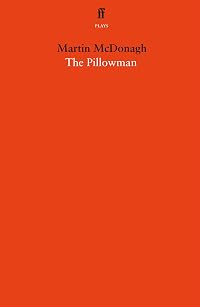
The Pillowman
by Martin McDonagh
On This Page
Description
'The first duty of a storyteller is to tell a story.' Or was it 'The only duty of a storyteller is to tell a story'? A writer in a totalitarian state is interrogated about the gruesome content of his short stories and their similarities to a number of child-murders that are happening in his town. 'Sometimes you don't even know what you've been craving until the real thing comes along.' New York Times 'McDonagh is more than just a very clever theatrical stylist. His tricks and turns have a show more purpose. They are bridges over a deep pit of sympathy and sorrow, illuminated by a tragic vision of stunted and frustrated lives.' Fintan O'Toole, Irish Times Martin McDonagh's searingly brilliant play premiered at the National Theatre, London in November 2003. show lessTags
Recommendations


Member Reviews
Right, so there's a lot of places to go with this play, in terms reviewing it. Lots to work with. Because The Pillowman is about a lot of things—rage, childhood trauma, art, violence, stories, symbolism, the subconscious. But I think I've found something which ties all of those things together, so that's what I'm going to focus on here: surrogacy.
I'm not talking about having a baby for someone, I'm just using it in the general sense of the word—the state of being a surrogate. Being a stand-in for someone else. As humans, more of our lives are spent making people surrogates than we'd like to think. How often do we take our anger out on the people who don't deserve it? How often do we take a liking (or a disliking) to someone because show more they remind us of someone else? How often do we (even subconsciously) make others the conduit for our pent-up pain over events in the past, over the fucked-up things our parents did and said or over the way we were bullied, how often do we take that simmering rage and, when it finally boils over, direct it not at the people who hurt us but at others quite unconnected with the original act?
Quite often, I think.
If this all sounds more than a bit Freudian to you, I understand. A lot of the concepts explored in this play are certainly of that nature. There's a lot of talk about childhoods and children, and all I could think about was how the act of killing a child is often imbued with such psychological and moral weight because of how the murderer sees his own self in the child, how the act is not, to him, a murder, but a mercy—how he sees himself and he destroys himself, and by doing so he tries to prevent himself from ever having existed at all because he so hates the knot of grief and rage and brokenness he was turned into because of his own childhood.
Not that I'm pardoning child murderers. Although pardoning child murderers is a very real topic in The Pillowman, which is why I brought it up in the first place. So in case you haven't already guessed, you probably shouldn't read this play if you have any especial sensitivity regarding the death or torture of children. Well, I suppose every human person with a soul has this sensitivity, but I guess I just mean that you shouldn't read this if you can't handle that being a main component of the story. This isn't horror, so the intent isn't to frighten or repulse you, but these things certainly happen while Martin McDonagh is spinning a tale as terrible as this one.
Writing is an important motif here, unsurprisingly since the protagonist is a writer and the plot concerns the implications of his stories. But here again we find surrogacy. What is writing but extended symbolism and self-exploration? Sounds masturbatory; probably is. Characters are not always surrogates for real people, sometimes they’re surrogates for ourselves, the parts of ourselves we can’t bear to analyse via classic introspection or therapy—the parts of ourselves who hate our parents, hate ourselves, desire obliteration more than anything—so we extract them and place them into little symbolic people made of words. It’s a dark take on the act of fiction writing and I wonder if Martin McDonagh believes it himself, or if Katurian Katurian is more of a nightmare, where the things we know and understand are horribly darkened and twisted up.
And violence against surrogates even runs through the subtler details of The Pillowman. Consider the tale of the Little Green Pig and the fact that Katurian works for a butcher, something which is only mentioned once in the very first scene. Or the parents in The Little Jesus, how they compare to Katurian and Michal’s parents, and Ariel’s, and what became of all three sets.
Every character in this play is guilty of surrogacy to some degree. The detectives who initially seem so boneheaded and brutish reveal their internal struggles and worldviews through some fantastic dialogue and monologues, and they both have a propensity to channel their anger and grief and unleash it on people who represent those that have hurt or abandoned them.
And maybe the person who creates surrogates is a victim themselves, cycles of abuse and of psychological trauma without outlet. If this sounds unbearably depressing to you, that’s because it is, but the last scene of the play holds some hope in that regard, some light. Not much, little more than a pinprick or the flicker of a candle from a mile away, but it’s enough, I think. The world is dark, McDonagh tells you. So perhaps the candle is just there to emphasise the darkness surrounding it.
I’m being vague about everything because you really should just read this play. (You can do so for free here.) It hits you like a punch in the gut—especially the titular story—but my god is it exceptional. Here’s a perfect balance between the cerebral and the concrete, a story that doesn’t forsake character development for symbolism and meta-fiction, which is philosophical and thought-provoking but also just a great tale. It seems perverse to say I loved The Pillowman, and if you read it you’ll understand why.
But I did love it. show less
I'm not talking about having a baby for someone, I'm just using it in the general sense of the word—the state of being a surrogate. Being a stand-in for someone else. As humans, more of our lives are spent making people surrogates than we'd like to think. How often do we take our anger out on the people who don't deserve it? How often do we take a liking (or a disliking) to someone because show more they remind us of someone else? How often do we (even subconsciously) make others the conduit for our pent-up pain over events in the past, over the fucked-up things our parents did and said or over the way we were bullied, how often do we take that simmering rage and, when it finally boils over, direct it not at the people who hurt us but at others quite unconnected with the original act?
Quite often, I think.
If this all sounds more than a bit Freudian to you, I understand. A lot of the concepts explored in this play are certainly of that nature. There's a lot of talk about childhoods and children, and all I could think about was how the act of killing a child is often imbued with such psychological and moral weight because of how the murderer sees his own self in the child, how the act is not, to him, a murder, but a mercy—how he sees himself and he destroys himself, and by doing so he tries to prevent himself from ever having existed at all because he so hates the knot of grief and rage and brokenness he was turned into because of his own childhood.
Not that I'm pardoning child murderers. Although pardoning child murderers is a very real topic in The Pillowman, which is why I brought it up in the first place. So in case you haven't already guessed, you probably shouldn't read this play if you have any especial sensitivity regarding the death or torture of children. Well, I suppose every human person with a soul has this sensitivity, but I guess I just mean that you shouldn't read this if you can't handle that being a main component of the story. This isn't horror, so the intent isn't to frighten or repulse you, but these things certainly happen while Martin McDonagh is spinning a tale as terrible as this one.
Writing is an important motif here, unsurprisingly since the protagonist is a writer and the plot concerns the implications of his stories. But here again we find surrogacy. What is writing but extended symbolism and self-exploration? Sounds masturbatory; probably is. Characters are not always surrogates for real people, sometimes they’re surrogates for ourselves, the parts of ourselves we can’t bear to analyse via classic introspection or therapy—the parts of ourselves who hate our parents, hate ourselves, desire obliteration more than anything—so we extract them and place them into little symbolic people made of words. It’s a dark take on the act of fiction writing and I wonder if Martin McDonagh believes it himself, or if Katurian Katurian is more of a nightmare, where the things we know and understand are horribly darkened and twisted up.
And violence against surrogates even runs through the subtler details of The Pillowman. Consider the tale of the Little Green Pig and the fact that Katurian works for a butcher, something which is only mentioned once in the very first scene. Or the parents in The Little Jesus, how they compare to Katurian and Michal’s parents, and Ariel’s, and what became of all three sets.
Every character in this play is guilty of surrogacy to some degree. The detectives who initially seem so boneheaded and brutish reveal their internal struggles and worldviews through some fantastic dialogue and monologues, and they both have a propensity to channel their anger and grief and unleash it on people who represent those that have hurt or abandoned them.
And maybe the person who creates surrogates is a victim themselves, cycles of abuse and of psychological trauma without outlet. If this sounds unbearably depressing to you, that’s because it is, but the last scene of the play holds some hope in that regard, some light. Not much, little more than a pinprick or the flicker of a candle from a mile away, but it’s enough, I think. The world is dark, McDonagh tells you. So perhaps the candle is just there to emphasise the darkness surrounding it.
I’m being vague about everything because you really should just read this play. (You can do so for free here.) It hits you like a punch in the gut—especially the titular story—but my god is it exceptional. Here’s a perfect balance between the cerebral and the concrete, a story that doesn’t forsake character development for symbolism and meta-fiction, which is philosophical and thought-provoking but also just a great tale. It seems perverse to say I loved The Pillowman, and if you read it you’ll understand why.
But I did love it. show less
Gallows humour, and a steady, unpleasant look at cruelty, and at deception. Not precisely metafiction but perhaps a commentary on metafiction, and also on: the influence we have on one another, to the point of complicity; storytelling, and its pedigree of brutality.
I remind myself: there is what people write (say), and there is what people do. McDonagh examines each separately and in resonance.
I remind myself: there is what people write (say), and there is what people do. McDonagh examines each separately and in resonance.
واقعاً تنها دلخوشی این روزهای خسته کنندهی پر از دانشگاه و کار میتونه کتاب خوندن باشه و چقدر خوب که این نمایشنامه عالی و خوب رو خوندم... واقعاً فکرش رو نمیکردم که انقدر این نمایشنامه خوب باشه اما صفحه به صفحهای که میخوندم بیشتر مجذوبش میشدم... نمایشنامه پر از پیرنگه... به غیر از پیرنگ اصلی داستان چند پیرنگ به عنوان داستانهای کوتاه نویسنده داخلش بازی میشه که همهی اونها غنای خاصی به پیرنگ اصلی show more بخشیده... واقعاً اگه از یه کار سوررئال و نمادین لذت میبرید پیشنهاد میکنم هرگز این رمان رو از دست ندید. show less
A former professor of mine once dismissed the original BBC Office as “self-congratulatory.” I laughed at the time and disagreed with him, but his phrase comes in handy when thinking abut The Pillowman, which reads as if a college sophomore who had binged on Tarantino and Pinter sat down to write a play. I say this with the utmost conviction, as I am certain that, at 19, I would have loved this thing. The meta-theatrical conceits! The language! The verbal violence! The puzzles! The occasions for talking to one’s roommate in sentences beginning, “No—that’s the whole point! The guy’s stories don’t make murders happen—and that shows the relationship between art and life, even though we are told later that the murders—” show more etc. Now, at 45, this stuff seems much more tame than Antigone and certainly more tame than Oleanna or Speed the Plow. One is also reminded of Stoppard while reading this, but Stoppard is smarter.
I can hear McDonagh’s admirers now, perhaps assuming that I’m some waif or fuddy-duddy shocked by the violence. Wrong. The violence itself isn’t shocking although it is awful. What makes The Pillowman so self-indulgent is that the violence lacks any kind of moral center. Tarantino’s films are all informed by moral quandaries, which is why Mr. Orange’s last words in Reservoir Dogs make the audience gasp. Even popular fictions like The Exorcist or Rosemary’s Baby work because of a moral center to which the storytellers appeal. Not here. Instead, we get an onstage dramatization of a story titled “The Little Jesus Girl,” prefaced by the stage direction, “The dreadful details of the following are all acted out onstage.” Fine, by all means, show the story of the crucified girl—but don’t do so as an excuse to display your own naughtiness. (“Is he really going there? My word!”) Not only does that make the whole thing empty—it also makes it boring. And yes, I can already hear the refrain But that’s the point! I admit to being too old to care. The wisest thing said in the play is when the author / victim states of his work, “I’m not trying to say anything at all!” Nonsense. The entire set up—in which two terrifying critics—er, cops—torture an innocent—er, guilty, er, cutely ambiguous—writer into explaining himself is an invitation for an audience to laugh along—or be laughed at. The whole thing has a built-in fail-safe designed to make any review such as this one seem like it was written by a rube. So be it.
One more thing. It comes to me, later, after having written this, that the above is the same point made by Norman Mailer in his review of American Psycho, a review I read for the first time about a month ago when I was killing time at the library. That's a book worth reading: Mind of an Outlaw, the new anthology of his essays.
Update. A few weeks later, thinking there had to be more to McDonagh, I read The Beauty Queen of Leenane. While better than The Pillowman, it's still thin soup. show less
I can hear McDonagh’s admirers now, perhaps assuming that I’m some waif or fuddy-duddy shocked by the violence. Wrong. The violence itself isn’t shocking although it is awful. What makes The Pillowman so self-indulgent is that the violence lacks any kind of moral center. Tarantino’s films are all informed by moral quandaries, which is why Mr. Orange’s last words in Reservoir Dogs make the audience gasp. Even popular fictions like The Exorcist or Rosemary’s Baby work because of a moral center to which the storytellers appeal. Not here. Instead, we get an onstage dramatization of a story titled “The Little Jesus Girl,” prefaced by the stage direction, “The dreadful details of the following are all acted out onstage.” Fine, by all means, show the story of the crucified girl—but don’t do so as an excuse to display your own naughtiness. (“Is he really going there? My word!”) Not only does that make the whole thing empty—it also makes it boring. And yes, I can already hear the refrain But that’s the point! I admit to being too old to care. The wisest thing said in the play is when the author / victim states of his work, “I’m not trying to say anything at all!” Nonsense. The entire set up—in which two terrifying critics—er, cops—torture an innocent—er, guilty, er, cutely ambiguous—writer into explaining himself is an invitation for an audience to laugh along—or be laughed at. The whole thing has a built-in fail-safe designed to make any review such as this one seem like it was written by a rube. So be it.
One more thing. It comes to me, later, after having written this, that the above is the same point made by Norman Mailer in his review of American Psycho, a review I read for the first time about a month ago when I was killing time at the library. That's a book worth reading: Mind of an Outlaw, the new anthology of his essays.
Update. A few weeks later, thinking there had to be more to McDonagh, I read The Beauty Queen of Leenane. While better than The Pillowman, it's still thin soup. show less
Brilliant stuff. The dialogue is really well done and McDonagh is skilled at withholding that final moral twist in a play built on moral twists. I have suspicions that to some the content and writing style might fall under 'shocklit' but, in my opinion, the comedy eclipses whatever accusations of gratuitousness might be levied at the over-the-top violence and cruelty.
It's well written—and funny—with enough narrative dexterity to pull out the poignancy when necessary. Excellent.
It's well written—and funny—with enough narrative dexterity to pull out the poignancy when necessary. Excellent.
This play must certainly be one of those most bittersweet of works: a work of such breathtaking genius that the author will probably never write anything to match it again. The story of a young writer questioned by the police regarding some short stories he's written, and the role they believe he played in the murder of young children, the story unwinds through a series of plot twists narrated by the stories the man has written, which illustrate the murders that have occurred, and ultimately pin the guilt on the culprit. The stories themselves are a treasure, as the writer gives us a combination of theatrical writing and short story composition that mesh nicely into a work that rivals Hamlet for its power and genius.
Gyomrokat felkészíteni, mert az első oldalakon rándul görcsbe, fordul fel, és nagyjából úgy is marad végig. Akinek gyereke van, szerintem ne olvassa. Iszonyat kemény darab. És baromi érdekes feszegetése az írói felelősségnek és az írói hiúságnak. A fordulatokkal vagyok kicsit bajban, mert az egyik, ami talán annak lehetett szánva, az első pillanattól egyértelmű volt. Talán mégsem szánta fordulatnak a szerző, és persze a hátteret rémálmodni sem lehetett volna. Majd most. A másikat is részben tudni lehetett, bár a végére az a gyomorkioldás azért baromi jólesett . McDonagh nem mondatta ki senkivel a nyomozó sztorijának logikai hibáit (miszerint az öregember menti meg a síneken gyalogló show more siket fiút a háta mögött közeledő vonattól, de a fiú egyrészt érezné a sínek rezgésében, hogy jön a vonat, másrészt ha a hallókészülékből tudja az öregember, hogy siket, akkor éppen remekül hall is, nem? – több helyen belekérdezett mondjuk az épp kihallgatott író, mert elég döcögős volt a sztori logikája, erre a tényre felhívta a figyelmet, de mindent azért nem rágott a szánkba, sőt, indoka is van nem folytatni a nyomozóval való kötözködést – egyre jobban tetszik ez a rész) , szerintem bízott az olvasóban/nézőben, ez tetszik. Az érzések ilyen skáláját ilyen intenzitással megmozgatni a nézőben/olvasóban, ráadásul ilyen rövid idő alatt, ez egészen bámulatos. Hiába kacsintgat ki többször is, hogy helló, ez csak egy szöveg, nem a valóság, most azért kell egy kis idő, míg összeszedem magam. show less
Members
- Recently Added By
Published Reviews
"McDonagh's least forgiving, bravest play."
added by SaraElizabeth11
"A complex tale about life and art, about fact and illusion, about politics, society, cruelty and creativity."
added by SaraElizabeth11
"Energizing... A blindingly bright black comedy... [What makes] the unsettling and exhilarating new play from Mr. McDonagh...so gripping as theater is how narrative art becomes the play's and the character's very life blood."
added by SaraElizabeth11
Lists

Plays I Like
230 works; 29 members

Top Five Books of 2013
1,562 works; 721 members

Favourite Books
1,819 works; 309 members

Books Read in 2018
4,360 works; 110 members

Favourite Drama of the 21st Century
18 works; 2 members

Best Dystopias
280 works; 276 members

Favourite Science Fiction Books of the 21st Century
47 works; 8 members
My Play Collection
769 works; 3 members

Next Plays / 2025
352 works; 1 member

Next Plays to Watch
50 works; 1 member
Author Information

29 Works 2,888 Members
Awards and Honors
Awards
Common Knowledge
- Canonical title
- The Pillowman
- Original publication date
- 2004
- People/Characters
- Katurian Katurian Katurian; Michal Katurian; Ariel; Tupolski; Mother; Father (show all 8); Boy; Girl
- Original language
- English
Classifications
Statistics
- Members
- 777
- Popularity
- 35,941
- Reviews
- 22
- Rating
- (4.28)
- Languages
- English, Spanish
- Media
- Paper
- ISBNs
- 4
- ASINs
- 10