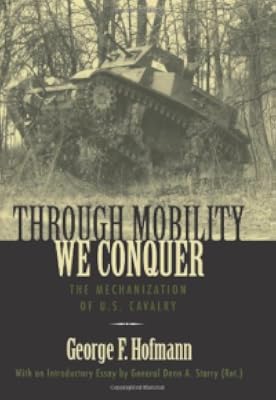
Through Mobility We Conquer: The Mechanization of U.S. Cavalry
by George F. Hofmann
On This Page
Description
The U.S. Cavalry, which began in the nineteenth century as little more than a mounted reconnaissance and harrying force, underwent intense growing pains with the rapid technological developments of the twentieth century. From its tentative beginnings during World War I, the eventual conversion of the traditional horse cavalry to a mechanized branch is arguably one of the greatest military transformations in history. Through Mobility We Conquer recounts the evolution and development of the show more U.S. Army's modern mechanized cavalry and the doctrine necessary to use it effectively, and explores th show lessTags
Member Reviews
This study of institutional warfare and clashing doctrines in the U.S. Army (vis-a-vis the role of the cavalry as an arm of battle) is very useful, if only for assessing who was actually doing the heavy lifting of creating a working mechanized force and those who were the obstructions. For one, George S. Patton is more impressive as a politician then as an innovator.
However, while I shouldn't criticize a book for what it is not, Hofmann's examination of the obstructionism of the Army branch chiefs suggests a certain gap in the literature. At the very least Hofmann gives a partial corporate portrait of a group of men who were just not coping well with machine-age modernity and mass society, and one comes away wanting to know more. My show more thought is that an examination of the U.S. Army through the perspective of the branch chiefs, somewhat in the style of Peter Karsten's "The Naval Aristocracy" would provide useful answers to where some of the intellectual dullness displayed came from. show less
However, while I shouldn't criticize a book for what it is not, Hofmann's examination of the obstructionism of the Army branch chiefs suggests a certain gap in the literature. At the very least Hofmann gives a partial corporate portrait of a group of men who were just not coping well with machine-age modernity and mass society, and one comes away wanting to know more. My show more thought is that an examination of the U.S. Army through the perspective of the branch chiefs, somewhat in the style of Peter Karsten's "The Naval Aristocracy" would provide useful answers to where some of the intellectual dullness displayed came from. show less
Members
- Recently Added By
Author Information
5 Works 72 Members
George F. Hofmann is an adjunct history professor at the University of Cincinnati.
Classifications
- Genres
- Nonfiction, History
- DDC/MDS
- 357.50973 — Society, government, & culture Public administration & military science Mounted forces and warfare
- LCC
- UA30 .H64 — Military Science Armies: Organization, distribution, military situation Armies: Organization, distribution, military situation By region or country
- BISAC
Statistics
- Members
- 17
- Popularity
- 1,453,105
- Reviews
- 1
- Rating
- (4.00)
- Languages
- English
- Media
- Paper, Ebook
- ISBNs
- 5