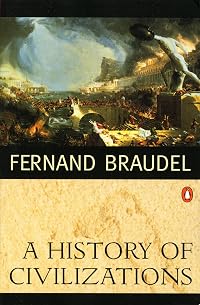
A History of Civilizations
by Fernand Braudel
On This Page
Description
Fernand Braudel was one of the greatest historians of the twentieth century. A leading member of the Annales school, he rejected a narrow focus on Western warfare, diplomacy, and power politics, and opened up economic and social history to influences from anthropology, sociology, geography, psychology, and linguistics. In the late 1950s, when the Annales approach was widely accepted in French universities, a major reform introduced the study of "the main contemporary civilizations" into the show more final year of secondary schools. Traditionalists attacked the new stress on the social sciences and eventually triumphed, but Braudel was firmly committed to such changes. This marvelous survey of world history, the last of his books to be translated into English, was originally intended for French "sixth-formers." Yet its real value is far more permanent. Even an "educational story," Braudel once suggested in a lecture, can become a "tale of adventure," provided the historian manages to "find the key to a civilization" and is not afraid of simplicity - "not simplicity that distorts the truth, produces a void, and is another name for mediocrity, but simplicity that is clarity, the light of intelligence." Such a light shines throughout A History of Civilizations. After an introductory section examining the nature of cultures and civilizations, their continuities and transformations, Braudel surveys broad historical developments in almost every corner of the globe: the Muslim world - from the rise of Islam to post-colonial revival; Black Africa - from the slave trade to the dilemmas of development; the Far East: China, India, the maritime states and Japan; Europe - from the collapse of the Roman Empire to political union; the European civilizations of the New World: Latin America and the United States; the English-speaking universe: Canada, Southern Africa, Australia, and New Zealand; and the other Europe: Russia, the USSR, and the CIS. For this excellent translation, Richard Mayne has gently updated the text. And yet, as he explains in his Introduction, very little was necessary. Braudel always had an astonishingly firm grasp on the broad sweep of history - a grasp which, "in the hands of a master, can help explain the most dramatic convulsions in the past, the present, and the future." show lessTags
Recommendations





























Member Recommendations

Member Reviews
Braudel is considered one of the great 20th c. historians. He fought the French educational establishment to broaden the scope of history to include material from sociology, anthropology, geography, etc., and above all economics. This was in opposition to the traditional kings and battles approach, and this book was intended as a textbook (not accepted by the authorities). Arguably the movement’s been quite fruitful, but this book is a very mixed bag – occasionally excellent, sometimes quite bad, and usually mediocre to good. It’s also not a history of civilizations - it deals with what Braudel considered the great living civilizations – and rather than being history as usually understood, it describes primary characteristics of show more each with some development over time. Even the treatment of each “civilization” varies a great deal from one to the next, e.g. considerable space is devoted to the literature of Latin America while not to the others. The civilizations included are the Muslim World, Black Africa, the Far East (includes India), then Europe and European civilization elsewhere (to which he devotes half the book).
In spite of the many gaps, blind spots and weaknesses, there are some real high points and original insights. For example, Braudel points out that, while the Crusades are usually seen as unmitigated folly in the West, and while they achieved nothing lasting on land, at their beginning the Mediterranean was dominated by Islam while at their end it was dominated by the West. This had important consequences limiting Islamic power and culture while removing constraints from those of the West. He’s probably at his best dealing with the West and Islam, and at his worst dealing with Latin America. To his credit he doesn’t pass over Africa as so many do, but gives it reasonable attention, describing among other things the great trading societies which grew up as a result of contact with Islam. His take on the United States is fairly sane, with useful analyses of the evolution of American capitalism and of the centralization of power and growth of bureaucracy in the Executive branch of the Federal government. But the section on the US has its share of romanticisms and a couple chauvinisms (that statement probably applies to all societies outside Europe, and perhaps to European ones as well). His take on the Soviet Union is balanced to slightly sympathetic, although it’s odd that we never hear of the millions killed by Stalin (or Mao).
Braudel’s rejection of traditional historical narrative, with its landmarks and mileposts, sometimes leaves you wondering what, where and when it is that he’s talking about. More importantly, he has a great weakness for making overarching generalizations, usually devoid of rational arguments stocked with facts which might lead us to share his conclusions. It’s often transparently obvious that these generalizations can neither explain the entire phenomenon they purport to explain, nor can the explanation be so simple. After a few of these you start to question Braudel’s judgment. He also spends a fair amount of time contemplating then-contemporary problems and speculating about the future. He defends this, but his performance is unconvincing, particularly in light of events since he wrote (1962). All the same, for someone who doesn’t expect this book to be comprehensive or even, and who reads it along with world histories which are, it’s still worth reading for its strengths and for the not-infrequent original insights. show less
In spite of the many gaps, blind spots and weaknesses, there are some real high points and original insights. For example, Braudel points out that, while the Crusades are usually seen as unmitigated folly in the West, and while they achieved nothing lasting on land, at their beginning the Mediterranean was dominated by Islam while at their end it was dominated by the West. This had important consequences limiting Islamic power and culture while removing constraints from those of the West. He’s probably at his best dealing with the West and Islam, and at his worst dealing with Latin America. To his credit he doesn’t pass over Africa as so many do, but gives it reasonable attention, describing among other things the great trading societies which grew up as a result of contact with Islam. His take on the United States is fairly sane, with useful analyses of the evolution of American capitalism and of the centralization of power and growth of bureaucracy in the Executive branch of the Federal government. But the section on the US has its share of romanticisms and a couple chauvinisms (that statement probably applies to all societies outside Europe, and perhaps to European ones as well). His take on the Soviet Union is balanced to slightly sympathetic, although it’s odd that we never hear of the millions killed by Stalin (or Mao).
Braudel’s rejection of traditional historical narrative, with its landmarks and mileposts, sometimes leaves you wondering what, where and when it is that he’s talking about. More importantly, he has a great weakness for making overarching generalizations, usually devoid of rational arguments stocked with facts which might lead us to share his conclusions. It’s often transparently obvious that these generalizations can neither explain the entire phenomenon they purport to explain, nor can the explanation be so simple. After a few of these you start to question Braudel’s judgment. He also spends a fair amount of time contemplating then-contemporary problems and speculating about the future. He defends this, but his performance is unconvincing, particularly in light of events since he wrote (1962). All the same, for someone who doesn’t expect this book to be comprehensive or even, and who reads it along with world histories which are, it’s still worth reading for its strengths and for the not-infrequent original insights. show less
The conqured always submit to the stronger; but their submission is merely provisional when civilisations clash.
Jaw dropping analysis and synthesis. Braudel took the heavy lifting of his notable trilogy and applied it to a primer, a survey of world history for young students. Starting with Islam and ending with Russia, Braudel uses the long view to explore the definitions of civilization and the migrations, faiths and systems which have cultivated such. I was staggered by the beauty of Braudel on India: luminous poetry.
Jaw dropping analysis and synthesis. Braudel took the heavy lifting of his notable trilogy and applied it to a primer, a survey of world history for young students. Starting with Islam and ending with Russia, Braudel uses the long view to explore the definitions of civilization and the migrations, faiths and systems which have cultivated such. I was staggered by the beauty of Braudel on India: luminous poetry.
This was my first Braudel book-- and it will not be my last. Although not a perfect history text, and somewhat ethnocentric, it still represents a landmark document in the study of civilizations that can serve as a primer towards further study. He highlights key areas of development from all over the world and speaks of the importance of bases of civilization rather than focusing on specific civilizations themselves. The study is fascinating and the writing is clear and poised. Overall, I was impressed. This should not be missed for those interested in history.
Braudel: "Is it possible somehow to convey simultaneously both that conspicuous history which holds our attention by its continual and dramatic changes - and that other, submerged history, almost silent and always discreet, virtually unsuspected either by its observers or its participants, which is little touched by the obstinate erosion of time?" - Fernand Braudel seems to have found an answer to this question in his method of measuring history on three scales: that of the 'quasi-immobile time of structures and traditions' (la longue durée), a time of slow change and constant repetition; 'the intermediate scale of 'conjunctures', rarely longer than a few generations, the time also of social history; and the rapid time-scale of events show more or of individual men, of which Braudel finally warns us not to be deceived by it: "We must learn to distrust this history with its still burning passions, as it was felt, described, and lived by contemporaries whose lives were as short and as short-sighted as ours."
Braudel in his 'History of Civilizations' gives an over-sight of the history of the main civilizations and cultures of the world, distrusting simple explications and not falling back into mere generalizations; above all he feels to have to negate that most popular view of culture as an entity in itself, whereas cultural influences and changes can be observed over time throughout the whole world, so it would be unjust to ascribe to any such culture an over-historical identity.
The last words of "L'identité de la France", another book of Braudel, were:
"Men do not make history, rather it is history above all that makes men and thereby absolves them from blame." show less
Braudel in his 'History of Civilizations' gives an over-sight of the history of the main civilizations and cultures of the world, distrusting simple explications and not falling back into mere generalizations; above all he feels to have to negate that most popular view of culture as an entity in itself, whereas cultural influences and changes can be observed over time throughout the whole world, so it would be unjust to ascribe to any such culture an over-historical identity.
The last words of "L'identité de la France", another book of Braudel, were:
"Men do not make history, rather it is history above all that makes men and thereby absolves them from blame." show less
Full of sweeping generalisations and inaccuracies, I'd like to think this is of use only as a record of how far the study of history has come.
Deep going, and frequently extremely boring. Braudel was more than a bit of a snob, too, and many cultural references in this book, originally written in 1962, are politically incorrect. Still, over a 6-8 week period, I managed to finish the silly thing,
This is a translation from the French of a pre-2nd Millennium History that develops wide-ranging themes & encompasses every important aspect of the rise of Humans in what is now regarded as a very loose term, 'Civilization', but in its original French back in 1963 it was considered a defining European-centric work on that topic.
Members
- Recently Added By
Lists

Big History
72 works; 1 member

Spotted in Public
9 works; 1 member

Bibliography of How the Old World Ended by Jonathan Scott
308 works; 1 member
Author Information

Fernan Braudel was the author of several acclaimed histories, including "A History of Civilizations", "On History", "The Structures of Everyday Life", & "The Wheels of Commerce". He died in 1985. (Bowker Author Biography) Fernand Braudel, 1902 - 1986 French historian Fernand Braudel was born in 1902. He studied under Lucien Febvre and was a show more founder of the Annales School of Historiography. He went to Brazil in 1935 as one of the young French scholars who founded the University of Sao Paulo. He was a German prisoner of war during World War II. After the war, he was a professor at the College de France in Paris from 1949-1972, editor of the journal Annales, a founder of the Maison des Sciences de l'Homme in 1963, and president of the VIth Section of the Ecole des Hautes Etudes from 1952-1956. While Braudel was a prisoner of war, he wrote "The Mediterranean and the Mediterranean World in the Age of Philippe II" (1949). The book shows the environment in which the peoples of the Mediterranean Basin used to live, from the mountains and plains, the sea and rivers to the roads and towns. He combines the rhythm of "geographic time" with the rapid rhythm of "individual time" and the movement of the people and their ideas. The subject matter of history changes because the time frame of history changes. The short-lived dramatic moments are replaced by the lengthy rhythms of material life. Braudel studied the history of the development of capitalism, the flows of communication and the money it induces, the shift in borders it results in and even the changes in the structure of the State it determines. Braudel's other works are "Ecrits sur l'histoire" (Writings on History, 1969), "La Dynamique du capitalisme" (Dynamics of Capitalism, 1985), and "Identity of France" (1986). The Fernand Braudel Institute of World Economics was created in 1987 by a group of economists, businessmen, journalists and civil servants that were concerned with the process of economic and social disintegration caused by decades of chronic inflation. (Bowker Author Biography) show less
Series
Belongs to Publisher Series
Common Knowledge
- Canonical title
- A History of Civilizations
- Original title
- Grammaire des civilisations
- Original publication date
- 1987
- First words
- It would be pleasant to be able to define the word 'civilization' simply and precisely, as one defines a straight line, a triangle or a chemical element.
- Last words
- (Click to show. Warning: May contain spoilers.)The former USSR, whose decades of effort put it in some ways in the lead, may well have to suffer the solitude its efforts have earned.
- Original language
- French
- Disambiguation notice
- This is the English title of Braudel's Grammaire des civilisations. It was originally the second book in a three-part educational series (Le Monde actuel, histoire et civilisations), written by three authors. Grammaire des ci... (show all)vilisations first appeared in French in 1963, went out of print in 1970, and was reissued by itself in 1987. The first publication in English was in 1993.
Classifications
Statistics
- Members
- 1,042
- Popularity
- 24,783
- Reviews
- 9
- Rating
- (3.53)
- Languages
- 9 — Chinese, English, French, Greek, Japanese, Polish, Portuguese, Romanian, Turkish
- Media
- Paper, Ebook
- ISBNs
- 17
- ASINs
- 3