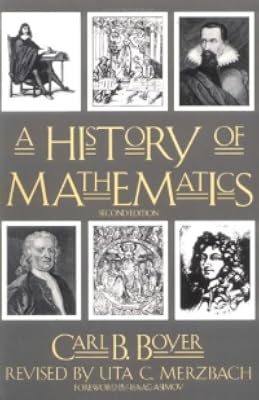
A History of Mathematics
by Carl B. Boyer
On This Page
Description
This revised edition features up-to-date coverage of topics such as Fermat's Last Theorem and the Poincare Conjecture, in addition to recent advances in areas such as finite group theory and computer-aided proofs. It distills thousands of years of mathematics into a single, approachable volume.Tags
Recommendations









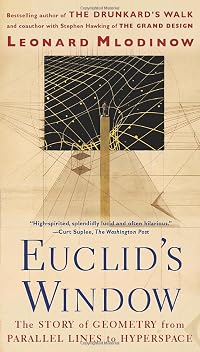


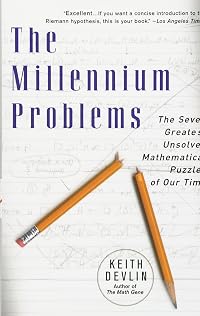


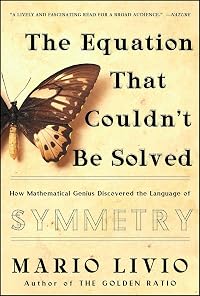









Member Recommendations

Member Reviews
This book is probably a god-send for your average mathematician. But for the average reader, no matter how well versed in mathematics he/she is, this book is too esoteric to be more than occasionally interesting. In general, it's too comprehensive (and incomprehensible) for the cost of time/energy to read. I can understand the need for detail:
"Another paper of great influence in the trend to abstraction was Ernst Steinitz's work on the algebraic theory of fields, which appeared in the winter of 1909-1910 and had been motivated by Kurt Hensel's work on p-adic fields."
or
"Heesch thought that the four-color conjecture could be solved by considering a set of around 8,900 configurations."
I won't say that the book was never interesting [did show more you know that our "Arabic numbers" are really Indian inspired? Ever since my visit to Egypt many years ago I wondered why their numbers were different from ours.] Anyway, I have enough Science Fiction background that I recognized most of the buzz-words: Riemann fields, topology, tensors, pseudosphere(?), Hermitian matrices....
If I were an advanced student of Mathematics I would definitely give this book a 5-star rating. But, given that I actually was able to plow through the entire book, and comprehended so little, tells even me that the author was not intrinsically boring. There's a phenomenal amount of information in this book; it's just a shame that I understood so little of it. However, I may have been inspired to see if I can find an "advanced math for dummies" book. Just what is "non Euclidean geometry"? show less
"Another paper of great influence in the trend to abstraction was Ernst Steinitz's work on the algebraic theory of fields, which appeared in the winter of 1909-1910 and had been motivated by Kurt Hensel's work on p-adic fields."
or
"Heesch thought that the four-color conjecture could be solved by considering a set of around 8,900 configurations."
I won't say that the book was never interesting [did show more you know that our "Arabic numbers" are really Indian inspired? Ever since my visit to Egypt many years ago I wondered why their numbers were different from ours.] Anyway, I have enough Science Fiction background that I recognized most of the buzz-words: Riemann fields, topology, tensors, pseudosphere(?), Hermitian matrices....
If I were an advanced student of Mathematics I would definitely give this book a 5-star rating. But, given that I actually was able to plow through the entire book, and comprehended so little, tells even me that the author was not intrinsically boring. There's a phenomenal amount of information in this book; it's just a shame that I understood so little of it. However, I may have been inspired to see if I can find an "advanced math for dummies" book. Just what is "non Euclidean geometry"? show less
This book reminds me of E.T. Bell's book, Men of Mathematics. It contains the history of mathematical discoveries as they are known to scholars. For instance, it shows that certain theorems were known to the oriental nations like China and India, and that a lot of things had to be rediscovered after the whole rigmarole with the fall of empires and nations and the destruction of ancient repositories of knowledge.
It starts with counting and goes on through the Egyptians, Babylonians, Greeks and Romans. After the Decline and Fall of the Roman Empire, we follow mathematical thought to India, China and Arabia. Throughout the book, it covers quadratics and how the ancients thought of them and goes on through the founding of Calculus and show more Analysis. The Giants are all covered, with Euler and Gauss each getting their own chapters. Basically, with every big name or thought in mathematics, the book is there, offering an opinion on stuff. Most of the stuff is priority of discovery, which is a huge thing to mathematicians.
This book is really interesting, but it takes a while for me to read the notation. I really wish I was better at that, but I am working on it. show less
It starts with counting and goes on through the Egyptians, Babylonians, Greeks and Romans. After the Decline and Fall of the Roman Empire, we follow mathematical thought to India, China and Arabia. Throughout the book, it covers quadratics and how the ancients thought of them and goes on through the founding of Calculus and show more Analysis. The Giants are all covered, with Euler and Gauss each getting their own chapters. Basically, with every big name or thought in mathematics, the book is there, offering an opinion on stuff. Most of the stuff is priority of discovery, which is a huge thing to mathematicians.
This book is really interesting, but it takes a while for me to read the notation. I really wish I was better at that, but I am working on it. show less
A comprehensive survey of mathematics, from Babylonian number systems to 20th century analysis, with emphasis on the areas you'd expect: ancient Greek geometry, Arab work on polynomials, the development of analysis in Europe, etc. A tad dry in places, but very clear and thorough. The presentation doesn't assume a particularly high level of mathematical sophistication on the part of the reader, but on the other hand, why in the hell would you find this book interesting if you haven't already done some mathematical work?
The story proceeds chronologically in more or less self-contained chapters that focus on particular areas and eras, so this book can be used as a reference by people who don't want to read the whole thing. In addition to show more its general utility as a history, Boyer's book gives you an appreciation what a vast human undertaking mathematics has been. Even something like basic algebra, which now seems so obvious and common-sensical, represents a tremendous feat of intellectual innovation.
If you're looking for a good popular exposition of the ideas of mathematics rather than the history per se, a good place to start is The Mathematical Experience by Davis and Hersh. show less
The story proceeds chronologically in more or less self-contained chapters that focus on particular areas and eras, so this book can be used as a reference by people who don't want to read the whole thing. In addition to show more its general utility as a history, Boyer's book gives you an appreciation what a vast human undertaking mathematics has been. Even something like basic algebra, which now seems so obvious and common-sensical, represents a tremendous feat of intellectual innovation.
If you're looking for a good popular exposition of the ideas of mathematics rather than the history per se, a good place to start is The Mathematical Experience by Davis and Hersh. show less
Very enlightening and entertaining,
a pleasure to read and share with the backstage details
of math thinkers and their lives and motives
brings math down to reality and yet celebrates
the imagination and creative of so many thinkers
a pleasure to read and share with the backstage details
of math thinkers and their lives and motives
brings math down to reality and yet celebrates
the imagination and creative of so many thinkers
I think this kind of book is important. I admit I had more questions than anything when reading because it's so hard for me to understand. But I still think it's an important process, questions can be more important than answers. It's a part of the power of deeper thinking.. and being a part of a human thought continuum.
Foreword by Isaac Asimov. "As time goes on, nearly every field of human endeavor is marked by changes which can be considered as correction and/or extension. ....But only among the sciences is there true progress; only there is the record one of continuous advance toward ever greater heights...." And "Only in mathematics is there no significant correction--only extension." [vii]
...
Chapter 13 entitled "The Arabic Hegemony". Noting that the work of al-Khwarizmi, the "father of algebra" [230] in the original Arabic is "lost". [227] Khwarizmi translated the Brahmagupta concerning the "Hindu Art of Reckoning", and it survives in the Latin translation with the title "De numero indorum". In this work, he gave so full "an account of the Hindu show more numerals that he probably is responsible for the widespread but false impression that our system of numeration is Arabic in origin." [227] Khwarizmi made no claim of originality, but our word "algorithm" is from "al-Khwarizmi", and now refers to any peculiar rule of procedure or operation. [228]
Islamic armies destroyed the library of Alexandria in 641. The leader of the troops was asked "what was to be done with the books". He commanded them to be burned, "for if they were in agreement with the Koran they were superfluous, if they were in disagreement they were worse".[226] {{This may be an apocryphal story; the Koran itself may not have been consolidated -- largely by Ayeesha -- at this time.}}
The Arabs did not take an interest in learning until India was conquered and the work known to Arabs as the Sindhind was brought to Baghdad. [226] It was translated into Arabic around 775, and shortly thereafter, so were Ptolemy's works translated from the Greek. Alchemy and astrology were the first studies which appealed to the conquerors. As the caliphate of al-Mamun dawned, a "House of Wisdom" was established, and Arabic versions were made of all Greek works that could be found. [227] show less
...
Chapter 13 entitled "The Arabic Hegemony". Noting that the work of al-Khwarizmi, the "father of algebra" [230] in the original Arabic is "lost". [227] Khwarizmi translated the Brahmagupta concerning the "Hindu Art of Reckoning", and it survives in the Latin translation with the title "De numero indorum". In this work, he gave so full "an account of the Hindu show more numerals that he probably is responsible for the widespread but false impression that our system of numeration is Arabic in origin." [227] Khwarizmi made no claim of originality, but our word "algorithm" is from "al-Khwarizmi", and now refers to any peculiar rule of procedure or operation. [228]
Islamic armies destroyed the library of Alexandria in 641. The leader of the troops was asked "what was to be done with the books". He commanded them to be burned, "for if they were in agreement with the Koran they were superfluous, if they were in disagreement they were worse".[226] {{This may be an apocryphal story; the Koran itself may not have been consolidated -- largely by Ayeesha -- at this time.}}
The Arabs did not take an interest in learning until India was conquered and the work known to Arabs as the Sindhind was brought to Baghdad. [226] It was translated into Arabic around 775, and shortly thereafter, so were Ptolemy's works translated from the Greek. Alchemy and astrology were the first studies which appealed to the conquerors. As the caliphate of al-Mamun dawned, a "House of Wisdom" was established, and Arabic versions were made of all Greek works that could be found. [227] show less
I am certain that I read the English version of this book as part of my History of Mathematics class while doing my MAT in secondary mathematics.
I loved doing the ancient mathematics!
Must re-read for a proper review.
Shira
I loved doing the ancient mathematics!
Must re-read for a proper review.
Shira
Members
- Recently Added By
Lists

Best Sellers / Popular 1968
237 works; 5 members
Author Information
8 Works 1,560 Members
All Editions
Some Editions
Series
Belongs to Publisher Series
Common Knowledge
- Canonical title*
- Storia della matematica
- Original title
- A History of Mathematics
- Original publication date
- 1968
- People/Characters
- Pythagoras; Euclid; Archimedes of Syracuse; Apollonius of Perga; Descartes, René, 1596-1650; Isaac Newton (show all 9); Gottfried Wilhelm von Leibniz; Leonhard Euler; Carl Friedrich Gauss
*Some information comes from Common Knowledge in other languages. Click "Edit" for more information.
Classifications
Statistics
- Members
- 1,174
- Popularity
- 21,440
- Reviews
- 10
- Rating
- (3.76)
- Languages
- English, Italian, Portuguese, Spanish
- Media
- Paper, Ebook
- ISBNs
- 19
- ASINs
- 7
