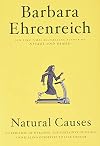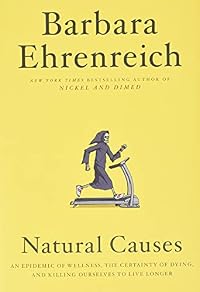
Natural Causes: An Epidemic of Wellness, the Certainty of Dying, and Killing Ourselves to Live Longer
by Barbara Ehrenreich
On This Page
Description
From the celebrated author of Nickel and Dimed, Barbara Ehrenreich explores how we are killing ourselves to live longer, not better. A razor-sharp polemic which offers an entirely new understanding of our bodies, ourselves, and our place in the universe, NATURAL CAUSES describes how we over-prepare and worry way too much about what is inevitable. One by one, Ehrenreich topples the shibboleths that guide our attempts to live a long, healthy life -- from the importance of preventive medical show more screenings to the concepts of wellness and mindfulness, from dietary fads to fitness culture. But NATURAL CAUSES goes deeper -- into the fundamental unreliability of our bodies and even our "mind-bodies," to use the fashionable term. Starting with the mysterious and seldom-acknowledged tendency of our own immune cells to promote deadly cancers, Ehrenreich looks into the cellular basis of aging, and shows how little control we actually have over it. We tend to believe we have agency over our bodies, our minds, and even over the manner of our deaths. But the latest science shows that the microscopic subunits of our bodies make their own "decisions," and not always in our favor. We may buy expensive anti-aging products or cosmetic surgery, get preventive screenings and eat more kale, or throw ourselves into meditation and spirituality. But all these things offer only the illusion of control. How to live well, even joyously, while accepting our mortality -- that is the vitally important philosophical challenge of this book. Drawing on varied sources, from personal experience and sociological trends to pop culture and current scientific literature, NATURAL CAUSES examines the ways in which we obsess over death, our bodies, and our health. Both funny and caustic, Ehrenreich then tackles the seemingly unsolvable problem of how we might better prepare ourselves for the end -- while still reveling in the lives that remain to us. show lessTags
Recommendations

























Member Reviews
After her own bout with cancer, the author begins to examine her relationship with her body and the medical industry. Just how helpful are all these invasive medical tests which generate so much discomfort and anxiety in her life? Are they necessary or more of a performative ritual meant to calm her?
This extremely personal question takes her down a road leading to questions about established medical practices versus evidence-based practice versus wellness practices. It turns out that a shocking few medical procedures are based on anything more substantial than tradition and there are very few things that can be ascertained about the processes of the body for certain. In the face of oncoming death and the overall lack of complete show more understanding of health, many medical and wellness practices have risen to prominence in a bid to assuaged fears.
The author's pursuit of answers is obviously not completely successful but it provides the curious mortal with a guide for deciding what level of sacrifices they will make in their life in hopes of extending its duration. This book weighs current health advice against quality of life and overall randomness of death. I enjoyed coming along with her on her fact-finding inquiry and making my own considered judgements. show less
This extremely personal question takes her down a road leading to questions about established medical practices versus evidence-based practice versus wellness practices. It turns out that a shocking few medical procedures are based on anything more substantial than tradition and there are very few things that can be ascertained about the processes of the body for certain. In the face of oncoming death and the overall lack of complete show more understanding of health, many medical and wellness practices have risen to prominence in a bid to assuaged fears.
The author's pursuit of answers is obviously not completely successful but it provides the curious mortal with a guide for deciding what level of sacrifices they will make in their life in hopes of extending its duration. This book weighs current health advice against quality of life and overall randomness of death. I enjoyed coming along with her on her fact-finding inquiry and making my own considered judgements. show less
Starts off bracingly with a genuinely eye-opening approach to health, health care, and what it's all for -- namely that you don't have to do any of the things conventional wisdom and the women's magazines would require of you just for the privilege of carrying on another day. You don't have to submit to physicals and diagnostic tests. There's very little evidence that the "lifestyle changes" typically pushed do much of anything in either extending lifespan or improving subjective experience of health. Even those who dutifully reorder their lifestyle in the manner proscribed still sometimes die young. Take downs of "mindfulness" other forms of vapid self-involvement were similarly delicious. For there, however, the book veers off into a show more long, repetitive argument about the immune system and the paradoxical behavior of certain cell types which may play a role in promoting, rather than suppressing cancer and some autoimmune disease. The final chapters end up in a very different place, musing about the creation of the concept of self as the root of our fear of death, and the potential of psychedelics to alleviate it. Definitely would read more Ehrenreich, but this was not her best. show less
In Barbara Ehrenreich's "Natural Causes," the author--who has a PhD in cellular immunology--discusses human biology; debunks conventional wisdom concerning health and aging; criticizes intrusive medical professionals who overprescribe and order unnecessary tests; and denounces our obsession with wellness, the mind-body connection, meditation, and exercise.
Ehrenreich, who has survived breast cancer, is fed up with mammograms ("a refined form of sadism"), colonoscopies ("an actual sexual assault"), bone density tests, and other screenings. She goes to the gym because she enjoys it, not because doing so is good for her. She believes that the notion that we can control our mental and physical well-being is an illusion fostered by the show more pharmaceutical, fitness, and food industries. We assume that taking care of our bodies will prolong our lives, make us feel stronger, and enable us to age more gracefully. Ehrenreich makes the case that, if we buy into all of this hype, we are living in a dream world.
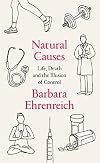
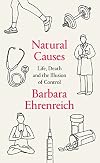
"Natural Causes" could have been an interesting, provocative, and cautionary work of non-fiction. It convincingly shows that "the trappings of big science" that we use to diagnose illness and cure the sick are, in some cases, too expensive, stress-inducing, and even demeaning. To her credit, the author emphasizes the value of evidence-based medicine over meaningless rituals. Unfortunately, Ehrenreich puts a damper on her subject by adopting a tone of excessive negativity and avoiding all but a modicum of sardonic humor. (The bright yellow cover, featuring a sneakered Angel of Death working out on a treadmill, leads us to anticipate a far more entertaining reading experience.) This book is a bit over two-hundred pages, although it seemed longer. The style is frequently muddled and tedious, and the information Ehrenreich imparts could have been compressed into a long essay. To sum up, this book is a downer, and it is highly likely that many will disagree with the author's bleak and fatalistic perspective on disease prevention, nutrition, and end of life issues. show less
Ehrenreich, who has survived breast cancer, is fed up with mammograms ("a refined form of sadism"), colonoscopies ("an actual sexual assault"), bone density tests, and other screenings. She goes to the gym because she enjoys it, not because doing so is good for her. She believes that the notion that we can control our mental and physical well-being is an illusion fostered by the show more pharmaceutical, fitness, and food industries. We assume that taking care of our bodies will prolong our lives, make us feel stronger, and enable us to age more gracefully. Ehrenreich makes the case that, if we buy into all of this hype, we are living in a dream world.
"Natural Causes" could have been an interesting, provocative, and cautionary work of non-fiction. It convincingly shows that "the trappings of big science" that we use to diagnose illness and cure the sick are, in some cases, too expensive, stress-inducing, and even demeaning. To her credit, the author emphasizes the value of evidence-based medicine over meaningless rituals. Unfortunately, Ehrenreich puts a damper on her subject by adopting a tone of excessive negativity and avoiding all but a modicum of sardonic humor. (The bright yellow cover, featuring a sneakered Angel of Death working out on a treadmill, leads us to anticipate a far more entertaining reading experience.) This book is a bit over two-hundred pages, although it seemed longer. The style is frequently muddled and tedious, and the information Ehrenreich imparts could have been compressed into a long essay. To sum up, this book is a downer, and it is highly likely that many will disagree with the author's bleak and fatalistic perspective on disease prevention, nutrition, and end of life issues. show less
I enjoyed the perspectives and information presented within this book. The sections on the cellular basis of aging were a bit beyond me but I identified with the topics on medical tests, patient-doctor relationships and how to accept aging and dying. I have witnessed the slow decline of my parents and in-laws. I have seen the endless and merciless testing, probing and inconvenience they experienced. I do not want my final days to be like theirs...
Listed below are content from the book that caught my interest and provoked some thinking on my part:
The immune system actually abets the growth and spread of tumors, which is like saying that the fire department is indeed staffed by arsonists. We all know that the function of the immune system show more is to protect us, most commonly from bacteria and viruses, so it's expected response to cancer should be a concerted and militant defense.
You can think of death bed bitterly or with resignation, as a tragic interruption of your life, and take every possible measure to postpone it. Or, more realistically, you can think of life as an interruption of and eternity of personal nonexistence, and seize it as a brief opportunity to observe and interact with the living, ever surprising world around us.
Once I realized I was old enough to die, I decided that I was also old enough not to incur any more suffering, annoyance, or boredom in the pursuit of a longer life. As for medical care: I will see help for an urgent problem, but I am no longer interested in problems that remain undetectable to me.
Rather than being fearful of not detecting disease, both patients and doctors should fear healthcare. The best way to avoid medical errors is to avoid medical care. The default should be: I am well. Good way to stay that way is to keep making good choices – – not to have my doctor look for problems.
Not only do I reject the torment of a medicalized death, but I refuse to except a medicalized life, and my determination only deepens with age. As the time that remains to be shrinks, each month and day becomes too precious to spend in windowless waiting rooms and under the cold scrutiny of machines. Being old enough to die is an achievement, not a defeat, and the freedom it brings is worth celebrating.
One recent study found that almost half the man over 65 being treated for prostate cancer are unlikely to live long enough to get the disease anyway. They will, however, live long enough to suffer from the adverse consequences of their treatment.
The US Census Bureau reports that nearly 40% of people age 65 and older suffer from at least one disability, with 2/3 of them saying they have difficulty walking or climbing. show less
Listed below are content from the book that caught my interest and provoked some thinking on my part:
The immune system actually abets the growth and spread of tumors, which is like saying that the fire department is indeed staffed by arsonists. We all know that the function of the immune system show more is to protect us, most commonly from bacteria and viruses, so it's expected response to cancer should be a concerted and militant defense.
You can think of death bed bitterly or with resignation, as a tragic interruption of your life, and take every possible measure to postpone it. Or, more realistically, you can think of life as an interruption of and eternity of personal nonexistence, and seize it as a brief opportunity to observe and interact with the living, ever surprising world around us.
Once I realized I was old enough to die, I decided that I was also old enough not to incur any more suffering, annoyance, or boredom in the pursuit of a longer life. As for medical care: I will see help for an urgent problem, but I am no longer interested in problems that remain undetectable to me.
Rather than being fearful of not detecting disease, both patients and doctors should fear healthcare. The best way to avoid medical errors is to avoid medical care. The default should be: I am well. Good way to stay that way is to keep making good choices – – not to have my doctor look for problems.
Not only do I reject the torment of a medicalized death, but I refuse to except a medicalized life, and my determination only deepens with age. As the time that remains to be shrinks, each month and day becomes too precious to spend in windowless waiting rooms and under the cold scrutiny of machines. Being old enough to die is an achievement, not a defeat, and the freedom it brings is worth celebrating.
One recent study found that almost half the man over 65 being treated for prostate cancer are unlikely to live long enough to get the disease anyway. They will, however, live long enough to suffer from the adverse consequences of their treatment.
The US Census Bureau reports that nearly 40% of people age 65 and older suffer from at least one disability, with 2/3 of them saying they have difficulty walking or climbing. show less
Ehrenreich has done it again, carrying us back to our evolutionary beginnings, journeying through human history, collecting and explaining past and current research, examining societal trends, and offering her own sharp and refreshingly grounded reflections on just what we think we are doing (in this case, in the realm of living healthy and "whole" lives while hoping against hope we can "reverse" aging and cheat death). And she does it all in a concise fashion that held me captivated through its 200 pages. There is wisdom here and times when I wiped a tear from my eye (e.g. the Brecht poem, along with the last line). I have enjoyed every book I have read by Ehrenreich, and this one is right up there at the top.
Informative and Illuminating. This author has a doctorate in cellular immunology, so one can expect quite a bit on the role of the different cells within our bodies. Some of this was quite dense but I believe I did understand most of what she was explaining. That our cells have different functions and can also turn on us. This section of the book, which was in the last half, was not my favorite. I loved her explanation and witticisms on the self help industry, and the ways we are mislead, or handled as they say, by information and biases without any scientific background or explanation. The barrage of current, healthy diet plans, the constantly changing shoulds and shouldn'ts. The illusion that if people follow this or that, a happy, show more healthy, long life will be the result. But....maybe not, is it possible we are not fully in control of our own fate? That we can do everything we are supposed to, but have no guarantee?
She takes on the medical industry and there consistent insistence on screenings and tests? How valid are all these tests and if one has them what do the findings mean? Tests, leading to more tests, leading to medicines that have side effects that are almost worse then the disease. I was diagnosed with MS over fifteen years ago, after five years of incorrect diagnoses and two unneeded surgeries. My neurologist immediately started me on an antibiotic spasm medication, an antibiotic depressant, because this diagnosis was sure to cause depression and Avonex. Avonex is a weekly, self delivered shot, and I decided to do it on Fridays, as I would have the weekend to recover. from the very beginning the side effects were horrible. I spent Friday nights and most Saturdays with a high fever, shivering and shaking. Just awful. Stuck with it for a few months and quit. Since then, except for treatments for excerbations, the only meds for this I take is my antispasmodic. Luckily for me, I feel I am better off.
Anyway there is much information presented in this book, some I agree with, some I want to look into further. It does, though give me the chance or choice to make an informed decision, and made me think of my future health decisions.
ARC from Netgalley. show less
She takes on the medical industry and there consistent insistence on screenings and tests? How valid are all these tests and if one has them what do the findings mean? Tests, leading to more tests, leading to medicines that have side effects that are almost worse then the disease. I was diagnosed with MS over fifteen years ago, after five years of incorrect diagnoses and two unneeded surgeries. My neurologist immediately started me on an antibiotic spasm medication, an antibiotic depressant, because this diagnosis was sure to cause depression and Avonex. Avonex is a weekly, self delivered shot, and I decided to do it on Fridays, as I would have the weekend to recover. from the very beginning the side effects were horrible. I spent Friday nights and most Saturdays with a high fever, shivering and shaking. Just awful. Stuck with it for a few months and quit. Since then, except for treatments for excerbations, the only meds for this I take is my antispasmodic. Luckily for me, I feel I am better off.
Anyway there is much information presented in this book, some I agree with, some I want to look into further. It does, though give me the chance or choice to make an informed decision, and made me think of my future health decisions.
ARC from Netgalley. show less
This is a weird book. It’s half about our obsession with controlling our own bodies—and the resulting mind/body dualism, which makes our newer obsession with controlling our own “selves” a bit hard to parse; who’s doing the controlling? The other half is about our cells, like the macrophages that are important parts of the immune system but also help cancer spread and kill us. Rather than being a community of cells working in harmony, we are made up of competing and occasionally rogue cells, whose reasons for going one way rather than another are and may forever remain mysterious—just as we now understand pregnancy as in part a competition between mother and fetus, each with its own aims. Also, she spends a lot of time show more reminding us that no matter how much we try to control things, we will nonetheless die. show less
Members
- Recently Added By
Published Reviews
ThingScore 75
“Natural Causes” is peevish, tender and deeply, distinctively odd — and often redeemed by its oddness. Ehrenreich is so offended by the American conflation of health with virtue and offers charming contrarian essays on the “defiant self-nurturance” of cigarette smoking, for example, and the dangers of eating fruit. The pleasures of her prose are often local, in the animated language, show more especially where scientific descriptions are concerned. Her description of cells rushing to staunch a wound is so full of wonder and delight that it recalls Italo Calvino. show less
added by melmore
Lists

Books Read in 2020
4,379 works; 123 members

Books Read in 2022
5,164 works; 111 members

Books Read in 2023
5,547 works; 144 members

Books That Changed Our Perspective
423 works; 168 members
Author Information

35+ Works 22,833 Members
Barbara Ehrenreich is the author of "Blood Rites"; "The Worst Years of Our Lives"; "Fear of Falling", which was nominated for a National Book Critics Circle Award, & eight other books. A frequent contributor to Time, Harper's, Esquire, The New Republic, Mirabella, The Nation, The New York Magazine, she lives near Key West, Florida. (Publisher Fact show more Sheets) Political activist and writer Barbara Ehrenreich was born in Butte, Montana on August 26, 1941. She studied physics at Reed College and graduated in 1963. She received a Ph.D. in Cell Biology from Rockefeller University in 1968. Rather than pursuing a career in science, however, she decided to focus on social change. Ehrenreich has written columns and contributed articles to publications including Time Magazine, The Progressive, The New York Times, Mother Jones, The Atlantic Monthly, Ms, The New Republic, Harper's Magazine, and The Nation. She taught essay writing at the Graduate School of Journalism at the University of California, Berkeley in 1998 and 2000. Ehrenreich has written many books, with 2001's Nickel and Dimed: On (Not) Getting by in America and 2005's Bait and Switch, The (Futile) Pursuit of the American Dream both becoming New York Times bestsellers. Nickel and Dimed examines working-class poverty, while Bait and Switch discusses white-collar unemployment. Her next bestseller was in 2014 with Living With a Wild God: A Nonbeliever's Search for the Truth about Everything. In 1998 Ehrenreich was named Humanist of the Year by the American Humanist Association, and she received the Nation Institute/Puffin Foundation Prize for Creative Citizenship in 2004. (Bowker Author Biography) show less
Awards and Honors
Distinctions
Common Knowledge
- Canonical title
- Natural Causes: An Epidemic of Wellness, the Certainty of Dying, and Killing Ourselves to Live Longer
- Alternate titles
- Natural Causes: An Epidemic of Wellness, the Certainty of Dying, and Killing Ourselves to Live Longer
- Original publication date
- 2018-04
- First words
- As a teenager, I aspired to be a scientist, but too many things happened to distract me from that goal, so I became instead a science appreciator.
- Last words
- (Click to show. Warning: May contain spoilers.)The blackbirds would keep on singing.
- Original language
- English
- Canonical DDC/MDS
- 306.9
- Canonical LCC
- RA776.5
Classifications
- Genres
- Sociology, General Nonfiction, Nonfiction, Science & Nature
- DDC/MDS
- 306.9 — Society, Government, and Culture Social sciences, sociology & anthropology Social Behavior - Dating, Marriage, Divorce Institutions pertaining to death
- LCC
- RA776.5 — Medicine Public aspects of medicine Public aspects of medicine Public health. Hygiene. Preventive medicine Personal health and hygiene
- BISAC
Statistics
- Members
- 749
- Popularity
- 37,376
- Reviews
- 37
- Rating
- (3.34)
- Languages
- 6 — Chinese, Dutch, English, German, Spanish, Turkish
- Media
- Paper, Audiobook, Ebook
- ISBNs
- 25
- ASINs
- 6