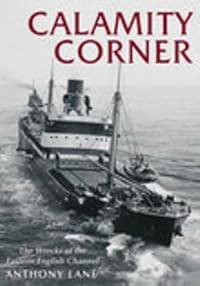
Calamity Corner
by Anthony Lane
On This Page
Description
For over five centuries, the English Channel's eastern approaches have been the busiest stretch of sea in the world. The route from London and the ports of northern Europe has seen more shipwrecks than almost any other part of the coastline and the area is well known for its shifting sands, narrow sea lanes and rapidly changing weather patterns. From the Goodwin Sands to the offshore hazards of northern France and Belgium, these sandbanks have caused many a ship to founder. Calamity Corner show more illustrates just how this stretch of coast, on both sides of the Channel, is so treacherous and gives us an idea of the sheer number of ships that have been lost here in the past few centuries, and tragedies, as well as triumphs of man over nature. Anthony Lane gives a truly local flavour to the maritime disasters from Kent through Sussex and the French and Belgian coasts where the North Sea funnels into the narrow English Channel. show lessTags
Member Reviews
This book I give four stars even though I have only browsed it - for it has the all-essential index, missing in so many books from smaller publishers, although the blank half-page would surely have allowed for an index of place names, sea features and the like.
Essentially a photograph album, the book makes clear the dangers of the sea, whether it's the weather, poor seamanship or just plain human error and bad luck. The photographs show the calamitous end that befalls some ships, ships that were the work of naval architects and human hands over months and years, ships that were once perhaps beautiful, certainly a place of work and home to mariners, ships that provided useful service to landlubbers worldwide, ships that cost their show more shipowners dear and, in the end, cost the insurance market or the government (in the case of a warship) dear too. Not just ships lost, often their cargoes lost and, sadly, all too often seafarers too.
The editor gets my vote for using italic script for the names of ships and vessels, but it is tedious reading two pages of italic script (pp 144 + 145) for accounts of rescues - that's a misuse of italics. Annoying when publishers can't use punctuation and script properly.
The simplified chart of the coastline and sea areas covered in this book is excellent - from Harwich to Eastbourne and from Zeebrugge to Boulogne.
I wonder what the incidence of shipwreck and other calamities for ships is? Fires on board are certainly not uncommon and minor accidents not uncommon in ships of all sizes - a ship is fairly dangerous a workplace - and, of course minor collisions and groundings are not uncommon either. In my career at sea, certainly I experienced fires large and small and other accidents but at least most warships, except the smallest, have trained medical staff and a sick bay. In the Royal Navy of my time (the last two decades of the Cold War), the ship's form for a Report of Collision or Grounding was an S.232 and that was the reason why the pennant number F232 was not used for the frigate HMS Marlborough (HMS Argyll was F231 and HMS Marlborough F233 - there was no F232!).
Do consider a donation to the Royal National Lifeboat Institution - the RNLI - that saves lives at sea. show less
Essentially a photograph album, the book makes clear the dangers of the sea, whether it's the weather, poor seamanship or just plain human error and bad luck. The photographs show the calamitous end that befalls some ships, ships that were the work of naval architects and human hands over months and years, ships that were once perhaps beautiful, certainly a place of work and home to mariners, ships that provided useful service to landlubbers worldwide, ships that cost their show more shipowners dear and, in the end, cost the insurance market or the government (in the case of a warship) dear too. Not just ships lost, often their cargoes lost and, sadly, all too often seafarers too.
The editor gets my vote for using italic script for the names of ships and vessels, but it is tedious reading two pages of italic script (pp 144 + 145) for accounts of rescues - that's a misuse of italics. Annoying when publishers can't use punctuation and script properly.
The simplified chart of the coastline and sea areas covered in this book is excellent - from Harwich to Eastbourne and from Zeebrugge to Boulogne.
I wonder what the incidence of shipwreck and other calamities for ships is? Fires on board are certainly not uncommon and minor accidents not uncommon in ships of all sizes - a ship is fairly dangerous a workplace - and, of course minor collisions and groundings are not uncommon either. In my career at sea, certainly I experienced fires large and small and other accidents but at least most warships, except the smallest, have trained medical staff and a sick bay. In the Royal Navy of my time (the last two decades of the Cold War), the ship's form for a Report of Collision or Grounding was an S.232 and that was the reason why the pennant number F232 was not used for the frigate HMS Marlborough (HMS Argyll was F231 and HMS Marlborough F233 - there was no F232!).
Do consider a donation to the Royal National Lifeboat Institution - the RNLI - that saves lives at sea. show less
Members
- Recently Added By
Author Information
7 Works 12 Members
Classifications
- Genres
- Nonfiction, History, Travel
- DDC/MDS
- 910.916336 — History & geography Geography & travel modified standard subdivisions of Geography and travel History, geographic treatment, biography - Discovery. exploration Geography of and travel in areas, regions, places in general Air And Water Atlantic Ocean
Statistics
- Members
- 4
- Popularity
- 3,950,863
- Reviews
- 1
- Rating
- (4.00)
- Languages
- English
- Media
- Paper
- ISBNs
- 1