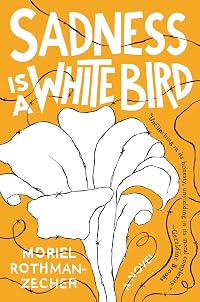
Sadness Is a White Bird
by Moriel Rothman-Zecher
On This Page
Description
"In this lyrical and searing debut novel written by a rising literary star and MacDowell Fellow, a young man is preparing to serve in the Israeli army while also trying to reconcile his close relationship to two Palestinian siblings with his deeply ingrained loyalties to family and country. Four days after his nineteenth birthday, Jonathan is sitting in a military jail in Israel. Languishing in the dark cell, he recalls the series of events that led him to this point. It all began when he show more returned to Israel after being raised and educated in Pennsylvania. He knows that he will soon be drafted as a soldier. He will be called upon to preserve and defend the Jewish state, which includes monitoring the Palestinian territories within its borders but he is conflicted. With an intense drive to know more about the plight of the displaced and occupied Palestinians, he encounters Laith and Nimreen--the twin daughter and son of his mother's friend. From that summer afternoon on, the three become inseparable: wandering the streets on weekends, piling onto buses en route to new discoveries, laughing uncontrollably. They share joints on the beach, trade private cultural treasures, intimate secrets, resentments, hopes, and dreams, revealing the deepest parts of themselves to each other. But with his draft date rapidly approaching, Jonathan wrestles with the question of what it means to be proud of your heritage while also feeling love for those outside of your own tribal family. And then that fateful day arrives, the one that lands Jonathan in prison and changes his relationship with the twins forever. Unflinching, important, and timely, Sadness Is a White Bird looks into the heart of what occupation and freedom really mean, exploring how one man attempts to find a place for himself, and discovers a beautiful, cross-cultural, against-the-odds love, the kind of love which we can hold up as an ideal in the midst of what seems like an implacable and never-ending conflict"-- show lessTags
Recommendations



Member Reviews
This book tells a tragic and ultimately stunning story, and although it is fiction - it speaks important truths to those who would hear them.
It is narrated by Jonathan, 19, currently in an Israeli prison. The narration is in the form of a monologue during which Jonathan reminisces about how he ended up in prison. Addressing his musings to his beloved Arab friend Laith, Jonathan frequently invokes snippets of poems by Palestinian Mahmoud Darwish, whose award-winning work has inspired the Palestinian people; "Identity Card" has been turned into a song of protest. Darwish, who died in 2008, is considered to be “the voice of the Palestinian Diaspora . . . the voice of the fragmented soul.”
With Darwish’s poetry, as in other aspects of show more this story, the author makes us work for the whole. He provides only pieces of the poet’s work; you need to google it to find out the rest. This is also true of the poetry of Yehuda Amichai, an Israeli poet quoted in the book. (Similarly, the ending is one we must construct ourselves along with the author.)
On its surface, this is a coming-of-age story about Jonathan, a Jew who grew up in a mostly non-Jewish town in Pennsylvania. He felt weakness and shame over his inability to respond to anti-semitic bullying. He fantasized about going to Israel and becoming a “warrior”:
“I was sick of being People of the Word. I wanted to be People of the Sword. I wanted tanned arms and campfires, braided folk songs and righteous rifles. I wanted to be like [my grandfather] Saba Yehuda, teeth bared like tiny shields against the stabbing world.”
Surrounded by other Jews at summer camp, he thinks:
“If dinky little Camp Samaria was so full of possibility, I could barely imagine what sort of redemption lay in wait in the actual Land of Milk and Honey and Uzis and Bamba [an Israeli snack] and Eucalyptus Groves and Khaki and Tragedy and Redemption.”
Note: the ideas of both tragedy and redemption form important parts of Jonathan’s psyche.
Jonathan was born in Israel and thus had dual citizenship; his mother was Israeli, and his grandfather still resided in Israel. When the grandfather became terminally ill and requested his daughter to come back so he could know his grandchildren better before he died, Jonathan got his wish to live in Israel. Enlistment to the Israeli Defense Forces is mandatory for all Israeli citizens who have turned 18, so Jonathan could also fulfill his desire to become a "warrior" when he turned 19.
But before that happened, he unexpectedly made two Arab friends, Laith and Nimreen, the twin children of his mother’s friend. That friendship changed everything Jonathan thought he knew and believed. He looked at the twins and “I felt it, like a drop of pomegranate juice spreading through a glass of bright-white milk, changing everything.”
As he later reflected, speaking in his mind to Laith:
“…you and your sister, molten twins, mournful and wild, silly and sacrilegious, sharp and stoned, gentle and beautiful, whose love was burning through my flesh, threatening to scorch and disfigure my past. To engulf my future.”
Jonathan grew to love and desire both Nimreen and Laith. It was perhaps the case that Jonathan was simply bisexual, but this author’s work is steeped in metaphor and symbolism. I saw Jonathan's relationship with both the twins as more of a reflection of his ambivalence about the divide between Israel and Palestine. Both male and female, cool versus fiery, appealed to him for different reasons, and he was torn between the two of them.
Through the twins, and especially Nimreen, Jonathan gains a new perspective on the Arab-Israeli conflict.
For background, it is important to know that the State of Israel was created from a movement at the turn of the 20th century in Eastern Europe by a group of Jewish intellectuals. They were looking for an alternative to living under the threat of increasing anti-Semitism and the violent movements spawned from it. They picked Palestine because of the historical association of Jews with the land. The term "Zionism" was coined in 1885 by the Viennese Jewish writer Nathan Birnbaum, Zion being one of the biblical names for Jerusalem. But unfortunately and inconveniently for the Zionists, the land was already occupied by an indigenous population. Much like European colonizers who came to America, however, the “Natives” were considered expendable.
The Zionists, in their moralistic fervor, seemed oblivious to the fact that even while they were trying to escape racism and injustice, they were expressing it on their own behalf somewhere else. But just as memory and identity have never been easily erased in Jews, nor were they so easily erased in Arabs. As one of Nimreen’s friends says to Jonathan:
“I’m not from Israel. I’m from before Israel, from beneath the Israeli towns and cities built over my homes and orchards and fields. I am an Arab Palestinian, not an Israeli.”
Jonathan, like many American Jews, had a rosy, idealistic view of Israelis that was reinforced by a sense of righteousness because of the horror of the Holocaust. Much of what Nimreen told him about the treatment of Arabs by Israelis was not only new to him, but hard for him to believe.
For example, Nimreen took Jonathan to meet her grandmother Selsabeel Ziad, who told him the appalling story of what happened to her first husband Marwan in 1956. In October of that year, Israel invaded Egypt in what the West called “The Suez Crisis” or the “Second Arab-Israeli War.” The Jews immediately imposed a curfew, enforcing it before notification of it could even be disseminated. Marwan and other shepherds were out with their flocks and returned to the village late. Unarmed and defenseless, they (and hidden bystanders) stood in shock as the Israelis mowed them down. Selsabeel and other woman and children ran away and survived, “in body at least.”
After they left the grandmother’s house, Jonathan said to Nimreen, “But is that what really happened?” Nimreen responded, “How dare you.”
[This account is unfortunately quite true. “The Kafr Qasim massacre” took place in the Israeli Arab village of Kafr Qasim situated on the Green Line, which was at that time the de facto border between Israel and the Jordanian West Bank. The massacre was carried out by the Israel Border Police, who killed Arab civilians returning from work after a curfew imposed earlier in the day of which they were unaware. In total 48 people were shot down, of which 19 were men, 6 were women and 23 were children aged 8–17. Arab sources usually give the death toll as 49, as they include the unborn child of one of the women. In December 2007, President of Israel Shimon Peres formally apologised for the massacre.]
Nimreen also educated Jonathan about the shootings of October, 2000, when Israeli Police killed 13 Palestinians — 12 of them Israeli citizens — who took to the streets to show solidarity with demonstrators in the West Bank and Gaza. For those killings, there was a complete absence of accountability. Nimreen said to Jonathan:
“Ever heard of Israeli Police shooting live bullets at Israeli Ultra Orthodox protestors or Israeli Mizrahim or Israeli Israelis period? We got the message, then. Our parents’ generation’s plan - integrate, keep hour heads down, beg for scraps, be Good Arabs - hasn’t gotten us anywhere. And anyway, whatever strategy we use to survive, our identity is Palestinian. That can’t be taken from us, you know?”
She agreed there are good and bad people on both sides, but “you guys have the checkpoints and the F-16s and M-16s and Q-16s and whatever and . . . and the Most Moral Army in the Universe, which just so happens to be controlling and destroying the lives of fucking millions of people.’”
As the author stated in an article:
“We are so similar. We are all swept up in self-righteousness, we are all afraid and violent and capable of wishing expulsion and death on the other side.
Israel is carrying out a massacre in Gaza.
If Hamas had the capability to kill or expel hundreds or thousands or hundreds of thousands of Israelis, I am often asked, wouldn’t they do so?
My answer is: Yes. I am confident that they would.
In that case, I am asked, why are you focusing primarily on what the Israeli government and military are doing?
My answer is: While the willingness to kill innocents on the other is similar, the capability to do so is not.”
He explains further:
“ . . . both sides may want to kill the other, but one side is immensely powerful, and the other side is not. This is not a conflict, and it is not war. If, God forbid, Hamas got a fleet of F-16s, and if, God willing, Gaza were protected by an Iron Dome, then this would be a two-sided war. But that is not the case, and so this is a massacre. . . .”
Jonathan can’t reconcile all of this in his mind. The Jews are seeking refuge from genocide - how can one not have compassion for them? How can their cause not be just? And yet, what he learns from Nimreen is also inexcusable.
Nimreen quotes more bitter lines from her favorite poet Dawish, and Jonathan asks her: “Does Darwish have any poems that aren’t so political?”
“Nimreen took a deep drag, and when she spoke, her voice was wrapped in a cloud: ‘There is nothing ‘not political’ in Palestine, habibi.’”
Nimreen and Laith both warn Jonathan that if he joins the army, he will not be the same person. But he insists he has no choice.
The result is a nightmare, and the only question is whether or not Jonathan awaken from it.
It is well to contemplate this segment Darwesh’s poem "Identity Card":
"Write down!
I am an Arab
You have stolen the orchards of my ancestors
And the land which I cultivated
Along with my children
And you left nothing for us
Except for these rocks..
So will the State take them
As it has been said?!
Therefore!
Write down on the top of the first page:
I do not hate poeple
Nor do I encroach
But if I become hungry
The usurper's flesh will be my food
Beware..
Beware..
Of my hunger
And my anger!"
Discussion: One can only hope this story will at least challenge some erroneous preconceptions Westerners have about the situation in Israel. As the author writes elsewhere and demonstrates so powerfully in this book:
“We need not look far to recall that the experience of oppression does not make a community moral. . . . Seeking justice means seeking justice for everyone.”
He continues:
“This is not a story of Cruel Israelis or Evil Jews versus Good Palestinians or Noble Arabs, and the answer will not come from simply reversing power structures. It is a story of mutual dehumanization and un-mutual power, and the answer has to come from creating power structures in which human beings’ violent, narrow instincts are checked and our capacity for decency is uplifted. And that is something no bomb, no burning, no rifle, no bullet can ever accomplish.”
Evaluation: This poignant and sobering story is distressingly bleak, because polarization over the region is so passionately adversarial and deep-seated. Nevertheless, the author manages to lends poetic beauty to moral complexity. The story also, importantly, illuminates the ways in which cultural discourse informs perspectives. It would be an outstanding choice for book clubs. show less
It is narrated by Jonathan, 19, currently in an Israeli prison. The narration is in the form of a monologue during which Jonathan reminisces about how he ended up in prison. Addressing his musings to his beloved Arab friend Laith, Jonathan frequently invokes snippets of poems by Palestinian Mahmoud Darwish, whose award-winning work has inspired the Palestinian people; "Identity Card" has been turned into a song of protest. Darwish, who died in 2008, is considered to be “the voice of the Palestinian Diaspora . . . the voice of the fragmented soul.”
With Darwish’s poetry, as in other aspects of show more this story, the author makes us work for the whole. He provides only pieces of the poet’s work; you need to google it to find out the rest. This is also true of the poetry of Yehuda Amichai, an Israeli poet quoted in the book. (Similarly, the ending is one we must construct ourselves along with the author.)
On its surface, this is a coming-of-age story about Jonathan, a Jew who grew up in a mostly non-Jewish town in Pennsylvania. He felt weakness and shame over his inability to respond to anti-semitic bullying. He fantasized about going to Israel and becoming a “warrior”:
“I was sick of being People of the Word. I wanted to be People of the Sword. I wanted tanned arms and campfires, braided folk songs and righteous rifles. I wanted to be like [my grandfather] Saba Yehuda, teeth bared like tiny shields against the stabbing world.”
Surrounded by other Jews at summer camp, he thinks:
“If dinky little Camp Samaria was so full of possibility, I could barely imagine what sort of redemption lay in wait in the actual Land of Milk and Honey and Uzis and Bamba [an Israeli snack] and Eucalyptus Groves and Khaki and Tragedy and Redemption.”
Note: the ideas of both tragedy and redemption form important parts of Jonathan’s psyche.
Jonathan was born in Israel and thus had dual citizenship; his mother was Israeli, and his grandfather still resided in Israel. When the grandfather became terminally ill and requested his daughter to come back so he could know his grandchildren better before he died, Jonathan got his wish to live in Israel. Enlistment to the Israeli Defense Forces is mandatory for all Israeli citizens who have turned 18, so Jonathan could also fulfill his desire to become a "warrior" when he turned 19.
But before that happened, he unexpectedly made two Arab friends, Laith and Nimreen, the twin children of his mother’s friend. That friendship changed everything Jonathan thought he knew and believed. He looked at the twins and “I felt it, like a drop of pomegranate juice spreading through a glass of bright-white milk, changing everything.”
As he later reflected, speaking in his mind to Laith:
“…you and your sister, molten twins, mournful and wild, silly and sacrilegious, sharp and stoned, gentle and beautiful, whose love was burning through my flesh, threatening to scorch and disfigure my past. To engulf my future.”
Jonathan grew to love and desire both Nimreen and Laith. It was perhaps the case that Jonathan was simply bisexual, but this author’s work is steeped in metaphor and symbolism. I saw Jonathan's relationship with both the twins as more of a reflection of his ambivalence about the divide between Israel and Palestine. Both male and female, cool versus fiery, appealed to him for different reasons, and he was torn between the two of them.
Through the twins, and especially Nimreen, Jonathan gains a new perspective on the Arab-Israeli conflict.
For background, it is important to know that the State of Israel was created from a movement at the turn of the 20th century in Eastern Europe by a group of Jewish intellectuals. They were looking for an alternative to living under the threat of increasing anti-Semitism and the violent movements spawned from it. They picked Palestine because of the historical association of Jews with the land. The term "Zionism" was coined in 1885 by the Viennese Jewish writer Nathan Birnbaum, Zion being one of the biblical names for Jerusalem. But unfortunately and inconveniently for the Zionists, the land was already occupied by an indigenous population. Much like European colonizers who came to America, however, the “Natives” were considered expendable.
The Zionists, in their moralistic fervor, seemed oblivious to the fact that even while they were trying to escape racism and injustice, they were expressing it on their own behalf somewhere else. But just as memory and identity have never been easily erased in Jews, nor were they so easily erased in Arabs. As one of Nimreen’s friends says to Jonathan:
“I’m not from Israel. I’m from before Israel, from beneath the Israeli towns and cities built over my homes and orchards and fields. I am an Arab Palestinian, not an Israeli.”
Jonathan, like many American Jews, had a rosy, idealistic view of Israelis that was reinforced by a sense of righteousness because of the horror of the Holocaust. Much of what Nimreen told him about the treatment of Arabs by Israelis was not only new to him, but hard for him to believe.
For example, Nimreen took Jonathan to meet her grandmother Selsabeel Ziad, who told him the appalling story of what happened to her first husband Marwan in 1956. In October of that year, Israel invaded Egypt in what the West called “The Suez Crisis” or the “Second Arab-Israeli War.” The Jews immediately imposed a curfew, enforcing it before notification of it could even be disseminated. Marwan and other shepherds were out with their flocks and returned to the village late. Unarmed and defenseless, they (and hidden bystanders) stood in shock as the Israelis mowed them down. Selsabeel and other woman and children ran away and survived, “in body at least.”
After they left the grandmother’s house, Jonathan said to Nimreen, “But is that what really happened?” Nimreen responded, “How dare you.”
[This account is unfortunately quite true. “The Kafr Qasim massacre” took place in the Israeli Arab village of Kafr Qasim situated on the Green Line, which was at that time the de facto border between Israel and the Jordanian West Bank. The massacre was carried out by the Israel Border Police, who killed Arab civilians returning from work after a curfew imposed earlier in the day of which they were unaware. In total 48 people were shot down, of which 19 were men, 6 were women and 23 were children aged 8–17. Arab sources usually give the death toll as 49, as they include the unborn child of one of the women. In December 2007, President of Israel Shimon Peres formally apologised for the massacre.]
Nimreen also educated Jonathan about the shootings of October, 2000, when Israeli Police killed 13 Palestinians — 12 of them Israeli citizens — who took to the streets to show solidarity with demonstrators in the West Bank and Gaza. For those killings, there was a complete absence of accountability. Nimreen said to Jonathan:
“Ever heard of Israeli Police shooting live bullets at Israeli Ultra Orthodox protestors or Israeli Mizrahim or Israeli Israelis period? We got the message, then. Our parents’ generation’s plan - integrate, keep hour heads down, beg for scraps, be Good Arabs - hasn’t gotten us anywhere. And anyway, whatever strategy we use to survive, our identity is Palestinian. That can’t be taken from us, you know?”
She agreed there are good and bad people on both sides, but “you guys have the checkpoints and the F-16s and M-16s and Q-16s and whatever and . . . and the Most Moral Army in the Universe, which just so happens to be controlling and destroying the lives of fucking millions of people.’”
As the author stated in an article:
“We are so similar. We are all swept up in self-righteousness, we are all afraid and violent and capable of wishing expulsion and death on the other side.
Israel is carrying out a massacre in Gaza.
If Hamas had the capability to kill or expel hundreds or thousands or hundreds of thousands of Israelis, I am often asked, wouldn’t they do so?
My answer is: Yes. I am confident that they would.
In that case, I am asked, why are you focusing primarily on what the Israeli government and military are doing?
My answer is: While the willingness to kill innocents on the other is similar, the capability to do so is not.”
He explains further:
“ . . . both sides may want to kill the other, but one side is immensely powerful, and the other side is not. This is not a conflict, and it is not war. If, God forbid, Hamas got a fleet of F-16s, and if, God willing, Gaza were protected by an Iron Dome, then this would be a two-sided war. But that is not the case, and so this is a massacre. . . .”
Jonathan can’t reconcile all of this in his mind. The Jews are seeking refuge from genocide - how can one not have compassion for them? How can their cause not be just? And yet, what he learns from Nimreen is also inexcusable.
Nimreen quotes more bitter lines from her favorite poet Dawish, and Jonathan asks her: “Does Darwish have any poems that aren’t so political?”
“Nimreen took a deep drag, and when she spoke, her voice was wrapped in a cloud: ‘There is nothing ‘not political’ in Palestine, habibi.’”
Nimreen and Laith both warn Jonathan that if he joins the army, he will not be the same person. But he insists he has no choice.
The result is a nightmare, and the only question is whether or not Jonathan awaken from it.
It is well to contemplate this segment Darwesh’s poem "Identity Card":
"Write down!
I am an Arab
You have stolen the orchards of my ancestors
And the land which I cultivated
Along with my children
And you left nothing for us
Except for these rocks..
So will the State take them
As it has been said?!
Therefore!
Write down on the top of the first page:
I do not hate poeple
Nor do I encroach
But if I become hungry
The usurper's flesh will be my food
Beware..
Beware..
Of my hunger
And my anger!"
Discussion: One can only hope this story will at least challenge some erroneous preconceptions Westerners have about the situation in Israel. As the author writes elsewhere and demonstrates so powerfully in this book:
“We need not look far to recall that the experience of oppression does not make a community moral. . . . Seeking justice means seeking justice for everyone.”
He continues:
“This is not a story of Cruel Israelis or Evil Jews versus Good Palestinians or Noble Arabs, and the answer will not come from simply reversing power structures. It is a story of mutual dehumanization and un-mutual power, and the answer has to come from creating power structures in which human beings’ violent, narrow instincts are checked and our capacity for decency is uplifted. And that is something no bomb, no burning, no rifle, no bullet can ever accomplish.”
Evaluation: This poignant and sobering story is distressingly bleak, because polarization over the region is so passionately adversarial and deep-seated. Nevertheless, the author manages to lends poetic beauty to moral complexity. The story also, importantly, illuminates the ways in which cultural discourse informs perspectives. It would be an outstanding choice for book clubs. show less
The title of Moriel Rothman-Zecher’s stunning novel, SADNESS IS A WHITE BIRD, is from Palestinian poet Mahmoud Darwish—“Sadness is a white bird that does not come near a battlefield.” As the universal symbol for peace, a white dove avoiding conflict is indeed a powerful metaphor for this sad story since the central message seems to be that clinging to notions of fear and tribalism can lead only to escalation, death and madness, while communion in all its forms has the potential for increased understanding, grace and peace.
Rothman-Zecher frames his story between scenes set in an Israeli prison. Jonathan, an Israeli paratrooper, narrates through a series of letters he writes to his Palestinian friend, Laith. Jonathan meets Laith show more and his twin sister Nimreen through his mother’s Palestinian friend. The three young adults bond, sharing family histories, intimate secrets, and dreams. Both families experienced traumas brought on by sectarian conflicts. Jonathan’s great uncle and his entire village were deported to death camps from Nazi-occupied Salonika, while Laith and Nimreen’s grandfather was executed by Israeli soldiers for returning after curfew from shepherding during the 1967 war.
The young friends spend time together exploring the countryside, Haifa, and the beach; smoking marijuana while obsessing about political and identity issues. Powerful scenes depict commonplace circumstances that exist in Israel today. While hitchhiking, the three are rejected by a Jewish couple and later ridiculed by a rowdy group of Arabs. Jewish privilege becomes evident at the inevitable checkpoint where Jonathan is passed through but Laith and Nimreen are detained for questioning despite all three being Israeli. In another scene, the trio goes in search of Darwish’s village only to find that its name has been changed and there is little remaining of its original Arab culture.
In the face of conflicting feelings between his bisexual attraction to his two Arab friends and his overarching sense of loyalty to his family and Israel, Jonathan becomes eligible for military service. Against Nimreen’s advice to refuse induction, Jonathan joins the paratroopers determined to preserve and defend the Jewish state, which his grandfather was instrumental in establishing. He naively believes that this will not affect his friendship with Laith and Nimreen. Of course, this turns out to be a mistake and has tragic consequences. “My soldier dream was the fourth member of our group, following the three of us wherever we went.” A heartbreaking accident during a riot strains Jonathan’s grasp of reality and serves as the impetus for the subsequent refusal to follow orders resulting in his incarceration.
This lyrical coming-of-age story balances sadness and confusion with moments of joy and humor. The narrative evokes the nuances of both cultures by employing both Arab and Hebrew dialogue as well as references to Arab and Hebrew literature. One senses that the type of communion these young people experience would be the clearest way forward for Israel. The joy of youth and love juxtaposed against the sad circumstances that persist in Israel today make for a powerful but unsettling read. show less
Rothman-Zecher frames his story between scenes set in an Israeli prison. Jonathan, an Israeli paratrooper, narrates through a series of letters he writes to his Palestinian friend, Laith. Jonathan meets Laith show more and his twin sister Nimreen through his mother’s Palestinian friend. The three young adults bond, sharing family histories, intimate secrets, and dreams. Both families experienced traumas brought on by sectarian conflicts. Jonathan’s great uncle and his entire village were deported to death camps from Nazi-occupied Salonika, while Laith and Nimreen’s grandfather was executed by Israeli soldiers for returning after curfew from shepherding during the 1967 war.
The young friends spend time together exploring the countryside, Haifa, and the beach; smoking marijuana while obsessing about political and identity issues. Powerful scenes depict commonplace circumstances that exist in Israel today. While hitchhiking, the three are rejected by a Jewish couple and later ridiculed by a rowdy group of Arabs. Jewish privilege becomes evident at the inevitable checkpoint where Jonathan is passed through but Laith and Nimreen are detained for questioning despite all three being Israeli. In another scene, the trio goes in search of Darwish’s village only to find that its name has been changed and there is little remaining of its original Arab culture.
In the face of conflicting feelings between his bisexual attraction to his two Arab friends and his overarching sense of loyalty to his family and Israel, Jonathan becomes eligible for military service. Against Nimreen’s advice to refuse induction, Jonathan joins the paratroopers determined to preserve and defend the Jewish state, which his grandfather was instrumental in establishing. He naively believes that this will not affect his friendship with Laith and Nimreen. Of course, this turns out to be a mistake and has tragic consequences. “My soldier dream was the fourth member of our group, following the three of us wherever we went.” A heartbreaking accident during a riot strains Jonathan’s grasp of reality and serves as the impetus for the subsequent refusal to follow orders resulting in his incarceration.
This lyrical coming-of-age story balances sadness and confusion with moments of joy and humor. The narrative evokes the nuances of both cultures by employing both Arab and Hebrew dialogue as well as references to Arab and Hebrew literature. One senses that the type of communion these young people experience would be the clearest way forward for Israel. The joy of youth and love juxtaposed against the sad circumstances that persist in Israel today make for a powerful but unsettling read. show less
Once in a while if we as readers are lucky, pick up a book that effects us profoundly. For me, it was this book, I kept putting it down, to think about what I was reading, and yes even to let my emotions level out. The subject is a complicated one, Jewish and Arab relations in Isreal, but the author gives us a personal viewpoint, using three friends, two Arab, one Jewish. When the book opens, Jonathan sits in a jail, he is our narrator and their story is revealed as Jonathan writes to his Arab friend, Laith.
Using a letter, we are privvy to Jonathan's most personal thoughts and experiences, essentially placed inside his mind. His conflicted thoughts, as now shortly after his nineteenth birthday, he is in the military, something all show more Isrealis of this age must do, but can't figure out where his loyalties lie. Do they like with the country he has sworn to protect, his grandfather insists the Jewish people are his family and that is all he needs to consider. What about his derp friendships, love for Laith and his twin sister? Where does this fit in, and how can he fight against a people who he can't hate. Learning the back stories of his own grandfather and the grandmother of the twins, leads him to only more doubt.
As far as novels go this is short in pages, but large in content. It is powerful and intense. The author presents all sides in this conflict, and it is these many sides that Jonathan tries to solidify into a cohesive hole. It is a novel of a deep friendship, and a young man who feels greatly. I sometimes wonder what would happen if the young people on both sides of this conflict, well any conflict really, put down their guns and refused to fight any longer. No longer wanting to watch their friends die, their families and countries torn apart. Just said no more to following leaders blindly. It will never happen, but wouldn't it be wonderful if it did?
Another read with Angela and Esil, this book probably the best one we have read together. I cherish these reads and the thoughts we share.
ARC from Edelweiss. show less
Using a letter, we are privvy to Jonathan's most personal thoughts and experiences, essentially placed inside his mind. His conflicted thoughts, as now shortly after his nineteenth birthday, he is in the military, something all show more Isrealis of this age must do, but can't figure out where his loyalties lie. Do they like with the country he has sworn to protect, his grandfather insists the Jewish people are his family and that is all he needs to consider. What about his derp friendships, love for Laith and his twin sister? Where does this fit in, and how can he fight against a people who he can't hate. Learning the back stories of his own grandfather and the grandmother of the twins, leads him to only more doubt.
As far as novels go this is short in pages, but large in content. It is powerful and intense. The author presents all sides in this conflict, and it is these many sides that Jonathan tries to solidify into a cohesive hole. It is a novel of a deep friendship, and a young man who feels greatly. I sometimes wonder what would happen if the young people on both sides of this conflict, well any conflict really, put down their guns and refused to fight any longer. No longer wanting to watch their friends die, their families and countries torn apart. Just said no more to following leaders blindly. It will never happen, but wouldn't it be wonderful if it did?
Another read with Angela and Esil, this book probably the best one we have read together. I cherish these reads and the thoughts we share.
ARC from Edelweiss. show less
Sadness is a White Bird examines both sides of the Israeli Palestinian conflict through the eyes of a young American Israeli man, Jonathan. Born in Israel but raised in the United States, his family returns to Israel to be with his ailing grandfather while Jonathan completes high school and joins the army. While a student, he becomes close with the twin son and daughter of his motherçs Palastinian friend.
The story opens with Jonathan in a military jail….what brought him to this situation? Well written and lyrical, this is a story of friendship, allegiance and duty. The ending may be a bit unsatisfying to some, but I think it apt for the historical and political context of this conflict.
This book will make you think, feel, and want show more to discuss. show less
The story opens with Jonathan in a military jail….what brought him to this situation? Well written and lyrical, this is a story of friendship, allegiance and duty. The ending may be a bit unsatisfying to some, but I think it apt for the historical and political context of this conflict.
This book will make you think, feel, and want show more to discuss. show less
This was a really gorgeous book with great narration. A young man leaves America to return to Israel for his military service. Before enlisting, he meets Palestinian brother/sister twins and develops a deep friendship with them both. As he learns their family history, he starts to feel conflicted about his upcoming military service. The narrative starts with him in a military jail, then flashes back to the time leading up to his arrest.
The issues are complex. His desire to help his family and the state of Israel war with his compassion for the Palestinians. There are no easy answers here, but it is a compassionate look at both sides.
The issues are complex. His desire to help his family and the state of Israel war with his compassion for the Palestinians. There are no easy answers here, but it is a compassionate look at both sides.
Is it wrong for me to say that I thought the parts about Salonica was where the books was strongest? There's a lot of stuff here about the relationship between young Jewish Israelis and the army, young Jewish Israelis and their Jewish identity and young Jewish Israelis and young Muslim Israelis, but a lot of it is glossily written and lacquered over with some YA lust, sexual experimentation and a cannabis haze. The giant and absurd coincidence propping up the centre of the book feels unearned and antithetical to the nuance that the author is attempting. This was a little disappointing on a couple of levels.
Sadness is a White Bird by Moriel Rothman-Zecher is a novel examining the Israeli-Palestinian issue from both sides. This is Ms. Rothman-Zecher’s debut novel.
Jonathan is an American Jew who decided to serve in the Israeli Defense Forces, only to find himself in jail. Jonathan is friends with two Palestinians, Nimreen and Laith, a brother and sister, he met while living in the United States.
Sadness is a White Bird by Moriel Rothman-Zecher tries to tackle the Israeli-Palestinian relationship from different perspective presenting the reader various shades of gray. The title of the book is taken from a line writing by Mahmoud Darwish, a Palestinian poet, “Sadness is a white bird that does not come near a battlefield.”
The book is show more styled as letters Jonathan writes Laith, his Palestinian friends, from an Israeli Army jail. In it Jonathan explores his Jewish identity, the statehood of both Israel and Palestine and the views of his friends which contradict his own.
The author goes to great length to be centered, showing why both sides might be right, but also might be wrong. The narrative is lyrical, aimed at the young-adult crowd, but still intelligent and exploratory.
The only thing I found strange is Jonathan’s bi-sexuality and the somewhat descriptive acts he performs with several people. That whole storyline bothered me, maybe it was to show what a confused young man he is, but I think there should be a better way to do so in, what otherwise is, a very elegant book.
The ending was somewhat vague, as is the whole situation, and frankly the whole book (which I believe is done on purpose). Jonathan might or might not have slipped into madness, or he was just acting out as young men who put themselves in impossible and stressful situations sometimes do.
For more reviews and bookish posts please visit: http://www.ManOfLaBook.com show less
Jonathan is an American Jew who decided to serve in the Israeli Defense Forces, only to find himself in jail. Jonathan is friends with two Palestinians, Nimreen and Laith, a brother and sister, he met while living in the United States.
Sadness is a White Bird by Moriel Rothman-Zecher tries to tackle the Israeli-Palestinian relationship from different perspective presenting the reader various shades of gray. The title of the book is taken from a line writing by Mahmoud Darwish, a Palestinian poet, “Sadness is a white bird that does not come near a battlefield.”
The book is show more styled as letters Jonathan writes Laith, his Palestinian friends, from an Israeli Army jail. In it Jonathan explores his Jewish identity, the statehood of both Israel and Palestine and the views of his friends which contradict his own.
The author goes to great length to be centered, showing why both sides might be right, but also might be wrong. The narrative is lyrical, aimed at the young-adult crowd, but still intelligent and exploratory.
The only thing I found strange is Jonathan’s bi-sexuality and the somewhat descriptive acts he performs with several people. That whole storyline bothered me, maybe it was to show what a confused young man he is, but I think there should be a better way to do so in, what otherwise is, a very elegant book.
The ending was somewhat vague, as is the whole situation, and frankly the whole book (which I believe is done on purpose). Jonathan might or might not have slipped into madness, or he was just acting out as young men who put themselves in impossible and stressful situations sometimes do.
For more reviews and bookish posts please visit: http://www.ManOfLaBook.com show less
Members
- Recently Added By
Lists

Animals in the Title
498 works; 11 members

Kirkus Starred Fiction Reviews of Books Published in 2018
330 works; 3 members
Author Information
2+ Works 189 Members
Awards and Honors
Common Knowledge
- Canonical title
- Sadness Is a White Bird
- Original publication date
- 2018
- People/Characters
- Jonathan; Nimreen; Laith; Mahmoud Darwish; Yehuda Amichai
- Important places
- Israel
Classifications
Statistics
- Members
- 145
- Popularity
- 226,729
- Reviews
- 12
- Rating
- (4.11)
- Languages
- English
- Media
- Paper, Audiobook, Ebook
- ISBNs
- 6
- ASINs
- 2