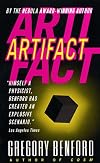
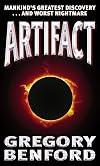
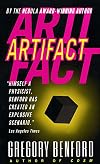
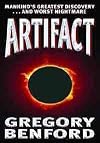
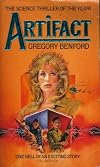
Artifact
by Gregory Benford
On This Page
Description
A small cube of black rock has been unearthed in a 3500-year-old Mycenaean tomb. An incomprehensible object in an impossible place; its age, its purpose, and its origins are unknown. Its discovery has unleashed a global storm of intrigue, theft andespionage, and is pushing nations to the brink of war. Its substance has scientists baffled. And the miracle it contains does not belong on this Earth.It is mystery and madness -- an enigma with no equal in recordedhistory. It is mankind's greatest show more discovery ... and worst nightmare. It may have already obliterated a world. Ours is next. show lessTags
Recommendations














Member Reviews
I have to admit that this review is based on having speed-read Artifact so that I only picked up maybe 20% of the words. I don't normally do that, but I couldn't help it once I realized that my plan to break out of a months-long not-reading-anything rut by picking up a guaranteed sugar rush—an old Gregory Benford technothriller that, as I remembered from having flipped through it in an airport bookstore or something long ago, is about physicists and military creeps fighting to possess an ancient plot object that probably contains a tiny black hole or the like; cool!—hadn't taken into account that Benford, when he's in setup mode and doing a lot of mundane international intrigue stuff while keeping the cool science thing mostly show more offstage, can be unbearably boring and kind of unpleasant. He is way too into this filler material: endless travelogue passages, endless arguments with stereotyped foreign antagonists about who has authority over what… and at least 10,000 occurrences of the male protagonist thinking that the female one is really hot, while she is thinking that he's a sexist oaf but there's still something strangely fascinating about him, etc. (will his condescending thoughts about her repressed emotions turn out to be exactly right? will they eventually get together and produce a few hasty sentences of cringe-worthy sex prose? what do you think?). That's basically the first two-thirds of the book and I was not digging it in the least. I persevered only because I wanted to see the cool science thing, dammit.
And eventually you do! There follows some procedural lab mystery stuff, and Benford (a retired astrophysicist) is, as usual, quite good at writing about scientists doing their jobs; they even turn into somewhat more interesting characters as long as that's going on. The theoretical physics stuff is pretty cool and, I think, not too badly explained although I have no idea whether it's interesting if you're not such a science nerd. Then the villains return and cause a bunch of escalating problems with the artifact and we're chasing it across the ocean floor and the book is suddenly a really entertaining technothriller with very little chaff. This could have all started about 200 pages earlier so I can only assume that Benford had a vastly excessive page count obligation in his book deal, or else he just found himself really enjoying writing about vaguely described archeological proceedings, creepy romantic tension, and above all, tough guys arguing.
Now, when you get toward the end of a book like this—where there is one main villain who has caused all this trouble by wanting to possess the dangerous SF object, and everyone is like "No, it's too dangerous, you don't understand!", and he's like "Raar, I will possess it, you can't stop me!"—there is really just one event you're waiting for. This event must happen. (Stop reading here if you really can't see where this is going and want to maintain suspense for the least surprising thing ever, even though the genre tradition really relies on you knowing how this works and eagerly awaiting it.) It must happen, and it does! Benford pulls out some pretty impressive and gruesome special effects as that guy gets his ironic just deserts (although it'd be more ironic if he'd actually brought this about by one last arrogant decision, like opening an Ark or something, instead of just randomly choosing to stand in the wrong place while menacing our heroes). It's the cheesiest possible plot resolution in an extremely '80s way, and I may have laughed out loud in appreciation of its shamelessness and its undeniably snazzy execution. Then there's a happy ending and some not-bad but very rushed "here's the SF explanation for some mythology" stuff.
So that's my big reading achievement for this fall: maybe 20% of Artifact, out of which I can highly recommend maybe a quarter. show less
And eventually you do! There follows some procedural lab mystery stuff, and Benford (a retired astrophysicist) is, as usual, quite good at writing about scientists doing their jobs; they even turn into somewhat more interesting characters as long as that's going on. The theoretical physics stuff is pretty cool and, I think, not too badly explained although I have no idea whether it's interesting if you're not such a science nerd. Then the villains return and cause a bunch of escalating problems with the artifact and we're chasing it across the ocean floor and the book is suddenly a really entertaining technothriller with very little chaff. This could have all started about 200 pages earlier so I can only assume that Benford had a vastly excessive page count obligation in his book deal, or else he just found himself really enjoying writing about vaguely described archeological proceedings, creepy romantic tension, and above all, tough guys arguing.
Now, when you get toward the end of a book like this—where there is one main villain who has caused all this trouble by wanting to possess the dangerous SF object, and everyone is like "No, it's too dangerous, you don't understand!", and he's like "Raar, I will possess it, you can't stop me!"—there is really just one event you're waiting for. This event must happen. (Stop reading here if you really can't see where this is going and want to maintain suspense for the least surprising thing ever, even though the genre tradition really relies on you knowing how this works and eagerly awaiting it.) It must happen, and it does! Benford pulls out some pretty impressive and gruesome special effects as that guy gets his ironic just deserts (although it'd be more ironic if he'd actually brought this about by one last arrogant decision, like opening an Ark or something, instead of just randomly choosing to stand in the wrong place while menacing our heroes). It's the cheesiest possible plot resolution in an extremely '80s way, and I may have laughed out loud in appreciation of its shamelessness and its undeniably snazzy execution. Then there's a happy ending and some not-bad but very rushed "here's the SF explanation for some mythology" stuff.
So that's my big reading achievement for this fall: maybe 20% of Artifact, out of which I can highly recommend maybe a quarter. show less
Here's something you don't see every day- A Quantum Mechanics Action Adventure! It's not the greatest book ever, but it really offered a lot that I found interesting, like a mathematician action hero. Benford does have a doctorate in physics and he uses it in his novels. This book is the tale of a Greek archaeologist who discovers a very strange black cube in an ancient Mycenaean tomb. She promptly involves a mathematician from MIT to run some technical tests on it's makeup, they hide it from a Greek army guy who is a total dink to her and later smuggle it out of Greece back to Boston. In an MIT lab, they discover that there is something very odd about it on a quantum level, meanwhile international relations start falling apart as a show more dramatic background for a civilian math professor and his archaeologist babe to wind up involved in a military operation. Like that would ever happen. It is a fun book if you like serious science in your scifi. The quantum artifact is based on a few suppositions that are legitimately possible and are valid mathematical solutions to the equations that govern quarks. In sum, if you know what quarks are and that they have 'color' that has nothing to do with color at all, then you would probably like it. If not, it still stands as a good scifi novel, and the author goes to great lengths to give the reader the actual science data that is needed to interpret a few of the clues along the way. show less
While this is hard science fiction that might turn off some, if you like a good artifact story the you don't want to pass it up. The book might drag to those not interested in science in a few places, but one can skip that to "get back to the action" if you want without losing too much of the story itself (personally I found it fascinating). There is a lot of mystery and action in addition to the hard science I mentioned earlier making it a worthwhile read to more that those interested in hard science fiction
Nice story with a strong science backing. An atifact with strange physical properties is found in an ancient tomb in Greece, particle physics, action and love ensue.
If you take it as a light reading, all is fine, but if start looking into the details, there are some plot holes and the characters are somewhat unreal: a mathematician who knows how to do metallurgy analysis, plays with particle physics, is a scuba diver and does better than the special forces behind enemy lines? Uhmm.
Also a lot of machismo, it appears men are unable to speak and easily resort to using fists.
But, let's be clear, I enjoyed the book.
If you take it as a light reading, all is fine, but if start looking into the details, there are some plot holes and the characters are somewhat unreal: a mathematician who knows how to do metallurgy analysis, plays with particle physics, is a scuba diver and does better than the special forces behind enemy lines? Uhmm.
Also a lot of machismo, it appears men are unable to speak and easily resort to using fists.
But, let's be clear, I enjoyed the book.
I not sure what to say about this book, it has a little Chrichtonesque techno-thriller feel, has archeological mystery, defiantly plenty of hard-sci-fi with the mystery of the artifact but I think it failed to bring it all together. It wasn't a total 3 as aspects kept me reading and other aspects I scanned due to the lack of interest and limited character development. In the end, it left me thinking and I couldn't just go on to the next book but the hangover didn't last long but the best part for me was the science but what I wanted was an archaeological mystery, 3.25-3.5, I want to give it a 4 but after more thought, it's just a 3 a good story take it or leave it.
Spoilers:
I think the story had an opportunity to be a great sci-fi show more mystery but Benford wasn't sure what he wanted to do, he spent too much time trying to explain the science of quarks in a cube and not enough energy (no pun intended) on the story that was set up in the beginning prologue. In the end, he didn't provide closure to the initial archaeological mystery and I found it interesting that an archaeologist was the lead on all the physics in the book. I think once the quarks were discovered that characters involvement, in reality, would have been limited to its discovery in the Mycenean tomb and how it got there but no this character has a thrilling adventure with the antagonist a Greek Arachelogist tied to the Greek government and political unrest in Greece in this story, there were some fluff action scenes with helicopters, boats, and guns that failed because they read like they were just thrown in. Benford needs to take lessons from Clive Cussler if he wanted to write that style of book. I enjoyed it because I liked the science and the mystery behind the science but the initial hook and subplot were lost once the new science-related subplot was presented. In the end, you learned a lot about quarks and he even dedicated the last chapter explaining the science in the book. But, the story of how it got there, was it extraterrestrial in origin, or any number of possible questions was lost on the characters trying to figure out the science behind the artifact until she figured out the physics of it all, I never knew and archaeologist could be so smart about physics. Yes, the last line was sarcasm. show less
Spoilers:
I think the story had an opportunity to be a great sci-fi show more mystery but Benford wasn't sure what he wanted to do, he spent too much time trying to explain the science of quarks in a cube and not enough energy (no pun intended) on the story that was set up in the beginning prologue. In the end, he didn't provide closure to the initial archaeological mystery and I found it interesting that an archaeologist was the lead on all the physics in the book. I think once the quarks were discovered that characters involvement, in reality, would have been limited to its discovery in the Mycenean tomb and how it got there but no this character has a thrilling adventure with the antagonist a Greek Arachelogist tied to the Greek government and political unrest in Greece in this story, there were some fluff action scenes with helicopters, boats, and guns that failed because they read like they were just thrown in. Benford needs to take lessons from Clive Cussler if he wanted to write that style of book. I enjoyed it because I liked the science and the mystery behind the science but the initial hook and subplot were lost once the new science-related subplot was presented. In the end, you learned a lot about quarks and he even dedicated the last chapter explaining the science in the book. But, the story of how it got there, was it extraterrestrial in origin, or any number of possible questions was lost on the characters trying to figure out the science behind the artifact until she figured out the physics of it all, I never knew and archaeologist could be so smart about physics. Yes, the last line was sarcasm. show less
Excellent scientific thriller about the attempts to locate and contain a monopole. Benford does a great job describing how science is really done.
High hopes
Because benford has written some good science fiction, but they were dashed as at about 80% through it turned into a thriller just trying to horrify between appearances of the deadly particle, and combat scenes that were pretty ridiculous. DNF
Because benford has written some good science fiction, but they were dashed as at about 80% through it turned into a thriller just trying to horrify between appearances of the deadly particle, and combat scenes that were pretty ridiculous. DNF
Members
- Recently Added By
Lists

Jean's Sci Fi/Fantasy Reading list
189 works; 12 members
Talk Discussions
Past Discussions
Sci-fi thriller with artifact (black cube) on cover in Name that Book (October 2007)
Author Information

239+ Works 22,543 Members
Gregory Benford, was born on January 30, 1941 in Mobile, Alabama. He is a physicist and science fiction writer who earned his Ph.D. from the University of California, San Diego, in 1967. He is a Woodrow Wilson Fellow and a consultant for NASA. Benford's first novel "Deeper than the Darkness" (1970), which was revised as "The Stars in Shroud" show more (1978), gave him notice as a serious Science Fiction writer. His most popular work is "Timescape" (1980), which was the winner of the Nebula and John W. Campbell Memorial Awards; it presented a hard physics approach to limited time travel. "In the Ocean of Night" (1977), "Across the Sea of Suns" (1984), "Great Sky River" (1987), "Tides of Light" (1989) and "Furious Gulf" (1994) were all a part of the Galactic Cluster Series. He has also written the juvenile novel "Jupiter Project" (1975), "Against Infinity" (1983) and the thriller "Artifact" (1985). He has been nominated for 12 Nebula Awards (winning for "Timescape" and for the novelette, "If the Stars are Gods"). Benford, writing alternately with Bruce Sterling, produces science fact articles for the Magazine of Fantasy and Science Fiction. They took over after the death of regular columnist Isaac Asimov. He has also co-edited theme anthologies with Martin H. Greenburg, which include "Hitler Victorious" (1986), "Nuclear War" (1988), "What Might Have Been, Volume 1: Alternate Empires" (1988), "Volume 2: Alternate Heroes" (1989) and "Volume 3: Alternate Wars." (Bowker Author Biography) show less
Some Editions
Series
Belongs to Publisher Series
Etiqueta Futura (6)
Work Relationships
Is contained in
Common Knowledge
- Canonical title
- Artifact
- Original title
- Artifact
- Original publication date
- 1985-06
- People/Characters
- Claire Anderson; John Bishop
- Important places
- Greece; Boston, Massachusetts, USA
- Epigraph
- The past isn't dead. It isn't even past.
-- William Faulkner - Dedication
- For
Eloise Nelson Benford - First words
- They buried the great King as twilight streaked the west crimson. (prologue)
Deep inside the tomb they barely heard the snarl of an approaching vehicle. - Quotations
- "My government does it, not me."
- Last words
- (Click to show. Warning: May contain spoilers.)"Sure," he said. "For a while."
(Click to show. Warning: May contain spoilers.)They have my thanks, though of course they are not responsible for any mistakes which made it through to the final version.
Gregory Benford
Athens-Laguna Beach-Cairo (A technical afterword) - Original language*
- English
*Some information comes from Common Knowledge in other languages. Click "Edit" for more information.
Classifications
Statistics
- Members
- 839
- Popularity
- 32,777
- Reviews
- 13
- Rating
- (3.25)
- Languages
- English, German, Italian, Spanish
- Media
- Paper, Ebook
- ISBNs
- 15
- ASINs
- 9