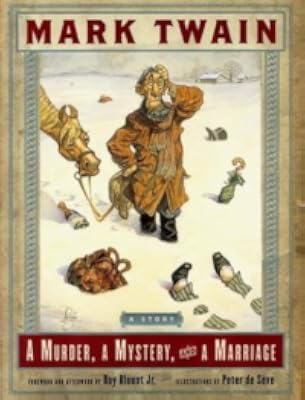
A Murder, a Mystery, and a Marriage
by Mark Twain 
On This Page
Description
"Upon the border of a remote and out-of-the-way village in south-western Missouri lived an old farmer named John Gray. . . ."In 1876, the same year The Adventures of Tom Sawyer was published, Mark Twain wrote a story for The Atlantic Monthly. He meant it as a "blind novelette"a challenge to other writers to submit their own ending of the story in a national competition. Twain asked his editor at The Atlantic to request submissions from leading authors of the day, including Henry show more James.Perhaps because few writers could write as well as Twain, no one responded, and Twain's original complete manuscript languished in literary hibernation. It was rediscovered in 1995 and appear in The Atlantic Monthly in 2001, having come full circle.Set in the fictional town of Deer Lick, Missouri, A Murder, a Mystery, and a Marriage chronicles the fortunes of a farmer determined to have his daughter marry the son of a wealthy man. It's a charming story in the Twain tradition and a delightful addition to his legacy. show lessTags
Recommendations

















Member Reviews
A Murder, A Mystery, and a Marriage is a short story or novella which capably shows the basic framework of a mystery plot. I would have enjoyed it more if the characters had been fleshed out. As it is, the motive and murderer were evident. The real mystery was how one of the characters got to the middle of the snow-covered field without leaving any tracks. That mystery was resolved at the end, and with good, Twain humor, but it's a shame to leave it until the end.
In the mid-1870s, Mark Twain pitched an idea to the editor of the Atlantic Monthly. He would challenge other notable authors of the day to write a story based on a skeleton plot. All the stories would then be published in the Atlantic Monthly. Twain was the only author to follow through with a story, and it remained unpublished until 2001. It’s an unremarkable story, made more appealing by the consummate narration of Garrison Keillor.
I found the additional content more interesting than the story itself. Roy Blount Jr. provides a foreword and afterword that put the story in its historical context. Twain was working on Huckleberry Finn at the time he wrote this story, and several elements in the story were fleshed out to better effect show more in Huck Finn. show less
I found the additional content more interesting than the story itself. Roy Blount Jr. provides a foreword and afterword that put the story in its historical context. Twain was working on Huckleberry Finn at the time he wrote this story, and several elements in the story were fleshed out to better effect show more in Huck Finn. show less
A book that took 125 years to publish. How could I pass this up when I saw it on the shelves while browsing my library's selection of Mark Twain's novels? To be honest, I probably would have been just fine passing on it. It's a short story, a very short story; half the book is commentary by Ray Blount Jr. Me and short stories typically don't get along well, and that was the case with this one as well. There just wasn't enough substance for this readers taste.
Despite that, the history of the novel is fascinating. In the midst of writing Huckleberry Finn, Twain was struck by an idea to come up with a skeleton plot and then have The Atlantic publish novelettes that he and other leading authors of the time, including Henry James, would show more write based upon said skeleton plot. He was obssessed with the idea and wrote numerous letters over the next couple decades to the publisher of The Atlantic, a close friend of his, to make it happen. Unfortunately for Twain, it never did. But now, over a century later, at least part of his dream has been made possible.
It is a strange little story however, and really makes you wonder, just what did Twain have against Jules Verne. And why would Twain name a hated character after his best friend, whom was known to be the complete opposite in almost every way of his fictional counterpart? The story takes place in a fictional Missouri town in which a young man is discovered laying in the snow, with no obvious means of having arrived there. That is the mystery, and this mystery leads to both the murder and the marriage. show less
Despite that, the history of the novel is fascinating. In the midst of writing Huckleberry Finn, Twain was struck by an idea to come up with a skeleton plot and then have The Atlantic publish novelettes that he and other leading authors of the time, including Henry James, would show more write based upon said skeleton plot. He was obssessed with the idea and wrote numerous letters over the next couple decades to the publisher of The Atlantic, a close friend of his, to make it happen. Unfortunately for Twain, it never did. But now, over a century later, at least part of his dream has been made possible.
It is a strange little story however, and really makes you wonder, just what did Twain have against Jules Verne. And why would Twain name a hated character after his best friend, whom was known to be the complete opposite in almost every way of his fictional counterpart? The story takes place in a fictional Missouri town in which a young man is discovered laying in the snow, with no obvious means of having arrived there. That is the mystery, and this mystery leads to both the murder and the marriage. show less
In Graham Greene's lingo this short book of Twain's is An Entertainment rather than a novel. It was
a fairly fun sketch of a hardscrabble family in a small town the husband-father of which had a wish for a rich son-in-law. Things go up and go down, a stranger "falls into" the story, there is lots of talk, all Hell breaks loose, and finally most things work out.
a fairly fun sketch of a hardscrabble family in a small town the husband-father of which had a wish for a rich son-in-law. Things go up and go down, a stranger "falls into" the story, there is lots of talk, all Hell breaks loose, and finally most things work out.
Twain wanted a collection of tales on the same plot outline by other authors of his time. Project never got off the ground. A bit of a mystery, a bit of a melodrama, with comedic touches.
A light bit of comic fluff by Mark Twain, which remained unpublished for 125 years after Twain wrote it. It was originally planned by Twain as a bare-bones plot which several prominent authors of the day would flesh out in their own fashion. This project never came to fruition, and the manuscript was discovered decades after his death. One of his lesser works, it consists of a comic bit of intrigue by a fake Count to marry a beautiful heiress. Interesting mainly for historical reasons.
Twain vents his jealousy of Jules Verne's success with a (for him) fairly conventional tall tale.
Members
- Recently Added By
Author Information

2,748+ Works 208,525 Members
Mark Twain was born Samuel L. Clemens in Florida, Missouri on November 30, 1835. He worked as a printer, and then became a steamboat pilot. He traveled throughout the West, writing humorous sketches for newspapers. In 1865, he wrote the short story, The Celebrated Jumping Frog of Calaveras County, which was very well received. He then began a show more career as a humorous travel writer and lecturer, publishing The Innocents Abroad in 1869, Roughing It in 1872, and, Gilded Age in 1873, which was co-authored with Charles Dudley Warner. His best-known works are The Adventures of Tom Sawyer, Mississippi Writing: Life on the Mississippi, and The Adventures of Huckleberry Finn. He died of a heart attack on April 21, 1910. (Bowker Author Biography) show less
Mark Twain has a Legacy Library. Legacy libraries are the personal libraries of famous readers, entered by LibraryThing members from the Legacy Libraries group.
Some Editions
Common Knowledge
- Original title
- A Murder, A Mystery and a Marriage
- Original publication date
- 2001
- People/Characters
- John Gray; Mary Gray; Hugh Gregory
- Important places
- Deer Lick, Missouri. USA
- First words
- Upon the border of a remote and out-of-the-way village in south-western Missouri lived an old farmer named John Gray.
- Last words
- (Click to show. Warning: May contain spoilers.)Moreover, I want to know where he lit when he fell.
- Original language
- English
Classifications
Statistics
- Members
- 482
- Popularity
- 62,778
- Reviews
- 12
- Rating
- (3.27)
- Languages
- 6 — Catalan, English, French, Italian, Portuguese, Spanish
- Media
- Paper, Audiobook, Ebook
- ISBNs
- 12
- UPCs
- 1
- ASINs
- 2