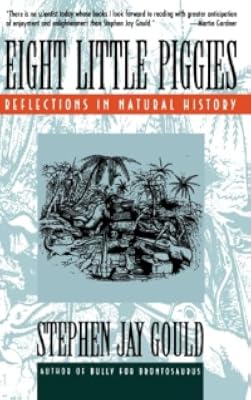
Eight Little Piggies: Reflections in Natural History
by Stephen Jay Gould
Reflections in Natural History (6)
On This Page
Description
Contemplative essays speaking often of the importance of the unbroken connection of modern man and our ancestors.Tags
Recommendations









Member Reviews
This collection of Gould's essays was published in 1993, but contains material from as far back as 1989. As with all his collections, the focus is on evolutionary biology, but he ranges pretty far across that subject. Sometimes he's focusing on small scientific details, which he uses to make broader points. Sometimes he's poking into odd corners of scientific history and shedding light on the lives of the people involved, especially when he feels they've been misunderstood in some way. A couple of the essays appear to be about completely unrelated things -- Mozart's musical prodigy, or the unreliability of Gould's own childhood memories -- but he always brings even those digressions back around to his main theme in unexpectedly graceful show more ways.
As always, his writing is both enthusiastic and wonderfully erudite. I don't know quite what it is about Gould, but somehow I always feels smarter after reading him. show less
As always, his writing is both enthusiastic and wonderfully erudite. I don't know quite what it is about Gould, but somehow I always feels smarter after reading him. show less
This collection of essays is Gould's last as an author but my first as a reader of him. They are somewhat eclectic, though grouped according to theme and overall evolution and scientific method crop up the most often. Technically, the approach is less diverse, with an opening starting with some personal or topical (at the time of writing) anecdote leading into a more general discussion of a Big Idea. This is somewhat irritating to me, because it reminds me of Radio 4's Thought for the Day, in which a news story is used to lead into some crass attempt to foist religion on to me.
The main body of each essay is well argued and clearly explained and demonstrates that Gould had not only a thorough understanding of his subject but the history show more of it, too. I learned much about modern ideas about evolution and found his remarks on scientific method interesting and worthwhile. It is also clear that he found an ocean of incomprehension of evolution around him - which he tried to mop up with his books, knowing that they could hardly even have a measurable effect.
I am left, however, with an even stronger desire for a book (preferable by Gould or Eldredge) in which a coherent description of evolution and all scales of operation is given. If anyone knows of one such, please mention it! show less
The main body of each essay is well argued and clearly explained and demonstrates that Gould had not only a thorough understanding of his subject but the history show more of it, too. I learned much about modern ideas about evolution and found his remarks on scientific method interesting and worthwhile. It is also clear that he found an ocean of incomprehension of evolution around him - which he tried to mop up with his books, knowing that they could hardly even have a measurable effect.
I am left, however, with an even stronger desire for a book (preferable by Gould or Eldredge) in which a coherent description of evolution and all scales of operation is given. If anyone knows of one such, please mention it! show less
I have to love Stephen Jay Gould. I like most popular science writers, like Carl Sagan, but how many title their books so that the library clerk comes back with a surprised look on his face? He said to me, “It’s a little thicker than I was expecting.” It was about the thickness I was expecting, and I enjoyed every page of it. Gould has a way of writing about evolutionary science that makes it approachable without dumbing it down.
Full review: http://libwen.wordpress.com/2011/06/29/eight-little-piggies-by-stephen-jay-gould...
Full review: http://libwen.wordpress.com/2011/06/29/eight-little-piggies-by-stephen-jay-gould...
First time I've read this one - I read and re-read Gould constantly, but this one was new to me. There were some interesting elements - the essays about the intertwining of new facts and new theories were good. And of course the bit (familiar from other books, but presented in a slightly different way here) about looking at an entire theory rather than a strawman selection from it, to understand why it was wrong and has been superseded.
Collected essays. This is what Gould is best at.
Enjoy them for the writing ability, the beautiful linking of apparently disparate facts and anecdotes or the key thought provoking messages that usually involve some form of humbling perspective on the universe or human beings.
Particular highlights for me were the writings on the evolution of the bones of the inner ear and an exposition on the philosophical bond between Darwin and right wing economics.
Well worth a read.
Enjoy them for the writing ability, the beautiful linking of apparently disparate facts and anecdotes or the key thought provoking messages that usually involve some form of humbling perspective on the universe or human beings.
Particular highlights for me were the writings on the evolution of the bones of the inner ear and an exposition on the philosophical bond between Darwin and right wing economics.
Well worth a read.
More of Gould's essays from Natural History, mostly (loosely) focused on evolution. Enjoyable as usual, but also some getting a bit dated now.
A very human science writer: Gould was an expert in writing about science in a way that ordinary, not-particularly-scientific readers could comprehend, at least in a general way. But more than that, he linked the science to anecdotes that readers could not only understand, but also identify with.
Members
- Recently Added By
Lists

Best Science Books for Non-Scientists
113 works; 57 members

al.vick-parents books
301 works; 1 member
Author Information

117+ Works 30,227 Members
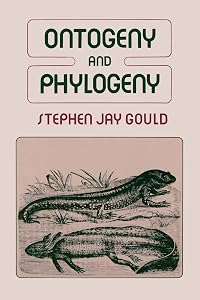
Born in New York City in 1941, Stephen Jay Gould received his B.A. from Antioch College in New York in 1963 and a Ph.D. in paleontology from Columbia University in 1967. Gould spent most of his career as a professor at Harvard University and curator of invertebrate paleontology at Harvard's Museum of Comparative Zoology. His research was mainly in show more the evolution and speciation of land snails. Gould was a leading proponent of the theory of punctuated equilibrium. This theory holds that few evolutionary changes occur among organisms over long periods of time, and then a brief period of rapid changes occurs before another long, stable period of equilibrium sets in. Gould also made significant contributions to the field of evolutionary developmental biology, most notably in his work, Ontogeny and Phylogeny. An outspoken advocate of the scientific outlook, Gould had been a vigorous defender of evolution against its creation-science opponents in popular magazines focusing on science. He wrote a column for Natural History and has produced a remarkable series of books that display the excitement of science for the layperson. Among his many awards and honors, Gould won the National Book Award and the National Book Critics Circle Award. His titles include; Ever Since Darwin, The Panda's Thumb, Hen's Teeth and Horse's Toes, Time's Arrow, Time's Cycle, Wonderful Life: The Burgess Shale and the Nature of History, The Structure of Evolutionary Theory and Full House: The Spread of Excellence from Plato to Darwin. Stephen Jay Gould died on May 20, 2002, following his second bout with cancer. (Bowker Author Biography) show less
Series

Belongs to Publisher Series
Common Knowledge
- Canonical title
- Eight Little Piggies: Reflections in Natural History
- Original title
- Eight Little Piggies: Reflections in Natural History
- Original publication date
- 1993
- Dedication
- For Agnes Pilot, for her unfailing intelligence, loyalty, and integrity
- Quotations
- The dogmatist within is always worse than the enemy without. (from: Men of the thirty-third division: an essay on integrity)
Good scholars struggle to understand the world in an integral way (pedants bite off tiny bits and worry them to death). (from: Men of the thirty-third division: an essay on integrity)
Great theories are expansive; failures mire us in dogmatism and tunnel vision. (from: More light on leaves)
Perhaps I am just a hopeless rationalist, but isn't fascination as comforting as solace? Isn't nature immeasurably more interesting for its complexities and its lack of conformity to our hopes? Isn't curiosity as wondrously a... (show all)nd fundamentally human as compassion? (from: Tires to sandals)
The pleasure of discovery in science derives not only from the satisfaction of new explanations, but also, if not more so, in fresh (and often difficult puzzles) that the novel solutions generate. (from: Eight little piggies) - Last words
- (Click to show. Warning: May contain spoilers.)Who says that life and culture do not progress!
- Blurbers
- Gardner, Martin
- Original language
- English
Classifications
Statistics
- Members
- 1,310
- Popularity
- 18,566
- Reviews
- 11
- Rating
- (3.94)
- Languages
- 5 — English, French, Italian, Portuguese, Spanish
- Media
- Paper, Audiobook, Ebook
- ISBNs
- 22
- ASINs
- 7