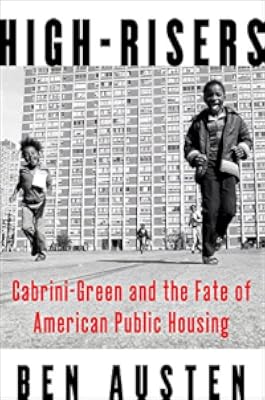
High-Risers: Cabrini-Green and the Fate of American Public Housing
by Ben Austen
On This Page
Description
Braids personal narratives, city politics, and national history to tell the timely and epic story of Chicago's Cabrini-Green, America's most iconic public housing project. Built in the 1940s atop an infamous Italian slum, Cabrini-Green grew to twenty-three towers and a population of 20,000--all of it packed onto just seventy acres a few blocks from Chicago's ritzy Gold Coast. Cabrini-Green became synonymous with crime, squalor, and the failure of government. For the many who lived there, it show more was also a much-needed resource--it was home. By 2011, every high-rise had been razed, the island of black poverty engulfed by the white affluence around it, the families dispersed. In this novelistic and eye-opening narrative, Ben Austen tells the story of America's public housing experiment and the changing fortunes of American cities. It is an account told movingly through the lives of residents who struggled to make a home for their families as powerful forces converged to accelerate the housing complex's demise. Beautifully written, rich in detail, and full of moving portraits, High-Risers is a sweeping exploration of race, class, popular culture, and politics in modern America that brilliantly considers what went wrong in our nation's effort to provide affordable housing to the poor--and what we can learn from those mistakes. show lessTags
Recommendations































Member Recommendations


Member Reviews
Ben Austen’s new book, High-Risers, tells the story of public housing in America in general and in Chicago in particular through the history of one infamous project (Cabrini-Green) and four individuals who lived there. The book resonated with me because of my personal history. I lived in a Chicago housing project (not Cabrini-Green) for five years; I drove a bus as a summer job, and my principal route took me through the largest of Chicago’s projects; and after graduating from the University of Chicago Law School, I was second chair as a lawyer defending the Chicago Housing Authority (the “CHA”) in the notorious Gautreaux case, which ruled on February 10, 1969 that the CHA had systematically discriminated against blacks in its show more choice of sites for constructing projects.>
The Chicago Housing Authority was formed in 1937 to alleviate a perceived housing crisis. Chicago was in the throes of coping with the “Great Migration” of rural black families from the south to northern cities in search of work. The goal of the CHA was to eradicate the deplorable slum buildings and replace them with decent, affordable, rent-subsidized housing for the needy. Modest progress in that direction was made with the construction a few small projects before the outbreak of World War II. But the crowded neighborhoods into which these families were forced to live (because of segregated housing practices) deteriorated rapidly and became slums. Money was not spent on upkeep, with leaks, cracked walls, and broken doors going unfixed.
The end of World War II created another dimension to the problems with housing. An acute shortage developed as 11 million men were mustered out of the military and started having families. The Baby Boom of the late 40’s and early 50’s resulted in a population expansion that simply overwhelmed the existing housing stock. Few, if any, cities experienced the obstacles and difficulties produced by the combination of the Great Migration and the Baby Boom in as great a degree as Chicago. Whites and blacks were competing for housing which exacerbated racial tensions. "White neighborhoods established racial covenants," Austen writes, "bylaws that barred homeowners from selling to African Americans. At one point, 85 percent of Chicago was covered under these restrictions."
The story of public housing in Chicago, and to a lesser extent in the country as a whole, is in fact a story of race relations. In High-Risers, author Ben Austen states that from 1945 to 1950, there were 500 recorded outbreaks of racial violence in Chicago, and 350 of them involved housing. The CHA attempted to alleviate the situation by providing decent housing, but was greatly constrained by the attitudes of the people and the government of Chicago.
The concept that some people (in particular, black people) would receive subsidized rent and desirable housing simply because they were poor was not popular with middle class white America, and it was almost universally despised by lower-middle class whites on the south side of Chicago. Whites had little appreciation of the effects of generations of white privilege (indeed, this is still largely the case), and saw this as nothing but “mooching” at their expense. Knowing the bad feelings that attractive public housing might engender, Senator Robert Taft of Ohio made certain that federal money would not be spent to beautify public housing projects. Chicago’s largest project, the Robert Taylor homes, was positively ugly. No money was spent on landscaping; instead, the perimeters were just paved over. There were “no flowers, no trees, no nothing. Everything became blacktop.” Cabrini-Green was not as bad, at least not initially, but after years of neglect and mismanagement it became an eyesore. As a result, few, if any, white families desired to move into Chicago’s projects.
Selecting sites for projects proved to be one of the most difficult aspects of operating the CHA. Chicago was - and still is - one of the most racially segregated cities in the country. Austen writes that the authorizing legislation required the approval of a site by the City Council before construction could begin. Depositions taken in the Gautreaux case revealed that the Council had established an informal working procedure whereby the Council as a whole would defer to the wishes of the alderman in whose ward a potential site was located. In effect, this procedure gave white aldermen effective veto power over the location of projects in predominantly white wards. This in turn meant that projects could be constructed only in predominantly black wards or unpopulated neighborhoods. One sub rosa argument used by the CHA to justify its site locations to the white population was that the projects’ black residents would move “there” instead of “near you.”
An invidious consequence of greatly restricting the number and area of potential sites was that the CHA had to build high rise structures if it was to meet the enormous demand for subsidized housing. In the words of a CHA executive:
"We no longer had power to select where the projects were going to go, and we had very little space to work with, so we had to go to the high-rises."
Thus, most of the housing units constructed by the CHA were contained in towers of 14 or more stories, located close to one another. In all, the CHA constructed 33 projects containing 168 high rise buildings. All the projects but one were located in predominantly black neighborhoods.
There were also projects for poor whites, and one had an interesting history, particularly to me, since I lived there from ages 3 to 8. It was a CHA project of temporary housing for [white] WWII veterans called Airport Homes near Midway Airport. Before the CHA could assign tenants to the building, the office where the keys to the buildings were kept was broken into by some veterans looking for housing. The burglars distributed the keys to their friends, who were able to move in as “squatters.” My father was one of those friends.
My earliest memory was being awakened in the middle of the night at my grandmother’s house where we were living at the time with her and several of my father’s siblings. My father said that we had a place to live! We moved with some furniture that night. The CHA initiated eviction procedures against the squatters. Some recent law school graduates volunteered to represent us squatters for a small fee, and we and the other squatters lived there for five years before being evicted. That project was razed, and is now a park.
In the early days after the war, the CHA made an effort to “qualify” good families for the projects. Two- parent families with at least one employed parent were given priority. The CHA even attempted to move a highly qualified black family into the project in which I lived. Austen describes the black family as “Jackie Robinson-like” in their presumably acceptable (to whites) traits. But that wasn’t good enough for the white residents of the project itself or for its neighbors. Not very peaceful demonstrations materialized almost immediately after that family moved in. I remember having to walk through a cordon of (white) police officers to go to and from kindergarten.
Trumbull Park Homes, located in a white neighborhood, was also supposed to be "whites only." However, as the Encyclopedia of Chicago reports, the project was “accidentally” integrated on July 30, 1953, because the CHA assumed that Betty Howard, an exceptionally fair-skinned African American, was white. Beginning on August 5 and continuing nightly for weeks thereafter, crowds of whites directed fireworks, rocks, and racial epithets toward Betty and Donald Howard's apartment. Police responded with a show of force but few arrests.
The CHA abandoned the attempt to integrate the projects after a short time.
Austen focuses his story on the notorious Cabrini-Green project. One aspect of Cabrini-Green that made it stand out from other projects was its proximity to the Loop, Chicago’s shopping and business center, and the “Gold Coast,” Chicago’s most expensive residential neighborhood. As you can imagine, the whites didn’t put up with that “waste” of lucrative real estate for long.
Austen is quite sympathetic to the people who lived in the projects. His sketches of four long-term project residents shows that they tried hard to maintain their neighborhood in the face of white animosity, CHA incompetence, and black gang activity. Nevertheless, reading between the lines, the reader can infer that even if they had been white, his subjects’ socioeconomic status made them less than desirable neighbors, particularly to Gold Coast residents.
Despite the efforts of tenants like those featured in the book, the physical condition of the projects (particularly the high-rises) deteriorated rather rapidly. As mentioned above, money for maintenance was a low priority. By 1965 when I drove a city bus on routes through the projects, broken windows, poor lighting, and abundant graffiti were evident to anyone driving by. In addition, Austen notes that the CHA was particularly inefficient when it came to repairing elevators, in spite of the buildings being high-rises. The stairwells were murky, with lightbulbs not replaced once they burned out. Austen quotes architect and city planner Oscar Newman who said at the time: "No one seems to be minding the store; what's more, no one seems genuinely to care."
Moreover, Chicago’s black gangs eventually took over most if not all of the buildings. My law school classmates who took Chicago police “ride-alongs” said the police officers told them that “the law stopped at the sixth floor,” which was as high up in a building they could get in response to a complaint before the perpetrators would be warned of their presence in time to escape. In addition, the apartments were so cheaply constructed that criminals could just push through a bathroom vanity in adjacent apartments to get into the one next to it.
In the aftermath of the April 4, 1968 assassination of Martin Luther King, Jr., the black neighborhoods of Chicago erupted in violence. An enormous number of (non-project) houses and apartments in predominantly black areas were destroyed in the rioting. The people left homeless by the rioting had no option but public housing, which put a tremendous stress on the already limited resources of the CHA. Many of those people, who would not otherwise have qualified for public housing because of prior criminal convictions or lack of employment, were assigned to the projects. The deterioration of the projects accelerated thereafter.
There were other difficulties as well. Over 60 percent of the families in public housing had only one parent at home. Th author writes: “Women on welfare were in many ways discouraged from marrying or officially sharing a residence with the father of their children, since the presence of a man could leave them ineligible for benefits.” Thus the median income of CHA residents was low and many kids spent days and nights unsupervised while their mothers worked, often at more than one job. Kids had no places to play besides the blacktop, unless they could get to churches or youth centers. Area schools were grossly deficient. Other amenities were scarce as well: for instance, grocery stores were literally miles away, and no one could afford cars.
The Cabrini project became nationally notorious when two white officers were shot by snipers ensconced well above the sixth floor in one of the towers. The police response was swift and brutal, but it alienated most of the black residents of the project. The project received even more notoriety when then Mayor Jayne Byrne moved into one of the units to publicize the conditions faced by the residents.
Despite efforts of the residents and the CHA to renovate Cabrini, there was really no hope of maintaining a public housing project on the Cabrini site. Chicago was in the process of urban gentrification that expanded inexorably from the Loop. Older housing near Cabrini was either being renovated or razed and replaced with new, high standard housing. The second Mayor Daley wanted to convert the Cabrini site to an up-scale neighborhood. Would-be gentrifiers did not see displaced families; they only saw dollar signs. [A four bedroom apartment with a lake view in that neighborhood (now that the projects are gone) would cost at least $1.5 million today.] The response of the CHA was to let the Cabrini project slowly disappear through attrition: as any family moved out, it was not replaced. Gradually, every tower became vacant or nearly so. Once a building was reduced to just a few residents, the CHA moved them and razed the building. The residents of the projects had no choice as to when and where they would be relocated. By the end of 2002, forty-two out of fifty-one high-rise public housing towers were demolished, and some 25,000 households were evicted in the process.
The end of the Cabrini-Green project marked the end of an era. The utilization of high-rise buildings to house under-employed black residents was deemed by most observers to be a failure, one which was blamed on the residents themselves.
The most invidious consequence of building subsidized high-rises was to institutionalize segregated neighborhoods. In the Gautreaux case, even though the court found that the CHA had unlawfully discriminated against blacks in the choice of sites for projects, the court was severely challenged to find an appropriate remedy. Its initial order prohibited the CHA from constructing future projects in predominantly black census tracts. (The use of census tracts as a measure or definition of neighborhood was my idea.) But an unintended consequence of that order was that the CHA simply stopped building any new housing. Instead, the CHA merely subsidized qualified families to move into existing housing. This procedure at least opened the possibility of fostering racially integrated housing. Future public housing in the rest of the country took the form of low density, low-rise buildings and supplemental rental payments to allow poor families to move into units they could not otherwise afford. But of course, wherever the poor moved into, the better off moved out of, and segregation once again prevailed.
While Austen’s High-risers personalizes the story outlined above by giving details of four real people who lived in Cabrini-Green, I found I was less interested in their personal stories than I was in the history of public housing in Chicago. I have deliberately short-changed the stories of the individuals in order to give my personal view of that history. In that regard, I apologize to the author, who has written a moving and compelling book.
(JAB) show less
The Chicago Housing Authority was formed in 1937 to alleviate a perceived housing crisis. Chicago was in the throes of coping with the “Great Migration” of rural black families from the south to northern cities in search of work. The goal of the CHA was to eradicate the deplorable slum buildings and replace them with decent, affordable, rent-subsidized housing for the needy. Modest progress in that direction was made with the construction a few small projects before the outbreak of World War II. But the crowded neighborhoods into which these families were forced to live (because of segregated housing practices) deteriorated rapidly and became slums. Money was not spent on upkeep, with leaks, cracked walls, and broken doors going unfixed.
The end of World War II created another dimension to the problems with housing. An acute shortage developed as 11 million men were mustered out of the military and started having families. The Baby Boom of the late 40’s and early 50’s resulted in a population expansion that simply overwhelmed the existing housing stock. Few, if any, cities experienced the obstacles and difficulties produced by the combination of the Great Migration and the Baby Boom in as great a degree as Chicago. Whites and blacks were competing for housing which exacerbated racial tensions. "White neighborhoods established racial covenants," Austen writes, "bylaws that barred homeowners from selling to African Americans. At one point, 85 percent of Chicago was covered under these restrictions."
The story of public housing in Chicago, and to a lesser extent in the country as a whole, is in fact a story of race relations. In High-Risers, author Ben Austen states that from 1945 to 1950, there were 500 recorded outbreaks of racial violence in Chicago, and 350 of them involved housing. The CHA attempted to alleviate the situation by providing decent housing, but was greatly constrained by the attitudes of the people and the government of Chicago.
The concept that some people (in particular, black people) would receive subsidized rent and desirable housing simply because they were poor was not popular with middle class white America, and it was almost universally despised by lower-middle class whites on the south side of Chicago. Whites had little appreciation of the effects of generations of white privilege (indeed, this is still largely the case), and saw this as nothing but “mooching” at their expense. Knowing the bad feelings that attractive public housing might engender, Senator Robert Taft of Ohio made certain that federal money would not be spent to beautify public housing projects. Chicago’s largest project, the Robert Taylor homes, was positively ugly. No money was spent on landscaping; instead, the perimeters were just paved over. There were “no flowers, no trees, no nothing. Everything became blacktop.” Cabrini-Green was not as bad, at least not initially, but after years of neglect and mismanagement it became an eyesore. As a result, few, if any, white families desired to move into Chicago’s projects.
Selecting sites for projects proved to be one of the most difficult aspects of operating the CHA. Chicago was - and still is - one of the most racially segregated cities in the country. Austen writes that the authorizing legislation required the approval of a site by the City Council before construction could begin. Depositions taken in the Gautreaux case revealed that the Council had established an informal working procedure whereby the Council as a whole would defer to the wishes of the alderman in whose ward a potential site was located. In effect, this procedure gave white aldermen effective veto power over the location of projects in predominantly white wards. This in turn meant that projects could be constructed only in predominantly black wards or unpopulated neighborhoods. One sub rosa argument used by the CHA to justify its site locations to the white population was that the projects’ black residents would move “there” instead of “near you.”
An invidious consequence of greatly restricting the number and area of potential sites was that the CHA had to build high rise structures if it was to meet the enormous demand for subsidized housing. In the words of a CHA executive:
"We no longer had power to select where the projects were going to go, and we had very little space to work with, so we had to go to the high-rises."
Thus, most of the housing units constructed by the CHA were contained in towers of 14 or more stories, located close to one another. In all, the CHA constructed 33 projects containing 168 high rise buildings. All the projects but one were located in predominantly black neighborhoods.
There were also projects for poor whites, and one had an interesting history, particularly to me, since I lived there from ages 3 to 8. It was a CHA project of temporary housing for [white] WWII veterans called Airport Homes near Midway Airport. Before the CHA could assign tenants to the building, the office where the keys to the buildings were kept was broken into by some veterans looking for housing. The burglars distributed the keys to their friends, who were able to move in as “squatters.” My father was one of those friends.
My earliest memory was being awakened in the middle of the night at my grandmother’s house where we were living at the time with her and several of my father’s siblings. My father said that we had a place to live! We moved with some furniture that night. The CHA initiated eviction procedures against the squatters. Some recent law school graduates volunteered to represent us squatters for a small fee, and we and the other squatters lived there for five years before being evicted. That project was razed, and is now a park.
In the early days after the war, the CHA made an effort to “qualify” good families for the projects. Two- parent families with at least one employed parent were given priority. The CHA even attempted to move a highly qualified black family into the project in which I lived. Austen describes the black family as “Jackie Robinson-like” in their presumably acceptable (to whites) traits. But that wasn’t good enough for the white residents of the project itself or for its neighbors. Not very peaceful demonstrations materialized almost immediately after that family moved in. I remember having to walk through a cordon of (white) police officers to go to and from kindergarten.
Trumbull Park Homes, located in a white neighborhood, was also supposed to be "whites only." However, as the Encyclopedia of Chicago reports, the project was “accidentally” integrated on July 30, 1953, because the CHA assumed that Betty Howard, an exceptionally fair-skinned African American, was white. Beginning on August 5 and continuing nightly for weeks thereafter, crowds of whites directed fireworks, rocks, and racial epithets toward Betty and Donald Howard's apartment. Police responded with a show of force but few arrests.
The CHA abandoned the attempt to integrate the projects after a short time.
Austen focuses his story on the notorious Cabrini-Green project. One aspect of Cabrini-Green that made it stand out from other projects was its proximity to the Loop, Chicago’s shopping and business center, and the “Gold Coast,” Chicago’s most expensive residential neighborhood. As you can imagine, the whites didn’t put up with that “waste” of lucrative real estate for long.
Austen is quite sympathetic to the people who lived in the projects. His sketches of four long-term project residents shows that they tried hard to maintain their neighborhood in the face of white animosity, CHA incompetence, and black gang activity. Nevertheless, reading between the lines, the reader can infer that even if they had been white, his subjects’ socioeconomic status made them less than desirable neighbors, particularly to Gold Coast residents.
Despite the efforts of tenants like those featured in the book, the physical condition of the projects (particularly the high-rises) deteriorated rather rapidly. As mentioned above, money for maintenance was a low priority. By 1965 when I drove a city bus on routes through the projects, broken windows, poor lighting, and abundant graffiti were evident to anyone driving by. In addition, Austen notes that the CHA was particularly inefficient when it came to repairing elevators, in spite of the buildings being high-rises. The stairwells were murky, with lightbulbs not replaced once they burned out. Austen quotes architect and city planner Oscar Newman who said at the time: "No one seems to be minding the store; what's more, no one seems genuinely to care."
Moreover, Chicago’s black gangs eventually took over most if not all of the buildings. My law school classmates who took Chicago police “ride-alongs” said the police officers told them that “the law stopped at the sixth floor,” which was as high up in a building they could get in response to a complaint before the perpetrators would be warned of their presence in time to escape. In addition, the apartments were so cheaply constructed that criminals could just push through a bathroom vanity in adjacent apartments to get into the one next to it.
In the aftermath of the April 4, 1968 assassination of Martin Luther King, Jr., the black neighborhoods of Chicago erupted in violence. An enormous number of (non-project) houses and apartments in predominantly black areas were destroyed in the rioting. The people left homeless by the rioting had no option but public housing, which put a tremendous stress on the already limited resources of the CHA. Many of those people, who would not otherwise have qualified for public housing because of prior criminal convictions or lack of employment, were assigned to the projects. The deterioration of the projects accelerated thereafter.
There were other difficulties as well. Over 60 percent of the families in public housing had only one parent at home. Th author writes: “Women on welfare were in many ways discouraged from marrying or officially sharing a residence with the father of their children, since the presence of a man could leave them ineligible for benefits.” Thus the median income of CHA residents was low and many kids spent days and nights unsupervised while their mothers worked, often at more than one job. Kids had no places to play besides the blacktop, unless they could get to churches or youth centers. Area schools were grossly deficient. Other amenities were scarce as well: for instance, grocery stores were literally miles away, and no one could afford cars.
The Cabrini project became nationally notorious when two white officers were shot by snipers ensconced well above the sixth floor in one of the towers. The police response was swift and brutal, but it alienated most of the black residents of the project. The project received even more notoriety when then Mayor Jayne Byrne moved into one of the units to publicize the conditions faced by the residents.
Despite efforts of the residents and the CHA to renovate Cabrini, there was really no hope of maintaining a public housing project on the Cabrini site. Chicago was in the process of urban gentrification that expanded inexorably from the Loop. Older housing near Cabrini was either being renovated or razed and replaced with new, high standard housing. The second Mayor Daley wanted to convert the Cabrini site to an up-scale neighborhood. Would-be gentrifiers did not see displaced families; they only saw dollar signs. [A four bedroom apartment with a lake view in that neighborhood (now that the projects are gone) would cost at least $1.5 million today.] The response of the CHA was to let the Cabrini project slowly disappear through attrition: as any family moved out, it was not replaced. Gradually, every tower became vacant or nearly so. Once a building was reduced to just a few residents, the CHA moved them and razed the building. The residents of the projects had no choice as to when and where they would be relocated. By the end of 2002, forty-two out of fifty-one high-rise public housing towers were demolished, and some 25,000 households were evicted in the process.
The end of the Cabrini-Green project marked the end of an era. The utilization of high-rise buildings to house under-employed black residents was deemed by most observers to be a failure, one which was blamed on the residents themselves.
The most invidious consequence of building subsidized high-rises was to institutionalize segregated neighborhoods. In the Gautreaux case, even though the court found that the CHA had unlawfully discriminated against blacks in the choice of sites for projects, the court was severely challenged to find an appropriate remedy. Its initial order prohibited the CHA from constructing future projects in predominantly black census tracts. (The use of census tracts as a measure or definition of neighborhood was my idea.) But an unintended consequence of that order was that the CHA simply stopped building any new housing. Instead, the CHA merely subsidized qualified families to move into existing housing. This procedure at least opened the possibility of fostering racially integrated housing. Future public housing in the rest of the country took the form of low density, low-rise buildings and supplemental rental payments to allow poor families to move into units they could not otherwise afford. But of course, wherever the poor moved into, the better off moved out of, and segregation once again prevailed.
While Austen’s High-risers personalizes the story outlined above by giving details of four real people who lived in Cabrini-Green, I found I was less interested in their personal stories than I was in the history of public housing in Chicago. I have deliberately short-changed the stories of the individuals in order to give my personal view of that history. In that regard, I apologize to the author, who has written a moving and compelling book.
(JAB) show less
High-rises weren’t the problem at Cabrini-Green … Rich people all around them lived in high-rise apartment buildings. The problem was the high concentration of poverty.
(Plus, as Austen writes, inferior building standards/materials…and lack of building maintenance…and administrative mis-management…and political graft…and racism…)
This is long-form journalism about public housing, specifically a history of Chicago’s Cabrini-Green -- a notorious complex of high-rise towers that were located mere blocks from the city's most prestigious areas. It was created in the 1940s as an improvement over the tenements and slums of that time, but myriad factors led the project into abject decline within decades. All of the high-rises show more were ultimately demolished by 2011, often disgorging residents with nowhere to go, and the area continues to be redeveloped and gentrified today.
Austen’s journalism is meticulous and his weaving-in of oral histories from Cabrini-Green residents (who loved it as their home) is moving. show less
(Plus, as Austen writes, inferior building standards/materials…and lack of building maintenance…and administrative mis-management…and political graft…and racism…)
This is long-form journalism about public housing, specifically a history of Chicago’s Cabrini-Green -- a notorious complex of high-rise towers that were located mere blocks from the city's most prestigious areas. It was created in the 1940s as an improvement over the tenements and slums of that time, but myriad factors led the project into abject decline within decades. All of the high-rises show more were ultimately demolished by 2011, often disgorging residents with nowhere to go, and the area continues to be redeveloped and gentrified today.
Austen’s journalism is meticulous and his weaving-in of oral histories from Cabrini-Green residents (who loved it as their home) is moving. show less
The history of Cabrini-Green is more than the history of a demolished housing project. It's the story of public housing, of a city, and of that city's political and institutional racism. Cabrini-Green and public housing are not a failure because they were conceptually flawed; they failed because the people in charge of the system never wanted them to succeed. Ben Austen has done an excellent job of bringing together the stories of individal residents with the history of the development.
Design flaws are often blamed for the failure of high rise housing, but the reality is more complicated. The design of Cabrini-Green was determined by politics as much as urban planning theory: the poor did not deserve housing that was too good for them. show more Maintenenance and security were never fully funded, allowing buildings to crumble under heavy use. Green areas around the buildings became concrete. Gang members were deliberately relocated to Cabrini-Green, increasing crime. One aspect Austen does not explain fully is the role of welfare rules in breaking up families, increasing the number of single mothers dependent on welfare in the projects. In addition, the loss of nearby jobs meant that an increasing number of families became dependent on welfare, and they were unable to access jobs that had moved to the suburbs. This also fueled the underground economy that people needed to survive.
Austen does an excellent job of showing the layers of racism in Chicago housing and politics. The projects became warehouses for urban black people, who had already been in higher need of housing due to fewer options and higher poverty. Required to build in both black and white neighborhoods, Mayor Daley simply stopped building public housing. CHA was a patronage operation that was poorly run for decades. When the tides changed, the answer simply became to disperse the tenants and use the land as part of the "new" Chicago.
Cabrini-Green became a symbol of public housing due to its visibility, located near Chicago's wealthiest neighborhoods. As such, it attracted disproportionate media attention, and portrayals of its residents became a reflection of media beliefs about urban black people: crack use, crime, and a permanent underclass. Austen's use of the personal stories of residents are a necessary counterpoint--showing how residents were real people, not stereotypes.
Because of its prime location, Cabrini-Green became a target for redevelopment. That redevelopment has not always been beneficial for its former residents. Most do not occupy units in the new "mixed income" housing that has come to replace the towers, and the overall number of units is lower. Market rate tenants also resent the presence of the subsidized renters, especially after the market crash of 2008. Vouchers have also not been successful for many. Because of a well intentioned rule setting voucher rates according to city averages, voucher values are both too low for an apartment in a more expensive neighborhood, but provide an incentive for landlords in poor neighborhoods to simply raise the rent to the value of the voucher. The result is that they remain in segregated neighborhoods.
This should be read alongside The Color of Law to understand the role of racism in American housing policy. Evicted and Ghetto are also good companion reads. show less
Design flaws are often blamed for the failure of high rise housing, but the reality is more complicated. The design of Cabrini-Green was determined by politics as much as urban planning theory: the poor did not deserve housing that was too good for them. show more Maintenenance and security were never fully funded, allowing buildings to crumble under heavy use. Green areas around the buildings became concrete. Gang members were deliberately relocated to Cabrini-Green, increasing crime. One aspect Austen does not explain fully is the role of welfare rules in breaking up families, increasing the number of single mothers dependent on welfare in the projects. In addition, the loss of nearby jobs meant that an increasing number of families became dependent on welfare, and they were unable to access jobs that had moved to the suburbs. This also fueled the underground economy that people needed to survive.
Austen does an excellent job of showing the layers of racism in Chicago housing and politics. The projects became warehouses for urban black people, who had already been in higher need of housing due to fewer options and higher poverty. Required to build in both black and white neighborhoods, Mayor Daley simply stopped building public housing. CHA was a patronage operation that was poorly run for decades. When the tides changed, the answer simply became to disperse the tenants and use the land as part of the "new" Chicago.
Cabrini-Green became a symbol of public housing due to its visibility, located near Chicago's wealthiest neighborhoods. As such, it attracted disproportionate media attention, and portrayals of its residents became a reflection of media beliefs about urban black people: crack use, crime, and a permanent underclass. Austen's use of the personal stories of residents are a necessary counterpoint--showing how residents were real people, not stereotypes.
Because of its prime location, Cabrini-Green became a target for redevelopment. That redevelopment has not always been beneficial for its former residents. Most do not occupy units in the new "mixed income" housing that has come to replace the towers, and the overall number of units is lower. Market rate tenants also resent the presence of the subsidized renters, especially after the market crash of 2008. Vouchers have also not been successful for many. Because of a well intentioned rule setting voucher rates according to city averages, voucher values are both too low for an apartment in a more expensive neighborhood, but provide an incentive for landlords in poor neighborhoods to simply raise the rent to the value of the voucher. The result is that they remain in segregated neighborhoods.
This should be read alongside The Color of Law to understand the role of racism in American housing policy. Evicted and Ghetto are also good companion reads. show less
A very well-written oral history of a handful of Cabrini-Greene residents. It makes clear the failure of Cabrini-Greene lays with government, both federal and local, to support and maintain the building, not with the residents.
If you don't believe that systemic racism or government overreach or inequality for POC occurs, you need to read this.
I lived in Chicago for 9 years, (as a transplant from Minnesota circa 2012) I knew of Cabrini-Green in the vague sense that it was a housing project that was massive and was torn down.
This book is the history of Cabrini-Green but it is also document of the failures of CHA, government funding, humanity.
Merged review:
If you don't believe that systemic racism or government overreach or inequality for POC occurs, you need to read this.
I lived in Chicago for 9 years, (as a transplant from Minnesota circa 2012) I knew of Cabrini-Green in the vague sense that it was a housing project that was massive and was torn down.
This show more book is the history of Cabrini-Green but it is also document of the failures of CHA, government funding, humanity. show less
I lived in Chicago for 9 years, (as a transplant from Minnesota circa 2012) I knew of Cabrini-Green in the vague sense that it was a housing project that was massive and was torn down.
This book is the history of Cabrini-Green but it is also document of the failures of CHA, government funding, humanity.
Merged review:
If you don't believe that systemic racism or government overreach or inequality for POC occurs, you need to read this.
I lived in Chicago for 9 years, (as a transplant from Minnesota circa 2012) I knew of Cabrini-Green in the vague sense that it was a housing project that was massive and was torn down.
This show more book is the history of Cabrini-Green but it is also document of the failures of CHA, government funding, humanity. show less
Great read about a neighborhood near to my heart. I was more motivated to read this book since I have worked there and have known many families from Cabrini. A very balanced and insightful look at public housing in Chicago.
I grew up on the east coast and had never heard of Cabrini-Green until I moved to just outside Chicago in my mid-twenties. This was super interesting and also not surprising that government would screw over poor people again and again.
Members
- Recently Added By
Published Reviews
Rather than vilify a governmental body, Austen shows how generational poverty, systemic racism, political cronyism and a desperate desire for belonging facilitated the downfall of the projects’ promise.
added by Lemeritus
Cabrini-Green is gone now, wiped out by a sweeping urban renewal program that demolished “every remaining public housing family high-rise, knocking down some 18,000 units.” So Austen covers the diaspora, too, as an island of poverty was wiped from existence by white prosperity. It’s a somewhat overstuffed history, but the author provides many powerful insights. As Dolores told her show more brother when offered an exit from Cabrini-Green, “I’m in the projects, but that’s my home. I love my home just like you love your home.” A weighty and robust history of a people disappeared from their own community. show less
added by Lemeritus
Cabrini-Green—and particularly its demolition—has been the subject of much media attention; Austen examines that treatment in newspaper accounts, as well as in several films and documentaries, which by and large perpetuate a one-dimensional view of the horrors of inner-city life. Austen is an expert on his subject, and the narrative at times feels bloated with an excess of his experience show more and research. Nevertheless, urban planners in particular will find this an instructive guide, or, perhaps more importantly, a cautionary tale about a failed attempt to provide affordable housing for the poor. show less
added by Lemeritus
Lists

2019 Notable Books for Adults
26 works; 3 members
Author Information

6+ Works 217 Members
Ben Austen has written for many publications, including the New York Times Magazine, GQ, Harper's Magazine, New York magazine, The Atlantic, and The Best American Travel Writing. He lives with his wife and two children in Chicago, where he was born and raised.
Awards and Honors
Awards
Distinctions
Notable Lists
Common Knowledge
- Important places
- Chicago, Illinois, USA; Cabrini Green, Chicago, Illinois, USA
- Epigraph
- Moving through the rubble and babble down the locked-up, abandoned, ravished, sin-sacked and mildewed city; turning the cane about as if it were a symbolic key to the city given a visitor; a holy witness from another country ... (show all)come to save even you, and especially you. Nathaniel brooded now as they passed the government projects -- adjacent to Rachel's house -- and the fad-ridden negro youths, harmonizing in a doorway, who apparently didn't know that their home was far over Jordan. -Leon Forrest, The Bloodworth Orphans
It's not just buildings.
It's not a place,
It's a feeling.
Since we all confess,
To be raised in Cabrini was a blessing....
Cabrini is down but not out.
Have no doubt, Cabrini is
God's goods stretched out... (show all).
--Michael McClarin, Cabrini-Green resident
Put the city up; tear the city down;
put it up again; let us find a city.
-Carl Sandburg, The Windy City - Dedication
- For my family and my city
- First words
- Tucked into the elbow where the river tacks north, just beyond the Loop and a mile from Lake Michigan, it is as historic a neighborhood as there is in Chicago.
- Quotations
- Amid a citywide housing shortage, Wood and Taylor found themselves defending a quota system that seemed unethical if also necessary. Wood believed, not inaccurately, that there was a racial tipping point at which whites would... (show all) view most inner-city public housing as an entitlement meant solely “for Negroes.”
A public housing development, the very idea of it, clashed with the country’s exalted sense of home ownership, with a national ethos wrapped up in visions of the frontiersman, the log cabin, and the self-made entrepreneur. ... (show all)Although the subsidy was reserved only for stable families with modest incomes—the “deserving poor”—the ceiling on what residents could earn was said to discourage hard work, acting as a sap on initiative and pluck.
Here was the American dream in practice: a select number of the nation’s ill-housed got public housing in cities; those better off were able to buy homes, increasingly in the suburbs, with the government taking on the risk.... (show all) African Americans—who’d been owned as property a little more than two generations earlier and then had their own property systematically taken away from them in the Jim Crow South—found themselves excluded from a gamed mortgage system that allowed others to accumulate wealth with little investment and with minimized risk.
Those displaced by government-funded urban renewal had to be relocated somewhere; they were moved into the new high-rise projects. Almost all these families were African American—not for nothing was urban renewal referred t... (show all)o ruefully as “Negro removal.”
Federal reforms to public assistance in the late sixties meant to help the neediest required that local authorities house tenants in order of application, prohibiting the ability to vet for those with jobs.
By the end of the decade, 60 percent of the families with children had only one parent at home. Women on welfare were in many ways discouraged from marrying or officially sharing a residence with the father of their children,... (show all) since the presence of a man could leave them ineligible for benefits.
The median income of CHA residents dropped from 64 percent of the citywide average in 1950 to just 37 percent in 1970.
In 1960, rent for a three-bedroom started at $41 a month and went up $1 for every $55 more a tenant earned annually, up to a maximum rent of $110. As the residents as a whole became poorer, the amount the CHA received from re... (show all)nts plummeted.
The 1969 Brooke Amendment prorated rents at no more than 25 percent of a household’s income (eventually upped to 30 percent). The law, while well meaning, meant a big jump in what working families who’d been paying a fixe... (show all)d amount each month now owed.
With less money coming in, the CHA cut back on maintenance. To save money at Cabrini-Green and other developments, the landscaped perimeters were paved over.
A precaution to protect both residents from falls and people below from falling objects, it also made tenants appear as if they were caged inside their buildings.
The government housing intended to clear out the slums a mere generation ago was now the “projects” and epitomized all the unruliness and otherness of the city in decline. And Cabrini-Green at this moment became the proxy... (show all) for all troubled public housing.
Distressed over their own safety, elderly tenants were allowed to transfer to senior housing elsewhere. More than seven hundred families moved out of Cabrini-Green by year’s end, a fifth of the 3,600 households, almost all ... (show all)of them coming from the high-rises. Many people on the public housing waiting list opted to wait longer rather than accept a vacant unit in Cabrini-Green, which they’d heard so much about of late. Those who did move in were generally poorer and less stable than the tenants they replaced, and the portion of families on welfare and headed by a single parent both jumped to three-quarters of the total. The reality at Cabrini edged ever closer to the idea of it in people’s minds.
The urban planner Oscar Newman pointed to the design of high-rise public housing to illustrate his theory about the role that physical layout plays in abetting or preventing crime. Newman contended that superblock public hous... (show all)ing lacked what he called “defensible space,” and therefore represented the worst of postwar modernist architecture. The towers were without through streets or commercial establishments, creating dead zones with no sense of shared ownership or communal supervision. That’s where crime was at its highest. In the words of Jane Jacobs—whose antimodernist vision from The Death and Life of Great American Cities guided a new breed of city planners—superblocks prohibited the self-regulating public safety from “eyes on the street” and the “normal presence of adults on lively sidewalks.” In public housing projects, the majority of the violent crimes occurred in isolated and unmonitored stairwells, laundry rooms, and elevators. City officials joked that the most dangerous public transportation in Chicago was a Cabrini-Green elevator.
...the CHA began a $21 million security pilot program at Cabrini-Green to combat its structural deficiencies. The lobbies in four of the high-rises were reconstructed. Access to the buildings was curtailed, with guard station... (show all)s built to block anyone from entering without first being screened. Bright lights were installed, as were vandal-proof mailboxes, polycarbonate glazed safety windows, and toilets in the lobbies, so children wouldn’t relieve themselves in the stairwells. The four towers were outfitted as well with all-weather cameras that could capture images in the dark and with state-of-the-art closed-circuit TV systems for monitoring the elevators, stairwells, and perimeters of the buildings. The areas outside the high-rises were to be surrounded by chain-link and wrought iron fencing, brightly lit, and turned into grassy courtyards, so as to “increase the territoriality of individual buildings”—though these changes were never enacted. Neither was the promise to focus on “diversion as well as prevention,” measures that were to include new social service programs for drug and alcohol abuse, for juvenile offenders, for school assistance, and for women to learn self-defense and problem solving strategies.
Congress had recently passed legislation giving those involuntarily displaced or in “substandard” living conditions greater access to public housing, and making it much harder for working-class families to secure a unit. ... (show all)The consequence of these well-intentioned policies, however, was that society’s dire problems were being dumped into neglected high-rise projects—it was less a solution than the making of a crisis.
From 1967 to 1987, amid the shift from an industrial to a service economy, the city lost some 325,000 manufacturing jobs. Two-thirds of the job growth in the Chicago area occurred outside the city. Middle-class and working-cl... (show all)ass African Americans moved from their longtime neighborhoods, following jobs and better housing opportunities elsewhere, leaving behind a higher concentration of poor families. During the 1970s, the percentage of families living well below the poverty line increased in twenty-five of Chicago’s predominantly black communities. The number of black communities with unemployment rates above 15 percent jumped from one to fifteen.
The crack epidemic was real—by 1991, 70 percent of males arrested in Chicago tested positive for cocaine. Yet the crisis didn’t elicit calls to mobilize medical and social services, and addicts weren’t treated with symp... (show all)athy. Rather, they were crack fiends, a scourge, and when they weren’t being ignored in their ghettoes they were to be arrested, incarcerated, and eradicated.
Violent crime peaked in 1991 and then dropped precipitously; by the late nineties, juvenile crime rates had fallen back to the levels of the early 1980s, as the economy improved and crack use abated. By then, however, the hys... (show all)teria had cemented into policy. Nearly every state had passed harsher sentencing laws for juvenile offenders; children were being tried as adults and receiving mandatory minimum sentences, including life terms. Pregnant cocaine users were charged with child abuse and even manslaughter. In Chicago, annual arrests for drugs other than marijuana tripled in less than a decade, with African Americans making up most of those charged.
“Bricks and mortar didn’t kill Dantrell Davis,” wrote Blair Kamin, the paper’s architecture critic. But Kamin did blame the avant-garde modernism of tower-in-the-park public housing for its part in turning Cabrini-Gre... (show all)en into an island of poverty. “Apartheid, American style,” Kamin wrote, adding that these designs imposed “an ideological straitjacket on the free-flowing fabric of big-city life.”
Fewer and fewer Americans believed they had a collective responsibility to provide enough for those who had too little. Most serious debate about inner cities, social services, and housing subsidies gave way to tough talk of ... (show all)police, prisons, and demolition.
A new law mandated that any large public housing development with a vacancy rate of over 10 percent undergo a test to determine whether a rehab made sense economically. Of the 100,000 units across the country that failed, a s... (show all)ixth of them were in Chicago, a total of 18,500 apartments, twice as many as in any other city.
Congress then voted to end the requirement that cities add a unit of public housing for every one torn down, ushering in the era of widespread demolition. By 1999, HUD would boast that HOPE VI had eliminated 50,000 units of p... (show all)ublic housing nationwide; a decade later, the number had doubled.
The majority of residents leaving public housing were given vouchers to find apartments on their own. The Section 8 program allowed cities to move away from building and operating actual public housing complexes; the governme... (show all)nt would instead pay private landlords to rent to qualifying families.
Jesse Jackson spoke at the convention—reluctantly, he claimed—saying that Clinton’s cuts to the social safety net were a devastating blow to the have-nots. He said new public housing complexes were in fact being built a... (show all)nd maintained across the land—they were the federal and state prisons that were home disproportionately to black men.
...the CHA hadn’t fixed up or rented out almost 3,500 of its units, despite the fact that the federal government was still paying the agency whether the units were occupied or not. The CHA had also issued 13,500 fewer vouch... (show all)ers than HUD had funded. With tens of thousands of families on the waiting list for a subsidized rental, and hundreds of thousands more above the public housing threshold but struggling to pay rent on the open market, the CHA built up a reserve of $430 million, claiming it as some sort of rainy-day fund—while just about every other city and state agency looked to be in penury.
...the foreclosure crisis had left Chicago gutted with abandoned properties—tens of thousands of them citywide. At the same time, the city had a shortage of 120,000 units of affordable housing and another 100,000 people sle... (show all)eping in shelters or on streets or without a permanent place to stay. “Do the math,” he demanded. “This country doesn’t have a housing crisis. It has a moral and political crisis. Can you feel me?”
Black wealth in the country, already a fraction of that of whites’, had been cut in half in the previous few years. Suddenly, a productive squatter next door seemed less like a criminal or a freeloader than a possible boon ... (show all)to a struggling community.
US banks were two and a half times more likely to steer African Americans toward risky subprime mortgages than they were whites, even when black borrowers qualified for traditional, more secure loans. Nationally, black and La... (show all)tino borrowers lost their homes to foreclosure at twice the rate of whites. - Last words
- (Click to show. Warning: May contain spoilers.)But Cabrini-Green was also Chicago, in al its ceaseless glory and failure. J.R. bellowed into the mist of the night air, "I love my home!"
- Canonical DDC/MDS
- 363.5850977311
- Canonical LCC
- HD7288.78.U52
Classifications
- Genres
- General Nonfiction, History, Nonfiction, Sociology, Sports and Leisure
- DDC/MDS
- 363.5850977311 — Society, government, & culture Social problems and social services Public Safety - Police, Crime Investigation Housing Programs and services Public operated housing, council housing
- LCC
- HD7288.78 .U52 — Social sciences Industries. Land use. Labor Industries. Land use. Labor Labor. Work. Working class
- BISAC
Statistics
- Members
- 168
- Popularity
- 195,701
- Reviews
- 7
- Rating
- (4.31)
- Languages
- English
- Media
- Paper, Audiobook, Ebook
- ISBNs
- 6
- ASINs
- 3