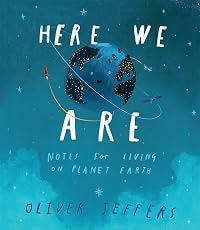
Here We Are: Notes for Living on Planet Earth
by Oliver Jeffers
On This Page
Description
In this salutation from Earth, the chronicler gives a tour of the planet and introduces those who call it home.Tags
Recommendations
Member Reviews
Celebrated author/artist Oliver Jeffers, inspired by the birth of his son, presents a picture-book love letter to our planet in this beautiful new book. "Here we are," the narrator informs us, pointing to our blue globe, as it hangs in space. From the land to the sea, from people to animals, all the wonderful, marvelous kinds of creature and thing that go to make up our planet are detailed. So too are various pieces of advice about living in this world of ours, from cherishing the time we have (there isn't much of it) to being kind to the other residents. In the end, on Earth, you are never alone...
Here We Are: Notes for Living on Planet Earth is Jeffers' newest book, and I think that it is (along with A Child of Books) one of my show more absolute favorites. The narrative is simple, but immensely moving, highlighting as it does both the diversity and the unity of life on Earth. The artwork is simply breathtaking! Jeffers utilizes a gorgeous color palette here, whether it be the purples of space (and the mountains) or the rainbow hues of Earth's peoples, in their many different garbs. I think my favorite pages were those on which so many different people and animals were depicted. I loved some of the humorous details here - the Dodo Bird, on the animal page, is thinking "I'm not supposed to be here" - but most of all I loved the sense of heart, the sense that this truly is a meditation on all that is important, in our earth-bound lives. Recommended to Jeffers' fans, and to anyone looking for children's picture-books about living in and belonging to the world. show less
Here We Are: Notes for Living on Planet Earth is Jeffers' newest book, and I think that it is (along with A Child of Books) one of my show more absolute favorites. The narrative is simple, but immensely moving, highlighting as it does both the diversity and the unity of life on Earth. The artwork is simply breathtaking! Jeffers utilizes a gorgeous color palette here, whether it be the purples of space (and the mountains) or the rainbow hues of Earth's peoples, in their many different garbs. I think my favorite pages were those on which so many different people and animals were depicted. I loved some of the humorous details here - the Dodo Bird, on the animal page, is thinking "I'm not supposed to be here" - but most of all I loved the sense of heart, the sense that this truly is a meditation on all that is important, in our earth-bound lives. Recommended to Jeffers' fans, and to anyone looking for children's picture-books about living in and belonging to the world. show less
I love the dedication of this book:
“To my son, Harland: This book was written in the first two months of your life as I tried to make sense of it all for you. These are the things I think you need to know.”
The author begins by explaining, “There is much to see and do here on Earth, so let’s get started with a quick tour.”
He writes about how the planet is made up of two parts: the land and the sea, and provides the basics about each. He then delves into the subject of people:
“On our planet, there are people.
One people is a person.
You are a person. You have a body.
Look after it, as most bits
Don’t grow back.”
He observes that there are many different kinds of people who live on Earth. He says: “We may all look different, show more act different and sound different . . . but don’t be fooled, we are all people.”
He talks about what people do, and how sometimes life seems to move slowly, and sometimes quickly: “It will be gone before you know it.”
He says, “It looks big, Earth. But there are lots of us on here (7,327,450,667 and counting) so be kind. There is enough for everyone.”
As he said in an interview, “I was explaining to my son the things that I find fascinating, which is that we are just this ball floating around this other ball.”
The author is also the illustrator, and employs bright colors and whimsical portrayals of people and animals.
Evaluation: The text is perfect for kids, and witty and wise enough to please the adults reading the book to their kids as well. The core messages - to be kind, accept difference, and appreciate the planet, will help teach children and give even the little ones much to contemplate. show less
“To my son, Harland: This book was written in the first two months of your life as I tried to make sense of it all for you. These are the things I think you need to know.”
The author begins by explaining, “There is much to see and do here on Earth, so let’s get started with a quick tour.”
He writes about how the planet is made up of two parts: the land and the sea, and provides the basics about each. He then delves into the subject of people:
“On our planet, there are people.
One people is a person.
You are a person. You have a body.
Look after it, as most bits
Don’t grow back.”
He observes that there are many different kinds of people who live on Earth. He says: “We may all look different, show more act different and sound different . . . but don’t be fooled, we are all people.”
He talks about what people do, and how sometimes life seems to move slowly, and sometimes quickly: “It will be gone before you know it.”
He says, “It looks big, Earth. But there are lots of us on here (7,327,450,667 and counting) so be kind. There is enough for everyone.”
As he said in an interview, “I was explaining to my son the things that I find fascinating, which is that we are just this ball floating around this other ball.”
The author is also the illustrator, and employs bright colors and whimsical portrayals of people and animals.
Evaluation: The text is perfect for kids, and witty and wise enough to please the adults reading the book to their kids as well. The core messages - to be kind, accept difference, and appreciate the planet, will help teach children and give even the little ones much to contemplate. show less
I am charmed. A very good birthday gift to a recently birthed child. It doesn't resemble Mo Willem's instruction manual, but it delighted me just as much.
Library copy
Library copy
This book is a beautifully illustrated book about a broad number of subjects within earth science. It has a lot of scientific content about space, anatomy, land, sea, and more.
I love this book. It has amazing illustrations and great pedagogical content. It gives kids a really engaging form of learning about a lot of different kinds of science.
This would be a great book to start with year with. It introduces such a wide variety of scientific topics that it would be great to just give students a hint as to what we'd be learning throughout the year.
I love this book. It has amazing illustrations and great pedagogical content. It gives kids a really engaging form of learning about a lot of different kinds of science.
This would be a great book to start with year with. It introduces such a wide variety of scientific topics that it would be great to just give students a hint as to what we'd be learning throughout the year.
I personally enjoyed this story due to the interactive and beautifully drawn illustrations that Jeffers adds to accompany the informational text about space and planet Earth, more specifically. Jeffers utilizes a variety of dark blues and purples to display mood and tone at the right moments of the text, and it helps readers to establish a foundation of Jeffers’ quirky writing style that does an exceptional job at explaining the “ins and outs” of planet Earth, such as the land and the people that inhabit it. For example, Jeffers writes “People come in many shapes, sizes and colors. We may all look different, act different and sound different….but don’t be fooled, we are all people.” To accompany this writing, Jeffers show more includes several pictures/drawings of a variety of individuals to represent the diverse and enormous population of the world. Not only does this bring to light the differences that can be seen among people internationally, but it also includes the point that there are similarities between all people. This in itself is an important message for all young readers to hear/read, and this is one of the many reasons why I enjoyed not just this piece of Jeffers’s literary work, but all of his books. show less
I got this book for my (then) 4 year old son. What I really liked about it was that it seemed like a welcome guide, or handbook for living on Earth, from a father to his baby. It talks about Earth's place in our solar system. That Earth's surface is land and water. On one page it shows the sky, with the moon orbiting us and us orbiting the sun. It shows stars, constellations, planets, our atmosphere, our air, the water cycle etc. All of that on one page. Like I said, it is a welcome guide, a taste of what we know. It then goes on to talk about the human body and the very important parts, like the brain, the heart and lungs. And how people need food, water and warmth. Then it talks about how different people are, but are really still show more just people. It then talks about many different animals in the animal kingdom, and how they don't speak our language but that is not any reason to not be nice to them. It even talks about how time can move slowly on Earth, but mostly it will move fast for us.
One of my favorite parts is that it talks about how we have come a long way, but there is still so much to learn and do.Which I think can be so inspiring for a child, because it might seem as if everything has been done. It then encourages you to ask questions, and the author says to ask him or any one of the other 7 billion people on the planet.
I really love this book because it starts the conversation on so many topics, most of them science related, some sociological in nature. It starts you thinking about how many things are connected and it piqued the interest of my son. The illustrations are pretty too. show less
One of my favorite parts is that it talks about how we have come a long way, but there is still so much to learn and do.Which I think can be so inspiring for a child, because it might seem as if everything has been done. It then encourages you to ask questions, and the author says to ask him or any one of the other 7 billion people on the planet.
I really love this book because it starts the conversation on so many topics, most of them science related, some sociological in nature. It starts you thinking about how many things are connected and it piqued the interest of my son. The illustrations are pretty too. show less
Here we are indeed. Planet Earth has some interesting commodities that make life here possible. This book really makes you think about the fabrics that make our meta-cognitive universe. It kinda scares me when I think about all the different clockwork pieces that fit together to make life work. It also makes me think about how we might just be simulated pieces that mirror a multi-complex-minded robot. I liked this book.
Members
- Recently Added By
Lists

Youth: Earth Science
205 works; 1 member

Youth: Astronomy
42 works; 1 member

Youth: Social Values
194 works; 1 member
Author Information

82+ Works 20,846 Members
Oliver Jeffers was born in Port Hedland, Western Australia in 1977. He grew up in Belfast, Northern Ireland. He received a First Class Honors Degree in illustration and visual communication and certificate of foundation studies from the University of Ulster, School of Art and Design in 2001. His work has been exhibited in multiple cities, show more including the National Portrait Gallery in London, the Brooklyn Museum, and Gestalten Space in Berlin. He writes and illustrates picture books. His debut book, How to Catch a Star, was published in 2004 and won a Merit Award at the CBI/Bisto Book of Year Awards. His second book, Lost and Found, won the Gold Award at Nestle Children's Book Prize and was developed into an animated short film, which has received over sixty awards including a BAFTA for Best Animated Short Film. His other books include The Incredible Book Eating Boy, The Great Paper Caper, Up and Down, Stuck, This Moose Belongs to Me, Once upon an Alphabet: Short Stories for All Letters, The Hueys series and A Child of Books. He has won numerous awards including the Smarties Award, Irish Book of the Year, The Blue Peter Book of the Year, and the 2017 Academy of British Cover Design Award in the Children's category. (Bowker Author Biography) show less
Awards and Honors
Awards
Distinctions
Notable Lists
Common Knowledge
- Original publication date
- 2017
Classifications
Statistics
- Members
- 1,416
- Popularity
- 16,707
- Reviews
- 49
- Rating
- (4.43)
- Languages
- 11 — Catalan, Chinese, Czech, Dutch, English, French, German, Irish, Italian, Portuguese, Spanish
- Media
- Paper, Audiobook, Ebook
- ISBNs
- 26
- ASINs
- 4