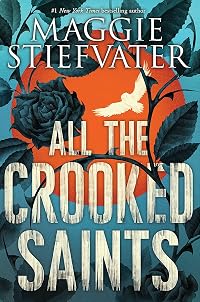
All the Crooked Saints
by Maggie Stiefvater
On This Page
Description
Here is a thing everyone wants: A miracle. Here is a thing everyone fears: What it takes to get one. Any visitor to Bicho Raro, Colorado is likely to find a landscape of dark saints, forbidden love, scientific dreams, miracle-mad owls, estranged affections, one or two orphans, and a sky full of watchful desert stars. At the heart of this place you will find the Soria family, who all have the ability to perform unusual miracles. And at the heart of this family are three cousins longing to show more change its future: Beatriz, the girl without feelings, who wants only to be free to examine her thoughts; Daniel, the Saint of Bicho Raro, who performs miracles for everyone but himself; and Joaquin, who spends his nights running a renegade radio station under the name Diablo Diablo. They are all looking for a miracle. But the miracles of Bicho Raro are never quite what you expect. show lessTags
Recommendations


















Member Reviews
Why are all of Stiefvater's words literary and poetical, moving and epic? Her books always suck me in, especially the stand-alones, and this one did not disappoint. There are so many beautiful characters and stories interwoven into this novel, I related to a number of our characters with their unique and everyday issues.
I just really love the idea of manifesting miracles into physical ailments. People beg for miracles everyday, beseeching a higher power to help them change. And yet so often, we are the one's who hold the key to granting our own miracles(not medical ones, obviously), to change our own lives, if only we have the strength and introspection to do so. This book will hopefully remind us all of that.
I just really love the idea of manifesting miracles into physical ailments. People beg for miracles everyday, beseeching a higher power to help them change. And yet so often, we are the one's who hold the key to granting our own miracles(not medical ones, obviously), to change our own lives, if only we have the strength and introspection to do so. This book will hopefully remind us all of that.
Being a saint isn't easy, as too many members of the Sorio family know. There's not only the granting of miracles, there's the aftermath when the recipient has to figure out what the miracle means and what to do for the second miracle to take place. Because it takes both miracles before a pilgrim can move on.
For the saint and family, that means not interferring lest their own darkness appear. When a new pilgrim seeking a miracle, and a young man who just wants a truck to start a business, show up at the Sorio outpost in remote Bicho Raro, Colorado in the 1960s, it's going to be harder for all of the Sorios to not become involved.
In Maggie Stiefvater's magical new novel, All the Crooked Saints, the Sorios have known for generations that show more helping a pilgrim get to the second step of a miracle, after the saint performs the first miracle, is dangerous to the pilgrim and themselves. As a result, their little settlement is overrun with pilgrims who haven't found the solution, from a bride whose dress is covered in butterflies and who weeps rivers of sadness, to twins entangled by a snake, to a padre with a animal head.
But Pete and Tony, the new guys in town, set in motion changes that cannot be stopped. Pete has a hole in his heart but it is an organ filled with kindness and determination. He works harder than anyone, and falls in love with the desert. The desert, in return, loves him back. Tony is a DJ making a name for himself but cannot bear being stared at any longer. He is in search of a miracle.
The current saint is quiet Daniel. His two beloved cousins are Beatriz, the tinkerer who works mechanical wonders, and Joaquin, an amateur DJ and weaver of tales. The trio drive through the desert at night so Joaquin can broadcast via the pirate radio station Beatriz created. The station exists in the back of the truck Pete was prommised by a distant relative.
Although miracles that finish the quest of pilgrims are in short supply when the novel begins, the meeting of the determination of Pete and Tony with the traditions and family heritage of the Sorios results in a story filled with magic realism, hope, love and problems that were decades in the making. Stefvater has a beautiful way of using hyperbole to create the world of the Sorios, to enrich the characterizations and to make everyone's quest meaningful.
The novel is marketed for teens, but it is a one that anyone who loves fables and family stories should miss. All the Crooked Saints is a beautifully elegant story that can make a reader's heart ache, and sing. show less
For the saint and family, that means not interferring lest their own darkness appear. When a new pilgrim seeking a miracle, and a young man who just wants a truck to start a business, show up at the Sorio outpost in remote Bicho Raro, Colorado in the 1960s, it's going to be harder for all of the Sorios to not become involved.
In Maggie Stiefvater's magical new novel, All the Crooked Saints, the Sorios have known for generations that show more helping a pilgrim get to the second step of a miracle, after the saint performs the first miracle, is dangerous to the pilgrim and themselves. As a result, their little settlement is overrun with pilgrims who haven't found the solution, from a bride whose dress is covered in butterflies and who weeps rivers of sadness, to twins entangled by a snake, to a padre with a animal head.
But Pete and Tony, the new guys in town, set in motion changes that cannot be stopped. Pete has a hole in his heart but it is an organ filled with kindness and determination. He works harder than anyone, and falls in love with the desert. The desert, in return, loves him back. Tony is a DJ making a name for himself but cannot bear being stared at any longer. He is in search of a miracle.
The current saint is quiet Daniel. His two beloved cousins are Beatriz, the tinkerer who works mechanical wonders, and Joaquin, an amateur DJ and weaver of tales. The trio drive through the desert at night so Joaquin can broadcast via the pirate radio station Beatriz created. The station exists in the back of the truck Pete was prommised by a distant relative.
Although miracles that finish the quest of pilgrims are in short supply when the novel begins, the meeting of the determination of Pete and Tony with the traditions and family heritage of the Sorios results in a story filled with magic realism, hope, love and problems that were decades in the making. Stefvater has a beautiful way of using hyperbole to create the world of the Sorios, to enrich the characterizations and to make everyone's quest meaningful.
The novel is marketed for teens, but it is a one that anyone who loves fables and family stories should miss. All the Crooked Saints is a beautifully elegant story that can make a reader's heart ache, and sing. show less
Yay! So glad this one finally came my way! I just love Maggie Steifvater’s storytelling, and this book was no exception. She has a real knack for character arcs, and for creating scenarios where you’re taken on a satisfying emotional journey. I may have moments of suspense when I read a MS book, but I always feel good things are going to turn out well in the end.
I loved the family experience of the Soria’s. Beatriz, Joaquim, and Daniel have such different takes on their family legacy of being saints and the offering of miracles, and the burdens that come with that, and the different lenses through which they view the Soria experience are thrilling to read. I loved all the miniature love stories, all the moments of redemption, and show more just each little sweet moment of triumph. This book is different from her Raven Cycle, but no less enjoyable.
Please excuse typos/name misspellings. Entered on screen reader. show less
I loved the family experience of the Soria’s. Beatriz, Joaquim, and Daniel have such different takes on their family legacy of being saints and the offering of miracles, and the burdens that come with that, and the different lenses through which they view the Soria experience are thrilling to read. I loved all the miniature love stories, all the moments of redemption, and show more just each little sweet moment of triumph. This book is different from her Raven Cycle, but no less enjoyable.
Please excuse typos/name misspellings. Entered on screen reader. show less
Read the audiobook; the reader's voice enchantingly set the milieu for this quirky story about a family who can perform miracles. That is, they can make visible the personality traits their supplicants need to work on, but then it is up to the supplicant to make the final shift to wholeness or acceptance. I loved the extended family, and all their little bickering but still putting up with each other. Not sure where all the food they shared came from, we don't really hear about shopping trips, and living in the desert must present challenges for supporting all the hanges-on. And I doubt most of those have their own source of income.
Sometimes when I take my dog out at night, there's just something about the moon or the weather or the light that makes me tell the dog "Hurry up, this is ghost weather."
This book has ghost weather. "Well that's no surprise, Twitchy, all the miracles and blackness..." No, I mean beyond that.
Magical realism is a weird and tricky genre for me. I hated Love in the Time of Cholera for other reasons, but its sense of magical realism never struck me as anything past awkward coincidences. I love love love Raven Boys but I would call it fantasy. I think the otherworldly feeling this has even when it isn't being about saints/miracles/blackness is what I'm meant to get from magical realism, that sense of the book's world being both my world and show more also very much not.
I don't know that I'd call this YA, though, just because I'm used to YA characters having teenager YA problems, and these are hardly that.
Maggie Stiefvater's writing style seems to be like mushrooms, or candy corn, or pineapple on pizza: Strong opinions for or against, not a lot of in-betweens. I'm a fan! (also of mushrooms and pineapple, but not candy corn.) If you're familiar with it and want to know if it's in this too, yes, yes it is. If you're not familiar with it, try it out!
Also! If you liked this, but want even darker, maybe try out Zoo City by Lauren Beukes? Like a town of pilgrims described from the POV of the pilgrims. Hanging-on darkness, the magical realism spooky feeling. I kept thinking of it while I was reading this. show less
This book has ghost weather. "Well that's no surprise, Twitchy, all the miracles and blackness..." No, I mean beyond that.
Magical realism is a weird and tricky genre for me. I hated Love in the Time of Cholera for other reasons, but its sense of magical realism never struck me as anything past awkward coincidences. I love love love Raven Boys but I would call it fantasy. I think the otherworldly feeling this has even when it isn't being about saints/miracles/blackness is what I'm meant to get from magical realism, that sense of the book's world being both my world and show more also very much not.
I don't know that I'd call this YA, though, just because I'm used to YA characters having teenager YA problems, and these are hardly that.
Maggie Stiefvater's writing style seems to be like mushrooms, or candy corn, or pineapple on pizza: Strong opinions for or against, not a lot of in-betweens. I'm a fan! (also of mushrooms and pineapple, but not candy corn.) If you're familiar with it and want to know if it's in this too, yes, yes it is. If you're not familiar with it, try it out!
Also! If you liked this, but want even darker, maybe try out Zoo City by Lauren Beukes? Like a town of pilgrims described from the POV of the pilgrims. Hanging-on darkness, the magical realism spooky feeling. I kept thinking of it while I was reading this. show less
The members of the Soria family specialize in performing miracles, and pilgrims come to the Colorado desert from all over for their services. Lately, though, those pilgrims haven't been leaving, because they find the *second* miracle - which they must perform themselves to rid themselves of their personal darknesses (made flesh by the first miracle) - is not an easy thing to create. The Sorias themselves fear their own darknesses, and when the younger generation starts breaking the taboo of helping the pilgrims heal themselves, old fears and truths start coming out of the woodwork.
I admit that I didn't fall in love with this one as right-from-the-first-page-immediately as I did with the Raven Boys books, but I got there eventually and I show more do love this story and its characters. Stiefvater is fabulous at what she does (creating amazingly relatable and real characters nestled in a supernatural story that nevertheless seems totally plausible because why not?) and I'll be here for it every time. show less
I admit that I didn't fall in love with this one as right-from-the-first-page-immediately as I did with the Raven Boys books, but I got there eventually and I show more do love this story and its characters. Stiefvater is fabulous at what she does (creating amazingly relatable and real characters nestled in a supernatural story that nevertheless seems totally plausible because why not?) and I'll be here for it every time. show less
I swear I could eat up Steifvater's worlds with a spoon, they are so luscious and so satisfying. This time desert renegades with peculiar and problematic miraculous powers. Pirate radio! Fame and family and finding a new way through despite the tragedies of the past. And the imagery -- the baying dog pack, butterflies and rain, the giant and his memorable, obnoxious car. Everywhere miracles, everywhere saints.
Members
- Recently Added By
Lists

2018 Hugo Eligible Novels
170 works; 16 members

Books recommended by Calgary Public Library staff
1,588 works; 4 members
Author Information

71+ Works 53,003 Members
Maggie Stiefvater is the author of the bestselling Shiver Trilogy (Shiver, Linger and Forever) and The Raven Cycle Series. She is also the author of a book in the Spirit Animals Series (Hunted). Her title Sinner made The New York Times Best Seller List in 2014. Maggie attended Mary Washington College, graduating with a B.A. in history. She is also show more an artist, equestrian, musician, and technical editor. She enjoys writing full time from her home in Virginia. (Bowker Author Biography) show less
Some Editions
Awards and Honors
Awards
Distinctions
Notable Lists
Common Knowledge
- Canonical title
- All the Crooked Saints
- Original publication date
- 2017
- People/Characters
- Beatriz Soria; Daniel Soria; Joaquin Soria; Francisco Soria; Antonia Soria; Pete Wyatt (show all 7); Tony DiRisio
- Important places
- Colorado, USA
- Dedication
- For David,
finally - First words
- You can hear a miracle a long way after dark.
- Last words
- (Click to show. Warning: May contain spoilers.)“Yes,” Daniel said. “We do.”
- Original language
- English
Classifications
- Genres
- Fiction and Literature, Teen, Fantasy, Young Adult
- DDC/MDS
- 813.6 — Literature & rhetoric American literature in English American fiction in English 2000-
- LCC
- PZ7 .S855625 .A — Language and Literature Fiction and juvenile belles lettres Fiction and juvenile belles lettres Juvenile belles lettres
- BISAC
Statistics
- Members
- 1,312
- Popularity
- 18,462
- Reviews
- 59
- Rating
- (3.80)
- Languages
- 5 — English, German, Polish, Spanish, Portuguese (Portugal)
- Media
- Paper, Audiobook, Ebook
- ISBNs
- 20
- ASINs
- 6