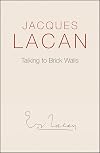
Talking to Brick Walls: A Series of Presentations in the Chapel at Sainte-Anne Hospital
by Jacques Lacan
On This Page
Description
'I've been talking to brick walls' says Lacan, meaning: 'Neither to you, nor to the Big Other. I'm speaking by myself. And this is precisely what interests you. It's up to you to interpret me.' These brick walls are those of the chapel at Sainte-Anne hospital. Getting back in touch with his younger years as a junior doctor, Lacan amuses himself, improvises, and lets himself go. The intention is a polemical one: the best of his pupils, captivated by the idea that analysis evacuates all prior show more knowledge, have been raising the banner of non-knowledge, borrowed from Bataille. No, says Lacan, psychoanalysis proceeds from a supposed knowledge, that of the unconscious. One gains access to it by the path of truth (the analysand ventures to say what comes to mind, frankly and with no frills) when it comes to an end in jouissance (the analyst interprets what the analysand says in terms of libido). However, two further paths bar access to this one: ignorance (to devote oneself to it with passion is always to consolidate established knowledge), and power (the passion for might obliterates what is revealed by parapraxes). Psychoanalysis teaches the virtues of powerlessness: this, at least, respects the real. A wise lesson for an era, this era of ours, that has seen bureaucracy, arm in arm with science, dreaming of changing humankind in its deepest reaches - through propaganda, through direct manipulation of the brain, through biotechnology, and even through social engineering. Admittedly things were no better before, but tomorrow they could be far worse. Jacques-Alain Miller show lessTags
Member Reviews
Talking to Brick Walls consists of three talks that Lacan gave at the end of 1971 and the beginning of 1972 on the topic of The Psychoanalyst's Knowledge. Although his Seminar was taking place at the Law Faculty at the Sorbonne, Lacan returned here to the original public site of the Seminar at the Sainte-Anne Hospital. These talks were given in the lead-up to Seminar XIX, on the topic "...or Worse."
The first talk, "Knowledge, Ignorance, Truth and Jouissance," starts with a meditation on ignorance as being important for showing up the value of knowledge. Lacan flits around to various topic, but settles on none, choosing instead to repeat his various slogans without giving much explanation.
The second talk, "On Incomprehension and Other show more Themes," begins with a question that one woman had asked Lacan: "Is the failure to comprehend Lacan a symptom?" Lacan insists that people must be able to understand him at some level, since they keep coming back to listen to him. He then gives a long, rambling discourse about the interplay between the symbolic, the real, and science.
The third talk, "I've Been Talking to Brick Walls," sees a nostalgic Lacan reflecting on his former times at the Sainte-Anne Hospital. He then makes a series of plays on the word for wall (la mur) and love (l'amour) that goes nowhere at all.
The volume also includes an appendix that is supposed to clarify the meaning of the last talk, but fails to add anything of interest.
Talking to Brick Walls is the third in this series of books by Polity Press that seeks to "fill in" various gaps in the Lacanian record. Unfortunately, this lead-up to Seminar XIX is a disappointment, showing an unfocused Lacan simply riffing on established grooves rather than doing anything really new or insightful. show less
The first talk, "Knowledge, Ignorance, Truth and Jouissance," starts with a meditation on ignorance as being important for showing up the value of knowledge. Lacan flits around to various topic, but settles on none, choosing instead to repeat his various slogans without giving much explanation.
The second talk, "On Incomprehension and Other show more Themes," begins with a question that one woman had asked Lacan: "Is the failure to comprehend Lacan a symptom?" Lacan insists that people must be able to understand him at some level, since they keep coming back to listen to him. He then gives a long, rambling discourse about the interplay between the symbolic, the real, and science.
The third talk, "I've Been Talking to Brick Walls," sees a nostalgic Lacan reflecting on his former times at the Sainte-Anne Hospital. He then makes a series of plays on the word for wall (la mur) and love (l'amour) that goes nowhere at all.
The volume also includes an appendix that is supposed to clarify the meaning of the last talk, but fails to add anything of interest.
Talking to Brick Walls is the third in this series of books by Polity Press that seeks to "fill in" various gaps in the Lacanian record. Unfortunately, this lead-up to Seminar XIX is a disappointment, showing an unfocused Lacan simply riffing on established grooves rather than doing anything really new or insightful. show less
Members
- Recently Added By
Lists

TLS 6009
39 works; 1 member
Author Information

205+ Works 6,066 Members
Jacques Lacan was born into an upper-middle-class Parisian family. He received psychiatric and psychoanalytic training, and his clinical training began in 1927. His doctoral thesis, "On Paranoia and Its Relation to Personality," already indicated an original thinker; in it he tried to show that no physiological phenomenon could be adequately show more understood without taking into account the entire personality, including its engagement with a social milieu. Practicing in France, Lacan led a "back to Freud" movement in the most literal sense, at a time when others were trying to interpret Sigmund Freud (see also Vol. 3) broadly. He emphasized the role of the image and the role of milieu in personality organization. Seeking to reinterpret Freud's theories in terms of structural linguistics, Lacan believed that Freud's greatest insight was his understanding of the "talking cure" as revelatory of the unconscious. By taking Freud literally, Lacan led a psychoanalytic movement that evolved into a very specific school of interpretation. Often embroiled in controversy, in the 1950s he opposed the standardization of training techniques, the classification of psychoanalysis as a medical treatment, and the then emerging school of ego psychology. Although general readers may find Lacan difficult to read, his works are provocative and rewarding. (Bowker Author Biography) show less
Work Relationships
Is contained in
Classifications
Statistics
- Members
- 14
- Popularity
- 1,676,437
- Reviews
- 1
- Rating
- (2.00)
- Languages
- English, French, German, Portuguese
- Media
- Paper
- ISBNs
- 4