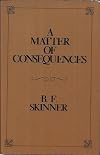
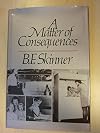
A Matter of Consequences
by B. F. Skinner
29 Members (2.50)
On This Page
Description
The first two volumes of Dr. Skinner's autobiography (Particulars of My Life and The Shaping of a Behaviorist) revealed his small-town boyhood and youth, and mapped out the development and implementation of his psychological theories, his experimental studies, and his writing, bringing us up to the time of the publication of Walden Two, perhaps the most successful modern utopian novel. In the present volume, he applies himself to a further explanation of his methods and philosophy, and show more delineates the ways in which his ideas have changed, grown, and been reinforced. This is the third and final volume of his autobiography. "Here is B.F. Skinner--in the third and final volume of his autobiography--writing about himself during the past thirty years: years in which the passionate debate over his work raged, and which he himself has evolved into one of the major controversial figures of our time. The first two volumes of Dr. Skinner's autobiography (Particulars of My Life and The Shaping of a Behaviorist) revealed his small-town boyhood and youth, mapped out the development and implementation of his psychological theories, his experimental studies, and his writing, bringing us up to the time of the publication of Walden Two, perhaps the most successful modern utopian novel. In the present volume, he applies himself to a further explanation of his methods and philosophy, and delineates the ways in which his ideas have changed, grown, and been reinforced. "I think I am beginning to see the scope of behavioral--or behavioristic--analysis," he wrote in 1972. "It does talk about the important things; it does point to conditions which can be changed; it does show what is wrong with other ways of talking about things." Dr. Skinner reiterates his belief in the benefits of the "Skinner Box" (a name maliciously coined by its critics--its correct name is "Aircrib," and it is intended as an aid to parents, not a replacement for them), citing his own experience with it raising his young daughter, and the experience of other parents who have used it successfully. He discusses the various attempts to found utopian communities based on Walden Two. And he defends his behavioral philosophy, and the application of it, against specific arguments and questions raised by his detractors over the past three decades. Parallel to--and often concurrent with--his professional concerns are those of more personal nature. Dr. Skinner writes about his family; about the growth and development of his daughters (which he closely recorded in order to satisfy both his paternal concern and his scientific interest), and his own intense involvement in their lives. He writes about his interest in music, literature, drama, and art; and about his relationships--good and bad--with friends and colleagues, especially at Harvard, where he spent most of his twenty-seven years of teaching. And he discusses the ways in which his lifelong professional study of human behavior has both reflected and affected his private life. Dr. Skinner brings to this closing volume of his autobiography the full range if his intellectual, philosophical, and emotional concerns. It is both a summing up of, and an apologia for, his life and work--a crucial document for all those who have followed the development of his ideas, and an important addition to the literature of modern psychology."--Provided by publisher show lessTags
Recommendations

































Member Reviews
Members
- Recently Added By
Author Information

55+ Works 4,946 Members
B. F. Skinner, an American behavioral psychologist, is known for his many contributions to learning theory. His Behavior of Organisms (1938) reports his experiments with the study of reflexes. Walden Two (1949), a utopian novel, describes a planned community in which positive rather than negative reinforcers serve to maintain appropriate behavior; show more the novel stimulated the founding of some experimental communities. In Beyond Freedom and Dignity (1971), Skinner attempted to show that only what he called a technology of behavior could save democracy from the many individual and social problems that plague it. (An early example of this technology is the so-called Skinner box for conditioning a human child.) A teacher at Harvard University from 1948 until his retirement, Skinner was for some the model of the objective scientist, for others the epitome of the heartless behaviorist who would turn people into automatons. (Bowker Author Biography) show less
Classifications
Statistics
- Members
- 29
- Popularity
- 956,766
- Rating
- (2.50)
- Languages
- English
- Media
- Paper
- ISBNs
- 2
- ASINs
- 2