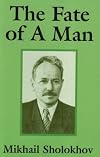
The Fate of a Man
by Mikhail Sholokhov
On This Page
Description
There is restraint and a trace of sadness in the way Mikhail Sholokov begins his story, as if to warn the reader that it is not an easy tale he has to tell.One postwar spring the author met a tall man with stooping shoulders and big rugged hands. And perhaps for the first and last time soldier Andrei Sokolov told a chance acquaintance the story of his life, told how he endured tortures and sufferings that would have broken many a man of weaker nature... But Sokolov's torn and wounded heart show more is still eager for life and eager to share life with his little Vanya, orphaned by the war like himself.Sholokov's The Fate of a Man ends on a stern note. Yet as one closes the book one believes that Andrei Sokolov will give all the strength of his generous Russian soul to his adopted son and that the boy will grow at his father's side into another man who can overcome any obstacle if his country calls upon him to do so. show lessTags
Recommendations






















Member Reviews
aron raivaajat -kirja
Russian/Reader/Annotated
Kniha je vystavená ako rozhovor autora s hrdinom, bývalým vojakom-vodičom Andrejom Sokolovom. Sokolov sa po jednom roku na vojne dostal v máji 1942 do nemeckého zajatia. Po nekonečných útrapách, neľudskému tyraniu a ťažkých prácach v Nemecku, ktoré musel znášať celé dva roky, sa znovu prebil k svojím. Vo vojne však stratil celú rodinu (ženu Irinu, dcérky Nastenku a Olušku a na vojne neskôr tiež syna Anatolije) a zostal úplne sám s nezodpovedanou otázkou, čím si zavinil tak ťažký osud. Skormútený ťažkými zážitkami sa Sokolov snaží nájsť novú vôľu k životu, nájsť zmysel ďalšej existencie. Tento zmysel nájde v malom cudzom chlapcovi Váňovi, ktorého vojna tiež pripravila o show more všetkých blízkych. show less
Aug 28, 2021Slovak
A kötet 10 nagyon rövid novellát tartalmaz, a leghosszabb novella is csak kb. 40 oldal.
A legtöbb novella a polgárháborúban megosztott kozákságról szól, de ezek a novellák olyan rövidek, hogy tulajdonképpen egyetlen mondattal az összes novella összefoglalható: a háború szar, és ráadásul értelmetlen is. Az mindenképpen pozitív, hogy nem igazán foglal állást az író az egyik oldal mellett sem.
A címadó novella kicsit hosszabb a többinél, de így sem sokkal összetettebb. Egy kissé feleslegesnek tűnő kerettörténetben egy II. világháborúban harcoló, majd német fogságba eső szovjet katona történetét ismerjük meg. A korábbiakhoz képest annyi az újdonság, hogy ennek a történetnek legalább a show more végén van egy kevés reménysugár. Nagyon-nagyon halvány persze.
A novelláskötet összes novellája végtelenül szomorú és lelombozó hangulatot áraszt ( az író látszólag érzéketlen, szenvtelen stílusa csak fokozza ezt a hatást ), egyetlen novella volt csak ami vidámabb történetet mesélt el, ez a nők szerepének változását mutatta be. show less
A legtöbb novella a polgárháborúban megosztott kozákságról szól, de ezek a novellák olyan rövidek, hogy tulajdonképpen egyetlen mondattal az összes novella összefoglalható: a háború szar, és ráadásul értelmetlen is. Az mindenképpen pozitív, hogy nem igazán foglal állást az író az egyik oldal mellett sem.
A címadó novella kicsit hosszabb a többinél, de így sem sokkal összetettebb. Egy kissé feleslegesnek tűnő kerettörténetben egy II. világháborúban harcoló, majd német fogságba eső szovjet katona történetét ismerjük meg. A korábbiakhoz képest annyi az újdonság, hogy ennek a történetnek legalább a show more végén van egy kevés reménysugár. Nagyon-nagyon halvány persze.
A novelláskötet összes novellája végtelenül szomorú és lelombozó hangulatot áraszt ( az író látszólag érzéketlen, szenvtelen stílusa csak fokozza ezt a hatást ), egyetlen novella volt csak ami vidámabb történetet mesélt el, ez a nők szerepének változását mutatta be. show less
Mar 20, 2014Hungarian
Ratings
Members
- Recently Added By
Author Information

289+ Works 3,835 Members
For decades a pillar of the Soviet literary establishment, Sholokhov owes his stature to And Quiet Flows the Don (1928--40), a four-volume epic of the life and fate of the Don Cossacks in the Revolution and civil war. Although himself a party member, Sholokhov depicts fairly impartially both sides in the conflict between the Reds and the Whites show more and shows how his hero, Grigory Melekhov, is driven by background and fate from one camp to the other. This realistic novel captures the exotic Cossack milieu superbly, and the whole works on a scale unseen since Tolstoy's War and Peace. Among Sholokhov's later works, Virgin Soil Upturned (1932--60), which deals with the collectivization of agriculture, deserves particular mention; the first volume is far more direct and honest than the much-later second volume. Over the years, Sholokhov's authorship of And Quiet Flows the Don has been questioned, most recently by Solzhenitsyn, but Sholokhov has had strong defenders in both the Soviet Union and the West. His political stance accounts for part of the anger directed against him. Extremely conservative, Sholokhov made vicious attacks on dissidents and the West and, aside from his concern for environmental issues, was a devoted follower of the party line. Sholokhov was awarded the Nobel Prize for Literature in 1965. (Bowker Author Biography) show less
Some Editions
Awards and Honors
Distinctions
Series
Belongs to Publisher Series
Work Relationships
Is contained in
Has the adaptation
Common Knowledge
- Canonical title
- The Fate of a Man
- Original title
- Судьба человека
- Alternate titles
- Ein Menschenschicksal : Erzählung; One Man’s Destiny
- Original publication date
- 1957 (Russisch) (Russisch); 1960 (Deutsch) (Deutsch)
- Dedication*
- Eugenii Griigoriewnie Lewickiej, członkowi KPZR od 1903 roku
- Original language*
- Russisch
*Some information comes from Common Knowledge in other languages. Click "Edit" for more information.
Classifications
- Genres
- Fiction and Literature, General Fiction
- DDC/MDS
- 891.7342 — Literature & rhetoric Asian Literature East Indo-European and Celtic literatures Russian and East Slavic languages Russian fiction USSR 1917–1991 Early 20th century 1917–1945
- LCC
- PG3476 .S52 — Language and Literature Slavic languages and literatures. Baltic languages. Albanian language Slavic. Baltic. Albanian Russian literature Individual authors and works 1917-1960
- BISAC
Statistics
- Members
- 158
- Popularity
- 205,253
- Reviews
- 4
- Rating
- (3.88)
- Languages
- 14 — Albanian, Dutch, English, Estonian, Finnish, German, Hungarian, Norwegian, Polish, Portuguese, Russian, Slovak, Spanish, Swedish
- Media
- Paper, Ebook
- ISBNs
- 15
- ASINs
- 10