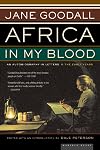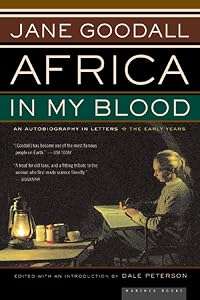
Africa in My Blood: An Autobiography in Letters: The Early Years
by Jane Goodall
On This Page
Description
Details the early life of English naturalist Jane Goodall through letters and travel diaries from her childhood, to her education at Oxford, to her historic trip to Africa where she meets Louis Leakey and begins her work with Chimpanzees.Tags
Recommendations






Member Reviews
Africa in My Blood: An Autobiography in Letters - Goodall/Peterson
3 stars
The sub-title says it all. This is a collection of Jane Goodall’s correspondence, beginning with a childish note to her mother written in 1942 and ending with the personal and business letters of 1967. Each chapter is introduced with biographical and interpretive information written by Dale Peterson.
I have great admiration for Jane Goodall. I stood in line for a signed copy of this book at an early Los Angeles Times Book Festival. I’d dipped into the book to read bits and pieces over the years, but this is the first time that I read it cover to cover. It was not an easy book to read. As much as I respect this woman, or possibly because I respect her, I show more didn’t like reading her very personal letters. I wasn’t especially interested in her personal life and it felt like an invasion of her privacy. Much of the early correspondence bored me, until she started writing from Gombe.
There were some insights to be gained from this book that made it worth reading. It brought home the very primitive nature of Goodall’s early research. This isn’t news, but her personal letters highlight her absolute focus on her task despite dire conditions and a substantial amount of serious illness. It’s unfortunate that these are all Goodall’s letters to others, and not their letters to her, but it’s clear that even at a distance, she was very connected to her family and dependent on them for emotional support. Her early, pervasive interest in animals is everywhere in her letters. Even in her earliest letters, it is sometimes difficult to tell if she is talking about an animal or a person in her comments.
I think my biggest take-away from this reading has to be the vast changes in technology that have taken place since the mid-twentieth century. She apologized for writing on airmail flimsy paper. Letters were lost and she waited weeks for return mail. Funding was not only limited but how the money would be distributed was complicated (the check was in the mail, but the river is flooded….). She wrote her reports on malfunctioning manual typewriters. The most technologically complicated piece of equipment that she started with was probably a pair of binoculars. Film from her first poor photographic efforts (before Hugo van Lawick arrived) were frequently overexposed or had film damaged by heat or water.
I’m just about to press a button to post this inconsequential book review to anyone in the world who would like to read it. It boggles the mind. show less
3 stars
The sub-title says it all. This is a collection of Jane Goodall’s correspondence, beginning with a childish note to her mother written in 1942 and ending with the personal and business letters of 1967. Each chapter is introduced with biographical and interpretive information written by Dale Peterson.
I have great admiration for Jane Goodall. I stood in line for a signed copy of this book at an early Los Angeles Times Book Festival. I’d dipped into the book to read bits and pieces over the years, but this is the first time that I read it cover to cover. It was not an easy book to read. As much as I respect this woman, or possibly because I respect her, I show more didn’t like reading her very personal letters. I wasn’t especially interested in her personal life and it felt like an invasion of her privacy. Much of the early correspondence bored me, until she started writing from Gombe.
There were some insights to be gained from this book that made it worth reading. It brought home the very primitive nature of Goodall’s early research. This isn’t news, but her personal letters highlight her absolute focus on her task despite dire conditions and a substantial amount of serious illness. It’s unfortunate that these are all Goodall’s letters to others, and not their letters to her, but it’s clear that even at a distance, she was very connected to her family and dependent on them for emotional support. Her early, pervasive interest in animals is everywhere in her letters. Even in her earliest letters, it is sometimes difficult to tell if she is talking about an animal or a person in her comments.
I think my biggest take-away from this reading has to be the vast changes in technology that have taken place since the mid-twentieth century. She apologized for writing on airmail flimsy paper. Letters were lost and she waited weeks for return mail. Funding was not only limited but how the money would be distributed was complicated (the check was in the mail, but the river is flooded….). She wrote her reports on malfunctioning manual typewriters. The most technologically complicated piece of equipment that she started with was probably a pair of binoculars. Film from her first poor photographic efforts (before Hugo van Lawick arrived) were frequently overexposed or had film damaged by heat or water.
I’m just about to press a button to post this inconsequential book review to anyone in the world who would like to read it. It boggles the mind. show less
An autobiography in the form of letters Jane Goodall has written to family throughout her life. It gives insight for her passion of chimps and how she considered them family.
The time spent on her studies was monumental. It was a good way to see her on a personal level and her family origin.
The time spent on her studies was monumental. It was a good way to see her on a personal level and her family origin.
I thought this was a great book to learn more about Jane Goodall and her work with chimpanzees.
Ratings
Members
- Recently Added By
Lists

Books With Body Parts in the Title
153 works; 9 members
Author Information

69+ Works 10,114 Members
Jane Goodall, 1934 - Jane Goodall, a well-respected English zoologist, is famous for her fieldwork with chimpanzees in Africa. An early interest in African wild animals and the opportunity, at age 18, to stay on a friend's farm in Kenya, led her to Dr. Louis Leakey; then curator of the National Museum of Natural History in Nairobi. Almost show more immediately Leakey hired Goodall as his assistant secretary, and she was soon accompanying Leakey and his wife on their expeditions. Following Leakey's suggestion that a field study of some of the higher primates would be a major contribution to the understanding of animal behavior, she began studying the chimpanzees of the Gombe Stream Research Center in Tanganyika (now Tanzania) in 1960. Although she had no undergraduate degree, Goodall earned a Ph.D. from Cambridge University in 1965, based on her first five years of research at the Gombe Center. After more than 20 years of extensive study and direct contact with wild chimpanzees in their natural habitat, Goodall continues to research, teach, and write about primate behavior today. (Bowker Author Biography) Jane Goodall's research at Gombe, Tanzania, is entering its fifth decade. Her books include "In the Shadow of Man", "Through a Window: My Thirty Years with the Chimpanzees of Gombe", & "Africa in My Blood: An Autobiography in Letters", edited by Dale Peterson. She resides in Dar es Salaam, Tanzania. (Bowker Author Biography) show less
Common Knowledge
- Original title
- Africa in My Blood: An Autobiography in Letters: The Early Years
- People/Characters
- Jane Goodall; Margaret Myfanwe Morris-Goodall; Judith Daphne Morris-Goodall; Elizabeth Hornmby Legarde Joseph; Elizabeth Olwen Joseph; Mary Audrey Gwyneth Joseph (show all 23); William Eric Joseph; Bernard Verdcourt; Desmond Morris; Louis Leakey; Sally Cary; Susan Cary; Andrew Brown; Robert E. Gilka; Leonard Carmichael; Mary Griswold; Melville Bell Grosvenor; Melvin M. Payne; Joseph B. Roberts; Frederick G. Vosburgh; Paul Brooks; Nigel O'C. Wolff; Hugo Van Lawick
- Important places
- Tanzania
- Blurbers
- Gould, Stephen Jay
Classifications
Statistics
- Members
- 241
- Popularity
- 135,446
- Reviews
- 3
- Rating
- (3.75)
- Languages
- English
- Media
- Paper
- ISBNs
- 3
- UPCs
- 2
- ASINs
- 3