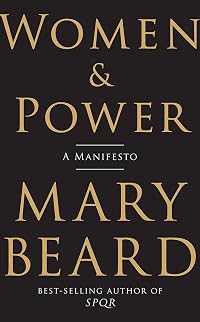
Women & Power: A Manifesto
by Mary Beard
On This Page
Description
Two essays connect the past with the present, tracing the history of misogyny to its ancient roots and examining the pitfalls of gender.Tags
Recommendations















Member Recommendations

Member Reviews
Mary Beard is a professor of Classics at Cambridge and the author of SPQR, the popular, critically-acclaimed and highly readable history of ancient Rome. So, what might she bring to the discussion of women and power, you might ask?
This small, powerful book contains two essays, rewrites from two lectures Beard gave. "The Public Voice of Women" discusses the ancient cultural underpinnings of how we see women & public speaking. She references classical literature, Shakespeare, even a bit of Henry James. And she begins with the first recorded example of a man telling a woman to "shut up."
The second essay/lecture "Women in Power" takes a look at women at just that, referencing everything from [Herland] by Charlotte Perkins Gilman, and the show more ancient Greek idioms still used to represent "the idea of women in, and out of, power." She discusses Margaret Thatcher handbag and Teresa May's "shoe thing" and how those things work to defy being packaged into a male template of power.
Beard suggests that rather than the fitting into the status quo that "...if women are not perceived to be fully within the structures of power, surely it is power that we need to redefine rather than women?" Chew on that.
This book was a holiday gift from the hubby, an excellent choice. I've read a fair number of feminist manifestos of one kind or another, and I found this small entry into the canon—Beard's perspective—to be powerful and enlightening, and an excellent read. show less
This small, powerful book contains two essays, rewrites from two lectures Beard gave. "The Public Voice of Women" discusses the ancient cultural underpinnings of how we see women & public speaking. She references classical literature, Shakespeare, even a bit of Henry James. And she begins with the first recorded example of a man telling a woman to "shut up."
The second essay/lecture "Women in Power" takes a look at women at just that, referencing everything from [Herland] by Charlotte Perkins Gilman, and the show more ancient Greek idioms still used to represent "the idea of women in, and out of, power." She discusses Margaret Thatcher handbag and Teresa May's "shoe thing" and how those things work to defy being packaged into a male template of power.
Beard suggests that rather than the fitting into the status quo that "...if women are not perceived to be fully within the structures of power, surely it is power that we need to redefine rather than women?" Chew on that.
This book was a holiday gift from the hubby, an excellent choice. I've read a fair number of feminist manifestos of one kind or another, and I found this small entry into the canon—Beard's perspective—to be powerful and enlightening, and an excellent read. show less
Two essays, delivered as lectures and somewhat refashioned for the print form, still have some of the momentum of the spoken word. Beard offers no solutions only directions in which to move our awareness and our thinking. In the first essay she outlines the Greek and Roman narratives--in literature and histories--and the ways that women are traditionally silenced, either by ridicule, by being ignored, or by, in some cases, having their tongues cut right out of their mouths. In our political culture, oratory is still the province of men. The deep, sonorous voice is preferred. Think of it the way you might imagine that a blue potato tastes 'different' from a white potato. We simply do not have any idea how deeply our prejudices against show more hearing and respecting the voices of women go--starting with a visceral response to women's voices especially when speaking outside of the domain assigned to them (protecting the family, women's issues, women's literature) etc. Beard guides the discussion towards the fact that this realization must come first, with awareness comes the possibility to take the next step.
In the second essay, Beard is less directly focussed on the past but rather on how the media (including the internet) use the imagery of the ancient western eras to portray women who have achieved positions of political power--usually negatively. She shows how some women have used female symbols creatively and, yeah, powerfully -- Maggie Thatcher and her handbag (Queen Elizabeth has also been a valiant handbag wielder -- apparently with nothing but a hankie and a few mints in it since she has no need to carry ID or money!). Beard took the time to analyze, for example, how often women who speak in public are described as shrill and whiney as well as how a woman politician who makes a mistake is vilified more strongly than a man who makes an equivalent mistake (or, um, like thousands that are far worse?). Again Beard can offer no solutions, only ideas for directions in which to move our thinking on these matters. A quick read, worth reading. ****1/2 show less
In the second essay, Beard is less directly focussed on the past but rather on how the media (including the internet) use the imagery of the ancient western eras to portray women who have achieved positions of political power--usually negatively. She shows how some women have used female symbols creatively and, yeah, powerfully -- Maggie Thatcher and her handbag (Queen Elizabeth has also been a valiant handbag wielder -- apparently with nothing but a hankie and a few mints in it since she has no need to carry ID or money!). Beard took the time to analyze, for example, how often women who speak in public are described as shrill and whiney as well as how a woman politician who makes a mistake is vilified more strongly than a man who makes an equivalent mistake (or, um, like thousands that are far worse?). Again Beard can offer no solutions, only ideas for directions in which to move our thinking on these matters. A quick read, worth reading. ****1/2 show less
Mary Beard is absolutely brilliant in these two lectures, The Public Voice Of Women delivered in 2014 and Women in Power delivered in 2017. In her academician’s voice she traces the dominant voice of men and the suppression of that of women in the public sphere, citing examples from Greek and Roman literature, her specialty. There are a few more modern literature references, as well as the perception of women’s voices in today’s media. She chronicles her own experience of abusive reaction to her writing, the silencing of Elizabeth Warren in the US Senate and the treatment of prominent world leaders such as Theresa May and Hillary Clinton, citing them as examples that we need to think differently about the structure of power:
We show more have to be more reflective about what power is, what it is for, and how it is measured. To put it another way, if women are not perceived to be fully within the structures of power, surely it is power that we need to redefine rather than women?
Start a conversation; discuss it with your friends. This is a manifesto. Beard doesn’t claim to have a solution. But has carefully laid out the case for one. show less
We show more have to be more reflective about what power is, what it is for, and how it is measured. To put it another way, if women are not perceived to be fully within the structures of power, surely it is power that we need to redefine rather than women?
Start a conversation; discuss it with your friends. This is a manifesto. Beard doesn’t claim to have a solution. But has carefully laid out the case for one. show less
These two short lectures are adapted into essays discussing the silencing of women and the separation of women from power. Beard uses her extensive knowledge of Greek and Roman culture to explore the earliest roots of misogyny and shows how these earliest ideas are sadly still a part of our culture. These essays are smart, clear, calm, and to-the-point. Definitely recommended.
You wouldn't think that a middle-aged classicist would attract the attention of the internet trolldom. You would be wrong. By appearing on television classical historian Mary Beard, of Cambridge University, managed to garner all sorts of attacks on her appearance, personality, sexuality and general right to be a public person. I mean how dare she expose an unwitting public to grey hair, a visibly middle-aged face and a lack of any effort toward sex appeal. Being an intellectual, her reaction was to think about the origins of these attitudes--the idea that women should keep quiet and never challenge men and generally not be a public presence except in a decorative manner. Not surprisingly, Beard finds examples of "sit down and shut up, show more woman" in our earliest literature. Interesting and well written. show less
There are few books like this anymore. We're used to long scholarly treatises and we're used to little soundbites that say everything and almost nothing at all.
What we've been missing is a call to arms. That's what a manifesto is. A mixed mission statement and an outrage. A rallying call and a hot pinprick of a single idea meant to sear itself into your brain.
That's what a manifesto is supposed to be. A wake-up call.
But what is this one in particular?
It's about the nature of power and misogyny, first cutting through the crap of old Greece through her quality scholarship and then directly applying the topic to our modern world. I can be boiled down to the Voice of Authority. If you don't have a lower register, you're told to shut up.
This show more isn't a joke, although it is furiously funny. It's no laughing matter, but many women and more men than you might think have gone crazy with the absolute absurdity of it.
But there you have it.
Sit down, shut up, bear with the assholes, bide your time, work within the system, tell yourself that one day the glass ceiling might be shattered, and eventually give up, frustrated, disheartened, and disillusioned.
Or postulate: "If the power game is rigged, then it's not women who need to change in order to get power. It's the nature of power that needs to be changed."
But what is power? Ah, well, that's the trick, isn't it?
IT IS WHAT WE DREAM UP. It's words. It's our decision to make. All of us. We can bow down to the almighty lower register or we could start listening to what ALL our smart PEOPLE have to say. Use logic. Reason. Clarity.
It's worth thinking about.
I'm a feminist. I'm also a man. It's freaking RATIONAL to be this. I'm not playing a Us vs Them game because it only leads to further cutting. The only way through this mess is TOGETHER.
So do I appreciate this manifesto?
Hell, yes.
And I part with you on a high note. A little Laurie Anderson that makes me laugh until I cry. Mach 20, yo.
https://www.youtube.com/watch?v=SirOxIeuNDE show less
What we've been missing is a call to arms. That's what a manifesto is. A mixed mission statement and an outrage. A rallying call and a hot pinprick of a single idea meant to sear itself into your brain.
That's what a manifesto is supposed to be. A wake-up call.
But what is this one in particular?
It's about the nature of power and misogyny, first cutting through the crap of old Greece through her quality scholarship and then directly applying the topic to our modern world. I can be boiled down to the Voice of Authority. If you don't have a lower register, you're told to shut up.
This show more isn't a joke, although it is furiously funny. It's no laughing matter, but many women and more men than you might think have gone crazy with the absolute absurdity of it.
But there you have it.
Sit down, shut up, bear with the assholes, bide your time, work within the system, tell yourself that one day the glass ceiling might be shattered, and eventually give up, frustrated, disheartened, and disillusioned.
Or postulate: "If the power game is rigged, then it's not women who need to change in order to get power. It's the nature of power that needs to be changed."
But what is power? Ah, well, that's the trick, isn't it?
IT IS WHAT WE DREAM UP. It's words. It's our decision to make. All of us. We can bow down to the almighty lower register or we could start listening to what ALL our smart PEOPLE have to say. Use logic. Reason. Clarity.
It's worth thinking about.
I'm a feminist. I'm also a man. It's freaking RATIONAL to be this. I'm not playing a Us vs Them game because it only leads to further cutting. The only way through this mess is TOGETHER.
So do I appreciate this manifesto?
Hell, yes.
And I part with you on a high note. A little Laurie Anderson that makes me laugh until I cry. Mach 20, yo.
https://www.youtube.com/watch?v=SirOxIeuNDE show less
"When it comes to silencing women, Wester civilization has had thousands of years of practice," writes Beard in the preface to her brief and brilliant book.
Because I live and work in settings that feel safe, places where my voice matters and finds respectful listeners, reading Beard's thoughtfully researched essays with images inspired by mythic stories gave me a quick reality check.
"...women, even when they are not silenced, still have to pay a high price for being heard..." What price? Everything from mansplaining to being called stupid and much worse. I don't have trolls calling me *unt or whore on social media, but such harangues happen countless times every day to thousands of people. Not for what they have said, but because they show more said anything while being female.
With millennia of this patterned behavior, the #metoo and #timesup movements are not only important, one wonders why they took so long to get started. show less
Because I live and work in settings that feel safe, places where my voice matters and finds respectful listeners, reading Beard's thoughtfully researched essays with images inspired by mythic stories gave me a quick reality check.
"...women, even when they are not silenced, still have to pay a high price for being heard..." What price? Everything from mansplaining to being called stupid and much worse. I don't have trolls calling me *unt or whore on social media, but such harangues happen countless times every day to thousands of people. Not for what they have said, but because they show more said anything while being female.
With millennia of this patterned behavior, the #metoo and #timesup movements are not only important, one wonders why they took so long to get started. show less
Members
- Recently Added By
Published Reviews
ThingScore 75
It’s a tonic to encounter a book that doesn’t just describe the scale of a problem but suggests remedies — and exciting ones at that. One solution recommended by Beard — enacted by her, really — is to cheerfully stand your ground. Beard is active on Twitter, where she famously engages with the legion of trolls who pick apart her work, age and appearance. She refuses to quit social show more media despite abuse that has extended to death threats. “It feels to me like leaving the bullies in charge of the playground,” she wrote on her blog after recent attacks against her. “It’s rather too much like what women have been advised to do for centuries. Don’t answer back, and just turn away.” show less
added by SnootyBaronet
Lists

The Guardian's 100 best books of the 21st century
100 works; 21 members

Review 3
41 works; 1 member

Review 2
36 works; 1 member

The Hive Recommends
62 works; 2 members

Books Read in 2020
4,379 works; 124 members

Female Author
1,235 works; 67 members

Books Read in 2023
5,547 works; 145 members

Books recommended by Calgary Public Library staff
1,588 works; 4 members

TBR of Books I Don't Own
132 works; 1 member
Author Information

50+ Works 15,375 Members
Some Editions
Awards and Honors
Awards
Distinctions
The Guardian Book of the Day (2017-11-05)
Common Knowledge
- Canonical title*
- Vrouwen & macht : een manifest
- Original title
- Women and Power: A Manifesto
- Original publication date
- 2017
- Dedication
- For Helen Morales
But I owe most to Helen Morales, once my colleague in Classics at Newnham College, Cambridge, now Professor at the Univerity of California, Santa Barbara. We talked through the issues, classical and otherwise, of women's powe... (show all)r and voice over long trans-atlantic phone calls. Among many other things, she pointed me in the direction of the Medusa imagery. This book is for her. - First words
- Preface
Women in the West have a lot to celebrate; let's not forget.
The Public Voice of Women
I want to start very near the beginning of the tradition of Western literature, and its first recorded example of a man telling a woman to 'shut up'; telling her that her voice was not to b... (show all)e heard in public.
Women in Power
In 1915 Charlotte Perkins Gilman published a funny, but unsettling, story entitled Herland.
Afterword, September 2017
Turning lectures into permanent print can be a tricky business. - Last words
- (Click to show. Warning: May contain spoilers.)Preface
When it comes to silencing women, Western culture has had thousands of years of practice.
(Click to show. Warning: May contain spoilers.)The Public Voice of Women
We need to work that out before we figure out how we modern Penelopes might answer back to our own Telemachuses - or, for that matter, just decide to lend Miss Triggs some hairpins.
(Click to show. Warning: May contain spoilers.)Women in Power
That boy.
(Click to show. Warning: May contain spoilers.)Afterword, September 2017
But for all that — as I hope this book shows — Telemachus' rebuke to his mother Penelope when she dares to open her mouth in public is one that still, too often, being replayed in the twenty-first century. - Blurbers
- Beech, Megan
- Original language
- English
- Canonical DDC/MDS
- 305.42
- Canonical LCC
- HQ1155
- Disambiguation notice
- Both 'The Public Voice of Women' and 'Women in Power' were originally lectures presented by Mary Beard in the LRB Winter Lecture series. Versions of the lectures appeared in the London Review of Books, 20 March 2014 an... (show all)d 16 March 2017 respectively. The lectures in this book have undergone "some very light updating".
*Some information comes from Common Knowledge in other languages. Click "Edit" for more information.
Classifications
- Genres
- Sexuality and Gender Studies, General Nonfiction, Nonfiction, History
- DDC/MDS
- 305.42 — Society, government, & culture Social sciences, sociology & anthropology Social group - Age, Gender, Ethnicity Women Social role and status of women
- LCC
- HQ1155 — Social sciences The family. Marriage, Women and Sexuality The Family. Marriage. Women Women. Feminism
- BISAC
Statistics
- Members
- 1,711
- Popularity
- 12,953
- Reviews
- 54
- Rating
- (4.00)
- Languages
- 11 — Catalan, Dutch, English, French, German, Greek, Italian, Polish, Spanish, Swedish, Portuguese (Portugal)
- Media
- Paper, Audiobook, Ebook
- ISBNs
- 32
- ASINs
- 9