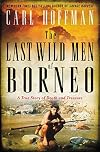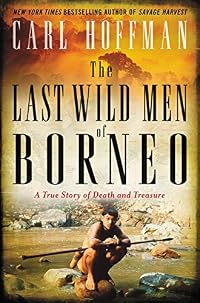
The Last Wild Men of Borneo: A True Story of Death and Treasure
by Carl Hoffman
On This Page
Description
Two modern adventurers sought a treasure possessed by the legendary "Wild Men of Borneo." One found riches. The other vanished forever into an endless jungle. Had he shed civilization—or lost his mind? Global headlines suspected murder. Lured by these mysteries, New York Times bestselling author Carl Hoffman journeyed to find the truth, discovering that nothing is as it seems in the world's last Eden, where the lines between sinner, saint and myth converge.In 1984, Swiss traveler Bruno show more Manser joined an expedition to the Mulu caves on Borneo, the planet's third largest island. There he slipped into the forest interior to make contact with the Penan, an indigenous tribe of peace-loving nomads living among the Dayak people, the fabled "Headhunters of Borneo." Bruno lived for years with the Penan, gaining acceptance as a member of the tribe. However, when commercial logging began devouring the Penan's homeland, Bruno led the tribe against these outside forces, earning him status as an enemy of the state, but also worldwide fame as an environmental hero. He escaped captivity under gunfire twice, but the strain took a psychological toll. Then, in 2000, Bruno disappeared without a trace. Had he become a madman, a hermit, or a martyr?
American Michael Palmieri is, in many ways, Bruno's opposite. Evading the Vietnam War, the Californian wandered the world, finally settling in Bali in the 1970s. From there, he staged expeditions into the Bornean jungle to acquire astonishing art and artifacts from the Dayaks. He would become one of the world's most successful tribal-art field collectors, supplying sacred works to prestigious museums and wealthy private collectors. And yet suspicion shadowed this self-styled buccaneer who made his living extracting the treasure of the Dayak: Was he preserving or exploiting native culture?
As Carl Hoffman unravels the deepening riddle of Bruno's disappearance and seeks answers to the questions surrounding both men, it becomes clear saint and sinner are not so easily defined and Michael and Bruno are, in a sense, two parts of one whole: each spent his life in pursuit of the sacred fire of indigenous people. The Last Wild Men of Borneo is the product of Hoffman's extensive travels to the region, guided by Penan through jungle paths traveled by Bruno and by Palmieri himself up rivers to remote villages. Hoffman also draws on exclusive interviews with Manser's family and colleagues, and rare access to his letters and journals. Here is a peerless adventure propelled by the entwined lives of two singular, enigmatic men whose stories reveal both the grandeur and the precarious fate of the wildest place on earth.
. show less
Tags
Recommendations







Member Reviews
The developed (western) world has a fascination with primitive cultures. Tattoos, piercings, yoga, tiedye, Burning Man, etc.. we idolize the primitive in a sterile constrained technological and overcrowded society. The 1960s was when this started to become commoditized. Hippies traveled to the far corners, seeking enlightenment from the ancient, or simply an escape into the wilderness. Most returned, some sent expensive artifacts home, and some stayed forever. This is the story of two central figures, one a Swiss national and self-styled wild-man, Bruno Manser, the other an American art dealer, Michael Palmieri. They both lived remarkable adventure-filled lives at the intersection between cultures, and at the tip of the spear. More than show more an adventure story, though, Hoffman's narrative examines what it really means to value the primitive. show less
This is the story of two Western men obsessed with Indonesian tribal culture. One of them seeks to join the ranks of the few tribes who still roam the jungles. He leaves behind his possessions and moves into the rainforest where he lives peaceable beside kind natives. While there, he realizes the grave injustice and lasting damage being done to the jungle by logging ventures. The territory of the various tribes are shrinking. He tries to use what influence he has to protect these simple people and preserve their land. Eventually, he disappears back into the jungle without a trace, never to be seen again.
The other man is an art collector. He has made a fortune from finding rare tribal artworks, mostly carvings and textiles, and selling show more them to museums and collectors. He is moved by this primal, antique work by unknown artisans across many years.
This book was hard for me to sustain interest in. Whether it's the gross white fantasy of living as a "primitive savage among nature's glory" or the frankly upsetting notion of enticing locals to strip ancient burial sites of artifacts to be sold overseas, both of these men made me kinda sick. I thought this book was going to be about the actual tribes from this region and their lifestyle. Instead it was about two white dudes exploiting another culture for their own fetishistic wish-fulfillment.
I think at least the one who wanted to become a native had some redeeming intent. Even though he didn't really want to become them, as he didn't listen to their advice about safety. When it talked about how he would just walk up to poisonous snakes and grab them out of curiosity ... I just can't. Not surprised that he disappeared.
The other one was just a businessman, really. He created a market for these artifacts and he can tell himself that he's preserving them for posterity, but he's really not. He's ripping them out of their context and not trying to learn anything about their makers, the beliefs surrounding them, or the culture of the people. They are now just commodities on the market, bringing six figure prices while the cultures that created them remain obscure and impoverished.
I honestly felt like the author was complicit in all this too. It seemed tone-deaf and dismissive of the culture that is apparently the focus of all this obsession. Even when he travels there and and spends time in the jungle following around a native family - it's not to learn about the culture, but to experience a small part of what these other Westerners did. Plus, honestly, the book was kinda boring.
The whole thing left a bad taste in my mouth. show less
The other man is an art collector. He has made a fortune from finding rare tribal artworks, mostly carvings and textiles, and selling show more them to museums and collectors. He is moved by this primal, antique work by unknown artisans across many years.
This book was hard for me to sustain interest in. Whether it's the gross white fantasy of living as a "primitive savage among nature's glory" or the frankly upsetting notion of enticing locals to strip ancient burial sites of artifacts to be sold overseas, both of these men made me kinda sick. I thought this book was going to be about the actual tribes from this region and their lifestyle. Instead it was about two white dudes exploiting another culture for their own fetishistic wish-fulfillment.
I think at least the one who wanted to become a native had some redeeming intent. Even though he didn't really want to become them, as he didn't listen to their advice about safety. When it talked about how he would just walk up to poisonous snakes and grab them out of curiosity ... I just can't. Not surprised that he disappeared.
The other one was just a businessman, really. He created a market for these artifacts and he can tell himself that he's preserving them for posterity, but he's really not. He's ripping them out of their context and not trying to learn anything about their makers, the beliefs surrounding them, or the culture of the people. They are now just commodities on the market, bringing six figure prices while the cultures that created them remain obscure and impoverished.
I honestly felt like the author was complicit in all this too. It seemed tone-deaf and dismissive of the culture that is apparently the focus of all this obsession. Even when he travels there and and spends time in the jungle following around a native family - it's not to learn about the culture, but to experience a small part of what these other Westerners did. Plus, honestly, the book was kinda boring.
The whole thing left a bad taste in my mouth. show less
I have a lot of thoughts about this one. My feelings about this book are anything but straightforward. It's faced-paced, absorbing, well-written. More than that, it made me think a lot.
There are a lot of tangled themes explored in this book: neo-colonialism, the ethics of the trade of primitive art, environmentalism and conservation, the classic Victorian Gentleman Explorer trope as lived by white men in the late 20th century, orientalism/the Western obsession with the "exotic," the very idea of what kinds of ways of living have meaning. I came out with so many conflicted emotions.
On the one hand, Hoffman directly addresses the grossness of the Western/white/Global North's obsession with indigenous/untouched cultures and Eastern show more spirituality and all the many, many ways that is destructive, especially in a consumer culture. And yet he also falls into exactly that trap himself. Which I can't actually fault him for, because I have a weakness in that area myself. I appreciate his honesty about it, and yet I wanted him to come to some better conclusions about it. That's probably not fair of me.
This is a book that raises a lot of questions, but gives few firm conclusions. I wanted more conclusions than it gave, but I don't think anyone would be able to supply them. Instead of forcing conclusions onto the text, he leaves the questions on their own, which was really the only honest way to write the book. show less
There are a lot of tangled themes explored in this book: neo-colonialism, the ethics of the trade of primitive art, environmentalism and conservation, the classic Victorian Gentleman Explorer trope as lived by white men in the late 20th century, orientalism/the Western obsession with the "exotic," the very idea of what kinds of ways of living have meaning. I came out with so many conflicted emotions.
On the one hand, Hoffman directly addresses the grossness of the Western/white/Global North's obsession with indigenous/untouched cultures and Eastern show more spirituality and all the many, many ways that is destructive, especially in a consumer culture. And yet he also falls into exactly that trap himself. Which I can't actually fault him for, because I have a weakness in that area myself. I appreciate his honesty about it, and yet I wanted him to come to some better conclusions about it. That's probably not fair of me.
This is a book that raises a lot of questions, but gives few firm conclusions. I wanted more conclusions than it gave, but I don't think anyone would be able to supply them. Instead of forcing conclusions onto the text, he leaves the questions on their own, which was really the only honest way to write the book. show less
Not the wild man I was expecting, but a good story well tall. I’m glad I had the chance to read this.
About the Swiss traveler Bruno Manser
who disappeared in 2000.
who disappeared in 2000.
Couldn't finish, just didn't get into it.
Ratings
Members
- Recently Added By
Author Information

5 Works 1,002 Members
Carl Hoffman is a former contributing editor to National Geographic Traveler and Wired. He is the author of the New York Times bestseller Savage Harvest and The Last Wild Men of Borneo. He lives in Washington, D.C.
Awards and Honors
Awards
Common Knowledge
- Canonical title
- The Last Wild Men of Borneo: A True Story of Death and Treasure
- Original publication date
- 2018
- People/Characters
- Bruno Manser; Michael Palmieri
- Important places
- Borneo
Classifications
- Genres
- Travel, Anthropology, Nonfiction, General Nonfiction, Art & Design, Biography & Memoir
- DDC/MDS
- 915.98 — History & geography Geography & travel Geography of and travel in Asia Southeast Asia; Indochina; Mekong River Indonesia and East Timor
- LCC
- DS646.312 .H63 — History of Europe, Asia, Africa and Oceania Asia History of Asia Indonesia (Dutch East Indies)
- BISAC
Statistics
- Members
- 95
- Popularity
- 327,985
- Reviews
- 6
- Rating
- (3.97)
- Languages
- English
- Media
- Paper, Audiobook, Ebook
- ISBNs
- 11
- ASINs
- 2