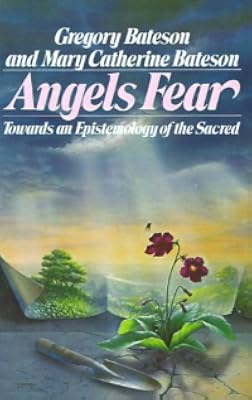
Angels Fear: Towards an Epistemology of the Sacred
by Gregory Bateson (Author), Mary Catherine Bateson (Author)
On This Page
Description
This is a re-issue of Gregory Bateson's and Mary Catherine Bateson's work, which has been out of print for the past 20 years, 2004 is the G. Bateson centennial and much interest is anticipated for his publications. This work is the final sustained thinking of Bateson. In collaboration with his daughter, Mary Catherine Bateson, this volume sets out Bateson's natural history of the relationship between ideas. The book incorporates writing by both father and daughter, including essays written show more by Bateson in the last years before his death. The book is a unique demonstration of thinking in progress. show lessTags
Recommendations















Member Reviews
I find it vexing as ever to attempt a summary of Batesonian thought, partly a reflection of how unorthodox Batesonian cybernetics is to that Cartesian outlook originally presented throughout my education, and partly from the conviction that all the myriad parts of Bateson's thought are equally relevant. Any attempted summary threatens to bulk so large as to suggest it would be easier to simply re-read Bateson.
Perhaps it suffices to emphasise two points. One is Bateson's use of metaphoric explanation, on the grounds the metaphor is the logic of biological life. While Western science predominates and is "pre-occupied with quantity, the artificiality of experiment, and the dualism of Descartes," [10] its logic proceeds mechanistically, show more linearly, empirically. The second point is that Bateson strives always to understand the living world as a "necessary unity" -- a world of mental process, in which he locates the sacred. Bateson leans upon Jung's conception of Creatura and Pleroma, not occurring rather encountered, and always in tandem. The distinction is hierarchic not substantive: Creatura is a level up from that of Pleroma, a higher logical type.
Creatura and Pleroma interface epistemologically, are not ontologically separate substances. Their boundary is best understood as a bridge across which information passes, our understanding of the world comprising both together. Seeing the world this way avoids the chief errors of Cartesian thought's insufficient holism: reducing the world to mechanical chains of causation (in which mind is alienated, consigned to an illusion); or, painting ourselves into corners from which we extract ourselves only through recourse to supernaturalism (explanations lying "outside the body" as miracle).
Building upon his unified outlook, Bateson in Angels Fear looks toward further explication of the natural world and life within it, and for a "syntax of consciousness" -- formal rules relating various disparate concepts falsely separated by our predominant dualism. An emphasis upon relations, as opposed to referents or "things", is the way forward. Structure is itself a means of communication, so structure is then an informational idea, and can be causal without having a separate "existence" as supernatural accounts would require. There is no ghost in the machine, rather a causal influence of structure inherent in the machine. "A model of the interaction between structure and process underlies much of the argument of this book, and it will be critical to understand the relationship between these notions and the problems of knowledge and description." [37]
Bateson helpfully points out the value of religion as opposed to science, without arguing any specific religion should replace Cartesian science. "Art, like religion, represents an area of experience that privileges Creatural ways of thinking" [198] in contrast to the Pleroma-limited approach of mechanistic science. "Certainly through human history, and perhaps necessarily into the future, religion has been the only kind of cognitive system that could provide a model for the integration and complexity of the natural world, because these are the characteristics that must persistently elude even the most meticulous efforts to [merely] describe." But again, the way forward includes both, never one over the other. "Apart from Creatura, nothing can be known; apart from Pleroma, there is nothing there to know." [200]
//
I suggested in my 2011 review of Bateson's Mind and Nature that this later effort, Angels Fear is inspirational recapitulation. That gloss was from memory and after a recent re-reading I'd amend that to: it is indeed recapitulation but not only that. There is a good deal here that while not offering new arguments, at least considers old material from the stance of reassessment and implication rather than mere summary, shifting the discussion to those questions Bateson wanted to examine next. Just as importantly, fully grasping the arguments here relies on a level of familiarity with Batesonian thought unobtainable from this book alone. Yet despite these reservations, Angels Fear served me well as introduction to Batesonian cybernetics, and could do for others equally well.
//
Originally begun by Gregory alone, but its completion interrupted by illness: Gregory requested the collaboration of anthropologist daughter Mary Catherine, originally as assistant, whose contributions evolved to that of co-author, eventually ushering the manuscript to completion after Gregory's death.
Includes a Glossary, with entries slightly edited in places from those taken from Mind and Nature; a consideration of sources with interesting commentary on unpublished manuscripts; and Index. show less
Perhaps it suffices to emphasise two points. One is Bateson's use of metaphoric explanation, on the grounds the metaphor is the logic of biological life. While Western science predominates and is "pre-occupied with quantity, the artificiality of experiment, and the dualism of Descartes," [10] its logic proceeds mechanistically, show more linearly, empirically. The second point is that Bateson strives always to understand the living world as a "necessary unity" -- a world of mental process, in which he locates the sacred. Bateson leans upon Jung's conception of Creatura and Pleroma, not occurring rather encountered, and always in tandem. The distinction is hierarchic not substantive: Creatura is a level up from that of Pleroma, a higher logical type.
Creatura and Pleroma interface epistemologically, are not ontologically separate substances. Their boundary is best understood as a bridge across which information passes, our understanding of the world comprising both together. Seeing the world this way avoids the chief errors of Cartesian thought's insufficient holism: reducing the world to mechanical chains of causation (in which mind is alienated, consigned to an illusion); or, painting ourselves into corners from which we extract ourselves only through recourse to supernaturalism (explanations lying "outside the body" as miracle).
Building upon his unified outlook, Bateson in Angels Fear looks toward further explication of the natural world and life within it, and for a "syntax of consciousness" -- formal rules relating various disparate concepts falsely separated by our predominant dualism. An emphasis upon relations, as opposed to referents or "things", is the way forward. Structure is itself a means of communication, so structure is then an informational idea, and can be causal without having a separate "existence" as supernatural accounts would require. There is no ghost in the machine, rather a causal influence of structure inherent in the machine. "A model of the interaction between structure and process underlies much of the argument of this book, and it will be critical to understand the relationship between these notions and the problems of knowledge and description." [37]
Bateson helpfully points out the value of religion as opposed to science, without arguing any specific religion should replace Cartesian science. "Art, like religion, represents an area of experience that privileges Creatural ways of thinking" [198] in contrast to the Pleroma-limited approach of mechanistic science. "Certainly through human history, and perhaps necessarily into the future, religion has been the only kind of cognitive system that could provide a model for the integration and complexity of the natural world, because these are the characteristics that must persistently elude even the most meticulous efforts to [merely] describe." But again, the way forward includes both, never one over the other. "Apart from Creatura, nothing can be known; apart from Pleroma, there is nothing there to know." [200]
//
I suggested in my 2011 review of Bateson's Mind and Nature that this later effort, Angels Fear is inspirational recapitulation. That gloss was from memory and after a recent re-reading I'd amend that to: it is indeed recapitulation but not only that. There is a good deal here that while not offering new arguments, at least considers old material from the stance of reassessment and implication rather than mere summary, shifting the discussion to those questions Bateson wanted to examine next. Just as importantly, fully grasping the arguments here relies on a level of familiarity with Batesonian thought unobtainable from this book alone. Yet despite these reservations, Angels Fear served me well as introduction to Batesonian cybernetics, and could do for others equally well.
//
Originally begun by Gregory alone, but its completion interrupted by illness: Gregory requested the collaboration of anthropologist daughter Mary Catherine, originally as assistant, whose contributions evolved to that of co-author, eventually ushering the manuscript to completion after Gregory's death.
Includes a Glossary, with entries slightly edited in places from those taken from Mind and Nature; a consideration of sources with interesting commentary on unpublished manuscripts; and Index. show less
Gregory Bateson and his daughter explore the natural history of ideas, exploring the nature of the mental process and its connection to the natural world or "the pattern which connects" all living things.
...escrito conjuntamente con su hija: "Los procedimeintos mágicos presentan cierta semejanza formal con la ciencia y con la religión. La magia puede ser una forma degenerada y aplicada de la ciencia o de la religión."
Feb 4, 2009Spanish
Ratings
Members
- Recently Added By
Lists

Recommended Nature Writing
346 works; 180 members

Books That Changed Our Perspective
423 works; 168 members
Author Information


Mary Catherine Bateson is a writer and cultural anthropologist. Bateson has written and co-authored many books and articles, and lectures across the country and abroad. She has taught at Harvard, Northeastern University, Amherst College, Spelman College and abroad in the Philippines and in Iran. In 2004 she retired from her position as Clarence J. show more Robinson Professor in Anthropology and English at George Mason University and is now Professor Emerita. She serves on multiple advisory boards including the National Center on Atmospheric Research and the NSF, dealing with climate change. Mary Catherine Bateson's books in print include Composing a Life, Our Own Metaphor, and Peripheral Visions, as well as a memoir, With a Daughter's Eye: A Memoir of Margaret Mead and Gregory Bateson. Her latest is Composing a Further Life: The Age of Active Wisdom (Knopf September 2010). Bateson divides her time between New Hampshire and Massachusetts. (Bowker Author Biography) show less
Some Editions
Series
Belongs to Publisher Series
Biblioteca Adelphi (216)
Common Knowledge
- Canonical title
- Angels Fear: Towards an Epistemology of the Sacred
- Original title
- Angels Fear: Towards an Epistemology of the Sacred
- Original publication date
- 1987
- Original language
- English
Classifications
Statistics
- Members
- 218
- Popularity
- 149,383
- Reviews
- 3
- Rating
- (4.04)
- Languages
- 8 — Danish, Dutch, English, French, German, Italian, Spanish, Swedish
- Media
- Paper
- ISBNs
- 13
- ASINs
- 1