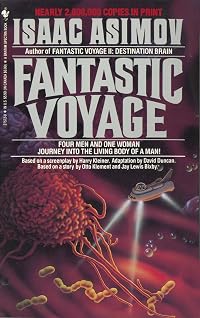
Fantastic Voyage [Novelization]
by Isaac Asimov, Jerome Bixby (Author), David Duncan (Adapter), Harry Kleiner (Screenplay Author), Otto Klement (Author)
Fantastic Voyage (1)
On This Page
Description
A fabulous adventure into the last frontier of man!Attention! This is the last message you will receive until your mission is completed. You have sixty minutes once miniaturization is complete. You must be out of Benes' body before then. If not, you will return to normal size and kill Benes regardless of the success of the surgery.
Four men and one woman reduced to a microscopic fraction of their original size, boarding a miniaturized atomic sub and being injected into a dying man's carotid show more artery. Passing through the heart, entering the inner ear where even the slightest sound would destroy them, battling relentlessly into the cranium.
Their objective . . . to reach a blood clot and destroy it with the piercing rays of a laser.
At stake . . . the fate of the entire world. show less
Tags
Recommendations
















Member Recommendations

Bookwomble Miniturised spies.
Member Reviews
A fun novelisation of the 1966 movie by Asimov, who does what he can within the scifi premise to include realistic science as problems to be solved by the crew of scientists and technicians, miniaturised in a nuclear-powered submarine and injected into the bloodstream of a defecting physicist with an inoperable brain tumour, to save his life and the knowledge he has in order to maintain a cold war stalemate.
Some nods to the Manhattan Project, deconstruction of super-spy tropes, critique of sexism in science (which Asimov then forgets), wrapped up in a neat race-against-time adventure.
Some nods to the Manhattan Project, deconstruction of super-spy tropes, critique of sexism in science (which Asimov then forgets), wrapped up in a neat race-against-time adventure.
3 1/2 stars: Good.
----------
From the back cover: Four men and one woman reduced to a microscopic fraction of their original size, boarding a miniaturized atomic sub and being infected into a dying man's carotid artery. Fighting their way past giant antibodies, passing through the heart itself, entering the inner ear where even the slightest sound would destroy them, battling relentlessly into the cranium. Their objective--to reach a blood clot and destroy it with the piercing rays of a laser gun. At stake--the fate of the entire world.
-------------------
This was a solid "Good". A Page turner, fast read. It is certainly a cold war era book--they go on the journey to save the life of a Soviet defector who has scientific knowledge that show more can change the balance of power. And our five protagonists--of course, one is actually a secret agent who wants to defector to die before he can tell his secrets.
Typical Isaac Asimov, the characters are caricatures, particularly our female. I had a few eye rolls, but nothing I would go so far as to say offended by. Asimov is the Agatha Christie of Sci-Fi-- great plots, cardboard characters.
I did love the descriptions of the parts of the body they were running across in miniaturized form. In one sequence, three characters had to leave the sub, and one started getting attacked by antibodies. I wanted to hug one! :)
Here is a passage in the "antibody sequence" which shows what I mean, both about the descriptions and the caricatures:
"They had no brains, not even the most primitive, and it was wrong to think of them as monsters or predators...They were merely molecules with atoms so arranged as to make them cling to the surfaces that fit theirs through blind action of inter-atomic forces. ... He kept pulling at the fuzz [antibodies] on Cora's back. .. [Antibodies] clung and joined, spanning her shoulders and making their wooly pattern across her abdomen. They hesitated over the uneven three dimensional curve of her breasts as though they had not figured that out yet."
Seriously??? Antibodies that are in a constant microscopie 3D environment at all times can't deal with breasts? Grow up, Isaac!
I would have liked the book better if there had not been the secret agent aspect, but conversely I liked that there was never an issue of "will they be shrunk forever"? There was the time element--the shrinking would automatically expire and they might start growing and thus kill their patient, but it was never a question of whether they'd be shrunk forever. That would have been tedious.
A good, fun, fast read. You can finish it in a few hours.
Sending this to a friend's son. show less
----------
From the back cover: Four men and one woman reduced to a microscopic fraction of their original size, boarding a miniaturized atomic sub and being infected into a dying man's carotid artery. Fighting their way past giant antibodies, passing through the heart itself, entering the inner ear where even the slightest sound would destroy them, battling relentlessly into the cranium. Their objective--to reach a blood clot and destroy it with the piercing rays of a laser gun. At stake--the fate of the entire world.
-------------------
This was a solid "Good". A Page turner, fast read. It is certainly a cold war era book--they go on the journey to save the life of a Soviet defector who has scientific knowledge that show more can change the balance of power. And our five protagonists--of course, one is actually a secret agent who wants to defector to die before he can tell his secrets.
Typical Isaac Asimov, the characters are caricatures, particularly our female. I had a few eye rolls, but nothing I would go so far as to say offended by. Asimov is the Agatha Christie of Sci-Fi-- great plots, cardboard characters.
I did love the descriptions of the parts of the body they were running across in miniaturized form. In one sequence, three characters had to leave the sub, and one started getting attacked by antibodies. I wanted to hug one! :)
Here is a passage in the "antibody sequence" which shows what I mean, both about the descriptions and the caricatures:
"They had no brains, not even the most primitive, and it was wrong to think of them as monsters or predators...They were merely molecules with atoms so arranged as to make them cling to the surfaces that fit theirs through blind action of inter-atomic forces. ... He kept pulling at the fuzz [antibodies] on Cora's back. .. [Antibodies] clung and joined, spanning her shoulders and making their wooly pattern across her abdomen. They hesitated over the uneven three dimensional curve of her breasts as though they had not figured that out yet."
Seriously??? Antibodies that are in a constant microscopie 3D environment at all times can't deal with breasts? Grow up, Isaac!
I would have liked the book better if there had not been the secret agent aspect, but conversely I liked that there was never an issue of "will they be shrunk forever"? There was the time element--the shrinking would automatically expire and they might start growing and thus kill their patient, but it was never a question of whether they'd be shrunk forever. That would have been tedious.
A good, fun, fast read. You can finish it in a few hours.
Sending this to a friend's son. show less
Magnificent! A team of specialists and a ship is miniaturised to a size that is smaller than a red blood cell and injected into a human artery in an effort to clear a blood clot in the brain of a scientist that holds a secret that can enormously benefit mankind.
They have but 60 minutes before they automatically grow back to their normal size, whether they are inside the patient or not!
This story regals us with the fantastic voyage through the human body. It is filled with wonder, some love, and danger.
Despite having been first published in 1966, this story still feels fresh, the technology and science it describes, very believable. Sit down, tuck in, enjoy!
They have but 60 minutes before they automatically grow back to their normal size, whether they are inside the patient or not!
This story regals us with the fantastic voyage through the human body. It is filled with wonder, some love, and danger.
Despite having been first published in 1966, this story still feels fresh, the technology and science it describes, very believable. Sit down, tuck in, enjoy!
Well that's a bizarre little story. On one hand, it's 1960s scifi in a nutshell, full of tensions about the 'Other Side' (obvious enough), weird but fascinating scientific gadgets and ideas, sexism, and with odd pacing and dialog. It's pretty much what I remember from other Asimov novels, although it's been a while.
Which is amusing, given that unlike what I'd guessed, in this case the movie actually game first. Based on a short by Otto Klement and Jerome Bixby, Asimov only got involved in the novelization--and then only if he was given leave to do the science properly. For the most part, he did. I don't know enough ananotomy to know if anything in particular is wrong, but it makes me want to know *more*, which I think is pretty much the show more entire point of the thing.
Otherwise, the entire plot is adventure driven: a (rather oddball) team must used a mostly untested technology to shrink down small enough to fit into a human bloodstream in order to remove a life threatening clot. Of course things go wrong (wouldn't be much of a book otherwise) and they end up on a rather circuitous route. Will they make it out and save the day? Of course. But what's going to go wrong first? Well that's the story!
There's a romance subplot, which is about as subtle as a brick to the face and sexist as heck. But I guess that's what they needed for the film? So it goes.
Overall, the first third or so (before they actually shrink or even know what's going on) eis boring and stilted to the extreme. Once things get going though, it's quite an enjoying ride. show less
Which is amusing, given that unlike what I'd guessed, in this case the movie actually game first. Based on a short by Otto Klement and Jerome Bixby, Asimov only got involved in the novelization--and then only if he was given leave to do the science properly. For the most part, he did. I don't know enough ananotomy to know if anything in particular is wrong, but it makes me want to know *more*, which I think is pretty much the show more entire point of the thing.
Otherwise, the entire plot is adventure driven: a (rather oddball) team must used a mostly untested technology to shrink down small enough to fit into a human bloodstream in order to remove a life threatening clot. Of course things go wrong (wouldn't be much of a book otherwise) and they end up on a rather circuitous route. Will they make it out and save the day? Of course. But what's going to go wrong first? Well that's the story!
There's a romance subplot, which is about as subtle as a brick to the face and sexist as heck. But I guess that's what they needed for the film? So it goes.
Overall, the first third or so (before they actually shrink or even know what's going on) eis boring and stilted to the extreme. Once things get going though, it's quite an enjoying ride. show less
After a scientist named Benes is successfully transported into the country from enemy territory, an assassination attempt leaves him with a dangerous and inoperable clot at the base of his brain.
The situation falls under the jurisdiction of the CMDF (Combined Miniature Defense Force) run by General Alan Carter and Colonel Donald Reid. Once Benes is stabilized far underground in CMDF headquarters, a team is formed that will be miniaturized and injected into Benes’s bloodstream to destroy the clot from inside his body using a laser.
The team consists of civilian CMO Michaels, neurosurgeon Peter Duvall and his assistant Cora Peterson, special agent Charles Grant—who smuggled Benes into the country—and Captain William Owens, designer show more and pilot of the experimental submarine Proteus, which will carry the crew through Benes’s circulatory system. They are given one hour to complete the mission and exit Benes’s body before the miniaturization effect begins to reverse.
As if this were not dangerous enough, there is suspicion that one among the crew might be an agent for the Other Side, sent to kill Benes. Every setback and mishap causes yet another member of the team to come under scrutiny as precious time ticks away…
Contrary to popular belief, the classic film Fantastic Voyage was not based on the novel by Isaac Asimov. It’s the other way around. Otto Klement and Jay Lewis Bixby wrote the original story, which was adapted for the screen by Harry Kleiner and David Duncan. Asimov was hired on to write the novelization of the movie and he did a decent job with the material. While character development is non-existent (with the most interesting being Grant, Duvall, Michaels, and Peterson) the pacing is perfect and the challenges that plague our heroes at almost every turn maintain solid tension through to the end. show less
The situation falls under the jurisdiction of the CMDF (Combined Miniature Defense Force) run by General Alan Carter and Colonel Donald Reid. Once Benes is stabilized far underground in CMDF headquarters, a team is formed that will be miniaturized and injected into Benes’s bloodstream to destroy the clot from inside his body using a laser.
The team consists of civilian CMO Michaels, neurosurgeon Peter Duvall and his assistant Cora Peterson, special agent Charles Grant—who smuggled Benes into the country—and Captain William Owens, designer show more and pilot of the experimental submarine Proteus, which will carry the crew through Benes’s circulatory system. They are given one hour to complete the mission and exit Benes’s body before the miniaturization effect begins to reverse.
As if this were not dangerous enough, there is suspicion that one among the crew might be an agent for the Other Side, sent to kill Benes. Every setback and mishap causes yet another member of the team to come under scrutiny as precious time ticks away…
Contrary to popular belief, the classic film Fantastic Voyage was not based on the novel by Isaac Asimov. It’s the other way around. Otto Klement and Jay Lewis Bixby wrote the original story, which was adapted for the screen by Harry Kleiner and David Duncan. Asimov was hired on to write the novelization of the movie and he did a decent job with the material. While character development is non-existent (with the most interesting being Grant, Duvall, Michaels, and Peterson) the pacing is perfect and the challenges that plague our heroes at almost every turn maintain solid tension through to the end. show less
http://nwhyte.livejournal.com/2146110.html
The story of a mission ministurised and injected into the bloodstream of an ailing scientist to cure him, the protagonists being four men and a woman who, this being an Asimov story, is the centre of some dubious sexual politics. The whole thing is very much in the Cold War context, the miniaturisation technology being fairly blatantly a parallel of nuclear technology.
Although I am aware of the general course of Asimov's career, I hadn't previously known some of the details of this book - that it was intended to be the novelisation of the film, but because Asimov finished faster than the studio it was actually published several months before the film was released; that he tweaked various details show more to make it more plausible than the film script; that the story it was based on was actually set in the nineteenth century. Asimov did his best with some tricky material; basically to keep the film plot going for the full 100 minutes there has to be an unexpected and implausible problem every few chapters which sets our team back. But this is not his greatest work. show less
The story of a mission ministurised and injected into the bloodstream of an ailing scientist to cure him, the protagonists being four men and a woman who, this being an Asimov story, is the centre of some dubious sexual politics. The whole thing is very much in the Cold War context, the miniaturisation technology being fairly blatantly a parallel of nuclear technology.
Although I am aware of the general course of Asimov's career, I hadn't previously known some of the details of this book - that it was intended to be the novelisation of the film, but because Asimov finished faster than the studio it was actually published several months before the film was released; that he tweaked various details show more to make it more plausible than the film script; that the story it was based on was actually set in the nineteenth century. Asimov did his best with some tricky material; basically to keep the film plot going for the full 100 minutes there has to be an unexpected and implausible problem every few chapters which sets our team back. But this is not his greatest work. show less
This novel isn't an original Asimov story, but his only novelization of a screenplay. While I prefer the movie for the sheer sense of wonder of the visuals, this is far from the worst novel Asimov wrote; he sticks close to the movie script, but manages to work in a bit of characterisation and background, and fixes some of the worst plot holes of the film. The end result is still recognisably Asimov and makes for non-essential but decent reading.
Members
- Recently Added By
Lists

Read the book and saw the movie
1,170 works; 193 members

1960s
281 works; 16 members

Books Read in 2007
326 works; 8 members

Books Read in 2025
4,128 works; 98 members
Author Information

2,405+ Works 294,442 Members
Isaac Asimov was born in Petrovichi, Russia, on January 2, 1920. His family emigrated to the United States in 1923 and settled in Brooklyn, New York, where they owned and operated a candy store. Asimov became a naturalized U.S. citizen at the age of eight. As a youngster he discovered his talent for writing, producing his first original fiction at show more the age of eleven. He went on to become one of the world's most prolific writers, publishing nearly 500 books in his lifetime. Asimov was not only a writer; he also was a biochemist and an educator. He studied chemistry at Columbia University, earning a B.S., M.A. and Ph.D. In 1951, Asimov accepted a position as an instructor of biochemistry at Boston University's School of Medicine even though he had no practical experience in the field. His exceptional intelligence enabled him to master new systems rapidly, and he soon became a successful and distinguished professor at Columbia and even co-authored a biochemistry textbook within a few years. Asimov won numerous awards and honors for his books and stories, and he is considered to be a leading writer of the Golden Age of science fiction. While he did not invent science fiction, he helped to legitimize it by adding the narrative structure that had been missing from the traditional science fiction books of the period. He also introduced several innovative concepts, including the thematic concern for technological progress and its impact on humanity. Asimov is probably best known for his Foundation series, which includes Foundation, Foundation and Empire, and Second Foundation. In 1966, this trilogy won the Hugo award for best all-time science fiction series. In 1983, Asimov wrote an additional Foundation novel, Foundation's Edge, which won the Hugo for best novel of that year. Asimov also wrote a series of robot books that included I, Robot, and eventually he tied the two series together. He won three additional Hugos, including one awarded posthumously for the best non-fiction book of 1995, I. Asimov. "Nightfall" was chosen the best science fiction story of all time by the Science Fiction Writers of America. In 1979, Asimov wrote his autobiography, In Memory Yet Green. He continued writing until just a few years before his death from heart and kidney failure on April 6, 1992. (Bowker Author Biography) show less


Some Editions
Awards and Honors
Distinctions
Series

Belongs to Publisher Series
Work Relationships
Is contained in
Is an adaptation of
Common Knowledge
- Canonical title
- Fantastic Voyage [Novelization]
- Original title
- Fantastic Voyage
- Original publication date
- 1966-10
- People/Characters
- Donald Reid; Alan Carter; Max Michaels; Peter Lawrence Duval; Cora Peterson; William Owens (show all 9); Charles Grant; Jan Benes; Gonder
- Important places
- USA; Jan Benes
- Related movies
- Fantastic Voyage (1966 | IMDb)
- Dedication
- To
Mark and Marcia
who twisted by arm - First words
- It was an old plane, a four-engine plasma jet that had been retired from active service, and it came in along a route that was neither economical nor particularly safe.
- Last words
- (Click to show. Warning: May contain spoilers.)The nurse ushered them out and Grant and Cora left, hand in warm hand, into a world that suddenly seemed to hold no terrors for them, but only the prospect of great joy.
- Original language
- English
- Canonical DDC/MDS
- 813.08762
- Disambiguation notice
- Novelization by Isaac Asimov of the 1966 film, based on a screenplay by Harry Kleiner, adaptation by David Duncan, based on a story by Otto Klement and Jay Lewis Bixby.
Contents: About Fantastic Voyage / Otto Klement -... (show all)- 1. Plane -- 2. Car -- 3. Headquarters -- 4. Briefing -- 5. Submarine -- 6. Miniaturization -- 7. Submergence -- 8. Entry -- 9. Artery -- 10. Heart -- 11. Capillary -- 12. Lung -- 13. Pleura -- 14. Lymphatic -- 15. Ear -- 16. Brain -- 17. Clot -- 18. Eye
Classifications
- Genres
- Science Fiction, Fiction and Literature
- DDC/MDS
- 813.08762 — Literature & rhetoric American literature in English American fiction in English By type Genre fiction Adventure fiction Speculative fiction Science fiction
- LCC
- PZ3 .A8316 — Language and Literature Fiction and juvenile belles lettres Fiction and juvenile belles lettres Fiction in English
- BISAC
Statistics
- Members
- 3,000
- Popularity
- 5,983
- Reviews
- 29
- Rating
- (3.58)
- Languages
- 11 — Dutch, English, French, German, Hungarian, Italian, Japanese, Polish, Portuguese, Spanish, Swedish
- Media
- Paper, Audiobook, Ebook
- ISBNs
- 46
- ASINs
- 40