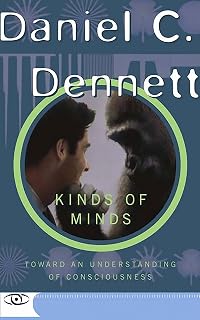
Kinds of Minds: Towards an Understanding of Consciousness
by Daniel C. Dennett
On This Page
Description
Combining ideas from philosophy, artificial intelligence, and neurobiology, Daniel Dennett leads the reader on a fascinating journey of inquiry, exploring such intriguing possibilities as: Can any of us really know what is going on in someone else's mind? What distinguishes the human mind from the minds of animals, especially those capable of complex behavior? If such animals, for instance, were magically given the power of language, would their communities evolve an intelligence as subtly show more discriminating as ours? Will robots, once they have been endowed with sensory systems like those that provide us with experience, ever exhibit the particular traits long thought to distinguish the human mind, including the ability to think about thinking? Dennett addresses these questions from an evolutionary perspective. Beginning with the macromolecules of DNA and RNA, the author shows how, step-by-step, animal life moved from the simple ability to respond to frequently recurring environmental conditions to much more powerful ways of beating the odds, ways of using patterns of past experience to predict the future in never-before-encountered situations. Whether talking about robots whose video-camera "eyes" give us the powerful illusion that "there is somebody in there" or asking us to consider whether spiders are just tiny robots mindlessly spinning their webs of elegant design, Dennett is a master at finding and posing questions sure to stimulate and even disturb. show lessTags
Recommendations























Member Reviews
Although I do not necessarily agree with all that Dennett stated in this book, I have to say that he stated it exceptionally well. This was an accessible, high level philosophical book detailing the conception of animal minds vs. human minds. Each philosophical concept he put forward he carefully defined and explained with often amusing examples.
The ideas that he came up with himself (i.e. The Tower of Generate and Test, mamataxis, etc.) were novel and interesting without being too difficult to grasp. I enjoyed the quotes at the beginning of each chapter. Although the book was dense in its content, it never strayed too far from what is easily grasped with a bit of mental effort. I'd recommend this alongside Species of Mind which show more addresses several small flaws in some conclusions that he draws. show less
The ideas that he came up with himself (i.e. The Tower of Generate and Test, mamataxis, etc.) were novel and interesting without being too difficult to grasp. I enjoyed the quotes at the beginning of each chapter. Although the book was dense in its content, it never strayed too far from what is easily grasped with a bit of mental effort. I'd recommend this alongside Species of Mind which show more addresses several small flaws in some conclusions that he draws. show less
Definitely able and interesting, and a better place than most for someone to begin to explore the problem of what makes a creature a "thinking," and thus a morally cognizable entity. I did think he ended rather abruptly, right as he picks up momentum on the question of pain and suffering in animals. For myself, the most intriguing discovery was his disagreement with Nagel and his classic essay, "What Is It Like To Be a Bat," which I rather enjoyed.
"This book began with a host of questions, and -- since this is a book by a philosopher -- it ends not with the answers, but, I hope, with better versions of the questions themselves." p 168.
One of my favorite non-fiction books ever. It cleared my thoughts about minds by showing me which ideas / questions even make sense or not and why. I have watched many lectures by Dennett before reading the book, so I knew what I was getting into.
This is one book I love to re-read over and over again.
One of my favorite non-fiction books ever. It cleared my thoughts about minds by showing me which ideas / questions even make sense or not and why. I have watched many lectures by Dennett before reading the book, so I knew what I was getting into.
This is one book I love to re-read over and over again.
Dennett wasn't exactly young when he wrote this but the energy is palpable. As the introduction states the book is about questions, but they're very good questions, even if by now they've been repeated often.
Nice job by Dennett. This was my first book by him and I very much enjoyed his analysis of mind. His ideas are fascinating and well developed. I'm looking forward to reading some of his other work.
Daniel Dennett tries to explain human conciousness, but leaves me thinking his arguments are just nit-picking over language.
Interesting at times, but ultimately disappointing.
Interesting at times, but ultimately disappointing.
In Kinds of Minds, Daniel C Dennett draws on ideas from philosophy, artificial intelligence, neuroscience and evolutionary biology to investigate the concept of mind. On this exhilarating journey, Dennett sets out the sort of questions that we need to ask if we are to find out what kinds of minds other animals have.
Members
- Recently Added By
Lists

Biblioteca de não ficção
41 works; 1 member

Books in the Bibliography of The Illusion of Conscious Will by Daniel Wegne
273 works; 1 member
Author Information

43+ Works 17,433 Members
Daniel C. Dennett is a University Professor and Austin B. Fletcher Professor of Philosophy at Tufts University and the author of numerous books including Intuition Pumps and Other Tools for Thinking, Breaking the Spell, Darwin's Dangerous Idea, and Consciousness Explained.
Some Editions
Series
Belongs to Publisher Series
Common Knowledge
- Canonical title
- Kinds of Minds: Towards an Understanding of Consciousness
- Original title
- Kinds of Minds: Towards an Understanding of Consciousness
- Original publication date
- 1996
- First words
- Can we ever really know what is going on in someone else's mind?
- Original language
- English
Classifications
Statistics
- Members
- 923
- Popularity
- 28,903
- Reviews
- 8
- Rating
- (3.55)
- Languages
- 14 — Czech, Dutch, English, Finnish, French, German, Hebrew, Hungarian, Italian, Portuguese, Romanian, Slovak, Spanish, Swedish
- Media
- Paper, Audiobook, Ebook
- ISBNs
- 27
- ASINs
- 6