Eden
by Stanisław Lem
On This Page
Description
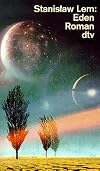
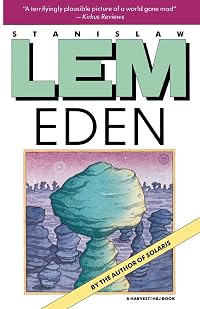
A six-man crew crash-lands on Eden, fourth planet from another sun. The men find a strange world that grows ever stranger, and everywhere there are images of death. The crew's attempt to communicate with this civilization leads to violence and to a cruel truth-cruel precisely because it is so human. Translated by Marc E. Heine. A Helen and Kurt Wolff Book.Tags
Recommendations






















Member Reviews
What a gem of an old SF! Indeed, Stanislaw Lem might be one of the very best SF authors, period. He has a wide range of works, from humorous to deeply disturbing to fantastically mysterious alien discoveries.
"What?" you say, "That whole tail-end period of the golden age of SF was FULL of great and detailed authors. Just look at Dune from 1965!"
"Yeah, yeah, but before Star Trek in the wee year of 1959, Eden was born, giving us one of the richest, most detailed alien worlds as seen through a small crew named only by their job titles, instead forcing us to see things through their worldviews, as screwed up (normal!) as they are, misunderstanding everything they see on Eden."
But this is not Dune.
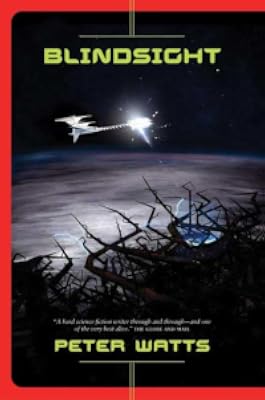
This is a full mystery that gets only digs show more us deeper into our own misunderstandings. Because this is an intelligent alien race that does not think like us. Not only superficially, but fundamentally, with strange technological focuses and social structures. Not to mention biological tools that feel like the most excellent precursor to Farscape or Asher's [b:Hilldiggers|1196558|Hilldiggers (Polity Universe #15)|Neal Asher|https://i.gr-assets.com/images/S/compressed.photo.goodreads.com/books/1358753930l/1196558._SY75_.jpg|1184643], or the look at a truly alien mind, as seen in Watts' [b:Blindsight|48484|Blindsight (Firefall, #1)|Peter Watts|https://i.gr-assets.com/images/S/compressed.photo.goodreads.com/books/1386924412l/48484._SX50_.jpg|47428].
And I'm only mentioning a single aspect, here. The rest is a serious look at how much we bring in our own prejudices, making our own hell, wherever we go.
When I look back at first contact novels in general, few will have quite this amazing creative factor to it. Sure, some books will have so and so good characters, etc, but none will be quite as serious about giving us the truly alien or near-perfect mirrors to our own stupidity.
I count this a truly classic "Important" SF. show less
"What?" you say, "That whole tail-end period of the golden age of SF was FULL of great and detailed authors. Just look at Dune from 1965!"
"Yeah, yeah, but before Star Trek in the wee year of 1959, Eden was born, giving us one of the richest, most detailed alien worlds as seen through a small crew named only by their job titles, instead forcing us to see things through their worldviews, as screwed up (normal!) as they are, misunderstanding everything they see on Eden."
But this is not Dune.
This is a full mystery that gets only digs show more us deeper into our own misunderstandings. Because this is an intelligent alien race that does not think like us. Not only superficially, but fundamentally, with strange technological focuses and social structures. Not to mention biological tools that feel like the most excellent precursor to Farscape or Asher's [b:Hilldiggers|1196558|Hilldiggers (Polity Universe #15)|Neal Asher|https://i.gr-assets.com/images/S/compressed.photo.goodreads.com/books/1358753930l/1196558._SY75_.jpg|1184643], or the look at a truly alien mind, as seen in Watts' [b:Blindsight|48484|Blindsight (Firefall, #1)|Peter Watts|https://i.gr-assets.com/images/S/compressed.photo.goodreads.com/books/1386924412l/48484._SX50_.jpg|47428].
And I'm only mentioning a single aspect, here. The rest is a serious look at how much we bring in our own prejudices, making our own hell, wherever we go.
When I look back at first contact novels in general, few will have quite this amazing creative factor to it. Sure, some books will have so and so good characters, etc, but none will be quite as serious about giving us the truly alien or near-perfect mirrors to our own stupidity.
I count this a truly classic "Important" SF. show less
Six nameless explorers find themselves marooned on a strange planet where the more they learn, the less anything makes sense. Automated factories produce nothing. Death is everywhere. They race to repair their ship before the increasingly menacing locals take effective action.
If you're looking for adolescent escapism, Stanislaw Lem is probably not for you. If you're looking for lighthearted diversion, try The Cyberiad. If, on the other hand, you are looking for a mesmerizing journey through an alien landscape, with dashes of horror and social commentary, all delivered with a truly poetic sensibility, give this one a try.
If you're looking for adolescent escapism, Stanislaw Lem is probably not for you. If you're looking for lighthearted diversion, try The Cyberiad. If, on the other hand, you are looking for a mesmerizing journey through an alien landscape, with dashes of horror and social commentary, all delivered with a truly poetic sensibility, give this one a try.
Crash landing on a planet whose beauty caught their eye, the six-man crew divide their efforts between repairing their ship and exploring the planet. Only one man is given a name; the others are identified only by their profession. Yet they are not mere sketches: each has a personality and a realistic variability. They are on the whole heroic, curious and adventurous, and debate whether to remain and explore even as they overcome the severe obstacles to repairing and righting their ship. The technology is an odd mix to contemporary eyes: atomic motors, autonomous robots, but film cameras. Attention to detail: the planet has no ionosphere - radios don't work. The planet is utterly alien: plants but no animals, unfamiliar smells. The show more initial explorations are as disorienting to us the readers as to the explorers.
* S P O I L E R S *
Contact with an abandoned automated factory; eventually with the population of the planet. An inadvertent killing of a local. Various reactions from regret to fear of retaliation. Observation of incomprehensible social patterns. Formation of theories. Much social, philosophical, and pragmatic debate. Sympathy develops when a native attaches itself to them, in a manner the men interpret as escape from something intolerable: slavery, genocide?
A deus-ex-machina in the form of a local scientist which risks its life to contact them and establish communications; a miracle of desperation, human cybernetic ingenuity and alien determination results in something of an explanation of a society controlled by a secret government which through disinformation and control of communication has convinced its people that it does not even exist, and sets groups against each other keeping the population divided and controlled. Large segments of society are damaged as a result of a failed genetic engineering program some generations earlier that itself has been declared as never having happened.
Our team of explorers wants to help. Intervene, interfere, leave alone and not meddle? Human weapons are superior, something could be done - but how do you help a system you don't understand, when your human sympathies are an inadequate guide? They would have to destroy the system entirely, become tyrants in turn, to try and build something different. And how could human standards be applied to make something better for such a different society? The elect to leave, reluctantly. From orbit they remark again how beautiful this flawed and damaged Eden seems. show less
* S P O I L E R S *
Contact with an abandoned automated factory; eventually with the population of the planet. An inadvertent killing of a local. Various reactions from regret to fear of retaliation. Observation of incomprehensible social patterns. Formation of theories. Much social, philosophical, and pragmatic debate. Sympathy develops when a native attaches itself to them, in a manner the men interpret as escape from something intolerable: slavery, genocide?
A deus-ex-machina in the form of a local scientist which risks its life to contact them and establish communications; a miracle of desperation, human cybernetic ingenuity and alien determination results in something of an explanation of a society controlled by a secret government which through disinformation and control of communication has convinced its people that it does not even exist, and sets groups against each other keeping the population divided and controlled. Large segments of society are damaged as a result of a failed genetic engineering program some generations earlier that itself has been declared as never having happened.
Our team of explorers wants to help. Intervene, interfere, leave alone and not meddle? Human weapons are superior, something could be done - but how do you help a system you don't understand, when your human sympathies are an inadequate guide? They would have to destroy the system entirely, become tyrants in turn, to try and build something different. And how could human standards be applied to make something better for such a different society? The elect to leave, reluctantly. From orbit they remark again how beautiful this flawed and damaged Eden seems. show less
One of my current top picks in sci fi, Eden rocketed to the top of my list about halfway through. This is a story of an accidental landing on a foreign planet by humans, but unlike other sci fi books that tackle the question of "what do we do now?", Lem takes a quite adult and rather logical approach to answering this question and follows the adventures of the skeleton crew that is stuck on Eden until their ship is repaired.
Overall it was quite brilliantly done. There are no real twists or "firework" moments. However, Lem manages to build tension despite all of that, and weaves a beautiful tapestry together of what it really means to be unable to comprehend alien society.
The text itself was a bit dry, though it would make for a great show more book to read aloud to someone else. show less
Overall it was quite brilliantly done. There are no real twists or "firework" moments. However, Lem manages to build tension despite all of that, and weaves a beautiful tapestry together of what it really means to be unable to comprehend alien society.
The text itself was a bit dry, though it would make for a great show more book to read aloud to someone else. show less
Kind of funny that I read this only a couple months after reading The Invincible, since they're almost the same book. Humans come to unexplored planet and then wonder what the hell is going on exactly.
I found it interesting that he decided to use the character's titles instead of names, so you had "the Captain", "the Doctor" etc... Only once (as far as I remember) did he use a name (one of the guys was named "Henry") and that was only because another character was calling out for him and it would have sounded funny if he was yelling, "Chemist, are you there?" It did help to keep things straight, but removing that extra, "Which one is Henry?" type thing that happens when reading other books with 5 or 6 main characters. Especially since show more Lem's forte is definitely not characterization.
I'm really hoping the next Lem book I read is totally crazy, because that's what got me reading his stuff in the first place. Though this wasn't bad at all. show less
I found it interesting that he decided to use the character's titles instead of names, so you had "the Captain", "the Doctor" etc... Only once (as far as I remember) did he use a name (one of the guys was named "Henry") and that was only because another character was calling out for him and it would have sounded funny if he was yelling, "Chemist, are you there?" It did help to keep things straight, but removing that extra, "Which one is Henry?" type thing that happens when reading other books with 5 or 6 main characters. Especially since show more Lem's forte is definitely not characterization.
I'm really hoping the next Lem book I read is totally crazy, because that's what got me reading his stuff in the first place. Though this wasn't bad at all. show less
It becomes quite clear toward the end of the novel that the story contained therein is a vehicle for some acute observations about the relativity of ethics, the difficulty of overcoming subjective assumptions about unfamiliar cultures, and information control as a means of societal control. At the same time, the author goes to great lengths to provide a detailed visualization of an alien world.
This book is relentlessly serious, as opposed to Lem's drolly humorous satires. Character development is minimal, but the effectively imagined weirdness of the strange world and the struggles of the stranded earthmen to understand its enigmas, even while trying to escape it, make for an interesting read.
This book is relentlessly serious, as opposed to Lem's drolly humorous satires. Character development is minimal, but the effectively imagined weirdness of the strange world and the struggles of the stranded earthmen to understand its enigmas, even while trying to escape it, make for an interesting read.
Started a bit wierdly as I saw it was 'first published in 1990' but the extreme retro feel became more normal once I realised it was written in 1059 and that was the translation date.
Of course it continues very wierdly as this is Stanislaw Lem. He is such a master of 'show not tell'. Six crew members known by their occupation - Captain, Engineer, Chemist, Physicist, Cyberneticist, Doctor - except the engineer is sometimes called Henry by the captain - and a very alien planet. There's a lot of detailed description in the first half and I did get a bit impatient but by the second half I found it hard to put down.
Of course it continues very wierdly as this is Stanislaw Lem. He is such a master of 'show not tell'. Six crew members known by their occupation - Captain, Engineer, Chemist, Physicist, Cyberneticist, Doctor - except the engineer is sometimes called Henry by the captain - and a very alien planet. There's a lot of detailed description in the first half and I did get a bit impatient but by the second half I found it hard to put down.
Members
- Recently Added By
Lists

Best Science Fiction Novels
816 works; 430 members

Best Science Fiction Originally Published in a Language Other Than English
449 works; 31 members
Author Information

Polish science fiction writer Stanislaw Lem was born on September 12, 1921. A medical graduate of Cracow University, he is at home both in the sciences and in philosophy, and this broad erudition gives his writings genuine depth. He has published extensively, not only fiction, but also theoretical studies. His books have been translated into 41 show more languages and sold over 27 million copies. He gained international acclaim for The Cyberiad, a series of short stories, which was first published in 1974. A trend toward increasingly serious philosophical speculation is found in his later works, such as Solaris (1961), which was made into a Soviet film by Russian director Andrei Tarkovsky in 1972 and remade by Steven Soderbergh in 2002. He died on March 27, 2006 in Krakow at the age of 84. (Bowker Author Biography) show less
Series
Belongs to Publisher Series
dtv Allgemeine Reihe (10106)
Dzieła Stanisława Lema (Wydawnictwo Gazety Wyborczej)
dtv phantastica (1853)
Work Relationships
Common Knowledge
- Canonical title*
- Eden
- Original title
- Eden
- Alternate titles*
- Eden - Roman einer außerirdischen Zivilisation
- Original publication date
- 1959
- People/Characters
- Henry
- Important places
- Eden (Planet)
- First words
- There was an error in the calculations.
Because of a miscalculation, the craft dipped too low and hit the atmosphere with an earsplitting scream. - Last words
- (Click to show. Warning: May contain spoilers.)"Wie schön!" Der Koordinator blickte noch immer auf den Bildschirm. "Aber, weißt du, nach der Wahrscheinlichkeitsrechnung gibt es noch schönere."
- Original language
- Polish
- Canonical DDC/MDS
- 891.8537
- Canonical LCC
- PG7158.L39
*Some information comes from Common Knowledge in other languages. Click "Edit" for more information.
Classifications
- Genres
- Science Fiction, Fiction and Literature
- DDC/MDS
- 891.8537 — Literature & rhetoric Literatures of other languages East Indo-European and Celtic literatures West and South Slavic languages (Bulgarian, Slovene, Polish, Czech, Slovak, Serbo-Croatian, and Macedonian) Polish Polish fiction 1919–1989
- LCC
- PG7158 .L39 — Language and Literature Slavic languages and literatures. Baltic languages. Albanian language Slavic. Baltic. Albanian Slavic Polish
- BISAC
Statistics
- Members
- 834
- Popularity
- 33,026
- Reviews
- 14
- Rating
- (3.68)
- Languages
- 16 — Czech, Danish, Dutch, English, Finnish, German, Hungarian, Italian, Japanese, Polish, Portuguese, Romanian, Russian, Serbian, Spanish, Turkish
- Media
- Paper, Audiobook, Ebook
- ISBNs
- 40
- ASINs
- 16