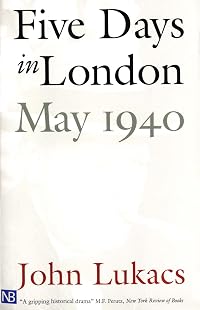
Five Days in London: May 1940
by John Lukacs
On This Page
Description
The days from May 24 to May 28, 1940 altered the course of the history of this century, as the members of the British War Cabinet debated whether to negotiate with Hitler or to continue the war. The decisive importance of these five days is the focus of John Lukacs's magisterial new book. Lukacs takes us hour by hour into the critical unfolding of events at 10 Downing Street, where Churchill and the members of his cabinet were painfully considering their war responsibilities. We see how the show more military disasters taking place on the Continent-particularly the plight of the nearly 400,000 British soldiers bottled up in Dunkirk-affected Churchill's fragile political situation, for he had been prime minister only a fortnight and was regarded as impetuous and hotheaded even by many of his own party. Lukacs also investigates the mood of the British people, drawing on newspaper and Mass-Observation reports that show how the citizenry, though only partly informed about the dangers that faced them, nevertheless began to support Churchill's determination to stand fast. Other historians have dealt with Churchill's difficulties during this period, using the partial revelations of certain memoirs and private and public papers. But Lukacs is the first to convey the drama and importance of these days, and he does so in a compelling narrative that combines deep knowledge with high literary style. show lessTags
Recommendations















Member Reviews
The late John Lukacs (d. 2019) was an opinionated cuss, so he rubs some folks the wrong way. But, I respect immensely his depth of knowledge on the Second World War, Churchill, and Hitler in particular. (Aside from maybe Ian Kershaw, Richard Evans, or Richard Overy, nobody could touch him on the historiography of Hitler.) Reaching back a bit and forward a bit, Lukacs details the events of May 24 to May 28, five days, in London.
His thesis is that it was in those days that Churchill, through his steadfastness and gumption, won the Second World War, or, rather did not lose it. (Lukacs says only the USA and USSR won the war, but the UK could have lost it. Lukacs also said that Hitler could have come out with a win or draw if he, perhaps, show more took Moscow and collapsed the USSR or defeated the Western allies at D-Day. But, (p. 189), Hitler could have won HIS war, Lukacs states, if Churchill had capitulated or Halifax had taken over and capitulated. (Dubious, perhaps, as Hitler, even with a defeated UK, probably would have rushed headlong into Russia. Perhaps without US and UK help the Soviet Union may have been defeated. But that's a big if. Ask Napoleon.)
I disagree with Lukacs, though, and wholeheartedly when he says this (p. 217): "The greatest threat to Western civilization was not Communism. It was National Socialism." First, I consider National Socialism and Communist Socialism to be step-brothers, and equally evil. I see not a spit-worth of difference between Hitler controlling Europe and Stalin controlling Europe. Both are totalitarian, statist, and purveyors of executions galore. Both are evil, none more evil than the other. He continues a theme he picks up in The Hitler of History, that (pp. 217-218) Hitler was "the greatest revolutionary of the twentieth century... merging nationalism and socialism into one tremendous force...." On that he may have a point.
But, kudos to Churchill, who was resolute, determined, dogged, and an instrument of Providence. "At best," Lukacs sums up, "civilization may survive, at least in some small part due to Churchill in 1940" (p. 219).
Photos, extensive footnotes (many discursive), bibliography, index. show less
His thesis is that it was in those days that Churchill, through his steadfastness and gumption, won the Second World War, or, rather did not lose it. (Lukacs says only the USA and USSR won the war, but the UK could have lost it. Lukacs also said that Hitler could have come out with a win or draw if he, perhaps, show more took Moscow and collapsed the USSR or defeated the Western allies at D-Day. But, (p. 189), Hitler could have won HIS war, Lukacs states, if Churchill had capitulated or Halifax had taken over and capitulated. (Dubious, perhaps, as Hitler, even with a defeated UK, probably would have rushed headlong into Russia. Perhaps without US and UK help the Soviet Union may have been defeated. But that's a big if. Ask Napoleon.)
I disagree with Lukacs, though, and wholeheartedly when he says this (p. 217): "The greatest threat to Western civilization was not Communism. It was National Socialism." First, I consider National Socialism and Communist Socialism to be step-brothers, and equally evil. I see not a spit-worth of difference between Hitler controlling Europe and Stalin controlling Europe. Both are totalitarian, statist, and purveyors of executions galore. Both are evil, none more evil than the other. He continues a theme he picks up in The Hitler of History, that (pp. 217-218) Hitler was "the greatest revolutionary of the twentieth century... merging nationalism and socialism into one tremendous force...." On that he may have a point.
But, kudos to Churchill, who was resolute, determined, dogged, and an instrument of Providence. "At best," Lukacs sums up, "civilization may survive, at least in some small part due to Churchill in 1940" (p. 219).
Photos, extensive footnotes (many discursive), bibliography, index. show less
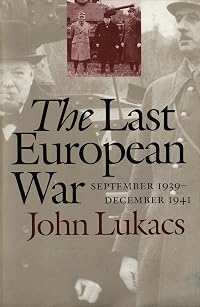
An historian often is compelled to return to a subject. Sometimes the revisit is to revise earlier theses and sometimes it is to look in closer detail at some aspect of his object of study. John Lukacs works on Churchill and World War II fall into the latter category. Lukacs, and ardent Churchill supporter, sees Churchill as the pivotal figure in the history of the Twentieth Century, and his decision to keep Britain fighting Germany at any cost in the Second World War as his key decision. This is the subject of Five Days in London May 1940. For Lukacs, the critical span of time was May 24th to the 28th, 1940, as the BEF staggered back to the coast and France tottered towards capitulation. Lukacs has covered the early part of the war show more before, each time with an increased focus on Churchill’s role. In his introduction to Five Days in London May 1940, Lukacs describes this work as “part of a lopsided trilogy: from three pages in The Last European War to fifteen pages in The Duel and then to two hundred and twenty pages in this one.”
Lukacs draws from interesting sources. While the main thrust of the narrative is to follow the events in London around the cabinet and, to a lesser extent, on the battlefield in France, he also discusses the mood of the country through newspapers, private diaries and most interestingly, the reports of the Mass-Observation group of the Ministry of Information, pioneers in public polling. On the mood of the public, one gets a surprising result. The newspapers are still full of advertisements for holiday (in France!) and there is as yet an air of some peacetime normalcy. The Mass-Observation group reports are fascinating. The picture that they paint is of a public divided in opinion and morale along sex and class lines-not yet the mythic image we have today of the “Finest Hour”. From the contemporary newspapers, the information is enlightening by its unenlightening nature. The precarious situation on the ground in France is not apparent-there are misleading articles on phantom soon-to-be launched counter-attacks and non-existent ever stiffening French resistance. Whether this is the natural result of the fog of war or a deliberate misinformation campaign is out of the scope of this work and is not explored by Lukacs.
A running theme in the works of John Lukacs is his playing down of the communist threat to Western Europe in the interwar era. This is again shown in the dismissive attitude he has towards the Tory leaders Baldwin, Chamberlain and Halifax in the 1930s. They were convinced that the only winners of a European war would be the Soviets and their pawns in the west. Baldwin, for instance, said that the outcome of a European war “would be Germany going Bolshevik”. Lukacs says that in the 1930s in Europe “the Left was weak. Except for the Soviet Union, there was no Communist regime anywhere on the globe; except for small minorities and some intellectuals, Communism did not attract masses of the people.” Here Lukacs is wrong. In Britain, the General Strike was a recent event. On the continent, the abortive revolutions of 1919, the Soviet invasion of Poland, and Kun’s Hungarian Soviet were closer in time to 1940 than 1989 is to us. Lukacs’ statement that the best opponents of Hitler were traditionalist patriots like Churchill, DeGaulle or Stauffenberg and the 1944 plotters overlooks the fact that the Nazis had liquidated the strong communist presence in Weimar through brute force and by co-opting large parts of their agenda. This idiosyncrasy in Lukacs’ thought detracts somewhat from his account of the time.
The internal machinations of the cabinet over what to do are the main focus of the narrative. Halifax and Chamberlain were still seeking some sort of accommodation, perhaps with Italy as an arbiter (the Italians having not yet entered the war). Churchill, according to Lukacs, in his heart-of-hearts had no plan but to carry on. First, to try and give a backbone to the French by the knowledge the Britain would carry on no matter what, and secondly and more importantly to do whatever it took to get America in the war. This is where the greatest controversy emerges. Churchill feared that Britain would be reduced to a minor partner or even a satellite of Germany if German domination of Europe was accepted. But as we now know, the price to pay for American entry into the war was Britain reduced to a minor partner of the United States and the ultimate dismantling of the Empire-something the Germans would not have wanted.
Lukacs’ focus on those five days allows the reader to see that accidents of history sometimes play out well, Dunkirk being a famous example. As is clear from the cabinet minutes, no one expected the withdrawal to go as well as it did, least of all Churchill. A critical accident I was not aware of was that of Neville Chamberlain. The former prime minister is considered a complete failure by most historians, but his mere presence in the cabinet prevented the loathsome David Lloyd-George from accepting a post as Minister of Agriculture and securing a spot back in power. Had Lloyd-George rejoined the cabinet, given his still considerable prestige, a coalition of himself, Halifax and Chamberlain could have forced a negotiated peace on Churchill, or even removed him from power. Halifax would most likely have been the new Prime Minister in that circumstance, and he was no supporter of Hitler. However, it doesn't take much imagination to see how a defeated and demoralized Britain could turn to someone like Lloyd-George. I think that Churchill and Lukacs both underestimate the damage that a Lloyd-George premiership would have done at that time. Churchill felt that better “someone like Lloyd-George than someone like [Sir Oswald] Mosley”, the leader of the British fascists who was arrested the day before the five days covered in this account. Lloyd-George was an admirer of Hitler (calling him the greatest living German in 1935) and the Nazi/Fascist domestic platform which is similar to the Lloyd-George welfare state in many respects. Given the defeatist attitude that he held even after the entry of the United States and Soviet Union and the success of the Battle of Britain, it is easy to imagine him as the British Petain.
There are moments in history where the right man is in the right place at the right time, and certainly one of those moments was the afternoon of May 28th, 1940. Lukacs certainly captures it well. The cabinet minutes record that Churchill said that “the nations that went down fighting rose again, but those which surrendered tamely were finished.” After a brief adjournment, Churchill called together the whole cabinet-as opposed to just the War Cabinet-and reiterated his point that Britain after an armistice would be reduced to a slave state of Germany. Halifax finally agreed. Churchill’s eloquence and tenacity had won the day.
While I disagree with some of Lukacs’ conclusions (for instance, I can imagine the war ending in 1940 with a “Cold War” between Germany and the remaining western powers, and that cold war ultimately ending the same way the actual Cold War did), I think Lukacs does a good job telling the story of those five days and identifying the crucial point. As he insightfully says “Churchill and Britain could not have won the Second World War; in the end America and Russia did. But in May 1940, Churchill was the one that did not lose it.” Contemporary works on the Second World War almost always end on a triumphant note celebrating a Panglossian view of the world since then. It is refreshing to read one that does not. I agree with Lukacs’ final somewhat pessimistic statement on our present and future:
“At best, civilization may survive, at least in some small part due to Churchill in 1940. At worst, he helped to give us-especially those of us who are no longer young but who were young then-fifty years. Fifty years before the rise of new kinds of barbarism not incarnated by the armed might of Germans or Russians, before the clouds of a new Dark Age may darken the lives of our children and grandchildren. Fifty years! Perhaps that was enough.” show less
Lukacs draws from interesting sources. While the main thrust of the narrative is to follow the events in London around the cabinet and, to a lesser extent, on the battlefield in France, he also discusses the mood of the country through newspapers, private diaries and most interestingly, the reports of the Mass-Observation group of the Ministry of Information, pioneers in public polling. On the mood of the public, one gets a surprising result. The newspapers are still full of advertisements for holiday (in France!) and there is as yet an air of some peacetime normalcy. The Mass-Observation group reports are fascinating. The picture that they paint is of a public divided in opinion and morale along sex and class lines-not yet the mythic image we have today of the “Finest Hour”. From the contemporary newspapers, the information is enlightening by its unenlightening nature. The precarious situation on the ground in France is not apparent-there are misleading articles on phantom soon-to-be launched counter-attacks and non-existent ever stiffening French resistance. Whether this is the natural result of the fog of war or a deliberate misinformation campaign is out of the scope of this work and is not explored by Lukacs.
A running theme in the works of John Lukacs is his playing down of the communist threat to Western Europe in the interwar era. This is again shown in the dismissive attitude he has towards the Tory leaders Baldwin, Chamberlain and Halifax in the 1930s. They were convinced that the only winners of a European war would be the Soviets and their pawns in the west. Baldwin, for instance, said that the outcome of a European war “would be Germany going Bolshevik”. Lukacs says that in the 1930s in Europe “the Left was weak. Except for the Soviet Union, there was no Communist regime anywhere on the globe; except for small minorities and some intellectuals, Communism did not attract masses of the people.” Here Lukacs is wrong. In Britain, the General Strike was a recent event. On the continent, the abortive revolutions of 1919, the Soviet invasion of Poland, and Kun’s Hungarian Soviet were closer in time to 1940 than 1989 is to us. Lukacs’ statement that the best opponents of Hitler were traditionalist patriots like Churchill, DeGaulle or Stauffenberg and the 1944 plotters overlooks the fact that the Nazis had liquidated the strong communist presence in Weimar through brute force and by co-opting large parts of their agenda. This idiosyncrasy in Lukacs’ thought detracts somewhat from his account of the time.
The internal machinations of the cabinet over what to do are the main focus of the narrative. Halifax and Chamberlain were still seeking some sort of accommodation, perhaps with Italy as an arbiter (the Italians having not yet entered the war). Churchill, according to Lukacs, in his heart-of-hearts had no plan but to carry on. First, to try and give a backbone to the French by the knowledge the Britain would carry on no matter what, and secondly and more importantly to do whatever it took to get America in the war. This is where the greatest controversy emerges. Churchill feared that Britain would be reduced to a minor partner or even a satellite of Germany if German domination of Europe was accepted. But as we now know, the price to pay for American entry into the war was Britain reduced to a minor partner of the United States and the ultimate dismantling of the Empire-something the Germans would not have wanted.
Lukacs’ focus on those five days allows the reader to see that accidents of history sometimes play out well, Dunkirk being a famous example. As is clear from the cabinet minutes, no one expected the withdrawal to go as well as it did, least of all Churchill. A critical accident I was not aware of was that of Neville Chamberlain. The former prime minister is considered a complete failure by most historians, but his mere presence in the cabinet prevented the loathsome David Lloyd-George from accepting a post as Minister of Agriculture and securing a spot back in power. Had Lloyd-George rejoined the cabinet, given his still considerable prestige, a coalition of himself, Halifax and Chamberlain could have forced a negotiated peace on Churchill, or even removed him from power. Halifax would most likely have been the new Prime Minister in that circumstance, and he was no supporter of Hitler. However, it doesn't take much imagination to see how a defeated and demoralized Britain could turn to someone like Lloyd-George. I think that Churchill and Lukacs both underestimate the damage that a Lloyd-George premiership would have done at that time. Churchill felt that better “someone like Lloyd-George than someone like [Sir Oswald] Mosley”, the leader of the British fascists who was arrested the day before the five days covered in this account. Lloyd-George was an admirer of Hitler (calling him the greatest living German in 1935) and the Nazi/Fascist domestic platform which is similar to the Lloyd-George welfare state in many respects. Given the defeatist attitude that he held even after the entry of the United States and Soviet Union and the success of the Battle of Britain, it is easy to imagine him as the British Petain.
There are moments in history where the right man is in the right place at the right time, and certainly one of those moments was the afternoon of May 28th, 1940. Lukacs certainly captures it well. The cabinet minutes record that Churchill said that “the nations that went down fighting rose again, but those which surrendered tamely were finished.” After a brief adjournment, Churchill called together the whole cabinet-as opposed to just the War Cabinet-and reiterated his point that Britain after an armistice would be reduced to a slave state of Germany. Halifax finally agreed. Churchill’s eloquence and tenacity had won the day.
While I disagree with some of Lukacs’ conclusions (for instance, I can imagine the war ending in 1940 with a “Cold War” between Germany and the remaining western powers, and that cold war ultimately ending the same way the actual Cold War did), I think Lukacs does a good job telling the story of those five days and identifying the crucial point. As he insightfully says “Churchill and Britain could not have won the Second World War; in the end America and Russia did. But in May 1940, Churchill was the one that did not lose it.” Contemporary works on the Second World War almost always end on a triumphant note celebrating a Panglossian view of the world since then. It is refreshing to read one that does not. I agree with Lukacs’ final somewhat pessimistic statement on our present and future:
“At best, civilization may survive, at least in some small part due to Churchill in 1940. At worst, he helped to give us-especially those of us who are no longer young but who were young then-fifty years. Fifty years before the rise of new kinds of barbarism not incarnated by the armed might of Germans or Russians, before the clouds of a new Dark Age may darken the lives of our children and grandchildren. Fifty years! Perhaps that was enough.” show less
This book focuses on five critical days in the life of the British War Cabinet as its members debated whether Britain should negotiate with Hitler or continue fighting. The crisis came at a crucial moment: Winston Churchill had been prime minister for barely two weeks, Lord Halifax strongly opposed Churchill’s determination to continue the war, and nearly 300,000 British soldiers were trapped at Dunkirk.
One of the book’s strengths is its attention to the attitudes and morale of ordinary British citizens, giving readers a sense of what the public understood and how they reacted during the crisis. However, one weakness is the portrayal of Neville Chamberlain as largely resigned to losing power and supportive of Churchill. This show more interpretation differs from many other historical accounts, which often describe Chamberlain as resentful of Churchill and willing to create difficulties for his new government.
This was a very readable and interesting book. I listened to this on audio. (6 hours 25 mins =256 pages)
ETA: ETA: After some research, it does appear that Chamberlain opposed Churchill at every turn UNTIL 1940 and then supported him in the war effort. show less
One of the book’s strengths is its attention to the attitudes and morale of ordinary British citizens, giving readers a sense of what the public understood and how they reacted during the crisis. However, one weakness is the portrayal of Neville Chamberlain as largely resigned to losing power and supportive of Churchill. This show more interpretation differs from many other historical accounts, which often describe Chamberlain as resentful of Churchill and willing to create difficulties for his new government.
This was a very readable and interesting book. I listened to this on audio. (6 hours 25 mins =256 pages)
ETA: ETA: After some research, it does appear that Chamberlain opposed Churchill at every turn UNTIL 1940 and then supported him in the war effort. show less
The days from May 24 to May 28, 1940 altered the course of the history of this century, as the members of the British War Cabinet debated whether to negotiate with Hitler or to continue the war. The decisive importance of these five days is the focus of John Lukacs’s magisterial new book. Lukacs takes us hour by hour into the critical unfolding of events at 10 Downing Street, where Churchill and the members of his cabinet were painfully considering their war responsibilities. We see how the military disasters taking place on the Continent-particularly the plight of the nearly 400,000 British soldiers bottled up in Dunkirk-affected Churchill’s fragile political situation, for he had been prime minister only a fortnight and was show more regarded as impetuous and hotheaded even by many of his own party. Lukacs also investigates the mood of the British people, drawing on newspaper and Mass-Observation reports that show how the citizenry, though only partly informed about the dangers that faced them, nevertheless began to support Churchill’s determination to stand fast.Other historians have dealt with Churchill’s difficulties during this period, using the partial revelations of certain memoirs and private and public papers. But Lukacs is the first to convey the drama and importance of these days, and he does so in a compelling narrative that combines deep knowledge with high literary style. show less
The title of this book refers to the period from May 24 through May 28, 1940 and concerns itself primarily with the deliberations of the British War Cabinet during the darkest days of World War II as the British Expeditionary Force (BEF) retreated to the Channel ports and ultimately the evacuation of over 300,000 troops from Dunkirk. The history textbook accounts of World War II tell us that Churchill's assumption of the prime minister's role two weeks earlier was evidence that support for his hardline opposition to Hitler and the Nazis was now settled British policy and that it was a given that the British would "fight them on the beaches", etc.
Lukacs' narrative makes it clear that it was not a foregone conclusion that Britain would show more fight on to the bitter end come what may. The War Cabinet consisted of Churchill, Neville Chamberlain, Foreign Secretary Lord Halifax and Labor representatives Clement Attlee and Arthur Greenwood. The discussions among this group included nine formal meetings during the five days with the collapse of Belgium and the rout of the French forces as a backdrop. In the middle of this week the decision was made to evacuate the BEF from Dunkirk. Churchill was essentially unchanged in his policy though acknowledging the desperation of their situation. Halifax favored an approach to Mussolini prior to Italy's entry into the war to facilitate an armistice and negotiations based on Britain's willingness to cede some undefined portion of its overseas territories to Germany and potentially Gibraltar and Malta to Mussolini as payment for services rendered. In return Britain's independence and autonomy would be recognized and observed. At the same time Paul Reynaud, the French premier encouraged the contacts with Mussolini and also urged the British to contact Roosevelt as the leader of a still neutral United Stated to broker a negotiated settlement that would recognize Hitler's conquests but give the French and the British a way out of the war if they were offered reasonable terms.
Churchill generally received the lukewarm support of Attlee and Greenwood. Chamberlain was supportive and played a critical role in mediating between the positions of Churchill and Halifax. As Lukacs makes clear it was not generally believed at this point that Churchill's leadership was for the duration. He was not favored by the king and was not the clear cut favorite at any time of his own Conservative Party many of whom expected a "restoration" of Chamberlain or perhaps Halifax's accession to the prime minister position. By the end of the week it was clear that the Mussolini gambit in particular and generally speaking the likelihood of an armistice leading to Britain's withdrawal from the war were put to rest. Regardless of whether or not the French signed a separate peace the British would carry on alone.
In parallel with the political narrative Lukacs reviews the state of British public opinion and public awareness in the latter part of each chapter, day by day. The newspapers were never really on top of the real state of affairs in France which may have been a positive thing for Britain's morale. A public opinion operation known as M.O. for Mass Observation was comprised of non-scientific day to day accounts comparing opinion by region, class and sex. Generally the greater the status the more pessimistic the outlook. Also, opinion in London was far more worried than in the rural areas. And women in general were more depressed about events than their men.
One more item worth highlighting is the role or lack thereof played by David Lloyd George, Liberal Party leader and Prime Minister during the victory over Germany in 1918. Churchill approached Lloyd George on a couple of occasions about joining the Cabinet as Minister of Agriculture. He was turned down twice ostensibly due to Lloyd George's hatred of Chamberlain. Lukacs believes that in the worst case scenario if Britain was defeated Lloyd George might have been the leader best placed to obtain terms from Hiller. He doesn't explicitly compare Lloyd George to Marshall Petain but the reader is invited to make the comparison for himself.
Five Days in London is an exceptionally fine deep dive into a brief time slice that in the author's opinion was the real "Hinge of Fate" of the war in that it was the closest Hitler would ever come to winning "his war". show less
Lukacs' narrative makes it clear that it was not a foregone conclusion that Britain would show more fight on to the bitter end come what may. The War Cabinet consisted of Churchill, Neville Chamberlain, Foreign Secretary Lord Halifax and Labor representatives Clement Attlee and Arthur Greenwood. The discussions among this group included nine formal meetings during the five days with the collapse of Belgium and the rout of the French forces as a backdrop. In the middle of this week the decision was made to evacuate the BEF from Dunkirk. Churchill was essentially unchanged in his policy though acknowledging the desperation of their situation. Halifax favored an approach to Mussolini prior to Italy's entry into the war to facilitate an armistice and negotiations based on Britain's willingness to cede some undefined portion of its overseas territories to Germany and potentially Gibraltar and Malta to Mussolini as payment for services rendered. In return Britain's independence and autonomy would be recognized and observed. At the same time Paul Reynaud, the French premier encouraged the contacts with Mussolini and also urged the British to contact Roosevelt as the leader of a still neutral United Stated to broker a negotiated settlement that would recognize Hitler's conquests but give the French and the British a way out of the war if they were offered reasonable terms.
Churchill generally received the lukewarm support of Attlee and Greenwood. Chamberlain was supportive and played a critical role in mediating between the positions of Churchill and Halifax. As Lukacs makes clear it was not generally believed at this point that Churchill's leadership was for the duration. He was not favored by the king and was not the clear cut favorite at any time of his own Conservative Party many of whom expected a "restoration" of Chamberlain or perhaps Halifax's accession to the prime minister position. By the end of the week it was clear that the Mussolini gambit in particular and generally speaking the likelihood of an armistice leading to Britain's withdrawal from the war were put to rest. Regardless of whether or not the French signed a separate peace the British would carry on alone.
In parallel with the political narrative Lukacs reviews the state of British public opinion and public awareness in the latter part of each chapter, day by day. The newspapers were never really on top of the real state of affairs in France which may have been a positive thing for Britain's morale. A public opinion operation known as M.O. for Mass Observation was comprised of non-scientific day to day accounts comparing opinion by region, class and sex. Generally the greater the status the more pessimistic the outlook. Also, opinion in London was far more worried than in the rural areas. And women in general were more depressed about events than their men.
One more item worth highlighting is the role or lack thereof played by David Lloyd George, Liberal Party leader and Prime Minister during the victory over Germany in 1918. Churchill approached Lloyd George on a couple of occasions about joining the Cabinet as Minister of Agriculture. He was turned down twice ostensibly due to Lloyd George's hatred of Chamberlain. Lukacs believes that in the worst case scenario if Britain was defeated Lloyd George might have been the leader best placed to obtain terms from Hiller. He doesn't explicitly compare Lloyd George to Marshall Petain but the reader is invited to make the comparison for himself.
Five Days in London is an exceptionally fine deep dive into a brief time slice that in the author's opinion was the real "Hinge of Fate" of the war in that it was the closest Hitler would ever come to winning "his war". show less
A nice piece of micro-history by a Czech historian with a crush on WSC. Redolent of "the Day Lincoln Was Shot", it's a lively look at the British decision to fight on after the fall of France in 1940. Lukacs jokes that his next book will be entitled "The Forty-five Minutes", a look at just the portion of the Cabinet Meeting at which the decision was made, but I think he could stop here! Just the right amount of detail for this type of thing. Read it!
Deep history, that's to say history at a level of detail that is almost forensic. The author is fortunate both in his choice of topic, and in his sense of what makes history. For five days in 1940 the fate of the world turned on a hairs breadth, in a debate between Churchill and forces within his own Conservative Party that were sympathetic to the cause of Naziism, and an even greater number who believed that defeat was inevitable (including the US) and that Britain had better surrender and ask for the best possible conditions. I wouldn't put the fact that Churchill carried the day in the end down to any nobility in the character of many of those politicians, as a breed they are contemptible and have destroyed their own country many show more times over since then, far more effectively than Hitler ever could have. But perhaps there was a flicker of something back then, some notion of self respect, but it's surely deserted us now. show less
Members
- Recently Added By
Lists

Mustich's 1000 Books to Read Before You Die: A Life Changing List
1,001 works; 20 members
Talk Discussions
Past Discussions
Folio Archives 384: Five Days in London, May 1940 by John Lukacs - 2011 in Folio Society Devotees (July 2024)
Author Information

52+ Works 4,140 Members
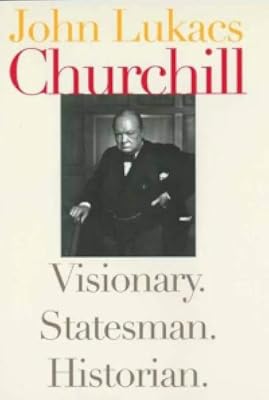
John Lukacs was born Janos Adalbert Lukacs in Budapest, Hungry on January 31, 1924. His father was Catholic and his mother was Jewish. He received an advanced degree in history from the University of Budapest. Although he was a practicing Catholic, he was considered Jewish enough to be conscripted into an army labor battalion when the Nazis show more occupied Hungary. He deserted in late 1944. When things did not improve under Soviet occupation and a Communist government, he fled illegally to the United States in July 1946. He was hired as a part-time lecturer in history at Columbia University to accommodate an influx of returning veterans. In 1947, he was hired by Chestnut Hill College in Philadelphia to teach full time. He taught there for 47 years, retiring in 1994. He wrote numerous books including The Last European War; Confessions of an Original Sinner; The Duel: The Eighty-Day Struggle Between Churchill and Hitler; The Hitler of History; A Student's Guide to the Study of History; Churchill: Visionary. Statesman. Historian.; At the End of an Age; George Kennan: A Study of Character; and A Short History of the Twentieth Century. He died from heart failure on May 6, 2019 at the age of 95. (Bowker Author Biography) show less
Awards and Honors
Notable Lists
Series
Belongs to Publisher Series
Common Knowledge
- Original publication date
- 1999
- People/Characters
- Winston Churchill (Churchill, Winston Leonard Spencer); Edward Frederick Lindley Wood, 1st Earl and 3rd Viscount of Halifax; Anthony Eden; Harold Macmillan; Harold Nicolson; David Lloyd George
- Important places
- London, England, UK; Dunkirk, Hauts-de-France, France
- Important events
- World War II (1939 | 1945)
- Dedication
- This book is dedicated to Philip and Marjorie
- First words
- This book attempts to reconstruct the history of five days that could have changed the world.
- Last words
- (Click to show. Warning: May contain spoilers.)Perhaps that was enough.
- Blurbers
- Moynihan, Daniel Patrick; Perutz, M.F.; Pryce-Jones, David
Classifications
Statistics
- Members
- 1,003
- Popularity
- 26,182
- Reviews
- 27
- Rating
- (3.68)
- Languages
- 8 — Dutch, English, French, German, Italian, Portuguese, Spanish, Swedish
- Media
- Paper, Audiobook, Ebook
- ISBNs
- 33
- ASINs
- 13