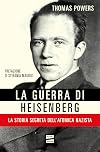
Heisenberg's War: The Secret History of the German Bomb
by Thomas Powers
On This Page
Description
One of the Most important - and controversial - aspects of the history of the Second World War is the failure of the Germans to build an atomic bomb. Germany was the birthplace of modern physics; it possessed the raw materials and the industrial base, and although many leading scientists fled from Hitler, it still commanded key intellectual resources. Yet at the end of the war the Germans had no bomb, and their nuclear research program was found to be negligible. What. Happened? Until now show more the conventional view has been that the Germans doubted that the bomb could be built, and were thus unwilling to try. In Heisenberg's War, Thomas Powers offers a radically new and convincing explanation - and in doing so reveals for the first time the entire complex fascinating story of the interplay between science and espionage, morality aid military necessity, paranoia and cool logic, that marked the German bomb program and the Allied response to. It. It is a story that revolves around some of the most famous scientists of our time: Niels Bohr, Robert Oppenheimer, Victor Weisskopf, Hans Bethe, Otto Hahn, and, most important the great Werner Heisenberg, one of the twentieth century's principal scientific minds and the only physicist of his stature to stay on in Nazi Germany. We see these men engrossed not only by the enormous challenge of understanding atomic energy; but also by the exigencies of ethics and wartime. Intelligence, engaging in plots and activities that would have shocked them under other circumstances. Secret messages, dangerous misunderstandings, undercover missions, increasingly panicky efforts by the Americans and the British to find out what the Germans were up to, even an American plan to have Heisenberg assassinated by an OSS gunman (an ex-major league baseball player) in Switzerland in 1944 - all these play a part in Powers's dramatic narrative. Pieced together. After years of documentary research and dozens of interviews with surviving participants, told with style and authority, Heisenberg's War is an extraordinary combination of spy story and serious historical investigation. It will stand as the definitive account of a deeply significant chapter in modern history. show lessTags
Recommendations
































Member Reviews
An excellent book, Powers covers the whole story in detail while keeping a narrative pace which makes the story engrossing. This is something of an expose, as Powers argues that Heisenberg did indeed have the opportunity to go full-force in building an atomic bomb, but chose not to - but not for noble reasons. Powers argues that Heisenberg's motive was more about the enormous industrial effort required, and his observation that his neck might well have been on the line should he champion such a project and have such an experimental idea fail. Intriguing and insightful, this book lays bare a chapter of history which has been mysterious to date.
2507 Heisenberg's War: The Secret History of the German Bomb, by Thomas Powers (read 22 May 1993) This book is an account of what Germany's leading physicist did during World War II. I thought the book poorly organized, but it revisits events which were vividly told in Richard Rhodes' classic The Making of the Atomic Bomb. The author concludes Heisenberg did not want to make a bomb for Hitler, and did not want to state so too plainly after the war. The thesis is well-supported and convincing. This was a book well worth reading.
Not just an examination of whether Germany's most famous physicist kept Hitler from the atom bomb, but also a detailed look at the competition among physicists in Germany, Britain, France and the U.S. to understand atomic energy and their concerns over its potential wartime use.
Ratings
Members
- Recently Added By
Lists

Mustich's 1000 Books to Read Before You Die: A Life Changing List
1,001 works; 20 members

Book Titles Mentioned In Newberry Medal And Honor Books
884 works; 3 members
Author Information

13+ Works 1,229 Members
Thomas Powers is the author of The Man Who Kept the Secrets: Richard Helms and the CIA (1979), Heisenberg's War: The Secret History of the German Bomb (1993), and The Confirmation (2000), a novel. He won a Pulitzer Prize for National Reporting in 1971 and has contributed to The New York Review of Books, The New York Times Book Review, Harper's, show more The Nation, The Atlantic, and Rolling Stone. show less
Awards and Honors
Work Relationships
Inspired
Common Knowledge
- People/Characters
- Werner Heisenberg; Niels Bohr
- Important events
- World War II (1939 | 1945); World War II, German nuclear weapon project (1939 | 1945)
- Canonical DDC/MDS
- 355.825119094309044
Classifications
- Genres
- History, Nonfiction, Science & Nature, General Nonfiction, Biography & Memoir
- DDC/MDS
- 355.825119094309044 — Society, government, & culture Public administration & military science The Military - Land, Air & Sea / Warfare Military equipment and supplies Weapons Ammunition and other destructive agents Charge-containing devices Grenades, mines, nuclear weapons Nuclear weapons standard subdivisions History, geographic treatment, biography Europe Germany and central Europe
- LCC
- QC16 .H35 .P69 — Science Physics Physics General
- BISAC
Statistics
- Members
- 351
- Popularity
- 90,416
- Reviews
- 3
- Rating
- (3.70)
- Languages
- 5 — Dutch, English, French, German, Italian
- Media
- Paper, Ebook
- ISBNs
- 11
- ASINs
- 2