On This Page
Description
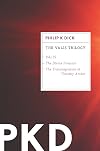
This e-book only edition brings together the three novels of Philip K. Dick's VALIS trilogy. VALIS What is VALIS? This question is at the heart of Philip K. Dick's groundbreaking novel, the first book in his defining trilogy. When a beam of pink light begins giving a schizophrenic man named Horselover Fat (who just might also be known as Philip K. Dick) visions of an alternate Earth where the Roman Empire still reigns, he must decide whether he is crazy, or whether a godlike entity is show more showing him the true nature of the world. The Divine Invasion God is not dead, he has merely been exiled to an extraterrestrial planet. And it is on this planet that God meets Herb Asher and convinces him to help retake Earth from the demonic Belial. As the middlie novel of Dick's VALIS trilogy, The Divine Invasion plays a pivotal role in answering the questions raised by the first novel, expanding that world while exploring just how much anyone can really know -- even God himself. The Transmigration of Timothy Archer The final book in the VALIS trilogy, The Transmigration of Timothy Archer brings the author's search for the identity and nature of God to a close. The novel follows Bishop Timothy Archer as he travels to Israel, ostensibly to examine ancient scrolls bearing the words of Christ. But, more importantly, this leads him to examine the decisions he made during his life and how they may have contributed to the suicide of his mistress and son. show lessTags
Recommendations
































Member Reviews
I am a huge Philip K. Dick fan. In addition to a dozen of his works, I read the entire 900 plus pages of The Exegesis of Philip K. Dick several years ago, and found it fascinating. These three books, however, were overwhelmed by the madness, religion, and drugs. VALIS seemed like the Exegesis thinly wrapped in a pseudo autobiography. The Divine Invasion had a much better plot, but the extended lapses into details unknown to ordinary readers spoiled the balance of the work. The Transmigration of Timothy Archer was much more like his other works, although the twists were all metaphysical and psychological, not sci-fi. Still, in sentences throughout all of this Dick’s wit shines. I especially liked “the Big Noodle, the AI system that show more processed Earth’s information, the vast artificial intelligence on which the government relied.” He ties it together with, “he had been feeding St. Anselm’s Proslogion to the Big Noodle with the idea of resurrecting the long discredited Ontological Proof for the existence of God.” I am still a huge fan, with many more PKD novels to read, but I need a break. My soul is exhausted. show less
Combines 3 novels
http://www.digital-falcon.com/articles/VALIS.shtml
Philip K. Dick’s direct encounter with a pink light shooting into his brain, which he called VALIS, occurred in March of 1974. He maintained afterward, as well as in the novel by that name, that as a result he was able to diagnose a condition in his son which would otherwise have been life threatening. Dick also identified the pink information beam as a god by whom he had himself been wounded.
In all his writing after the spring of 1974, including the material he called the Exegesis, Dick compulsively and brilliantly elaborated possible explanations of the VALIS episode. It can be argued that the pink flash in his brain was simply the precursor of the massive stroke which killed him in show more 1982. Why didn’t he recognize the experience in terms of brain-fault, early tremor, pain-signal of worse to come, generated from his own biology?
In VALIS, Phil Dick, the narrator, explains: “The information was fired at my friend Horselover Fat.� To which another character responds: “But that’s you. ‘Phil’ means ‘Horselover’ in Greek, lover of horses. ‘Fat’ is the German translation of ‘Dick.’� It may be that only the crazy, visionary aspect of the author could experience the wound as information rather than noise.
Instead of seeing the event as a failure of Dick’s personal biology, Horselover experienced it as an attack by VALIS which became the core event around which he organized brilliant explorations of the nature of consciousness and identity. The succeeding years were among the best and most creative of Dick’s life.
At one time Horselover speculated that he has been hit by an extraterrestrial information beam shot from his TV set. At another, he feared he was the victim of remote control tests by super-elite conspirators using receptors implanted in unsuspecting citizens.
According to the cipher beamed at Dick by VALIS, as interpreted by Horselover, the mute, deaf, telepathic, asthmatic, long-skulled, three-eyed Ikhnatons, originally from the Syrius star-system, survived the Age of Iron, ruled by the Empire from the Fall of the Temple in Jerusalem through Nixon’s resignation, and covertly influenced our history toward a fruitful end. The Age of King Felix began in August of 1974.
Dick experienced mind as “not talking to us but by means of us.� VALIS, Appendix # 35. He concluded that humans have suffered a “malfunction--a failure--of memory retrieval� lying in “our particular subcircuit.� Salvation comes through anamnesis, “the loss of amnesia.� Therefore the “external information� involves disinhibiting instructions, with the core content actually intrinsic to us.� Id #48.
Most encyclopedias report that, in 1974, American scientists detected a sub-atomic particle, the psi or J meson, which they interpreted as “a state composed of a charmed quark and a charmed antiquark.� Reading that in the papers at the time, I began chanting: lumen naturae, lumen gratiae, lumen fidei, light of nature, light of grace, light of revelation. Here comes Uncle Felix, the Rightful, Happy King!
Had Dick seen the etiology of his condition simply in terms of his nearly catastrophic blood pressure during his encounter with VALIS, he may have abandoned shamanic interpretation and settled for modern medicine. Instead, the event became a strange attractor around which the apparent chaos of his preceding experiences coalesced into a self-organizing, creative symphony of multiphrenic genius. show less
Philip K. Dick’s direct encounter with a pink light shooting into his brain, which he called VALIS, occurred in March of 1974. He maintained afterward, as well as in the novel by that name, that as a result he was able to diagnose a condition in his son which would otherwise have been life threatening. Dick also identified the pink information beam as a god by whom he had himself been wounded.
In all his writing after the spring of 1974, including the material he called the Exegesis, Dick compulsively and brilliantly elaborated possible explanations of the VALIS episode. It can be argued that the pink flash in his brain was simply the precursor of the massive stroke which killed him in show more 1982. Why didn’t he recognize the experience in terms of brain-fault, early tremor, pain-signal of worse to come, generated from his own biology?
In VALIS, Phil Dick, the narrator, explains: “The information was fired at my friend Horselover Fat.� To which another character responds: “But that’s you. ‘Phil’ means ‘Horselover’ in Greek, lover of horses. ‘Fat’ is the German translation of ‘Dick.’� It may be that only the crazy, visionary aspect of the author could experience the wound as information rather than noise.
Instead of seeing the event as a failure of Dick’s personal biology, Horselover experienced it as an attack by VALIS which became the core event around which he organized brilliant explorations of the nature of consciousness and identity. The succeeding years were among the best and most creative of Dick’s life.
At one time Horselover speculated that he has been hit by an extraterrestrial information beam shot from his TV set. At another, he feared he was the victim of remote control tests by super-elite conspirators using receptors implanted in unsuspecting citizens.
According to the cipher beamed at Dick by VALIS, as interpreted by Horselover, the mute, deaf, telepathic, asthmatic, long-skulled, three-eyed Ikhnatons, originally from the Syrius star-system, survived the Age of Iron, ruled by the Empire from the Fall of the Temple in Jerusalem through Nixon’s resignation, and covertly influenced our history toward a fruitful end. The Age of King Felix began in August of 1974.
Dick experienced mind as “not talking to us but by means of us.� VALIS, Appendix # 35. He concluded that humans have suffered a “malfunction--a failure--of memory retrieval� lying in “our particular subcircuit.� Salvation comes through anamnesis, “the loss of amnesia.� Therefore the “external information� involves disinhibiting instructions, with the core content actually intrinsic to us.� Id #48.
Most encyclopedias report that, in 1974, American scientists detected a sub-atomic particle, the psi or J meson, which they interpreted as “a state composed of a charmed quark and a charmed antiquark.� Reading that in the papers at the time, I began chanting: lumen naturae, lumen gratiae, lumen fidei, light of nature, light of grace, light of revelation. Here comes Uncle Felix, the Rightful, Happy King!
Had Dick seen the etiology of his condition simply in terms of his nearly catastrophic blood pressure during his encounter with VALIS, he may have abandoned shamanic interpretation and settled for modern medicine. Instead, the event became a strange attractor around which the apparent chaos of his preceding experiences coalesced into a self-organizing, creative symphony of multiphrenic genius. show less
Ratings
Members
- Recently Added By
Author Information

669+ Works 146,629 Members
Phillip Kindred Dick was an American science fiction writer best known for his psychological portrayals of characters trapped in illusory environments. Born in Chicago, Illinois, on December 16, 1928, Dick worked in radio and studied briefly at the University of California at Berkeley before embarking on his writing career. His first novel, Solar show more Lottery, was published in 1955. In 1963, Dick won the Hugo Award for his novel, The Man in the High Castle. He also wrote a series of futuristic tales about artificial creatures on the loose; notable of these was Do Androids Dream of Electric Sheep?, which was later adapted into film as Blade Runner. Dick also published several collections of short stories. He died of a stroke in Santa Ana, California, in 1982. (Bowker Author Biography) show less
Some Editions
Series

Work Relationships
Contains
Common Knowledge
- Canonical title
- The VALIS Trilogy
- Original title
- The VALIS Trilogy
- Alternate titles*
- La Trilogie divine (SIVA, L'Invasion Divine, La Transmigration de Timothy Archer) (SIVA, L'Invasion Divine, La Transmigration de Timothy Archer)
- Original publication date
- 2003; VALIS (1978) (1978); The Divine Invasion (1980) (1980); The Transmigration of Timothy Archer (1981) (1981)
*Some information comes from Common Knowledge in other languages. Click "Edit" for more information.
Classifications
Statistics
- Members
- 400
- Popularity
- 77,566
- Reviews
- 3
- Rating
- (3.84)
- Languages
- English, French, German, Italian
- Media
- Paper, Audiobook, Ebook
- ISBNs
- 15
- ASINs
- 13