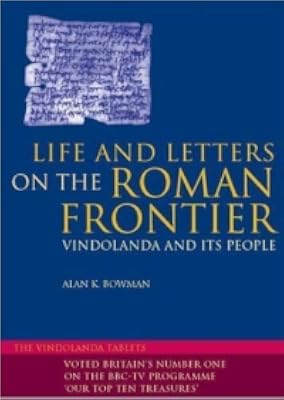
Life and Letters on the Roman Frontier: Vindolanda and Its People
by Alan K. Bowman
On This Page
Description
Greetings, I ask that you send the things which I need for the use of my boys . . . which you well know I cannot properly get hold of here . . . --A Roman soldier on the frontier of England around AD 100 Over three hundred letters and documents were recently discovered at the fort of Vindolanda, in Northern England, written on wooden tablets which have survived nearly 2,000 years. Painstakingly deciphered by Alan Bowman, the materials contribute a wealth of evidence for daily life in the show more Roman Empire. Military documents testify to the lifestyle of officers and soldiers stationed at Vindolanda, show lessTags
Recommendations












Member Reviews
This book will tell you some interesting things about the social life of Roman army officers and their families, the manufacturing and building activities the men of the Roman auxiliaries did when not fighting, the process of Romanizing conquered provinces, and the networks of trade that sprung up to supply the Roman army in Britian. All this comes from some remarkably preserved bits of wood almost 2,000 years old.
But this isn't a friendly, popular archaeology book. Its bibliography and notes and organization clearly indicate an intended audience of scholars. The text seems to be organized as if nobody will read the book cover to cover. Specific conclusions and facts are repeated from chapter to chapter. I suspect it was thought that show more its intended academic audience would simply read whatever chapter was titled in line with their speciality.
Still, those who have seen the Vindolanda writings on tv or at the British Museum may be curious to see full translations of many fragments, and students of Roman military administration or Roman Britain will certainly want to take a look. The book also includes several photos of the actual fragments and explains why the script doesn't seem to much resemble what we think of as Roman writing. Indeed, one of Bowman's major emphasis is what the Vindolanda fragments tell us about the evolution of Roman writing from Old Roman Script to New Roman Script. show less
But this isn't a friendly, popular archaeology book. Its bibliography and notes and organization clearly indicate an intended audience of scholars. The text seems to be organized as if nobody will read the book cover to cover. Specific conclusions and facts are repeated from chapter to chapter. I suspect it was thought that show more its intended academic audience would simply read whatever chapter was titled in line with their speciality.
Still, those who have seen the Vindolanda writings on tv or at the British Museum may be curious to see full translations of many fragments, and students of Roman military administration or Roman Britain will certainly want to take a look. The book also includes several photos of the actual fragments and explains why the script doesn't seem to much resemble what we think of as Roman writing. Indeed, one of Bowman's major emphasis is what the Vindolanda fragments tell us about the evolution of Roman writing from Old Roman Script to New Roman Script. show less
Ratings
Members
- Recently Added By
Author Information

28+ Works 831 Members
Common Knowledge
Classifications
- Genres
- History, Nonfiction, Anthropology, General Nonfiction
- DDC/MDS
- 936.2 — History & geography History of ancient world (to ca. 499) Europe north and west of Italian Peninsula to ca. 499 England to 410 and Wales to 410
- LCC
- DA147 .V56 .B68 — History of Europe, Asia, Africa and Oceania Great Britain History of Great Britain England History By period Early and medieval to 1485 Celts. Romans. Saxons. Danes. Normans
- BISAC
Statistics
- Members
- 136
- Popularity
- 241,415
- Reviews
- 1
- Rating
- (4.10)
- Languages
- English
- Media
- Paper, Ebook
- ISBNs
- 7