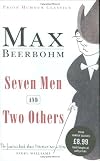
Seven Men and Two Others
by Sir Max Beerbohm
On This Page
Description
The tales that make up Seven Men and Two Others start out as a set of "faux" memoirs set amid London literary life in the precious fin de siecle era and proceed into deliciously absurd fantasy. With a sense of fun, a hint of nostalgia, razor-sharp satire, and pitch-perfect parody, Beerbohm tugs at the affected nature of the whole literary scene--lamentable authors, wily agents, and preposterous weekend salons.Tags
Recommendations
















Member Reviews
Five stars for two at least of the Seven Men: Enoch Soames and 'Savonarola' Brown, literary miniatures about two failed poets of sublime incompetence. Enoch Soames is a tale of Faustian time travel into what was, for Beerbohm, the barely imaginable future - which is now our well remembered past. Marvellous plot. But the plot is only the vehicle for Soames' delicately awful poems. Brown's tragedy, 'Savonarola', in Shakespearian blank verse, is another kettle of fish entirely. Splendidly declaratory. Here is the magnificently scornful Lucretia Borgia to infatuated Savonarola, after he abandons his habit and makes his appearance in the guise of a Renaissance nobleman, to woo her:
Go! Pad thy calves!
Then might'st thou just conceivably with show more luck,
Capture the fancy of some serving wench.
Beerbohm had perfect pitch. show less
Go! Pad thy calves!
Then might'st thou just conceivably with show more luck,
Capture the fancy of some serving wench.
Beerbohm had perfect pitch. show less
Wonderful, wonderful Max Beerbohm. Seven better than Zuleika Dobson!
Ratings
Members
- Recently Added By
Lists

Harold Bloom - The Western Canon: D. The Chaotic Age
833 works; 24 members

Michael Dirda's Desert Island Books
62 works; 5 members
Author Information

84+ Works 3,610 Members
Henry Maximilian Beerbohm was born in England in 1872. In his twenties, Beerbohm became part of the literary circle of Oscar Wilde, and in 1898 he became the drama critic for the Saturday Review. His predecessor George Bernard Shaw recommended Beerbohm for this position supposedly because of Beerbohm's attacks on Plays Pleasant and Unpleasant, one show more of Shaw's own works. It was also Shaw who gave Beerbohm the nickname The Incomparable Max. Beerbohm was known primarily for his sharp wit, often expressed in parody and satire, His first book The Works of Max Beerbohm was a collection of essays in a mock-scholarly format. Other essay collections include Yet Again, And Even Now, Around Theatres, and Mainly on the Air, which was based on a series of radio broadcasts. His fiction includes one novel titled Zuleika Dobson: An Oxford Love Story and numerous short stories. Many of his short stories have been published in such collections as The Happy Hypocrite, Seven Men, and A Variety of Things. Beerbohm's flair for humor and parody was carried over into his art. He was a gifted caricaturist and was as well known for his drawings as for his writing. His drawings have been published in the collections Caricatures of Twenty-five Gentlemen, The Second Childhood of John Bull, A Book of Caricatures, Fifty Caricatures, Rosetti and His Circle, and Things Old and New. Beerbohm resigned from the Saturday Review in 1910 when he married Florence Kahn, an American actress, and they retired to Rapallo, Italy. The Beerbohms returned to England for several years during World War II, but in 1947 they returned to Rapallo where Beerbohm died in 1956. Beerbohm was knighted in 1939. (Bowker Author Biography) show less
All Editions
Some Editions
Awards and Honors
Notable Lists
Work Relationships
Contains
Classifications
Statistics
- Members
- 198
- Popularity
- 164,903
- Reviews
- 2
- Rating
- (4.05)
- Languages
- English
- Media
- Paper
- ISBNs
- 5
- ASINs
- 10