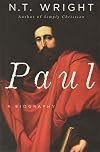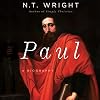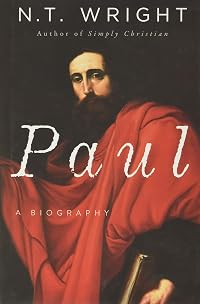
Paul: A Biography
by N. T. Wright
On This Page
Description
In this definitive biography, renowned Bible scholar, Anglican bishop, and bestselling author N. T. Wright offers a radical look at the apostle Paul, illuminating the humanity and remarkable achievements of this intellectual who invented Christian theology transforming a faith and changing the world. For centuries, Paul, the apostle who "saw the light on the Road to Damascus" and made a miraculous conversion from zealous Pharisee persecutor to devoted follower of Christ, has been one of the show more church's most widely cited saints. While his influence on Christianity has been profound, N. T. Wright argues that Bible scholars and pastors have focused so much attention on Paul's letters and theology that they have too often overlooked the essence of the man's life and the extreme unlikelihood of what he achieved. To Wright, "The problem is that Paul is central to any understanding of earliest Christianity, yet Paul was a Jew; for many generations Christians of all kinds have struggled to put this together." Wright contends that our knowledge of Paul and appreciation for his legacy cannot be complete without an understanding of his Jewish heritage. Giving us a thoughtful, in-depth exploration of the human and intellectual drama that shaped Paul, Wright provides greater clarity of the apostle's writings, thoughts, and ideas and helps us see them in a fresh, innovative way. Paul is a compelling modern biography that reveals the apostle's greater role in Christian history as an inventor of new paradigms for how we understand Jesus and what he accomplished and celebrates his stature as one of the most effective and influential intellectuals in human history. show lessTags
Recommendations


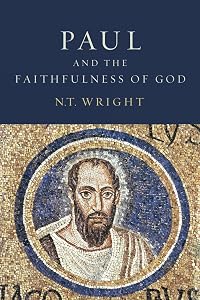





Member Recommendations
Member Reviews
Summary: Wright translates his scholarship that gives a "new account" of Paul's life into a popular biography, tracing the life and thought of the apostle through the letters he wrote and narrative of his journeys.
Over the last thirty years, perhaps no one has written more on the life and thought of the Apostle Paul than N. T. Wright, most notably his two volume Paul and the Faithfulness of God. Wright is associated with what is called "the New Perspective" on Paul. What he has done in this volume is distill his scholarship into a highly readable account of the life and thought of this apostle. Reading this, you will see some of the ways Wright casts the life of Paul in new perspective.
We see this in his portrayal of Paul's Damascus show more road experience. He imagines Paul possibly reflecting on the vision of Ezekiel, perhaps praying the Shema, when suddenly he gazes upward...into the face of Jesus, whose followers he has been persecuting. Wright challenges us to see that this was not a conversion to a new religion, but the shattering and transforming realization that Jesus was the fulfillment of the scriptures Paul had studied so long--that he "had been absolutely right in his devotion to Israel and the Torah, but absolutely wrong in his view of Israel's vocation and identity and even in the meaning of the Torah."
He then traces the travels of Paul from the formative years in the wilderness and Tarsus where he rethought everything in the light of Christ, and then his successive journeys taking the message of Christ into Asia Minor, then later into Europe in Philippi, Athens, and Corinth. In the Galatian controversy with Peter and his subsequent letter, we catch the first glimpse of Paul's transformed vision, where he sees both Jew and Gentile incorporated and included into a new people enjoying the blessing of Abraham's faith. It is this that explains his methodology of teaching in synagogues, and then to Gentiles who will hear him and seeking to form new communities made up of those who give allegiance to Christ, and share table fellowship.
The biography offers some of Wright's distinctive judgments on matters scholars have debated, southern versus northern theories of Galatians (he opts for south), and the origin of the prison letters, neither from Caesarea or Rome, but during an imprisonment in the latter part of his time in Ephesus. Wright explores this as a nadir of Paul's ministry, both in the experience of prison, but also in the receipt of disturbing news from Corinth from those questioning his reputation. He proposes that this accounts for the somewhat disjointed style of 2 Corinthians, written after his release. He also believes that after writing this, he penned his magnum opus to the Romans, spelling out to a church where tensions existed separating Jew and Gentile, the purpose of God to include Gentiles with Jews as heirs of the promise of the covenant to make one new people.
Throughout, Wright explores the character of this apostle, who he describes as "bossy" on the voyage to Rome, and often troublesome in jumping into the fray. Paul did not let sleeping dogs lie. But Wright also argues, that like many "angular" entrepreneurs, it was these very qualities that, on a human level accounted for the success of this apostle in establishing these new communities across the Roman empire.
The work was a delight to read on many levels, as a reflection on the career of Paul and as an exploration of the relationship of Jesus and the hope of Israel revealed in Torah and the prophets. I savored his insights into each of Paul's letters, and the vision of the church Paul articulated, that would sustain a movement long after his martyrdom, even as it continues to do so to this day.
Paul has often been maligned as a misogynist, as a heretic from his Jewish origins, and more. For others, we read him through Reformation glasses. Wright may or may not convince you otherwise, but this marvelous distillation of his scholarship will make you both think about, and hopefully rejoice in, what this apostle accomplished. And perhaps it will help you read his letters with new eyes. show less
Over the last thirty years, perhaps no one has written more on the life and thought of the Apostle Paul than N. T. Wright, most notably his two volume Paul and the Faithfulness of God. Wright is associated with what is called "the New Perspective" on Paul. What he has done in this volume is distill his scholarship into a highly readable account of the life and thought of this apostle. Reading this, you will see some of the ways Wright casts the life of Paul in new perspective.
We see this in his portrayal of Paul's Damascus show more road experience. He imagines Paul possibly reflecting on the vision of Ezekiel, perhaps praying the Shema, when suddenly he gazes upward...into the face of Jesus, whose followers he has been persecuting. Wright challenges us to see that this was not a conversion to a new religion, but the shattering and transforming realization that Jesus was the fulfillment of the scriptures Paul had studied so long--that he "had been absolutely right in his devotion to Israel and the Torah, but absolutely wrong in his view of Israel's vocation and identity and even in the meaning of the Torah."
He then traces the travels of Paul from the formative years in the wilderness and Tarsus where he rethought everything in the light of Christ, and then his successive journeys taking the message of Christ into Asia Minor, then later into Europe in Philippi, Athens, and Corinth. In the Galatian controversy with Peter and his subsequent letter, we catch the first glimpse of Paul's transformed vision, where he sees both Jew and Gentile incorporated and included into a new people enjoying the blessing of Abraham's faith. It is this that explains his methodology of teaching in synagogues, and then to Gentiles who will hear him and seeking to form new communities made up of those who give allegiance to Christ, and share table fellowship.
The biography offers some of Wright's distinctive judgments on matters scholars have debated, southern versus northern theories of Galatians (he opts for south), and the origin of the prison letters, neither from Caesarea or Rome, but during an imprisonment in the latter part of his time in Ephesus. Wright explores this as a nadir of Paul's ministry, both in the experience of prison, but also in the receipt of disturbing news from Corinth from those questioning his reputation. He proposes that this accounts for the somewhat disjointed style of 2 Corinthians, written after his release. He also believes that after writing this, he penned his magnum opus to the Romans, spelling out to a church where tensions existed separating Jew and Gentile, the purpose of God to include Gentiles with Jews as heirs of the promise of the covenant to make one new people.
Throughout, Wright explores the character of this apostle, who he describes as "bossy" on the voyage to Rome, and often troublesome in jumping into the fray. Paul did not let sleeping dogs lie. But Wright also argues, that like many "angular" entrepreneurs, it was these very qualities that, on a human level accounted for the success of this apostle in establishing these new communities across the Roman empire.
The work was a delight to read on many levels, as a reflection on the career of Paul and as an exploration of the relationship of Jesus and the hope of Israel revealed in Torah and the prophets. I savored his insights into each of Paul's letters, and the vision of the church Paul articulated, that would sustain a movement long after his martyrdom, even as it continues to do so to this day.
Paul has often been maligned as a misogynist, as a heretic from his Jewish origins, and more. For others, we read him through Reformation glasses. Wright may or may not convince you otherwise, but this marvelous distillation of his scholarship will make you both think about, and hopefully rejoice in, what this apostle accomplished. And perhaps it will help you read his letters with new eyes. show less
What I have always appreciated about Wright is how he has worked very diligently to demonstrate how one can still hold on to canonical Christian beliefs and understand them in historically intelligible ways.
Such is on display in Paul: A Biography (link in picture). Wright attempts to reconstruct the life of Paul based on Paul’s letters and Luke’s account in Acts of the Apostles, contextualizing his development, the experiences he endures, and the letters he wrote situated in their appropriate chronological order and contexts. In short, Paul: A Biography is a diachronic and more popularly directed condensation of Paul and the Faithfulness of God.
By virtue of necessity such an exposition will be speculative in many respects, show more although the speculation is historically informed by what is known about the Eastern Mediterranean world of the first century. I still remain unconvinced by his early Galatians hypothesis (I understand it as written around the same time as 2 Corinthians), but walked away with a far greater willingness to countenance an Ephesian imprisonment in which Ephesians, Colossians, and Philemon were written.
I would thus highly recommend Paul: A Biography just like I tend to recommend a lot of Wright’s popular level writing: it is great for an audience which is not well versed, and not much interested, in the “inside baseball” of the world of scholarship on Paul, as long as one recognizes there is a lot of analysis going on which may not be explicitly manifest in this work but can be found in Paul and the Faithfulness of God, Paul and His Recent Interpreters, etc. Likewise, it is good to remember he is crafting a story for coherence and there are a lot of questions behind the scenes which cannot be fully resolved. But he provides a well-reasoned portrait which can help believers better understand Paul in his context. show less
Such is on display in Paul: A Biography (link in picture). Wright attempts to reconstruct the life of Paul based on Paul’s letters and Luke’s account in Acts of the Apostles, contextualizing his development, the experiences he endures, and the letters he wrote situated in their appropriate chronological order and contexts. In short, Paul: A Biography is a diachronic and more popularly directed condensation of Paul and the Faithfulness of God.
By virtue of necessity such an exposition will be speculative in many respects, show more although the speculation is historically informed by what is known about the Eastern Mediterranean world of the first century. I still remain unconvinced by his early Galatians hypothesis (I understand it as written around the same time as 2 Corinthians), but walked away with a far greater willingness to countenance an Ephesian imprisonment in which Ephesians, Colossians, and Philemon were written.
I would thus highly recommend Paul: A Biography just like I tend to recommend a lot of Wright’s popular level writing: it is great for an audience which is not well versed, and not much interested, in the “inside baseball” of the world of scholarship on Paul, as long as one recognizes there is a lot of analysis going on which may not be explicitly manifest in this work but can be found in Paul and the Faithfulness of God, Paul and His Recent Interpreters, etc. Likewise, it is good to remember he is crafting a story for coherence and there are a lot of questions behind the scenes which cannot be fully resolved. But he provides a well-reasoned portrait which can help believers better understand Paul in his context. show less
What an extraordinary way to read Paul! Tom Wright has masterfully woven all of Paul from Acts and the epistles, along with insights from historical research, into a single narrative. He tackles the questions of "What made Paul tick?" and "Why was Paul ultimately so successful?" with well-reasoned imagination. Every serious student of Paul should take the opportunity just once to read him with Tom Wright.
This biography of Paul is both deep and accessible. Wright makes a point of placing Paul in his own time and cultures, often making even well known passages suddenly make sense.
https://nwhyte.livejournal.com/3809188.html
This book by the former Bishop of Durham is meant to be a popular biography of the Apostle Paul, tracing his voyages, both intellectual and across the Eastern Mediterranean, in the middle part of the first century AD. St Paul is probably the most important historical figure in Christianity apart from Jesus Christ, and it's therefore of interest to get a better understanding of what he was actually trying to do. We are impeded by the fact that there is no contemporary record of his existence outside the New Testament, where he is a key character in the Acts of the Apostles and traditionally regarded as the author of a dozen or so of the Epistles, with most modern scholars agreeing that he really show more did write more than half of them. We are also impeded by the fact that while a lot of his surviving writing seems to be arguing against other lines of thought inside and outside the early Christian community, we barely know what the other side really said because only Paul's side of the argument survives.
Faced with all of this, it's a difficult task to make sense of the story for the non-specialist reader, and for this non-specialist reader, it didn't quite come together. I got that Paul's particular innovations were to cast Jesus as a fulfiller of Jewish tradition, and to embrace non-Jews in Christianity. I didn't really get the basics of what Paul thought the faith basis of Christianity is - I felt that Wright was striving to avoid being trapped in the traditional Protestant v Catholic debate here and ended up not saying all that much. I think there is probably more to be said about Paul's views on women, especially women in ministry, which I suspect were more modern than most people like to believe. I did like the nitty-gritty (if largely imagined) detail of Paul continuing to ply his trade as a maker and repairer of tents while also evangelising the Levant. I was frustrated that Wright presents very little of other scholars' views, and gives no recommendations for further reading.
The single most interesting thing about St Paul is that he had a sudden conversion experience one day while travelling to Damascus, probably in the mid-30s, only a few years after the Crucifixion. Until then, he had been colluding in the persecution of Christians (not yet called that of course) by Jewish and Roman authorities. But in that moment on the road, he experienced the direct presence of Jesus, was struck blind for several days, and then felt compelled to preach Christianity for the rest of his life (probably about thirty years). It's pretty difficult to explain, let alone explain away, and Wright doesn't really try. Of course it comes near the very start of the story, and we don't know a lot about the end (though apparently his remains have recently been identified).
Anyway, I found this not totally satisfying. show less
This book by the former Bishop of Durham is meant to be a popular biography of the Apostle Paul, tracing his voyages, both intellectual and across the Eastern Mediterranean, in the middle part of the first century AD. St Paul is probably the most important historical figure in Christianity apart from Jesus Christ, and it's therefore of interest to get a better understanding of what he was actually trying to do. We are impeded by the fact that there is no contemporary record of his existence outside the New Testament, where he is a key character in the Acts of the Apostles and traditionally regarded as the author of a dozen or so of the Epistles, with most modern scholars agreeing that he really show more did write more than half of them. We are also impeded by the fact that while a lot of his surviving writing seems to be arguing against other lines of thought inside and outside the early Christian community, we barely know what the other side really said because only Paul's side of the argument survives.
Faced with all of this, it's a difficult task to make sense of the story for the non-specialist reader, and for this non-specialist reader, it didn't quite come together. I got that Paul's particular innovations were to cast Jesus as a fulfiller of Jewish tradition, and to embrace non-Jews in Christianity. I didn't really get the basics of what Paul thought the faith basis of Christianity is - I felt that Wright was striving to avoid being trapped in the traditional Protestant v Catholic debate here and ended up not saying all that much. I think there is probably more to be said about Paul's views on women, especially women in ministry, which I suspect were more modern than most people like to believe. I did like the nitty-gritty (if largely imagined) detail of Paul continuing to ply his trade as a maker and repairer of tents while also evangelising the Levant. I was frustrated that Wright presents very little of other scholars' views, and gives no recommendations for further reading.
The single most interesting thing about St Paul is that he had a sudden conversion experience one day while travelling to Damascus, probably in the mid-30s, only a few years after the Crucifixion. Until then, he had been colluding in the persecution of Christians (not yet called that of course) by Jewish and Roman authorities. But in that moment on the road, he experienced the direct presence of Jesus, was struck blind for several days, and then felt compelled to preach Christianity for the rest of his life (probably about thirty years). It's pretty difficult to explain, let alone explain away, and Wright doesn't really try. Of course it comes near the very start of the story, and we don't know a lot about the end (though apparently his remains have recently been identified).
Anyway, I found this not totally satisfying. show less
Wow! I am always reluctant to use the word genius but you have to hand it to Tom Wright as he is the complete master of his material and his subject. What I would really like is for him to reduce the book to about 12 illustrated lectures and then I would feel that I knew Paul
Respected biblical scholar N. T. Wright offers an insightful look at the life of the Apostle Paul. He correctly bases his insights on first century culture. He examines the Scriptures and looks at recent scholarship, offering his interpretations. He looks at Paul's writings in relation to what was going on in Paul's life at the time. This book will be studied for many years to come.
Members
- Recently Added By
Author Information

296+ Works 56,328 Members
N. T. Wright serves as Senior Research Fellow at Wycliffe Hall, Oxford University, as well professor emeritus of New Testament and Early Christianity at the School of Divinity at the University of St. Andrews. He is the award-winning author of many books, including Broken Signposts, Paul: A Biography, Surprised by Hope, and many more.
Common Knowledge
- Alternate titles*
- Paulus : een biografie
- Original publication date
- 2018
- Dedication
- In loving memory of Carey Alison Wright
October 12, 1956-June 3, 2017 - First words
- It begins with an ancient tale of sex and violence.
*Some information comes from Common Knowledge in other languages. Click "Edit" for more information.
Classifications
- Genres
- Religion & Spirituality, Biography & Memoir, Nonfiction, History, General Nonfiction
- DDC/MDS
- 225.92 — Religion The Bible New Testament Biblical geography and history Biography
- LCC
- BS2506.3 .W749 — Philosophy, Psychology and Religion The Bible The Bible New Testament Works about the New Testament Men, women, and children of the New Testament
- BISAC
Statistics
- Members
- 995
- Popularity
- 26,300
- Reviews
- 11
- Rating
- (4.21)
- Languages
- Dutch, English, Portuguese
- Media
- Paper, Audiobook, Ebook
- ISBNs
- 16
- ASINs
- 5