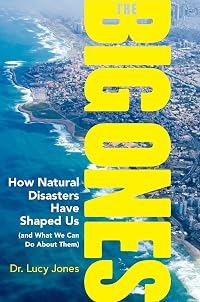
The Big Ones: How Natural Disasters Have Shaped Us (and What We Can Do About Them)
by Lucy Jones
On This Page
Description
By the world-renowned seismologist, a riveting history of natural disasters, their impact on our culture, and new ways of thinking about the ones to comeEarthquakes, floods, tsunamis, hurricanes, volcanoes—they stem from the same forces that give our planet life. Earthquakes give us natural springs; volcanoes produce fertile soil. It is only when these forces exceed our ability to withstand them that they become disasters. Together they have shaped our cities and their architecture; show more elevated leaders and toppled governments; influenced the way we think, feel, fight, unite, and pray. The history of natural disasters is a history of ourselves.
In The Big Ones, leading seismologist Dr. Lucy Jones offers a bracing look at some of the world's greatest natural disasters, whose reverberations we continue to feel today. At Pompeii, Jones explores how a volcanic eruption in the first century AD challenged prevailing views of religion. She examines the California floods of 1862 and the limits of human memory. And she probes more recent events—such as the Indian Ocean tsunami of 2004 and the American hurricanes of 2017—to illustrate the potential for globalization to humanize and heal.
With population in hazardous regions growing and temperatures around the world rising, the impacts of natural disasters are greater than ever before. The Big Ones is more than just a work of history or science; it is a call to action. Natural hazards are inevitable; human catastrophes are not. With this energizing and exhaustively researched book, Dr. Jones offers a look at our past, readying us to face down the Big Ones in our future. show less
Tags
Recommendations











Member Reviews
Fire and Ice by Robert Frost
Some say the world will end in fire,
Some say in ice.
From what I’ve tasted of desire
I hold with those who favor fire.
But if it had to perish twice,
I think I know enough of hate
To say that for destruction ice
Is also great
And would suffice.
Undoubtedly, The Voice of New England had the deeds of his fellow humans in mind, rather than so-called Acts of God, when he penned the above rumination in rhyme about a possible apocalypse. Nevertheless, his thought provoking short verse seems particularly apt when we contemplate the effects of volcanoes, earthquakes, and floods on our species and the structures we have built, often in the least advisable locations.
In this equally thought provoking volume, Dr. Lucy Stone, show more who spent three decades of her career as a seismologist with the United States Geological Survey, outlines the many ways our race has suffered by the hand of Mother Nature. Part scientific treatise, part history lesson and part memoir, she lays out a series of case studies that examines such monumental events as the earthquake that struck Lisbon, Portugal in 1755 and the Mississippi River flood in 1927. Both heartbreaking and hopeful, Jones describes how humankind sets itself up for failure by congregating on floodplains and fissures in the earth, either through ignorance or folly. On the other hand, knowledge is power, and with what we now know of plate tectonics and fluid mechanics, we can now avoid some of the mistakes of the past. With a minimum of technical jargon, she explains the physical processes that move earth, air and water, often to our detriment. Not only does she demystify some of the theories underlying the many “ologies” at work studying this ball of rock and brine that we inhabit, but she also sprinkles anecdotes and stories of those who seek and have sought to unlock nature’s secrets. Most of us are familiar with the name of Charles Richter, who developed the well-known scale used to estimate the intensity of earthquakes. More obscure, but no less important is John Milne, the English Victorian geologist that moved to Japan to study this phenomenon and is now considered one of the founding fathers of seismology. His is just one of several fascinating vignettes presented within these pages.
Clearly written and well-illustrated with maps and diagrams, this engaging book will be of interest not only to the armchair geologist but to any curious reader who would like to know more about living with our living planet. show less
Some say the world will end in fire,
Some say in ice.
From what I’ve tasted of desire
I hold with those who favor fire.
But if it had to perish twice,
I think I know enough of hate
To say that for destruction ice
Is also great
And would suffice.
Undoubtedly, The Voice of New England had the deeds of his fellow humans in mind, rather than so-called Acts of God, when he penned the above rumination in rhyme about a possible apocalypse. Nevertheless, his thought provoking short verse seems particularly apt when we contemplate the effects of volcanoes, earthquakes, and floods on our species and the structures we have built, often in the least advisable locations.
In this equally thought provoking volume, Dr. Lucy Stone, show more who spent three decades of her career as a seismologist with the United States Geological Survey, outlines the many ways our race has suffered by the hand of Mother Nature. Part scientific treatise, part history lesson and part memoir, she lays out a series of case studies that examines such monumental events as the earthquake that struck Lisbon, Portugal in 1755 and the Mississippi River flood in 1927. Both heartbreaking and hopeful, Jones describes how humankind sets itself up for failure by congregating on floodplains and fissures in the earth, either through ignorance or folly. On the other hand, knowledge is power, and with what we now know of plate tectonics and fluid mechanics, we can now avoid some of the mistakes of the past. With a minimum of technical jargon, she explains the physical processes that move earth, air and water, often to our detriment. Not only does she demystify some of the theories underlying the many “ologies” at work studying this ball of rock and brine that we inhabit, but she also sprinkles anecdotes and stories of those who seek and have sought to unlock nature’s secrets. Most of us are familiar with the name of Charles Richter, who developed the well-known scale used to estimate the intensity of earthquakes. More obscure, but no less important is John Milne, the English Victorian geologist that moved to Japan to study this phenomenon and is now considered one of the founding fathers of seismology. His is just one of several fascinating vignettes presented within these pages.
Clearly written and well-illustrated with maps and diagrams, this engaging book will be of interest not only to the armchair geologist but to any curious reader who would like to know more about living with our living planet. show less
The Big Ones, by Dr. Lucy Jones is a wonderful accounting of many of the largest and most devastating natural disasters that have shaped our history. Dr. Jones lays out a compelling narrative about the role that natural disasters have played in advancing scientific thought and research, politics, and social norms. While Dr. Jones is a geologist (seismologist) by training, her recounting of natural disasters don't solely focus on geologic hazards, and often points out how human decisions (or lack thereof) not only help create, but often times exacerbate, a natural disaster and turns an event into a catastrophe. She explores the volcanic eruption of Pompeii, devastating floods in California in 1862 and the disastrous 1927 Mississippi show more River floods. The great earthquakes of Lisbon, Portugal in 1755 and Tokyo in 1923, as well as the earthquakes and tsunami that created wide destruction in the Indian Ocean in 2004 and East Japan in 2011. The range of disasters that she covers span not only recorded human history, but covers the range of geologic and meteorologic disasters.
I loved the history that Dr. Jones provides for each of the events, recounting the details of the disasters from personal accounts written at the time. And while these details are fascinating, and provide a human voice to the narrative, what I really enjoyed was the assessment and interpretation of the events and how these disasters helped shape our modern society. From transitioning from the beliefs that natural disasters were created by angry, vengeful, or just callous deities to our reliance on modern scientific theories. What really struck a chord with me was the focus on science communication, and how communication of the risks and probabilities of any single disaster can result in tragic consequences, or have a profound impact on bettering our society. How even into the modern era (the 20th and 21st centuries) a reliance to stick to old, outdated belief systems (even if backed by science) often lead to a greater catastrophe when a disaster does strike.
I highly recommend The Big Ones to anybody interested in science history. Dr. Jones' narrative is easy to follow, and she clearly conveys the knowledge and experience that she has gained over several decades working in the field. I listened to the audio version of the book, narrated by the author, and she does a great job. Her fluency in Chinese is evident when she tells of the earthquakes in China in the 1970s - one predicted, one not, and she displays her skill as a science communicator. show less
I loved the history that Dr. Jones provides for each of the events, recounting the details of the disasters from personal accounts written at the time. And while these details are fascinating, and provide a human voice to the narrative, what I really enjoyed was the assessment and interpretation of the events and how these disasters helped shape our modern society. From transitioning from the beliefs that natural disasters were created by angry, vengeful, or just callous deities to our reliance on modern scientific theories. What really struck a chord with me was the focus on science communication, and how communication of the risks and probabilities of any single disaster can result in tragic consequences, or have a profound impact on bettering our society. How even into the modern era (the 20th and 21st centuries) a reliance to stick to old, outdated belief systems (even if backed by science) often lead to a greater catastrophe when a disaster does strike.
I highly recommend The Big Ones to anybody interested in science history. Dr. Jones' narrative is easy to follow, and she clearly conveys the knowledge and experience that she has gained over several decades working in the field. I listened to the audio version of the book, narrated by the author, and she does a great job. Her fluency in Chinese is evident when she tells of the earthquakes in China in the 1970s - one predicted, one not, and she displays her skill as a science communicator. show less
Contrary to the title, The Big Ones does not necessarily cover the most intense natural disasters. For example, the earthquakes covered include Lisbon 1755, Kanto 1923, and Tangshan 1976, but not Chile 1960 or Alaska 1964.
Instead the author, formerly a seismologist with the USGS, focuses on events that impacted large populations. For each of the 11 events described here, the narrative emphasizes the human response. There are stories of great heroism, but all too often minority communities have been scapegoated for "causing" these natural disasters.
The book is dedicated to urban planners, and it ends with a call to develop resilient communities that can survive the forces of nature we cannot control.
Instead the author, formerly a seismologist with the USGS, focuses on events that impacted large populations. For each of the 11 events described here, the narrative emphasizes the human response. There are stories of great heroism, but all too often minority communities have been scapegoated for "causing" these natural disasters.
The book is dedicated to urban planners, and it ends with a call to develop resilient communities that can survive the forces of nature we cannot control.
An exploration of notable natural disasters in human history, the development of scientific inquiry to better understand them, and the kinds of lessons that can be learned from their aftermath.
The author is the authority regarding earthquakes and their effects in Southern California. She has investigated all sorts of natural disasters, from Mount Vesuvius' destruction of Pompeii in 79 CE to the Tohoku earthquake and tsunami 0f 2011, with all kinds of events in between: earthquakes, volcanoes, hurricanes, etc. The author attempts to show the developments in the ways humans respond to these events in terms of attribution of cause and how it leads them to respond.
To me the most important aspect of this work is the author's insistence on show more looking at natural disasters not just in terms of the event itself but also in terms of its aftermath. It's not just about living through the moment of crisis; it's also about making sure life can continue afterward: yes, making sure needed supplies get through and effective rebuilding, but ideally, better preparation so that fewer buildings need to be condemned and quality of life is not catastrophically lost when it doesn't have to be.
All of this has special relevance for Southern California, obviously, but in a changing world we are seeing disasters happening everywhere. Not the most pleasant of reading, for obvious reasons, but worth exploring. show less
The author is the authority regarding earthquakes and their effects in Southern California. She has investigated all sorts of natural disasters, from Mount Vesuvius' destruction of Pompeii in 79 CE to the Tohoku earthquake and tsunami 0f 2011, with all kinds of events in between: earthquakes, volcanoes, hurricanes, etc. The author attempts to show the developments in the ways humans respond to these events in terms of attribution of cause and how it leads them to respond.
To me the most important aspect of this work is the author's insistence on show more looking at natural disasters not just in terms of the event itself but also in terms of its aftermath. It's not just about living through the moment of crisis; it's also about making sure life can continue afterward: yes, making sure needed supplies get through and effective rebuilding, but ideally, better preparation so that fewer buildings need to be condemned and quality of life is not catastrophically lost when it doesn't have to be.
All of this has special relevance for Southern California, obviously, but in a changing world we are seeing disasters happening everywhere. Not the most pleasant of reading, for obvious reasons, but worth exploring. show less
A very interesting read. This book gives somewhat of a different perspective on some of the world's major natural disasters. Instead of focusing on the death & destruction the author does a very reasoned analysis of both the causes and impacts (physical, cultural, sociological, and historical). When you think you are well read and still find major historical occurrences that you never even heard of ...
This book provides a superficial look at a few of the world's biggest natural disasters and how these disasters effected societies. Jones explores how the disaster victims and relevant governments dealt with the catastrophe and what they are doing to mitigate the adverse effects of any subsequent natural disasters. This is a history book with minimal, superficial science. The book is informative with an easy going writing style, however, I was hoping for more specific information on the disaster themselves and the engineering options used to mitigate disaster impacts. This book makes for a good introductory text to the subject.
The Big Ones: How Natural Disasters Have Shaped Us (and What We Can Do About Them) by Lucy Jones is a highly recommended look at eleven of the world's greatest natural disasters. Dr. Jones tells the historical and geological stories of the selected disasters, and what they have revealed about the population effected. Each disaster covered was the "Big One"at the time it happened and fundamentally changed the community and culture in the region. Taken together as a whole, all of these disasters can provide insight into how fear influences the response to catastrophes and the reasoning behind those reactions.
The disasters covered are:
Pompeii, Roman Empire, AD 79: A volcanic eruption of Mount Vesuvius sent down poisonous gases and heavy show more ash to bury the Roman city.
Lisbon, Portugal, 1755: On November 1, All Saints Day, An earthquake occurred with the smallest estimated magnitude being 8.5 and the largest is 9.0. A tsunami headed up the mouth the Tagus River.
Iceland, 1783: The Laki eruption in 1783-84 resulted in 10,000 deaths, from the gases and famine. Pastor Jon Steingrimsson should be remembered for his tireless work in trying to find food for survivors. The gas emissions effected weather and health across Europe.
California, United States, 1861–62: A devastating flood occurred in the winter of 1861–62, killing thousands and bankrupting the state. A three-hundred-mile stretch of California’s Central Valley was covered under thirty feet deep in water.
Tokyo-Yokohama, Japan, 1923: An earthquake of magnitude 7.9 destroyed most of Tokyo and Yokohama and killed over 140,000 people.
Mississippi, United States, 1927: A flood covered over twenty-six thousand square miles of land had been flooded, displacing over six hundred thousand people.
Tangshan, China, 1976: July 27, 1976 a magnitude 7.8 struck right on a fault running right through Tangshan, a city of 1.5 million people.
The Indian Ocean, 2004: The magnitude 9.1 earthquake and tsunami hit the west coast of Sumatra, Indonesia, on December 26, 2004. The physical scale of it was unprecedented. The length of the fault that moved in that earthquake was over nine hundred miles. Wave heights from the resulting tsunami were 100 ft, 65 ft, to 35 feet and travel across the ocean, slamming into the coastlines of eleven countries.
New Orleans, Louisiana, United States, 2005: Hurricane Katrina, a Category 3 storm that stretched some 400 miles across, struck the gulf coast of the United States causing $100 billion in damages. Hundreds of thousands of people were displaced from their homes while FEMA was slow to react.
L’Aquila, Italy, 2009: An earthquake swarm starts in January and leads up to the big one, on April 6, when a magnitude 6.3 earthquake tore L’Aquila apart. The city sat directly on top of a fault and every building sustained damage and twenty thousand were destroyed.
Fortune Tohoku, Japan, 2011: On March 11th a magnitude 9 earthquake occurred offshore, where a fault slipped 250 miles. The resulting tsunami was several times larger than expected, with waves from 40 to 100 feet high. Waves hit the backup generators at the Daiichi nuclear power plant and the cooling systems failed for three reactors, which then overheated and nuclear fuel melted.
The final chapter is based on the likelihood that the San Andreas fault will slip, resulting in a huge earthquake occurring in Los Angeles in the future and the ShakeOut program that helps translate the science of the earthquake into a tangible reality for citizens. Finally, after empathy, these seven steps are suggested for those involved in future natural disasters: Educate yourself; Don’t assume government has you covered; Engage with local leaders; Work with your community; Remember that disasters are more than the moment at which they happen; Think for yourself. Dr. Jones includes notes, a bibliography and illustration credits.
Disclosure: My review copy was courtesy of Knopf Doubleday Publishing Group.
http://www.shetreadssoftly.com/2018/04/the-big-ones.html show less
The disasters covered are:
Pompeii, Roman Empire, AD 79: A volcanic eruption of Mount Vesuvius sent down poisonous gases and heavy show more ash to bury the Roman city.
Lisbon, Portugal, 1755: On November 1, All Saints Day, An earthquake occurred with the smallest estimated magnitude being 8.5 and the largest is 9.0. A tsunami headed up the mouth the Tagus River.
Iceland, 1783: The Laki eruption in 1783-84 resulted in 10,000 deaths, from the gases and famine. Pastor Jon Steingrimsson should be remembered for his tireless work in trying to find food for survivors. The gas emissions effected weather and health across Europe.
California, United States, 1861–62: A devastating flood occurred in the winter of 1861–62, killing thousands and bankrupting the state. A three-hundred-mile stretch of California’s Central Valley was covered under thirty feet deep in water.
Tokyo-Yokohama, Japan, 1923: An earthquake of magnitude 7.9 destroyed most of Tokyo and Yokohama and killed over 140,000 people.
Mississippi, United States, 1927: A flood covered over twenty-six thousand square miles of land had been flooded, displacing over six hundred thousand people.
Tangshan, China, 1976: July 27, 1976 a magnitude 7.8 struck right on a fault running right through Tangshan, a city of 1.5 million people.
The Indian Ocean, 2004: The magnitude 9.1 earthquake and tsunami hit the west coast of Sumatra, Indonesia, on December 26, 2004. The physical scale of it was unprecedented. The length of the fault that moved in that earthquake was over nine hundred miles. Wave heights from the resulting tsunami were 100 ft, 65 ft, to 35 feet and travel across the ocean, slamming into the coastlines of eleven countries.
New Orleans, Louisiana, United States, 2005: Hurricane Katrina, a Category 3 storm that stretched some 400 miles across, struck the gulf coast of the United States causing $100 billion in damages. Hundreds of thousands of people were displaced from their homes while FEMA was slow to react.
L’Aquila, Italy, 2009: An earthquake swarm starts in January and leads up to the big one, on April 6, when a magnitude 6.3 earthquake tore L’Aquila apart. The city sat directly on top of a fault and every building sustained damage and twenty thousand were destroyed.
Fortune Tohoku, Japan, 2011: On March 11th a magnitude 9 earthquake occurred offshore, where a fault slipped 250 miles. The resulting tsunami was several times larger than expected, with waves from 40 to 100 feet high. Waves hit the backup generators at the Daiichi nuclear power plant and the cooling systems failed for three reactors, which then overheated and nuclear fuel melted.
The final chapter is based on the likelihood that the San Andreas fault will slip, resulting in a huge earthquake occurring in Los Angeles in the future and the ShakeOut program that helps translate the science of the earthquake into a tangible reality for citizens. Finally, after empathy, these seven steps are suggested for those involved in future natural disasters: Educate yourself; Don’t assume government has you covered; Engage with local leaders; Work with your community; Remember that disasters are more than the moment at which they happen; Think for yourself. Dr. Jones includes notes, a bibliography and illustration credits.
Disclosure: My review copy was courtesy of Knopf Doubleday Publishing Group.
http://www.shetreadssoftly.com/2018/04/the-big-ones.html show less
Members
- Recently Added By
Lists

Urban Planning (Michelle TBR)
39 works; 3 members
Author Information

1+ Work 195 Members
Awards and Honors
Common Knowledge
- Original publication date
- 2018
- Important places
- Mount Vesuvius, Campania, Italy; Pompeii, Campania, Italy; Lisbon, Portugal; Laki, Iceland; California, USA; Kanto, Japan (show all 12); Mississippi River, USA; Tangshan, China; Sumatra, Indonesia; New Orleans, Louisiana, USA; L'Aquila, Abruzzo, Italia; Tohoku, Japan
- Important events
- Eruption of Mount Vesuvius, destruction of Pompeii; Lisbon earthquake; Eruption of Laki, Iceland; Great Flood, California (1861-62); Great Kantō Earthquake; Mississippi River flood (show all 11); Tangshan earthquake, China (1976); Sumatra earthquake and tsunami (2004); Hurricane Katrina (2005); L'Aquila, Italy earthquake (2009); Tohoku, Japan earthquake and tsunami (2011)
- Dedication
- For our unsung heroes: the city planners, building officials, and others who love their communities and work every day to prevent future natural disasters from becoming human catastrophes.
- First words
- (Introduction) Earthquakes are happening constantly around the world.
We all know the story of Pompeii. - Last words
- (Click to show. Warning: May contain spoilers.)Natural disasters strike us down together, and it is together that we will get back on our feet.
- Blurbers
- Brinkley, Douglas; Ripley, Amanda
- Original language
- English
- Canonical DDC/MDS
- 363.34
- Canonical LCC
- GB5014
Classifications
- Genres
- Nonfiction, Science & Nature, General Nonfiction, History
- DDC/MDS
- 363.34 — Society, government, & culture Social problems and social services Public Safety - Police, Crime Investigation Terrorism, Disasters, Civil Defense Disaster relief
- LCC
- GB5014 — Geography, Anthropology and Recreation Physical geography Physical geography Natural disasters
- BISAC
Statistics
- Members
- 199
- Popularity
- 164,550
- Reviews
- 7
- Rating
- (3.88)
- Languages
- English, Spanish
- Media
- Paper, Audiobook, Ebook
- ISBNs
- 8
- ASINs
- 3