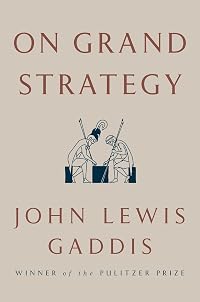
On Grand Strategy
by John Lewis Gaddis
On This Page
Description
Distilled from the Yale University seminar, "Studies in Grand Strategy," a master class in strategic thinking surveys statecraft from the ancient Greeks through FDR and beyond as vital historical lessons for future world leaders. "John Lewis Gaddis, the distinguished historian of the Cold War, has for almost two decades co-taught grand strategy at Yale University with his colleagues Charles Hill and Paul Kennedy. Now, in [this book], Gaddis reflects on what he has learned. In chapters show more extending from the ancient world through World War II, Gaddis assesses grand strategic theory and practice in Herodotus, Thucydides, Sun Tzu, Octavian/Augustus, Saint Augustine, Machiavelli, Elizabeth I, Philip II, the American Founding Fathers, Clausewitz, Tolstoy, Lincoln, Wilson, Franklin D. Roosevelt, and Isaiah Berlin. On Grand Strategy applies the sharp insights and wit readers have come to expect from Gaddis to times, places, and people he's never written about before. For anyone interested in the art of leadership, On Grand Strategy is, in every way, a master class."--Dust jacket. show lessTags
Recommendations







Member Reviews
This book really disappointed me. I expected a discussion of, well, strategy. Instead, this was more of a self-help book with historical examples. Those historical examples were largely context-light, presented as simplistic archetypes of styles of thinking. (Gaddis particularly loves the device of pitting two historical figures against each other as opposing archetypes.) A reader wouldn't come away from this book with any deeper understanding of military strategy, international relations or politics. You could get some insight about how to think better about challenges in your own life, but I don't think it's particularly good at that, too. Mostly it's just a simplified collection of historical examples shoe-horned into the old show more metaphor of foxes and hedgehogs — the one where the fox knows many things and the hedgehog knows one big thing. (Gaddis argues for an optimal third way halfway in between, or maybe a little closer to the fox than the hedgehog.) It's a fun metaphor but doesn't really hold up at book length.
Others who enjoy self-improvement books more, or aren't as immersed in history as I am, might like this more. (If someone wants to buy my copy for $5 or $10, you're welcome to it!) show less
Others who enjoy self-improvement books more, or aren't as immersed in history as I am, might like this more. (If someone wants to buy my copy for $5 or $10, you're welcome to it!) show less
Based on a course taught at Yale University, "On Grand Strategy" is a sweeping introduction to strategy as told through history. You will meet leaders from the ancient world, the Renaissance and the modern world. The analysis of Octavian (better known as Augustus) and how he rose to power is particularly compelling. The contrast between Elizabeth I of England and Philip II of Spain was simply fantastic. In fact, I felt it would be fantastic to take this course when it was taught.
I do find the book was a bit lacking on two respects. First, the book has a large Eurocentric approach with a few examples outside that area. Second, the book doesn't seem to have a grand strategy or framework to propose (though there are some suggestions).
If show more you liked this book, I would also recommend two of Robert Greene's books: "The 48 Laws of Power" and "The 33 Strategies of War." Greene takes a similar approach of digging for insights in history but he is more direct in drawing lessons and principles from history. show less
I do find the book was a bit lacking on two respects. First, the book has a large Eurocentric approach with a few examples outside that area. Second, the book doesn't seem to have a grand strategy or framework to propose (though there are some suggestions).
If show more you liked this book, I would also recommend two of Robert Greene's books: "The 48 Laws of Power" and "The 33 Strategies of War." Greene takes a similar approach of digging for insights in history but he is more direct in drawing lessons and principles from history. show less
On Grand Strategy is an interesting voyage through history. It is not what I expected in the sense that I started it with The Art of War in mind. Instead I got a study on great leaders through history, their approach to governance, and the long lasting effects of their actions. We go from Xerxes to Roosevelt looking at similarities between victors and losers across time building a theory on the use and practicality of war and violence.
The main points in this book could be summarized as:
a.) War requires an objective
b.) Clear goals are always required and must always align to limited means
c.) Practicality, Pragmatism and Adaptability wins over Ideals, Theories and Rigidity
d.) Common Sense is ultimately what differentiates a great leader show more from a powerful loser
I enjoyed the multitude of references to other works from the likes of Sun Tsu, Machiavelli, Tolstoy, and St. Augustine.
Through this book my admiration for leaders such as Lincoln, Augustus Ceasar, and Queen Elizabeth grew.
Not dissatisfied, not disappointed. show less
The main points in this book could be summarized as:
a.) War requires an objective
b.) Clear goals are always required and must always align to limited means
c.) Practicality, Pragmatism and Adaptability wins over Ideals, Theories and Rigidity
d.) Common Sense is ultimately what differentiates a great leader show more from a powerful loser
I enjoyed the multitude of references to other works from the likes of Sun Tsu, Machiavelli, Tolstoy, and St. Augustine.
Through this book my admiration for leaders such as Lincoln, Augustus Ceasar, and Queen Elizabeth grew.
Not dissatisfied, not disappointed. show less
It was a fun and relaxing read, though it is unclear what my takeaway is - or should be.
Some penguin (instant) classics can be summed up in few words, this book, too, maybe, but not in something actionable. That's what's missing for me a bit.
It is well-written and full of historical anecdotes to keep you reading...
Some penguin (instant) classics can be summed up in few words, this book, too, maybe, but not in something actionable. That's what's missing for me a bit.
It is well-written and full of historical anecdotes to keep you reading...
Professor Gaddis is the founder and one of the co-teachers of a famous seminar on grand strategy at Yale University. This Pulitzer prize winning book is a distillation of that seminar. Professor Gaddis defines grand strategy as a way of linking aspirations, which are potentially limitless, and resources, which are necessarily limited. Employing examples ranging from Xerxes’s invasion of early 5th century BCE Greece to FDR’s management of World War II, the author shows how to link resources to aspirations, how to see both the big picture and the little details, and how to evaluate theory through practice.
Chapters consider such topics as the invasion of Greece (foxes vs. hedgehogs), the Peloponnesian War (aspirations vs. resources and show more mission creep), the relations between states and rulers (Machiavelli), Napoleon’s invasion of Russia (losing sight of your objective, not knowing when to quit), the American Civil War (Lincoln as a leader), and Franklin Roosevelt and World War II. For the chapter on Napoleon’s ill-fated venture in Russia, Professor Gaddis uses both von Clausewitz and Tolstoy to illustrate the difficulties of controlling large armies.
A fascinating book, one that should be read by every president and commander-in-chief. show less
Chapters consider such topics as the invasion of Greece (foxes vs. hedgehogs), the Peloponnesian War (aspirations vs. resources and show more mission creep), the relations between states and rulers (Machiavelli), Napoleon’s invasion of Russia (losing sight of your objective, not knowing when to quit), the American Civil War (Lincoln as a leader), and Franklin Roosevelt and World War II. For the chapter on Napoleon’s ill-fated venture in Russia, Professor Gaddis uses both von Clausewitz and Tolstoy to illustrate the difficulties of controlling large armies.
A fascinating book, one that should be read by every president and commander-in-chief. show less
If I was being generous I'd say the author is try to teach you something about strategy through showing interesting bits of history that contain teachable moments. Or maybe the author doesn't really have much to say. I too have ready a history book or two in my life, what I wanted is something more explicit. Otherwise, if you don't have any commentary of your own I'd rather read a better history book than this.
Excellent.
Members
- Recently Added By
Published Reviews
The most important book I read as a student at West Point was a weighty tome titled “Makers of Modern Strategy.” It covered the evolution of strategic thinking from Machiavelli to the nuclear age, explaining the rise and fall of states as a result of choices made by statesmen and generals about how, where, when and why to employ military force to achieve political objectives. It was an show more edited text—no one person, it seems, was erudite enough to be an expert across such a broad range of history—and hence suffered from differences in writing style and inconsistencies in theme, but it was the best education in grand strategy available in a single volume.
Until now. Yale historian John Lewis Gaddis, who won the Pulitzer Prize for his 2011 biography of George Kennan, has compiled a lifetime of thought about success or failure in statesmanship into “On Grand Strategy.” Like “Makers of Modern Strategy,” it explores the facets of wisdom, temperament and courage that create great leaders and enduring empires. Unlike its storied predecessor, Mr. Gaddis’s book has the advantage of being a long walk with a single, delightful mind, which makes it much easier for the reader to comprehend the lessons that cohere across continents and millennia. show less
Until now. Yale historian John Lewis Gaddis, who won the Pulitzer Prize for his 2011 biography of George Kennan, has compiled a lifetime of thought about success or failure in statesmanship into “On Grand Strategy.” Like “Makers of Modern Strategy,” it explores the facets of wisdom, temperament and courage that create great leaders and enduring empires. Unlike its storied predecessor, Mr. Gaddis’s book has the advantage of being a long walk with a single, delightful mind, which makes it much easier for the reader to comprehend the lessons that cohere across continents and millennia. show less
added by ndara
Author Information

22+ Works 5,364 Members
John Lewis Gaddis is the Robert A. Lovett Professor of Military and Naval History at Yale University
Awards and Honors
Notable Lists
Common Knowledge
- Original title
- On grand strategy
- Original publication date
- 2018
- First words
- The date is 480 B.C.E.
- Last words
- (Click to show. Warning: May contain spoilers.)All at either end of that tigthrope - well, almost all - deserve respect.
- Original language*
- Amerikanisch
- Canonical DDC/MDS
- 355.4
*Some information comes from Common Knowledge in other languages. Click "Edit" for more information.
Classifications
- Genres
- History, Nonfiction, General Nonfiction, Business, Politics and Government
- DDC/MDS
- 355.4 — Society, government, & culture Public administration & military science The Military - Land, Air & Sea / Warfare Military operations
- LCC
- U162 .G125 — Military Science Military science (General) Strategy
- BISAC
Statistics
- Members
- 788
- Popularity
- 35,233
- Reviews
- 9
- Rating
- (3.54)
- Languages
- 7 — Chinese, Dutch, English, Italian, Polish, Portuguese (Portugal), Spanish
- Media
- Paper, Audiobook, Ebook
- ISBNs
- 18
- ASINs
- 5