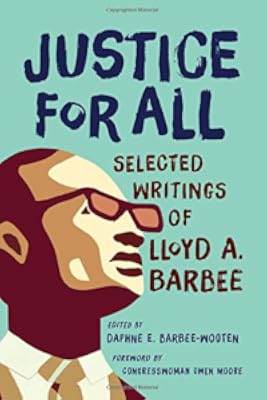
Justice for All: Selected Writings of Lloyd A. Barbee
by Lloyd A Barbee
On This Page
Description
"Civil rights leader and state legislator Lloyd Barbee often signed his letters with "Justice for All," a phrase that was emblematic of his work. Best known for his work litigating desegregation of Milwaukee Public Schools, he went on to serve in the state assembly, where he legislated on civil rights issues ranging from housing and employment discrimination to reparations for African Americans and indigenous people. He also introduced bills to legalize abortion, same-sex marriage, and show more marijuana, political issues that put him ahead of his time. This book gathers Barbee's writings on the subjects of his legislative efforts and world events, providing an important historical record of the civil rights movement and insight into issues that continue into today."--Provided by publisher. show lessMember Reviews
Lloyd A. Barbee was a Black member of the Wisconsin State assembly from 1965-1977 and was also a civil rights activist who worked for the integration of the Milwaukee School System and other civil rights causes. As a sole Black member of the Wisconsin legislature for part of his tenure and for his espousal of liberal causes, he is considered to be a significant figure in Wisconsin history. That being acknowledged, we cannot overlook the fact that the index of the biography of the governor whose service overlapped half of Barbee’s, “Patrick J. Lucey: A Lasting Legacy” (see my review) contains only one citation to Barbee, that identifying him as a Wisconsin Representative who brought a landmark civil rights case.
“Justice For show more All” is a collection of Barbee’s writings and statements on a variety of topics. They cover his life and career, his role in minority politics and the issues of Fair Housing; School Desegregation; Racism in Education; Criminal Justice; Women’s Rights; Health Care; Environmental, and Economic Issues; Press and Privacy Rights; National Figures; and International Civil Rights. The appendices include transcripts of his defense of Dick Gregory in Milwaukee County Circuit Court against charges of disorderly conduct and selections from Barbee’s brief on an appeal raising the issue of racial imbalance in criminal jury selection.
Why should anyone read the words of a state legislator and civil rights activist almost 20 years after his death? My answer is that this work provides insights into the issues and perspectives of the Wisconsin Black community as articulated by one of its most prominent spokesmen from the 1960s-1990s as well as the legislative process of that era. If your feelings are in accord with Barbee, you will find much to praise. If not, it is good to hear the other side. Some issues persist or are reflected to the present day. Consider his call to disarm (now defund) the police. His opposition to place police, jobs he described as “uniformed gestapo goon squad jobs” in schools is an issue that still reverberates to our day. Do not overlook his December 3, 1973 speech to students at UW-Oshkosh on victimless crimes. “I whole heartedly support the legalization of the sale and possession of marijuana…It creates no victims, except perhaps through its illegal sale when the consumer gets poor merchandise.” Reform is needed in “sex statutes. It’s time the government is taken out of the bedroom. We should remove all state curbs on sexual activities between consenting parties, married or otherwise…Specifically we should remove the criminal penalties for homosexuals, adultery, fornication, cohabitation, and possession of ‘indecent materials’ when such actions do not involve minors, under 14.” He spoke about the American Blacks who refused to stand “ramrod straight” during the playing of the Star Spangled Banner (take a knee?) at the 1972 Munich Olympics. If he said anything about terrorists shooting Israeli athletes it did not make the book. His analysis of the effect of higher energy costs on the poor should be of interest to all policy makers. Whether prophet or trailblazer, he was part of a continuing conversation and societal developments.
I found some of Barbee’s comments to be inconsistent or beyond the scope of the Wisconsin legislature. I was intrigued by an early account of his coalition building with rural legislators which seemed unlikely given his later apparent tendency to characterize those who opposed his proposals as either white racists or Black lackeys. His legislative comments about the British occupation of Northern Ireland (which I probably would have supported had I heard about them at the time), Bahamas’ Independence and his proposal that Blacks be allowed to be citizens of the United States and of Africa (What country? What do the Africans think about that?) bring to mind Governor Ronald Reagan’s comment “California does not have a foreign policy.”
Being broken down into short statements and press releases, this volume is a quick and easy read. Whatever your political leanings, “Justice For All” challenges its readers to slow down, listen and reflect. Good practices for today.
I did receive a free copy of this book without an obligation to post a review. show less
“Justice For show more All” is a collection of Barbee’s writings and statements on a variety of topics. They cover his life and career, his role in minority politics and the issues of Fair Housing; School Desegregation; Racism in Education; Criminal Justice; Women’s Rights; Health Care; Environmental, and Economic Issues; Press and Privacy Rights; National Figures; and International Civil Rights. The appendices include transcripts of his defense of Dick Gregory in Milwaukee County Circuit Court against charges of disorderly conduct and selections from Barbee’s brief on an appeal raising the issue of racial imbalance in criminal jury selection.
Why should anyone read the words of a state legislator and civil rights activist almost 20 years after his death? My answer is that this work provides insights into the issues and perspectives of the Wisconsin Black community as articulated by one of its most prominent spokesmen from the 1960s-1990s as well as the legislative process of that era. If your feelings are in accord with Barbee, you will find much to praise. If not, it is good to hear the other side. Some issues persist or are reflected to the present day. Consider his call to disarm (now defund) the police. His opposition to place police, jobs he described as “uniformed gestapo goon squad jobs” in schools is an issue that still reverberates to our day. Do not overlook his December 3, 1973 speech to students at UW-Oshkosh on victimless crimes. “I whole heartedly support the legalization of the sale and possession of marijuana…It creates no victims, except perhaps through its illegal sale when the consumer gets poor merchandise.” Reform is needed in “sex statutes. It’s time the government is taken out of the bedroom. We should remove all state curbs on sexual activities between consenting parties, married or otherwise…Specifically we should remove the criminal penalties for homosexuals, adultery, fornication, cohabitation, and possession of ‘indecent materials’ when such actions do not involve minors, under 14.” He spoke about the American Blacks who refused to stand “ramrod straight” during the playing of the Star Spangled Banner (take a knee?) at the 1972 Munich Olympics. If he said anything about terrorists shooting Israeli athletes it did not make the book. His analysis of the effect of higher energy costs on the poor should be of interest to all policy makers. Whether prophet or trailblazer, he was part of a continuing conversation and societal developments.
I found some of Barbee’s comments to be inconsistent or beyond the scope of the Wisconsin legislature. I was intrigued by an early account of his coalition building with rural legislators which seemed unlikely given his later apparent tendency to characterize those who opposed his proposals as either white racists or Black lackeys. His legislative comments about the British occupation of Northern Ireland (which I probably would have supported had I heard about them at the time), Bahamas’ Independence and his proposal that Blacks be allowed to be citizens of the United States and of Africa (What country? What do the Africans think about that?) bring to mind Governor Ronald Reagan’s comment “California does not have a foreign policy.”
Being broken down into short statements and press releases, this volume is a quick and easy read. Whatever your political leanings, “Justice For All” challenges its readers to slow down, listen and reflect. Good practices for today.
I did receive a free copy of this book without an obligation to post a review. show less
Members
- Recently Added By
Lists

Must-Read Books by Black Authors
114 works; 92 members
Author Information
1 Work 8 Members
Classifications
- Genres
- Politics and Government, Nonfiction, History, Sociology, Biography & Memoir
- DDC/MDS
- 328.73 — Society, government, & culture Political science U.S. Congress - Legislation & Legislative Process North America United States
- LCC
- F586.42 .K64 .B373 — Local History of the United States, Canada and Latin America United States local history Wisconsin
- BISAC
Statistics
- Members
- 8
- Popularity
- 2,504,570
- Reviews
- 1
- Rating
- (4.00)
- Languages
- English
- Media
- Paper, Ebook
- ISBNs
- 2