On This Page
Description
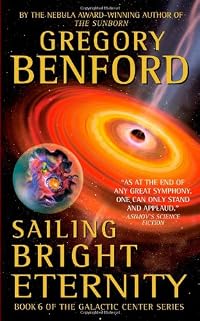
The continuing war between humans and mechs, artificial intelligences dedicated to the destruction of the human race. In this episode, remnants of humans and aliens flee for a glorious last stand in the Esty, a world which uses the energy of a black hole. Sixth and final novel of the Galactic Center saga.Tags
Recommendations







Member Reviews
If you made it this far into the series, congratulations. Whether or not you'll like how it ends is a bit of a coin toss.
We learn that the old man at the end of Furious Gulf is none other than Nigel Walmsley. Someone how the jerk protagonist from the first two books managed to survive some 30,000+ years (time dilation and really advanced technology helped) and is now present to help Toby escape the Mechanicals that have been pursuing him. So the first solid chunk of the book is a flashback of Nigel's life since arriving here at the Galactic Center. Amazingly enough, the man changed! He's gone from being a jerk to a curmudgeon. Yes, that's an improvement. He's been humbled by marriage and parenthood, not to mention the discoveries made show more at the Galactic Center and how humanity fits into the galactic pecking order. But loss probably shaped him the most. This Nigel I liked, but I couldn't help but feel that the guy is a stand-in for Benford himself.
But the Mechanicals get the upper hand, errr appendage, and Toby is off on his own, wandering through those volatile estys again, trying to find his father or, at least, other Bishops. At one point, the whole thing transforms into the sci-fi adventures of Huckleberry Finn on the space-time-river equivalent of the Mississippi. I really wondered where Benford was going with this. It had its moments but it seemed like a distraction. Ultimately, this section comes to an abrupt end, and Toby is reunited with Killeen.
There's a final showdown with the Mantis, which was needed as the thing was responsible for so much suffering. The method of resolution was unexpected, but fitting. Afterwards, there's a bit of a long epilogue as we see glimpses of our main characters' lives. I found it to be a bit sad. There is no "happily ever after," but there is an after. And the takeaway borrows thematically from Shakespeare:
3.75 stars rounded up to four because of Nigel Walmsley's evolution. show less
We learn that the old man at the end of Furious Gulf is none other than Nigel Walmsley. Someone how the jerk protagonist from the first two books managed to survive some 30,000+ years (time dilation and really advanced technology helped) and is now present to help Toby escape the Mechanicals that have been pursuing him. So the first solid chunk of the book is a flashback of Nigel's life since arriving here at the Galactic Center. Amazingly enough, the man changed! He's gone from being a jerk to a curmudgeon. Yes, that's an improvement. He's been humbled by marriage and parenthood, not to mention the discoveries made show more at the Galactic Center and how humanity fits into the galactic pecking order. But loss probably shaped him the most. This Nigel I liked, but I couldn't help but feel that the guy is a stand-in for Benford himself.
But the Mechanicals get the upper hand, errr appendage, and Toby is off on his own, wandering through those volatile estys again, trying to find his father or, at least, other Bishops. At one point, the whole thing transforms into the sci-fi adventures of Huckleberry Finn on the space-time-river equivalent of the Mississippi. I really wondered where Benford was going with this. It had its moments but it seemed like a distraction. Ultimately, this section comes to an abrupt end, and Toby is reunited with Killeen.
There's a final showdown with the Mantis, which was needed as the thing was responsible for so much suffering. The method of resolution was unexpected, but fitting. Afterwards, there's a bit of a long epilogue as we see glimpses of our main characters' lives. I found it to be a bit sad. There is no "happily ever after," but there is an after. And the takeaway borrows thematically from Shakespeare:
All the world's a stage,Benford could be considered guilty of meandering around with metaphysical speculation about higher lifeforms, but I can forgive him for that. We humans have this arrogance that the world—you could argue the universe—revolves around us. We are blissfully ignorant of older and far more advanced lifeforms in the universe, and our narcissism boasts that they don't exist because we don't have proof of them having visited us, as if we were so special that we merited being fawned over. It's a conceit that Benford doesn't ascribe to.
And all the men and women merely Players;
3.75 stars rounded up to four because of Nigel Walmsley's evolution. show less
A tepid long-winded ending to what could have been Benford's magnum opus. There's a strong core question: how can organic beings, such as ourselves, hope to survive in the long run, against mechanical intelligence that can learn and improve much faster, with fewer limits. The setting is the far future and the center of the galaxy, where Benford can romp in speculative astrophysics.
But the book fails for many reasons. It is claustrophobically set in the Wedge, an artificial construction of space-time (esty). After hundreds of pages there, I still never had a feeling for what it was as like to be in the Wedge. The strongest reference point was Hodgson's Night Land.
The book is almost all info-dumps. There are pages and pages on memes -- show more remember that was a hot topic? When there's not an info-dump, something catastrophic happens. Humans have little to do other than survive, briefly. That may fit thematically but it requires more skill than Benford applies to make it work as a story.
And worst of all, the resolution to the challenge of mechanical intelligence that has dominated the entire series of novels is an implausible MacGuffin, which will be left behind the spoiler curtain.
For me, this series peaked with the third entry, Great Sky River, which told an intense personal tale, the most planet-bound of the series, with relatively few info dumps. The fourth entry, Tides of Light, is an OK followup. After that, there's little to recommend.
Not recommended. show less
But the book fails for many reasons. It is claustrophobically set in the Wedge, an artificial construction of space-time (esty). After hundreds of pages there, I still never had a feeling for what it was as like to be in the Wedge. The strongest reference point was Hodgson's Night Land.
The book is almost all info-dumps. There are pages and pages on memes -- show more remember that was a hot topic? When there's not an info-dump, something catastrophic happens. Humans have little to do other than survive, briefly. That may fit thematically but it requires more skill than Benford applies to make it work as a story.
And worst of all, the resolution to the challenge of mechanical intelligence that has dominated the entire series of novels is an implausible MacGuffin, which will be left behind the spoiler curtain.
For me, this series peaked with the third entry, Great Sky River, which told an intense personal tale, the most planet-bound of the series, with relatively few info dumps. The fourth entry, Tides of Light, is an OK followup. After that, there's little to recommend.
Not recommended. show less
Ciclo del Centro Galactico I
Ratings
Members
- Recently Added By
Lists

Broderick and Di Filippo's Science Fiction: The 101 Best Novels 1985-2010
103 works; 7 members
Author Information

237+ Works 22,301 Members
Gregory Benford, was born on January 30, 1941 in Mobile, Alabama. He is a physicist and science fiction writer who earned his Ph.D. from the University of California, San Diego, in 1967. He is a Woodrow Wilson Fellow and a consultant for NASA. Benford's first novel "Deeper than the Darkness" (1970), which was revised as "The Stars in Shroud" show more (1978), gave him notice as a serious Science Fiction writer. His most popular work is "Timescape" (1980), which was the winner of the Nebula and John W. Campbell Memorial Awards; it presented a hard physics approach to limited time travel. "In the Ocean of Night" (1977), "Across the Sea of Suns" (1984), "Great Sky River" (1987), "Tides of Light" (1989) and "Furious Gulf" (1994) were all a part of the Galactic Cluster Series. He has also written the juvenile novel "Jupiter Project" (1975), "Against Infinity" (1983) and the thriller "Artifact" (1985). He has been nominated for 12 Nebula Awards (winning for "Timescape" and for the novelette, "If the Stars are Gods"). Benford, writing alternately with Bruce Sterling, produces science fact articles for the Magazine of Fantasy and Science Fiction. They took over after the death of regular columnist Isaac Asimov. He has also co-edited theme anthologies with Martin H. Greenburg, which include "Hitler Victorious" (1986), "Nuclear War" (1988), "What Might Have Been, Volume 1: Alternate Empires" (1988), "Volume 2: Alternate Heroes" (1989) and "Volume 3: Alternate Wars." (Bowker Author Biography) show less
Some Editions
Series

Belongs to Publisher Series
Work Relationships
Common Knowledge
- Original publication date
- 1995-08
- People/Characters
- Nigel Walmsley
- First words
- Black holes have weather, of a sort.
Classifications
Statistics
- Members
- 580
- Popularity
- 50,539
- Reviews
- 4
- Rating
- (3.58)
- Languages
- 5 — Chinese, Dutch, English, German, Spanish
- Media
- Paper, Ebook
- ISBNs
- 13
- ASINs
- 6