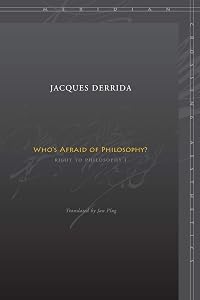
Who's Afraid of Philosophy?: Right to Philosophy 1 (Meridian: Crossing Aesthetics)
by Jacques Derrida
On This Page
Description
This volume reflects Jacques Derrida's engagement in the late 1970s with French political debates on the teaching of philosophy and the reform of the French university system. He was a founding member of the Research Group on the Teaching of Philosophy (Greph), an activist group that mobilized opposition to the Giscard government's proposals to "rationalize" the French educational system in 1975, and a convener of the Estates General of Philosophy, a vast gathering in 1979 of educators from show more across France. While addressing specific contemporary political issues on occasion, thus providing insight into the pragmatic deployment of deconstructive analysis, the essays deal mainly with much broader concerns. With his typical rigor and spark, Derrida investigates the genealogy of several central concepts which any debate about teaching and the university must confront. Thus there are essays on the "teaching body," both the faculty corps and the strange interplay in the French (but not only the French) tradition between the mind and body of the professor; on the question of age in teaching, analyzed through a famous letter of Hegel; on the class, the classroom, and the socio-economic concept of class in education; on language, especially so-called "natural languages" like French; and on the legacy of the revolutionary tradition, the Estates General, in the university. The essays are linked by the extraordinary care and precision with which Derrida undertakes a political intervention into, and a philosophical analysis of, the institutionalization of philosophy in the university. show lessTags
Recommendations





















Members
- Recently Added By
Author Information

402+ Works 19,760 Members
Jacques Derrida was born in El-Biar, Algeria on July 15, 1930. He graduated from the École Normal Supérieure in 1956. He taught philosophy and logic at both the University of Paris and the École Normal Supérieure for around 30 years. His works of philosophy and linguistics form the basis of the school of criticism known as deconstruction. This show more theory states that language is an inadequate method to give an unambiguous definition of a work, as the meaning of text can differ depending on reader, time, and context. During his lifetime, he wrote more than 40 books on various aspects of deconstruction including Of Grammatology, Glas, The Postcard: From Socrates to Freud and Beyond, and Ulysses Gramophone: Hear Say Yes in Joyce. He died of pancreatic cancer on October 9, 2004 at the age of 74. (Bowker Author Biography) show less
Classifications
Statistics
- Members
- 37
- Popularity
- 765,270
- Languages
- English
- Media
- Paper
- ISBNs
- 2
- ASINs
- 1