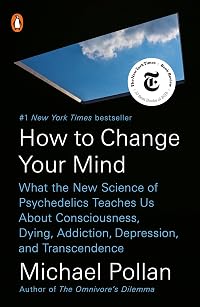
How to Change Your Mind: What the New Science of Psychedelics Teaches Us About Consciousness, Dying, Addiction, Depression, and Transcendence
by Michael Pollan
On This Page
Description
When Michael Pollan set out to research how LSD and psilocybin are being used to provide relief to people suffering from difficult-to-treat conditions such as depression, addiction and anxiety, he did not intend to write what is undoubtedly his most personal book. But upon discovering how these remarkable substances are improving the lives not only of the mentally ill but also of healthy people coming to grips with the challenges of everyday life, he decided to explore the landscape of the show more mind in the first person as well as the third. Thus began a singular adventure into the experience of various altered states of consciousness, along with a dive deep into both the latest brain science and the thriving underground community of psychedelic therapists. Pollan sifts the historical record to separate the truth about these mysterious drugs from the myths that have surrounded them since the 1960s, when a handful of psychedelic evangelists catalyzed a powerful backlash against what was then a promising field of research. A unique and elegant blend of science, memoir, travel writing, history, and medicine, How to Change Your Mind is a triumph of participatory journalism. By turns dazzling and edifying, it is the gripping account of a journey to an exciting and unexpected new frontier in our understanding of the mind, the self, and our place in the world. The true subject of Pollan's "mental travelogue" is not just psychedelic drugs but also the eternal puzzle of human consciousness and how, in a world that offers us both struggle and beauty, we can do our best to be fully present and find meaning in our lives. show lessTags
Recommendations













Member Reviews
I read this book after seeing Michael Pollan on Sixty Minutes. In a word: riveting. Pollan wrote this as an investigative journalist. He started with the science which took him quite a distance. But because psychedelics are not exactly mainstream yet, he soon dove into a world about as far off the grid as you can get.
The science portion lays the groundwork for why psychedelics are so interesting to scientists who study the brain and the mind. A series of brain scan studies revealed how psychedelics shut down the default mode network (DMN) in the brain. This is the same thing that happens when adept spiritualists meditate. The experience is one of ego dissolution and universal love. So you can either spend forty years in a monastic show more tradition learning the right way to meditate, or you can use psychedelics and get there in a few days.
Then he went the distance to experience each of the three psychedelic compounds with the longest traditions and best results. He sought healers and other guides for a direct experience. That's where he went off grid. None of these people advertise, but they do have friends and past clients who will give recommendations.
Pollan tells a great story. His descriptions of these deep experiences are well worth the read. He even works in some humor in places. It turns out kids don't have a functioning DMN. In essence, children are tripping all the time. No wonder they seem like ET aliens. show less
The science portion lays the groundwork for why psychedelics are so interesting to scientists who study the brain and the mind. A series of brain scan studies revealed how psychedelics shut down the default mode network (DMN) in the brain. This is the same thing that happens when adept spiritualists meditate. The experience is one of ego dissolution and universal love. So you can either spend forty years in a monastic show more tradition learning the right way to meditate, or you can use psychedelics and get there in a few days.
Then he went the distance to experience each of the three psychedelic compounds with the longest traditions and best results. He sought healers and other guides for a direct experience. That's where he went off grid. None of these people advertise, but they do have friends and past clients who will give recommendations.
Pollan tells a great story. His descriptions of these deep experiences are well worth the read. He even works in some humor in places. It turns out kids don't have a functioning DMN. In essence, children are tripping all the time. No wonder they seem like ET aliens. show less
Clearheadedly lays out the objective value of psychedelics, over and above the exaltations of praise and shouts of condemnation surrounding their history. I was once really excited about these chemicals and their possibilities, but my interest faded after I crossed paths with people whom these substances led into delusion and confusion (like Brian Wilson said, “They come on like they're peaceful / But inside they're so uptight”), and furthermore after having some uneventful and bad trips of my own. But after finishing this book I feel that excitement again, and the findings scientists are actually coming across during my lifetime bring me joy and hope.
In particular I loved learning about the default mode network, a subsystem in the show more brain responsible for many of the self-referential processes essential to having a self and ego. This is the kind of thing I was looking for when I decided to study cognitive science in undergrad — an empirical understanding of the actual mechanisms behind selfhood; how a brain of many disparate parts and processes yields a coherent identity. Over time my interest in these questions also faded, but much of that curiosity is coming back to me now.
One of the bigger findings of the modern psychedelic renaissance of research is that psychedelics disrupt and quiet this network in the brain, which may lead to that egoless state we’ve all heard touted by psychonauts and heady people. But Pollan effectively extracts the truth and objective value of these substances away from all the stigma surrounding it. The egoless state psychs temporarily induce has so much power in treating addiction, anxiety, and depression, which in a sense are really all tyrannical impositions of order made by the ego. Pollan explores the clinical, therapeutic, and spiritual value of this temporary egolessness with a fine balance between skepticism and openness. show less
In particular I loved learning about the default mode network, a subsystem in the show more brain responsible for many of the self-referential processes essential to having a self and ego. This is the kind of thing I was looking for when I decided to study cognitive science in undergrad — an empirical understanding of the actual mechanisms behind selfhood; how a brain of many disparate parts and processes yields a coherent identity. Over time my interest in these questions also faded, but much of that curiosity is coming back to me now.
One of the bigger findings of the modern psychedelic renaissance of research is that psychedelics disrupt and quiet this network in the brain, which may lead to that egoless state we’ve all heard touted by psychonauts and heady people. But Pollan effectively extracts the truth and objective value of these substances away from all the stigma surrounding it. The egoless state psychs temporarily induce has so much power in treating addiction, anxiety, and depression, which in a sense are really all tyrannical impositions of order made by the ego. Pollan explores the clinical, therapeutic, and spiritual value of this temporary egolessness with a fine balance between skepticism and openness. show less
How to Change Your Mind: What the New Science of Psychedelics Teaches Us About Consciousness, Dying, Addiction, Depression and Transcendance by Michael Pollan explores the world of psychedelics from their historical and spiritual roots to contemporary therapeutic uses. In depth and well-researched but told with Pollan's engaging, journalistic style. As usual, he connects personally, this time by describing his own psychedelic experiences. The book is fascinating. As a long time meditator, I was struck by the connections between meditation and psychedelic experiences. Pollan includes the work of Justin Brewer, who I encountered through Dan Harris, the founder of 10% Happier.
Amazing.
I'm not sure how to begin. Michael Pollan is about my age and a materialist - an atheist, with the perspective that the physical laws of matter should be able to explain everything there is. And yet. Those who go on psychedelic journeys so often have mystical experiences - "the conviction that some profound objective truth has been disclosed," like they "have been let in on a deep secret of the universe, and they cannot be shaken." William James wrote, "Dreams cannot stand this test."
Pollan writes, "The most straightforward [explanation]...is that it's simply true: the altered state of consciousness has opened the person up to a truth that the rest of us... simply cannot see."
Pollan then gives us a pretty long history of the show more research on psychedelics done in this country in the last century; and details about his experiences, which do qualify as "mystical" (a survey told him so). He trips on three different psychedelic substances: mushrooms, LSD, and "the toad," literally toad venom. This last is the most amazing and the most difficult for him to put into words. What can definitely be said is that the effects of smoking the distilled venom of this toad kick in before the smoker even has a chance to exhale - you inhale one puff and you are transported to before the Big Bang, before there was any being at all. Pollan remarks on how often people express gratitude for "being alive" - after smoking the toad, he was on his knees with gratitude for there being "being" at all.
This actually was an interesting complement to my recent reading of LOST IN MATH by Sabine Hossenfelder. That was about the fundamental question of why we should ever expect the laws of physics to be "beautiful", why we are bothered that quantum mechanics doesn't seem intuitive - why should it be? There would have been no reason for our species to evolve to have a fundamental understanding of quantum mechanics or to have brains that "like" the laws of physics. Why the hubris that we should be able to know and understand everything? Maybe there are things we can't know.
Not without physical tweaks, that is - in the form of certain pharmaceuticals, mushrooms, or toads - that change our perceptions enough for us to see something beyond what we can usually see.
Maybe there is something "beyond" after all.
The book also has a great section on how psychedelics are slowly finding their way back into medical research, and are showing promise to treat an array of disorders: addiction, depression, end-of-life anxiety. The story of the end days of the cancer patient who turned his mind around with psychedelics almost brought me to tears. The description of how psychedelics can alleviate addictions was enlightening - OK, existential dread being lifted by a mystical experience, that makes a certain kind of sense; but how and why should tripping help you quit smoking? I loved one woman's explanation: "It put smoking in a whole new context. Smoking seemed very unimportant; it seemed kind of stupid, to be honest."
We've seen such sea changes in the legalization of marijuana, in the acceptance of gay marriage - maybe we'll live to see psychedelics taken off the list of controlled substances; maybe shrooms will start "popping up" someday in a store near you. This book made me really want to do drugs. Maybe not the toad. But some of the others, for sure. show less
I'm not sure how to begin. Michael Pollan is about my age and a materialist - an atheist, with the perspective that the physical laws of matter should be able to explain everything there is. And yet. Those who go on psychedelic journeys so often have mystical experiences - "the conviction that some profound objective truth has been disclosed," like they "have been let in on a deep secret of the universe, and they cannot be shaken." William James wrote, "Dreams cannot stand this test."
Pollan writes, "The most straightforward [explanation]...is that it's simply true: the altered state of consciousness has opened the person up to a truth that the rest of us... simply cannot see."
Pollan then gives us a pretty long history of the show more research on psychedelics done in this country in the last century; and details about his experiences, which do qualify as "mystical" (a survey told him so). He trips on three different psychedelic substances: mushrooms, LSD, and "the toad," literally toad venom. This last is the most amazing and the most difficult for him to put into words. What can definitely be said is that the effects of smoking the distilled venom of this toad kick in before the smoker even has a chance to exhale - you inhale one puff and you are transported to before the Big Bang, before there was any being at all. Pollan remarks on how often people express gratitude for "being alive" - after smoking the toad, he was on his knees with gratitude for there being "being" at all.
This actually was an interesting complement to my recent reading of LOST IN MATH by Sabine Hossenfelder. That was about the fundamental question of why we should ever expect the laws of physics to be "beautiful", why we are bothered that quantum mechanics doesn't seem intuitive - why should it be? There would have been no reason for our species to evolve to have a fundamental understanding of quantum mechanics or to have brains that "like" the laws of physics. Why the hubris that we should be able to know and understand everything? Maybe there are things we can't know.
Not without physical tweaks, that is - in the form of certain pharmaceuticals, mushrooms, or toads - that change our perceptions enough for us to see something beyond what we can usually see.
Maybe there is something "beyond" after all.
The book also has a great section on how psychedelics are slowly finding their way back into medical research, and are showing promise to treat an array of disorders: addiction, depression, end-of-life anxiety. The story of the end days of the cancer patient who turned his mind around with psychedelics almost brought me to tears. The description of how psychedelics can alleviate addictions was enlightening - OK, existential dread being lifted by a mystical experience, that makes a certain kind of sense; but how and why should tripping help you quit smoking? I loved one woman's explanation: "It put smoking in a whole new context. Smoking seemed very unimportant; it seemed kind of stupid, to be honest."
We've seen such sea changes in the legalization of marijuana, in the acceptance of gay marriage - maybe we'll live to see psychedelics taken off the list of controlled substances; maybe shrooms will start "popping up" someday in a store near you. This book made me really want to do drugs. Maybe not the toad. But some of the others, for sure. show less
I must have read a review of ‘How To Change Your Mind’ that persuaded me to read it, as altered states of consciousness are interesting to read about. I really enjoyed [b:The Doors of Perception|3188964|The Doors of Perception|Aldous Huxley|https://i.gr-assets.com/images/S/compressed.photo.goodreads.com/books/1364525216l/3188964._SX50_.jpg|23668205]. Rather uncharitably, I assumed at the start that Pollan’s enthusiasm for psychedelics was a form of midlife crisis. To my surprise, though, by the end of the book I could not only see the appeal in theory but could even imagine wanting to try them myself one day. This is no small thing, as I am extremely control freakish about my body and try to avoid taking even over the counter show more medicines in case of side effects. Pollan really does make the psychedelic experience sound convincingly meaningful and therapeutic. At one point he compares it with a shortcut to the effects of cognitive behavioural therapy, which seems magical. His trips rather resemble supercharged dreaming, and I certainly love vivid dreams.
The book is broadly structured in three parts: the history of LSD and magic mushrooms in the West and how they went from promising medical treatment to criminalised, followed by Pollan’s personal accounts of his experiences taking several psychedelic drugs, then concluding with a summary of the resurgence in medical research using LSD and psilocybin. The first part could perhaps have been a little shorter, although it was as engagingly written as the rest of the book. Pollan’s accounts of his own trips are likewise compelling. The most interesting part from my perspective, however, was the latter third. This summarised recent research, including how the effects of psychedelics manifest in the brain as observed via MRI. Trials have demonstrated that psychedelics can be remarkably effective at alleviating depression and addiction, indeed more effective than traditional treatments. Pollan reflects on what this might mean for mental health more generally, which was a fascinating reminder of how the categories of mental illness are both arbitrary and exist as a result of treatments rather than vice versa. As well as throwing diagnostic categories into doubt, psychedelic treatments could bridge the divide between psychotherapy and psychiatry. An investigator on one of the trials summarises this neatly:
This is a transformative idea. Pollan briefly discusses some of the implications, such as a lack of profitability (one-off treatments rather than regular dosing, no patents), medicalising the mystical, and the difficulty of testing psychedelics in standard double-blind tests:
Given the impact of psychedelics in the 1960s and the backlash against them in the 70s, it’s also clear that there’s something subversive (indeed anti-capitalist!) in drugs that awaken empathy, openness, joy, spirituality, and linkage with nature. As well as treating mental illness, could LSD be the antidote to the neoliberal psychopath Homo Economicus? ...Is this just rediscovering ideas from my parents’ hippy generation? If so, maybe it’s worth giving them another try? Pollan’s evangelism is explained and evidenced so thoroughly as to be very thought-provoking. Drugs like LSD have been banned throughout my life and this book significantly altered my understanding of them (in combination with David Nutt’s [b:Drugs Without the Hot Air: Minimizing the Harms of Legal and Illegal Drugs|13592853|Drugs Without the Hot Air Minimizing the Harms of Legal and Illegal Drugs|David J. Nutt|https://i.gr-assets.com/images/S/compressed.photo.goodreads.com/books/1422556032l/13592853._SY75_.jpg|19180965]). Hopefully research will continue to discover what good psychedelics can do, for people just searching for a profound experience as well as the mentally ill.
I also learned from this book that Dr. Paul Stamets on Star Trek Discovery is named after a real Paul Stamets, who is likewise an expert in mycelial networks. Albeit not the kind that are suitable for intergalactic travel, as far as I know. show less
The book is broadly structured in three parts: the history of LSD and magic mushrooms in the West and how they went from promising medical treatment to criminalised, followed by Pollan’s personal accounts of his experiences taking several psychedelic drugs, then concluding with a summary of the resurgence in medical research using LSD and psilocybin. The first part could perhaps have been a little shorter, although it was as engagingly written as the rest of the book. Pollan’s accounts of his own trips are likewise compelling. The most interesting part from my perspective, however, was the latter third. This summarised recent research, including how the effects of psychedelics manifest in the brain as observed via MRI. Trials have demonstrated that psychedelics can be remarkably effective at alleviating depression and addiction, indeed more effective than traditional treatments. Pollan reflects on what this might mean for mental health more generally, which was a fascinating reminder of how the categories of mental illness are both arbitrary and exist as a result of treatments rather than vice versa. As well as throwing diagnostic categories into doubt, psychedelic treatments could bridge the divide between psychotherapy and psychiatry. An investigator on one of the trials summarises this neatly:
"We’ve had this conflict between the biologically based treatments and psychodynamic treatments. They’re been fighting one another for legitimacy and resources. Is mental illness a disorder of chemistry, or is it a loss of meaning in one’s life? Psychedelic therapy is the wedding of those two approaches.”
This is a transformative idea. Pollan briefly discusses some of the implications, such as a lack of profitability (one-off treatments rather than regular dosing, no patents), medicalising the mystical, and the difficulty of testing psychedelics in standard double-blind tests:
The very strangeness of these molecules and their actions upon the mind is [...] testing whether Western medicine can deal with the implicit challenges they pose. To cite one obvious example, conventional drug trials of psychedelics are difficult if not impossible to blind: most participants can tell whether they’ve received psilocybin or a placebo, and so can their guides. Also, in testing these drugs, how can researchers hope to tease out the chemical’s effect from the critical influence of set and setting? Western science and modern drug testing depend on the ability to isolate a single variable, but it isn’t clear that the effects of a psychedelic drug can ever be isolated, whether from the context in which it is administered, the presence of the therapists involved, or the volunteer’s expectations. Any of these factors can muddy the waters of causality. [...] Add to this the fact that the kind of experience these drugs sponsor often goes under the heading of ‘spiritual,’ and you have, with psychedelic therapy, a very large pill for modern medicine to swallow.
Given the impact of psychedelics in the 1960s and the backlash against them in the 70s, it’s also clear that there’s something subversive (indeed anti-capitalist!) in drugs that awaken empathy, openness, joy, spirituality, and linkage with nature. As well as treating mental illness, could LSD be the antidote to the neoliberal psychopath Homo Economicus? ...Is this just rediscovering ideas from my parents’ hippy generation? If so, maybe it’s worth giving them another try? Pollan’s evangelism is explained and evidenced so thoroughly as to be very thought-provoking. Drugs like LSD have been banned throughout my life and this book significantly altered my understanding of them (in combination with David Nutt’s [b:Drugs Without the Hot Air: Minimizing the Harms of Legal and Illegal Drugs|13592853|Drugs Without the Hot Air Minimizing the Harms of Legal and Illegal Drugs|David J. Nutt|https://i.gr-assets.com/images/S/compressed.photo.goodreads.com/books/1422556032l/13592853._SY75_.jpg|19180965]). Hopefully research will continue to discover what good psychedelics can do, for people just searching for a profound experience as well as the mentally ill.
I also learned from this book that Dr. Paul Stamets on Star Trek Discovery is named after a real Paul Stamets, who is likewise an expert in mycelial networks. Albeit not the kind that are suitable for intergalactic travel, as far as I know. show less
This fascinating and revelatory book about psychedelic drugs has changed everything I thought I knew about them -- what they do, what they risk, and what the history of research and regulation actually was. I came of age in the 1960's, but I never tried these drugs: too scared. As time went by, I became very afraid of them, and totally unaware that a lot of research had actually been done on the drugs, suggesting very positive uses. Pollen goes into that history, and -- even more interesting -- goes into his own experience of these drugs. He is clearly an evangelist for psychedelics, but I find his arguments (and experience) convincing. It all leaves me very curious. At 78, this book may have pointed me in a new direction.
When I read Michael Pollan's The Omnivore's Dilemma years ago, it changed my life. This book could be life changing for many people too. It is a detailed look at using guided psychedelic therapy to treat a wide-range of mental health issues, including but not limited to the fears of the terminally ill, addiction, and treatment-resistant depression. Clearly the mental health field needs to find some different solutions, because what we have now isn't working.
How to Change Your Mind is a highly readable and interesting account of the history, present use, and future possibilities of LSD, psilocybin (a word I never remember how to say or spell) and a few other more obscure drugs.
Like me, Michael Pollan eschews pseudo-science and new age show more flakiness, and thus he takes an evidence-based, factual approach to this topic.
I look forward to a future when I can visit a guided psychedelic therapy spa, although I'm not holding my breath. Maybe in Europe . . .
Recommended for: Everyone. The people who should read it most--those who think psychedelics are horrible, dangerous substances, won't be open to it though. Otherwise, anyone interested in mental healthy, philosophy, psychology, alternative ways of looking at the world . . .
Why I Read This Now: a few weeks ago I found out Michael Pollan, an author I adore, is coming to Vancouver. I thought it would be best if I read his latest book before the event. Yay, me, I finished it today and see him tomorrow night.
Rating: Because this isn't a topic that is particularly pertinent to my life at this time, and because I didn't need over 400 pages on this topic . . . 4 stars. show less
How to Change Your Mind is a highly readable and interesting account of the history, present use, and future possibilities of LSD, psilocybin (a word I never remember how to say or spell) and a few other more obscure drugs.
Like me, Michael Pollan eschews pseudo-science and new age show more flakiness, and thus he takes an evidence-based, factual approach to this topic.
I look forward to a future when I can visit a guided psychedelic therapy spa, although I'm not holding my breath. Maybe in Europe . . .
Recommended for: Everyone. The people who should read it most--those who think psychedelics are horrible, dangerous substances, won't be open to it though. Otherwise, anyone interested in mental healthy, philosophy, psychology, alternative ways of looking at the world . . .
Why I Read This Now: a few weeks ago I found out Michael Pollan, an author I adore, is coming to Vancouver. I thought it would be best if I read his latest book before the event. Yay, me, I finished it today and see him tomorrow night.
Rating: Because this isn't a topic that is particularly pertinent to my life at this time, and because I didn't need over 400 pages on this topic . . . 4 stars. show less
Members
- Recently Added By
Lists

Recommend the 20 best books you've read in the last five years
2,168 works; 608 members

Top Five Books of 2018
802 works; 265 members

Litsy Awards 2018
248 works; 9 members

Books Read in 2018
4,360 works; 110 members

Seeking the Soul
46 works; 1 member

Books Read in 2021
5,361 works; 114 members

Books That Changed Our Perspective
423 works; 168 members

el
1,139 works; 1 member
Author Information

34+ Works 42,842 Members
Michael Pollan is a contributing writer for "The New York Times Magazine" as well as a contributing editor at "Harper's" magazine. He is the author of two prize-winning books: "Second Nature: A Gardener's Education" and "A Place of My Own: The Education of an Amateur Builder." Pollan lives in Connecticut with his wife and son. (Publisher Provided) show more Michael Pollan was born in 1955 and raised on Long Island, NY. He received his B.A. in English from Bennington College in 1977 and his Masters, also in English, from Columbia University, in 1981. He is the author of Cooked: A Natural History of Transformation, as well as 5 New York Times bestselling books: Food Rules: An Eater's Manual, In Defense of Food: An Eater's Manifesto, The Omnivore's Dilemma: A Natural History of Four Meals. The Botany of Desire: A Plant's-Eye View of the World and Ho wto Change Your Mind: What the New Science of Psychedelics Teaches Us about Consciousness, Dying, Addiction, Depression, and Transcendence. (Bowker Author Biography) show less
Some Editions
Awards and Honors
Awards
Distinctions
The Guardian Book of the Day (2018-05-22)
Common Knowledge
- Original title
- How to Change Your Mind: What the New Science of Psychedelics Teaches Us about Consciousness, Dying, Addiction, Depression, and Transcendence
- Original publication date
- 2018
- Related movies
- How to Change Your Mind (Netflix documentary)
- Epigraph
- The soul should always stand ajar.
—Emily Dickinson - Dedication
- For my father
- First words
- PROLOGUE: A New Door
MIDWAY THROUGH the twentieth century, two unusual new molecules, organic compounds with a striking family resemblance, exploded upon the West. In time, they would change the course of social, poli... (show all)tical, and cultural history, as well as the personal histories of the millions of people who would eventually introduce them to their brains.
If the start of the modern renaissance of psychedelic research can be dated with any precision, one good place to do it would be the year 2006. • • Chapter 1 - Last words
- (Click to show. Warning: May contain spoilers.)I still tend to think that consciousness must be confined to brains, but I am less certain of this belief now than I was before I embarked on this journey. Maybe it too has slipped out from between the bars of that cage. Mysteries abide. But this I can say with certainty: the mind is vaster, and the world ever so much more alive, than I knew when I began.
- Blurbers
- Andersen, Kurt; Coyote, Peter; Kabat-Zinn, Jon; Weil, Andrew; Goleman, Daniel; Hawken, Paul
- Original language
- English
Classifications
- Genres
- General Nonfiction, Science & Nature, Nonfiction, Religion & Spirituality, Biography & Memoir
- DDC/MDS
- 615.7 — Applied science & technology Medicine & health Pharmacology and therapeutics Medicines grouped by effects
- LCC
- RM324.8 .P65 — Medicine Therapeutics. Pharmacology Therapeutics. Pharmacology Drugs and their actions
- BISAC
Statistics
- Members
- 2,858
- Popularity
- 6,377
- Reviews
- 81
- Rating
- (4.18)
- Languages
- 11 — Dutch, English, French, German, Italian, Polish, Russian, Spanish, Swedish, Turkish, Portuguese (Portugal)
- Media
- Paper, Audiobook, Ebook
- ISBNs
- 35
- ASINs
- 9