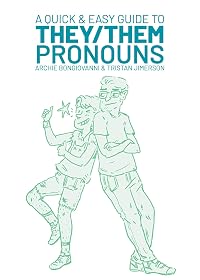
A Quick & Easy Guide to They/Them Pronouns (Quick & Easy Guides)
by Archie Bongiovanni
Easy Guide to They/Them Pronouns (1)
On This Page
Description
Archie, a snarky genderqueer artist, is tired of people not understanding gender neutral pronouns. Tristan, a cisgender dude, is looking for an easy way to introduce gender neutral pronouns to his increasingly diverse workplace. The longtime best friends team up in this short and fun comic guide that explains what pronouns are, why they matter, and how to use them. They also include what to do if you make a mistake, and some tips-and-tricks for those who identify outside of the binary to show more keep themselves safe in this binary-centric world. A quick and easy resource for people who use they/them pronouns, and people who want to learn more!. show lessTags
Recommendations





Member Recommendations
Member Reviews
Review also posted on my blog: https://bennilovesbooks.wordpress.com/2018/06/20/review-a-quick-easy-guide-to-th...
I received an ARC of this book from the publisher. This book has content warnings for depictions of misgendering (not condoned).
As someone who uses they/them pronouns and has to deal with getting misgendered on a regular basis, this guide was incredibly validating and also very thorough. Not only does it give solid examples of how to use they/them pronouns in conversation, but it also addresses why people should use them when they are asked and how it feels if they don’t. Archie and Tristan present two different perspectives — one from someone who uses they/them pronouns and one from someone who doesn’t — that are show more intricately woven together to form the narrative, and it really works because it is hard to get people to understand this stuff. People argue that it’s “bad grammar” (it’s not) or “unnatural” (nope) or “too hard” (you probably do it every day), and it’s demeaning and exhausting. Tristan’s portion of the narrative shows exactly what being a good ally should look like, and Archie’s portion also shows a variety of methods that they/them pronoun-users can utilize to advocate for themselves.
Additionally, this book is just a delight to read. The text is fantastic, and the illustrations are wonderfully done and a joy to look at. It’s informative and funny, and the comics form does an excellent job of utilizing emotion to get the point across. This book is one of the reasons why I love comics — there are few other forms that can get emotions across like this.
I have two small criticisms. First, I do wish that more people involved with this book besides Archie used they/them pronouns, although I really appreciate how everyone credited for working on this book had their pronouns listed out to make it clear who was working from personal experience and who wasn’t. Second, I don’t actually recommend asking people to say their pronouns in public situations because that is essentially asking someone to out themself, and not everyone is comfortable with that. In many cases, it’s possible that someone will either be forced to come out or forced to misgender themself, and neither of those options are very appealing to us. Dealing with this is a tricky thing, but I think more discussion needs to take place around it.
Aside from those two small things, I adored this! I would definitely recommend it for anyone who is looking for something to hand to those people who insist on misgendering you repeatedly (or insists that “theirs” is not a real word… Yes, I actually got that once) and you want them to knock it off.
Final rating: 5 of 5 stars show less
I received an ARC of this book from the publisher. This book has content warnings for depictions of misgendering (not condoned).
As someone who uses they/them pronouns and has to deal with getting misgendered on a regular basis, this guide was incredibly validating and also very thorough. Not only does it give solid examples of how to use they/them pronouns in conversation, but it also addresses why people should use them when they are asked and how it feels if they don’t. Archie and Tristan present two different perspectives — one from someone who uses they/them pronouns and one from someone who doesn’t — that are show more intricately woven together to form the narrative, and it really works because it is hard to get people to understand this stuff. People argue that it’s “bad grammar” (it’s not) or “unnatural” (nope) or “too hard” (you probably do it every day), and it’s demeaning and exhausting. Tristan’s portion of the narrative shows exactly what being a good ally should look like, and Archie’s portion also shows a variety of methods that they/them pronoun-users can utilize to advocate for themselves.
Additionally, this book is just a delight to read. The text is fantastic, and the illustrations are wonderfully done and a joy to look at. It’s informative and funny, and the comics form does an excellent job of utilizing emotion to get the point across. This book is one of the reasons why I love comics — there are few other forms that can get emotions across like this.
I have two small criticisms. First, I do wish that more people involved with this book besides Archie used they/them pronouns, although I really appreciate how everyone credited for working on this book had their pronouns listed out to make it clear who was working from personal experience and who wasn’t. Second, I don’t actually recommend asking people to say their pronouns in public situations because that is essentially asking someone to out themself, and not everyone is comfortable with that. In many cases, it’s possible that someone will either be forced to come out or forced to misgender themself, and neither of those options are very appealing to us. Dealing with this is a tricky thing, but I think more discussion needs to take place around it.
Aside from those two small things, I adored this! I would definitely recommend it for anyone who is looking for something to hand to those people who insist on misgendering you repeatedly (or insists that “theirs” is not a real word… Yes, I actually got that once) and you want them to knock it off.
Final rating: 5 of 5 stars show less
It will take you fifteen minutes to read this little comic book. It will probably take you almost as long to read this review!
The book is written and illustrated by Archie (non-binary, who uses they/them pronouns) and Tristan (cis male, who uses he/him). It's a quick, light-hearted, and practical guide to how to use they/them pronouns for those non-binary people who like to be addressed that way (not all do). For example:
"Chris put on their jeans and then they went to the supermarket."
Image: Queer Utopia: not there yet, hence this book.
There’s also a little bit of the why. But not much, because:
Image: It doesn’t matter why!
However, I think many people unfamiliar with the idea that gender isn’t divided rigidly into two distinct show more categories often do want to understand why: not to pry into the lives of individuals, but to understand the broader issues. You won’t get that context from the book, but you might from this review.
tl;dr
Regardless of how much you understand or approve of this terminology:
• Good manners mean you should try to address people as they want to be addressed, whether that is Khalid, rather than Kal; they, rather than she; or Mrs Webster, rather than Susan. Non-binary people find repeated misgendering demeaning and stressful.
• If in doubt, ask someone what pronouns they use, ideally by giving yours first (never by asking if they’re male or female).
• When you make a mistake, correct yourself, and move on, without making an overwrought apology. Spoiler alert: you will make mistakes.
• Singular "they" is grammatically fine, as explained below.
Basic Terms
"Non-binary", "gender-fluid" or "genderqueer" people don't feel fully, traditionally, or consistently male or female. Like a girl who is a tomboy most of the time, but occasionally likes dressing up in pink frills and doing so-called girly stuff. These people often prefer they/theirs pronouns (instead of he/his or she/hers) and do not like gendered nouns (like woman/man, son/daughter, or girlfriend/boyfriend) applied to them.
Image: Examples of traditional gendered phrases and non-gendered alternatives:
Ladies and gentlemen -> Folks, guests, everyone.
Men and women -> You all, friends.
Guys and gals -> Everyone, anyone.
The lady in the red blouse -> The person in the red shirt.
Grammar of Singular They - it's OK
The grammatical objection is easy to dismiss. Since the demise of thee/thou, you/your has been used as singular and plural. And singular they/their has been used for centuries, by writers including Chaucer, Austen, Byron, Eliot, Trollope, and Dickens, particularly where someone's gender isn't known ("someone left their coat behind"). It's also common generically: in Vanity Fair (1848), Thackeray has Rosalind say "A person can't help their birth.", and I’ve yet to read a review where anyone complains about it.
The authoritative dictionaries and style guides in the English-speaking world accept it, though there seems to be more resistance among US grammar mavens than those in the UK, where it’s always been in common use. If you’re British, see Oxford Dictionaries on the matter. If you’re USican, see Merriam Webster. If you’re in NZ, Canada, Australia, or any other English-speaking country, you’ll have to find your own authority. Here are a couple of excellent analyses of the grammar and history:
* OED Blog: A brief history of singular ‘they’.
* Motivated Grammar: Singular they and the many reasons it’s correct.
You match the verb with "they", which sounds more natural: "they are" and "you are", regardless of the number of people you're referring to (not "they is" or "you is"). For example:
"Chris bought new jeans because they are going to a party tonight."
It can occasionally be ambiguous, but that's easily avoided or fixed, perhaps by repeating the person's name.
Terminology
Back to people. Non-binary people are not necessarily transgender or intersex in the medical sense, though may describe themselves as trans. The only correlation with sexuality is that if your gender is not firmly male or female, you're unlikely to identify as completely straight.
Trans(gender) people feel the gender assigned at birth was wrong, and they transition, not necessarily surgically, to living as an other gender full time, permanently.
"Transvestites" are people who only sometimes dress as their non-birth sex. That term and "transsexual" are often viewed as outdated, or worse, so best avoided.
* Sexuality is OUTward-looking: who you're attracted to.
* Sex is about biology: chromosomes and reproductive organs. Clearcut for most.
* Gender is INward-looking: who you feel you are. It is usually reflected in how you present yourself to the world. For the vast majority of people, their gender corresponds to what the doctor/midwife/parents presumed at birth (the term for that is "cis").
Image: Genderbread Person v3. (Source.)
See also The Gender Unicorn at transstudent.org
Some non-binary people continue to use their gendered birth name and to have a beard or prominent bust. You can’t tell someone’s gender just by looking.
Spectrums and Labels
Whereas sex is usually clear, gender is more a matter of degree (and arguably, a social construct), rather than a binary concept (one of two labels).
The idea that gender is not rigidly binary or tied solely to chromosomes is strange to many of us. However, many cultures had and do have words and roles for such people. It's not a modern western invention. See Wikipedia’s Third Gender page.
I've never doubted that I'm female, but most of the time, I'm not an especially feminine one, so I can understand and empathise to some extent.
What I can't personally relate to is the need for a label, let alone different nouns and pronouns. I can just be a woman who's sometimes a bit of a tomboy (tomman?!). However, my nowq-adult kid is firmly non-binary, as is their spouse, so we use they/them for them individually and as a couple.
Be Kind
For me, it comes back to good manners and empathy, without which it is very difficult to have good relationships. And what relationship is more important than between parents and children?
But it goes both ways. Good manners should be applied to those who don't know, don't understand, or just get muddled by new terminology - hence this book. If I slip up (rare, now), and I don’t correct myself, my husband or child will. But with elderly relatives, we just model the correct pronouns, but don’t correct mistakes. If they love and accept our child, but don’t quite get or remember this new (to them) terminology, that's what is important. Context matters, too: I would be unlikely to correct anyone at a funeral, unless they were misgendering the deceased!
Image: Ways to change your language
Who Is This Book For?
Books like this are important, and the authors have a gentle approach to their mission, but I’m not sure they’ve really thought about their target audience. The format is geared to pre-teens, teens, and YA, but the content is more directed at those unfamiliar with the terminology, most of who are likely to be older. There’s a section on how to introduce gender-neutral awareness in professional settings, for instance. But near the end, there’s a section on coming out as non-binary, which seems aimed more at youthful readers - though obviously one can come out at any age.
In a nice touch, all the people at the publishing house, are listed at the front, giving their name, pronouns, and job title. (But they’re all he/him or she/her!)
Language Change is Pretty Queer
A living language evolves - otherwise “nice pedant” would mean stupid teacher! Even though singular they is nothing new, this particular usage is. Similarly, all the other terms here are subject to change, and even now, what is the norm in the UK may not be the norm in other English-speaking countries.
In particular, "queer" is currently the umbrella term in the UK for LGBTQ+, so encompassing all the above, and more. However, it's also still used as a slur. Don't be shocked if queer people use it, but if in doubt, avoid using it yourself.
Image: More examples of validating language. (Source.)
See Also
• Sally Hines' Is Gender Fluid?, which I reviewed HERE. It also has a very youthful, funky format, though not comic book.
• Alex Iantaffi and Meg-John Barker’s Life Isn’t Binary, which I reviewed HERE. It starts with sexualities and genders, but goes on to relationships, bodies, emotions, and thinking. Barker likes “they” because “I experience myself as pretty plural”.
• Cordelia Fine’s Delusions of Gender, which I reviewed HERE, an antidote to Mars and Venus.
• Robert Webb's autobiography, How Not to be a Boy, which I reviewed HERE. He rails against the damage gender stereotypes do to men and women. show less
The book is written and illustrated by Archie (non-binary, who uses they/them pronouns) and Tristan (cis male, who uses he/him). It's a quick, light-hearted, and practical guide to how to use they/them pronouns for those non-binary people who like to be addressed that way (not all do). For example:
"Chris put on their jeans and then they went to the supermarket."
Image: Queer Utopia: not there yet, hence this book.
There’s also a little bit of the why. But not much, because:
Image: It doesn’t matter why!
However, I think many people unfamiliar with the idea that gender isn’t divided rigidly into two distinct show more categories often do want to understand why: not to pry into the lives of individuals, but to understand the broader issues. You won’t get that context from the book, but you might from this review.
tl;dr
Regardless of how much you understand or approve of this terminology:
• Good manners mean you should try to address people as they want to be addressed, whether that is Khalid, rather than Kal; they, rather than she; or Mrs Webster, rather than Susan. Non-binary people find repeated misgendering demeaning and stressful.
• If in doubt, ask someone what pronouns they use, ideally by giving yours first (never by asking if they’re male or female).
• When you make a mistake, correct yourself, and move on, without making an overwrought apology. Spoiler alert: you will make mistakes.
• Singular "they" is grammatically fine, as explained below.
Basic Terms
"Non-binary", "gender-fluid" or "genderqueer" people don't feel fully, traditionally, or consistently male or female. Like a girl who is a tomboy most of the time, but occasionally likes dressing up in pink frills and doing so-called girly stuff. These people often prefer they/theirs pronouns (instead of he/his or she/hers) and do not like gendered nouns (like woman/man, son/daughter, or girlfriend/boyfriend) applied to them.
Image: Examples of traditional gendered phrases and non-gendered alternatives:
Ladies and gentlemen -> Folks, guests, everyone.
Men and women -> You all, friends.
Guys and gals -> Everyone, anyone.
The lady in the red blouse -> The person in the red shirt.
Grammar of Singular They - it's OK
The grammatical objection is easy to dismiss. Since the demise of thee/thou, you/your has been used as singular and plural. And singular they/their has been used for centuries, by writers including Chaucer, Austen, Byron, Eliot, Trollope, and Dickens, particularly where someone's gender isn't known ("someone left their coat behind"). It's also common generically: in Vanity Fair (1848), Thackeray has Rosalind say "A person can't help their birth.", and I’ve yet to read a review where anyone complains about it.
The authoritative dictionaries and style guides in the English-speaking world accept it, though there seems to be more resistance among US grammar mavens than those in the UK, where it’s always been in common use. If you’re British, see Oxford Dictionaries on the matter. If you’re USican, see Merriam Webster. If you’re in NZ, Canada, Australia, or any other English-speaking country, you’ll have to find your own authority. Here are a couple of excellent analyses of the grammar and history:
* OED Blog: A brief history of singular ‘they’.
* Motivated Grammar: Singular they and the many reasons it’s correct.
You match the verb with "they", which sounds more natural: "they are" and "you are", regardless of the number of people you're referring to (not "they is" or "you is"). For example:
"Chris bought new jeans because they are going to a party tonight."
It can occasionally be ambiguous, but that's easily avoided or fixed, perhaps by repeating the person's name.
Terminology
Back to people. Non-binary people are not necessarily transgender or intersex in the medical sense, though may describe themselves as trans. The only correlation with sexuality is that if your gender is not firmly male or female, you're unlikely to identify as completely straight.
Trans(gender) people feel the gender assigned at birth was wrong, and they transition, not necessarily surgically, to living as an other gender full time, permanently.
"Transvestites" are people who only sometimes dress as their non-birth sex. That term and "transsexual" are often viewed as outdated, or worse, so best avoided.
* Sexuality is OUTward-looking: who you're attracted to.
* Sex is about biology: chromosomes and reproductive organs. Clearcut for most.
* Gender is INward-looking: who you feel you are. It is usually reflected in how you present yourself to the world. For the vast majority of people, their gender corresponds to what the doctor/midwife/parents presumed at birth (the term for that is "cis").
Image: Genderbread Person v3. (Source.)
See also The Gender Unicorn at transstudent.org
Some non-binary people continue to use their gendered birth name and to have a beard or prominent bust. You can’t tell someone’s gender just by looking.
Spectrums and Labels
Whereas sex is usually clear, gender is more a matter of degree (and arguably, a social construct), rather than a binary concept (one of two labels).
The idea that gender is not rigidly binary or tied solely to chromosomes is strange to many of us. However, many cultures had and do have words and roles for such people. It's not a modern western invention. See Wikipedia’s Third Gender page.
I've never doubted that I'm female, but most of the time, I'm not an especially feminine one, so I can understand and empathise to some extent.
What I can't personally relate to is the need for a label, let alone different nouns and pronouns. I can just be a woman who's sometimes a bit of a tomboy (tomman?!). However, my nowq-adult kid is firmly non-binary, as is their spouse, so we use they/them for them individually and as a couple.
Be Kind
For me, it comes back to good manners and empathy, without which it is very difficult to have good relationships. And what relationship is more important than between parents and children?
But it goes both ways. Good manners should be applied to those who don't know, don't understand, or just get muddled by new terminology - hence this book. If I slip up (rare, now), and I don’t correct myself, my husband or child will. But with elderly relatives, we just model the correct pronouns, but don’t correct mistakes. If they love and accept our child, but don’t quite get or remember this new (to them) terminology, that's what is important. Context matters, too: I would be unlikely to correct anyone at a funeral, unless they were misgendering the deceased!
Image: Ways to change your language
Who Is This Book For?
Books like this are important, and the authors have a gentle approach to their mission, but I’m not sure they’ve really thought about their target audience. The format is geared to pre-teens, teens, and YA, but the content is more directed at those unfamiliar with the terminology, most of who are likely to be older. There’s a section on how to introduce gender-neutral awareness in professional settings, for instance. But near the end, there’s a section on coming out as non-binary, which seems aimed more at youthful readers - though obviously one can come out at any age.
In a nice touch, all the people at the publishing house, are listed at the front, giving their name, pronouns, and job title. (But they’re all he/him or she/her!)
Language Change is Pretty Queer
A living language evolves - otherwise “nice pedant” would mean stupid teacher! Even though singular they is nothing new, this particular usage is. Similarly, all the other terms here are subject to change, and even now, what is the norm in the UK may not be the norm in other English-speaking countries.
In particular, "queer" is currently the umbrella term in the UK for LGBTQ+, so encompassing all the above, and more. However, it's also still used as a slur. Don't be shocked if queer people use it, but if in doubt, avoid using it yourself.
Image: More examples of validating language. (Source.)
See Also
• Sally Hines' Is Gender Fluid?, which I reviewed HERE. It also has a very youthful, funky format, though not comic book.
• Alex Iantaffi and Meg-John Barker’s Life Isn’t Binary, which I reviewed HERE. It starts with sexualities and genders, but goes on to relationships, bodies, emotions, and thinking. Barker likes “they” because “I experience myself as pretty plural”.
• Cordelia Fine’s Delusions of Gender, which I reviewed HERE, an antidote to Mars and Venus.
• Robert Webb's autobiography, How Not to be a Boy, which I reviewed HERE. He rails against the damage gender stereotypes do to men and women. show less
"Every time I get misgendered, it feels like someone is adding a brick to my backpack."
This is a wonderful book - One I'd like to hand out to school administrative staff and other parents and strangers on the street in my town! As a parent of a gender neutral oldest child, it was easy to switch pronouns once I knew that was how they were most comfortable.
It's easy to change, once you know, and this guide is a wonderful tool to remind everyone that changing how we speak to each other in general just makes spaces more comfortable for everyone - more inclusive and welcoming. It's easier to make these small changes, especially if it means NOT adding another brick to someone's already burdened and heavy backpack (You know we all carry show more burdns, let's just be good people to each other!)
I definitely look forward to ordering a few copies of this! show less
This is a wonderful book - One I'd like to hand out to school administrative staff and other parents and strangers on the street in my town! As a parent of a gender neutral oldest child, it was easy to switch pronouns once I knew that was how they were most comfortable.
It's easy to change, once you know, and this guide is a wonderful tool to remind everyone that changing how we speak to each other in general just makes spaces more comfortable for everyone - more inclusive and welcoming. It's easier to make these small changes, especially if it means NOT adding another brick to someone's already burdened and heavy backpack (You know we all carry show more burdns, let's just be good people to each other!)
I definitely look forward to ordering a few copies of this! show less
OK, this is the book I need to learn how to navigate a more gender-neutral-aware world. This is a good source for understanding why some people use neutral pronouns and how to acknowledge them, how to use gender-neutral language in daily life, and tips and no-no's for conversations and interactions. It doesn't bother addressing grammarians' concerns about using a plural pronoun for a single person, stating, "Language is always changing. That's why we don't say forsooth anymore..." A friendly and approachable format for teens and adults wanting to learn more.
A nice introduction to a topic of which I only recently became aware and with which I know I will struggle, partly due to leading a pretty sheltered and homogenous life in Iowa, but mostly due to lifelong habit, a poor memory for other people's actual names much less their pronouns, and sheer laziness I will admit. But I'm trying.
The they/them pronoun thing seems harder to process for me due to it requiring I be an active participant as opposed to following the more passive "thou shalt not" school of avoiding misdeeds and traditionally offensive words. (Which, at some point "moist" apparently became? That one snuck up on me unexpectedly.) Part of the irony is that pronouns themselves arise from laziness. In the immortal words of show more Schoolhouse Rock:
"You see a pronoun was made to take the place of a noun
'Cause saying all those nouns over and over
Can really wear you down"
Anyway, the book, while thin, was quite enlightening and thought provoking and mostly handled well.
I thought it was a counterproductive that after one of the narrating character says, "However, when you outright refuse to use a person's correct pronouns it's rude, selfish, and lazy," the other narrator is portrayed in a maliciously gleeful way as they add, "And even if you are OK with being all three of those, remember that it can also get you fired." That moment felt unnecessarily threatening and really clunked for me. A quick Google search yielded several conservative opinion pieces using this angle as a way of criticizing the pronoun movement and this Snopes.com article:
https://www.snopes.com/fact-check/transgender-pronouns-fine-nyc/ show less
The they/them pronoun thing seems harder to process for me due to it requiring I be an active participant as opposed to following the more passive "thou shalt not" school of avoiding misdeeds and traditionally offensive words. (Which, at some point "moist" apparently became? That one snuck up on me unexpectedly.) Part of the irony is that pronouns themselves arise from laziness. In the immortal words of show more Schoolhouse Rock:
"You see a pronoun was made to take the place of a noun
'Cause saying all those nouns over and over
Can really wear you down"
Anyway, the book, while thin, was quite enlightening and thought provoking and mostly handled well.
I thought it was a counterproductive that after one of the narrating character says, "However, when you outright refuse to use a person's correct pronouns it's rude, selfish, and lazy," the other narrator is portrayed in a maliciously gleeful way as they add, "And even if you are OK with being all three of those, remember that it can also get you fired." That moment felt unnecessarily threatening and really clunked for me. A quick Google search yielded several conservative opinion pieces using this angle as a way of criticizing the pronoun movement and this Snopes.com article:
https://www.snopes.com/fact-check/transgender-pronouns-fine-nyc/ show less
I've been waiting for this since Limerence announced it, and I'm super pleased with the result!
The first 25 pages is set-up: what are pronouns and why is it important to use the correct pronouns when referring to or talking to a person.
The middle section is the how-to portion of the book. How to use gender neutral pronouns in a professional setting, when you don't know a person's pronouns, etc. How to correct yourself if you accidentally misgender someone (hint: don't make it a huge thing all about YOU). How to stand up for a non-binary friend OR let them stand up for themselves, and how to know the difference.
There are a few pages aimed toward non-binary folks, directly from Archie (the non-binary half of the creative team) about show more navigating the process of coming out, figuring out when to pick your battles, etc. It's written for non-binary folks, but that portion is also useful for cisgender (your pronouns match what you were assigned at birth, usually your sex) people as it gives you a source of understanding and empathy.
The book wraps up with a few handy pages that are sort of like cheat-sheets. You could even photocopy them to hang in your work cubicle! (We do not condone copying pages and distributing them without written consent from Limerence because that's illegal and not cool.)
In all - this is a great book and, at 70 pages, a handy reference to leave in the breakroom, your local library, etc. I really appreciate that the creative team put it together specifically to be readable and affordable, and that they made it clear that this is the start of a conversation and the start of the work we all need to do to make our society more inclusive and welcoming. show less
The first 25 pages is set-up: what are pronouns and why is it important to use the correct pronouns when referring to or talking to a person.
The middle section is the how-to portion of the book. How to use gender neutral pronouns in a professional setting, when you don't know a person's pronouns, etc. How to correct yourself if you accidentally misgender someone (hint: don't make it a huge thing all about YOU). How to stand up for a non-binary friend OR let them stand up for themselves, and how to know the difference.
There are a few pages aimed toward non-binary folks, directly from Archie (the non-binary half of the creative team) about show more navigating the process of coming out, figuring out when to pick your battles, etc. It's written for non-binary folks, but that portion is also useful for cisgender (your pronouns match what you were assigned at birth, usually your sex) people as it gives you a source of understanding and empathy.
The book wraps up with a few handy pages that are sort of like cheat-sheets. You could even photocopy them to hang in your work cubicle! (We do not condone copying pages and distributing them without written consent from Limerence because that's illegal and not cool.)
In all - this is a great book and, at 70 pages, a handy reference to leave in the breakroom, your local library, etc. I really appreciate that the creative team put it together specifically to be readable and affordable, and that they made it clear that this is the start of a conversation and the start of the work we all need to do to make our society more inclusive and welcoming. show less
A quick and decent little primer on exactly what the title says. The artwork is cute (reminds me a bit of Lucy Knisley’s work, but less polished) and my only gripe is that it perpetuates the claim that “guys” isn’t a gender-neutral phrase, which frankly I think is a little dumb.
Members
- Recently Added By
Lists

Books Read in 2023
5,638 works; 147 members

Trans/Queer Lit
48 works; 5 members
Author Information

21+ Works 895 Members
All Editions
Awards and Honors
Awards
Distinctions
Notable Lists
Series

Belongs to Publisher Series
Work Relationships
Is contained in
Classifications
- Genres
- LGBTQ+, Graphic Novels & Comics, Teen
- DDC/MDS
- 425.55 — Language English & Old English languages Grammar of standard English Nouns, pronouns, adjectives, articles Pronouns
- LCC
- P279 .B64 — Language and Literature Philology. Linguistics Language. Linguistic theory. Comparative grammar Comparative grammar
- BISAC
Statistics
- Members
- 575
- Popularity
- 51,396
- Reviews
- 35
- Rating
- (4.20)
- Languages
- English
- Media
- Paper, Ebook
- ISBNs
- 3
- ASINs
- 1