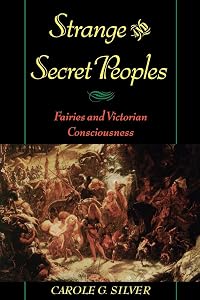
Strange and Secret Peoples: Fairies and Victorian Consciousness
by Carole G. Silver
On This Page
Description
By recapturing the nineteenth-century worlds of the super- and sub-human, and recontextualizing a forgotton obsession - this text enables twentieth-century readers to recover a legacy too precious to be lost.Tags
Recommendations









Member Reviews
Strange and Secret People is solid piece of scholarship concerning the relationship between Victorian folklorists and fairies. Silver discusses what fairies represented in the immense intellectual turmoil of the period. The chapters cover topics like the creation of a British national culture palatable to the native elites, rather than imported French or German stories, as well as fairies as representations of anxieties about female sexuality, the lower classes, disabled children, and the pains of the Industrial Revolution. Perhaps the most interesting parts where the discussions of Darwin and the pseudo-science of fairies, and various attempts to link fairies to either a vanished race of pygmies similar to the tribes encountered in show more Africa and Asia, or the future spiritual evolution of the human race. Science-as-it-could-have been, rather than science-as-it-is. The final chapter concerns the fairies as always vanishing but never quite gone, and the way that they were finally relegated to nursery tales and robbed of all power.
I can’t fault Silver’s scholarship; I doubt that there is a single source that she missed. On the other hand, I think this book could’ve used more theoretical grounding, and more of a focus on the Victorian folklorists who recorded these primary sources. There’s too much analysis of the Victorian’s psychosexual hangups, and not enough of why the Victorians thought these stories were important. A second weakness is some unclarity in this very long period, and what may have changed between early Romanticism, the heights of Imperial power, and the pseudo-science of Theosophy and other spiritual practices. show less
I can’t fault Silver’s scholarship; I doubt that there is a single source that she missed. On the other hand, I think this book could’ve used more theoretical grounding, and more of a focus on the Victorian folklorists who recorded these primary sources. There’s too much analysis of the Victorian’s psychosexual hangups, and not enough of why the Victorians thought these stories were important. A second weakness is some unclarity in this very long period, and what may have changed between early Romanticism, the heights of Imperial power, and the pseudo-science of Theosophy and other spiritual practices. show less
This is a brilliant book -- I wish I would have found and read it years earlier, it would have helped me understand many things more broadly and place them in a better and more useful perspective. The illustrations in the hardcover are MUCH better than in the paperback.
Ratings
Members
- Recently Added By
Lists

thought provoking
15 works; 1 member
Author Information
6 Works 413 Members
Awards and Honors
Awards
Classifications
Statistics
- Members
- 142
- Popularity
- 228,759
- Reviews
- 2
- Rating
- (3.72)
- Languages
- English
- Media
- Paper, Ebook
- ISBNs
- 6
- ASINs
- 1