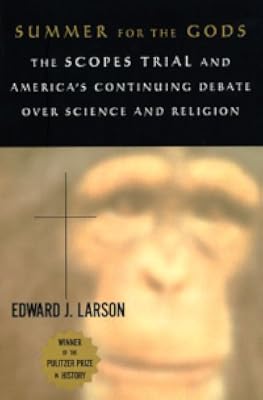
Summer for the Gods: The Scopes Trial and America's Continuing Debate over Science and Religion
by Edward J. Larson
On This Page
Description
Reissued with a new preface: the Pulitzer Prize-winning book that is ?quite simply the best book ever written on the Scopes Trial and its place in American history and myth."Tags
Recommendations


Member Reviews
If you happened to have read the play Inherit the Wind, and let it create your impression of the Scopes Monkey Trial, you particularly need to read this book. This is the story of how the Scopes Monkey trial REALLY happened. There are key details that the play doesn't even try to tell you.
I'll just mention the two biggest revelations:
-The events leading to the Scopes trial were a farce. The town of Dayton, Tennessee was struggling, and the town leaders, gathering in a downtown drugstore, convinced a substitute teacher named John Scopes to deliberately challenge Tennessee's law against teaching evolution so that the resulting trial would bring Dayton some publicity, boosting its economy.
-The famous part of the trial, Darrow v. Bryan, show more didn't have to happen. The American Civil Liberties Union wanted to defend Scopes mainly on freedom-of-speech grounds. But once the fundamentalist William Jennings Bryan joined the prosecution, Clarence Darrow--who was militantly anti-religion--immediately wanted to face down Bryan as a stand against Christianity. He came to Dayton and insinuated himself into the defense team and its strategy, despite that some members of the defense were much more interested in promoting civil liberties than in bashing religion. Essentially, Darrow probably would never have participated in the Scopes trial if Bryan hadn't. show less
I'll just mention the two biggest revelations:
-The events leading to the Scopes trial were a farce. The town of Dayton, Tennessee was struggling, and the town leaders, gathering in a downtown drugstore, convinced a substitute teacher named John Scopes to deliberately challenge Tennessee's law against teaching evolution so that the resulting trial would bring Dayton some publicity, boosting its economy.
-The famous part of the trial, Darrow v. Bryan, show more didn't have to happen. The American Civil Liberties Union wanted to defend Scopes mainly on freedom-of-speech grounds. But once the fundamentalist William Jennings Bryan joined the prosecution, Clarence Darrow--who was militantly anti-religion--immediately wanted to face down Bryan as a stand against Christianity. He came to Dayton and insinuated himself into the defense team and its strategy, despite that some members of the defense were much more interested in promoting civil liberties than in bashing religion. Essentially, Darrow probably would never have participated in the Scopes trial if Bryan hadn't. show less
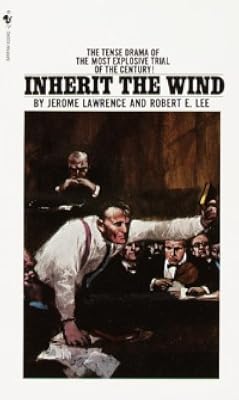
The Scope Trial (occasionally referred to with both contempt and fondness as “The Monkey Trial”) has a life of its own, and much of that life has little or nothing to do with what actually occurred in Dayton, Tennessee during the summer of 1925 when William Jennings Bryan and Clarence Darrow met to defend the merits of the case. Lawrence and Lee’s 1955 play “Inherit the Wind” and the film based off it five years later form much of the basis for popular (but ultimately false) ideas about the trial. And of course it doesn’t help matters that the topics of science and religious have been held to be, at least in the popular imagination, mortal enemies.
In “Summer for the Gods,” Edward J, Larson retells the story of the trial show more stripped of all the mythology, without compromising readability or interest for the layperson. Larson is both a law and history professor, so he’s in a unique position to clarify the historical content and the legal matters. He does a stupendous job of doing both.
Not that the idea of media sensationalism is anything new, but one of the things I liked most about this book was that it shows exactly how the trial was, in many ways, a Potemkin village. As soon as the Butler Act (the statute which prevented the teaching of evolutionary theory in science classrooms in the state of Tennessee) was passed, the newly founded ACLU offered to defend anyone prosecuted by the state for breaking the law. Their plan – for the case to work its way up through the courts and eventually find itself in the Supreme Court docket – didn’t go exactly as planned.
The trial ended up bringing names that spelled the worst kind of boosterism for the beleaguered small-town residents of Dayton who had probably never seen the likes of the media circus they witnessed for those several days – two of the country’s best-known attorneys, Clarence Darrow for the defense and William Jennings Bryan heading up the prosecution. Darrow was fresh out of defending accused murders Leopold and Loeb, whose trial had only a year before also been breathlessly called in the media “the trial of the century”; Bryan was a decade out of his two-year stint as Woodrow Wilson’s Secretary of State, from which he resigned due to the international buildup of the First World War. He was a staunch progressive – back when “progressive” meant, among other things, supporting prohibition and belief in Biblical literalism. How times change.
The issues on the table? Well, they weren’t anything resembling what recent similar cases – say Dover v. Kitzmiller – argued. Bryan’s legal arguments really had very little to do with the merits of science or evolutionary theory. Instead, he argued on majoritarian grounds that if a state law is passed, it was obviously the will of the people and, having gained the appropriate number of votes in the legislature and being signed by the governor, it was constitutionally legitimate. It was much more of a states’ rights, or even a people’s rights, approach than the imagined epic battle between science and religion. The lynchpin of the defense was to get Bryan to testify and ultimately push him into a corner about the proclaimed literal truth of Genesis. A little spoiler alert: despite Darrow’s attempt to utterly embarrass and confound Bryan by getting him on the witness stand and grilling him on the timeline of the events in Old Testament (probably the most historically accurate part of the trial that people would remember) the trial ends in a way that most people who don’t know much about it wouldn’t anticipate. The presiding judge dismisses Bryan’s testimony as irrelevant, and Scopes loses. And since the Bryan’s purpose isn’t to shame Scopes or even make him a personal target, he magnanimously offered to pay the $100 fine for Scope’s conviction, which never had to be paid anyway, since the fine was overturned by a higher court.
Being one of the many whose sole knowledge of the Scopes Trial was based mostly on the play and what was casually bandied about in high school science books, I appreciated Larson’s approach, as full of it is of equanimity and balance. Larson says a few things that make it rather obvious where he falls in the “debate” insofar as there is one (and among professional biologists, there really isn’t): he can look down condescendingly on Bryan on the witness stand trying to defend his ultra-literal view of Genesis, but those of us who credit science where it is due have a hard time not having a little fun at Bryan’s expense. Go read, then watch “Inherit The Wind.” Then as a good counterbalance, and some reliable history, read this. It’s one of the best books on science and religion I’ve had the pleasure of reading in a while. show less
In “Summer for the Gods,” Edward J, Larson retells the story of the trial show more stripped of all the mythology, without compromising readability or interest for the layperson. Larson is both a law and history professor, so he’s in a unique position to clarify the historical content and the legal matters. He does a stupendous job of doing both.
Not that the idea of media sensationalism is anything new, but one of the things I liked most about this book was that it shows exactly how the trial was, in many ways, a Potemkin village. As soon as the Butler Act (the statute which prevented the teaching of evolutionary theory in science classrooms in the state of Tennessee) was passed, the newly founded ACLU offered to defend anyone prosecuted by the state for breaking the law. Their plan – for the case to work its way up through the courts and eventually find itself in the Supreme Court docket – didn’t go exactly as planned.
The trial ended up bringing names that spelled the worst kind of boosterism for the beleaguered small-town residents of Dayton who had probably never seen the likes of the media circus they witnessed for those several days – two of the country’s best-known attorneys, Clarence Darrow for the defense and William Jennings Bryan heading up the prosecution. Darrow was fresh out of defending accused murders Leopold and Loeb, whose trial had only a year before also been breathlessly called in the media “the trial of the century”; Bryan was a decade out of his two-year stint as Woodrow Wilson’s Secretary of State, from which he resigned due to the international buildup of the First World War. He was a staunch progressive – back when “progressive” meant, among other things, supporting prohibition and belief in Biblical literalism. How times change.
The issues on the table? Well, they weren’t anything resembling what recent similar cases – say Dover v. Kitzmiller – argued. Bryan’s legal arguments really had very little to do with the merits of science or evolutionary theory. Instead, he argued on majoritarian grounds that if a state law is passed, it was obviously the will of the people and, having gained the appropriate number of votes in the legislature and being signed by the governor, it was constitutionally legitimate. It was much more of a states’ rights, or even a people’s rights, approach than the imagined epic battle between science and religion. The lynchpin of the defense was to get Bryan to testify and ultimately push him into a corner about the proclaimed literal truth of Genesis. A little spoiler alert: despite Darrow’s attempt to utterly embarrass and confound Bryan by getting him on the witness stand and grilling him on the timeline of the events in Old Testament (probably the most historically accurate part of the trial that people would remember) the trial ends in a way that most people who don’t know much about it wouldn’t anticipate. The presiding judge dismisses Bryan’s testimony as irrelevant, and Scopes loses. And since the Bryan’s purpose isn’t to shame Scopes or even make him a personal target, he magnanimously offered to pay the $100 fine for Scope’s conviction, which never had to be paid anyway, since the fine was overturned by a higher court.
Being one of the many whose sole knowledge of the Scopes Trial was based mostly on the play and what was casually bandied about in high school science books, I appreciated Larson’s approach, as full of it is of equanimity and balance. Larson says a few things that make it rather obvious where he falls in the “debate” insofar as there is one (and among professional biologists, there really isn’t): he can look down condescendingly on Bryan on the witness stand trying to defend his ultra-literal view of Genesis, but those of us who credit science where it is due have a hard time not having a little fun at Bryan’s expense. Go read, then watch “Inherit The Wind.” Then as a good counterbalance, and some reliable history, read this. It’s one of the best books on science and religion I’ve had the pleasure of reading in a while. show less
Edward Larson's Summer for the Gods is an vexing history of the Scope anti-evolution reaching trial held in Dayton, Tennessee in 1925. For 12 days in the hot July summer, Clarence Darrow and William Jennings Bryan duked it out over whether the Tennessee state legislature could mandate that schools not teach content that contradicts Biblical ideas. A dumb law to be sure, but in the 1920s America, evolution (and everything that came with it) was not as settled as it is today. Larson's account of the trial (and the political and religious atmosphere that surrounded it) is commendable for it completeness. He even corrects the record on later publications. For anyone interested in landmark legal cases or science history, this is a very good show more read. show less
Terrific book on the Scopes monkey trial and the continuing (evolving?) debate between science and religion in the public sphere in America. The book is divided into thirds, a "before", "during" and "after" trial section. What makes the book special is its emphasis on the currents and trends leading up to and away from the trial. In addition, Larson clears away a lot of the cobwebs and hoary cliches that have come to be associated with the trial itself, presenting the actual proceedings concisely and lucidly. Unexpected and involving bonuses include passages on the inception of the ACLU, and sections on court arguments and societal impact post-Scopes. The ability to contextualize these "ripples" of influence both forward and backward in show more time from that seminal moment makes this much more than just a recap of that hot summer in Tennessee. show less
This book won the Pulitzer in 1998, for history, and covers the Scopes trial. I read it for more background about the conflict between Religion and Science in the US, it seems very relevant now. It's a well written and researched book, I learned a lot. I hadn't realized how much of the Scopes trial was about show, and bringing attention and business to Dayton, Tennessee. I was also interested to realize how much of the fight against teaching evolution focused on high school, and high school text books.
Also interesting, and somewhat frightening to learn, that the percentage of people in the US who believe literally in the bible creation story has not changed a lot in the years since the Scopes trial. In 2019, a Gallup poll found that 40% show more of the US believed in Creationism., show less
Also interesting, and somewhat frightening to learn, that the percentage of people in the US who believe literally in the bible creation story has not changed a lot in the years since the Scopes trial. In 2019, a Gallup poll found that 40% show more of the US believed in Creationism., show less
When I started reading “Summer for the gods: the Scopes trial and America’s continuing debate over science and religion” I thought that I knew something about the Scopes trial. As the author points out, most Americans feel that way. Edward J Larson, the author, is a professor at Pepperdine University. He has both a PhD in history and a law degree which should make him very qualified to write this book. For me the most important part of of the book was the “before” and “after” sections, the actual events of the trial turn out to be less surprising, and less important, than why it happened and what the results were.
The events prior to the trial was most surprising to me. Religious fundamentalists writing for social show more justice? That surprised me even considering that the society they wanted justice for was lily white and strictly Christian. Evolution was, by the 1920s, a settled issue with most churches. The modern leaning churches accepting science and the pentecostal churches, those that came into being during the First Great Awakening when Europeans and Africans worshiped together as bondsmen to the wealthy English planters, rejecting science as an evil influence that would destroy morality. Outlawing the teaching of evolution was a dead idea until William Jennings Bryan began to advocate for it. As an experienced politician he was quickly successful in attracting conservative fundamentalists to the cause.
The trial was instigated by the American Civil Liberties Union in an attempt to protect teachers freedom of speech and freedom from government sponsored religious influence in the classroom. Unfortunately they soon lost control of the trial when Bryan and Clarence Darrow, two of the era's biggest headline makers, were recruited to argue the case. The prosecution and the ACLU wanted to focus on the law itself, Bryan and Darrow both wanted religion introduced into their arguments. As we all know Bryan and Darrow prevailed.
Scopes was convicted, giving the ACLU a chance to appeal to the state supreme court. This was partially botched by a local attorney who had latched on to the trial as a chance redeem his reputation. Since the appeal was on a very limited point the ACLU expected to lose in Tennessee State Supreme Court and was planning strategy for an appeal to the US Supreme Court when Tennessee pulled the rug out from under them by overturning the conviction on a point they had not been asked to look at. With no conviction there was nothing to appeal effectively ending the legal battle.
After the trial both sides felt they had won. The anti-evolution forces managed to get laws passed in more states, southern and western states but failed in the north and midwest. The ACLU was unable to recruit any teachers to serve as another test case. But when the anti-evolution forces stopped trying to pass laws outside their areas it appeared to many that the fundamentalists had accepted defeat. As we know from current events they only turned inward to regroup. Bryan’s legacy suffered from his association with the trial. To his liberal friends it appeared that he had suffered from bad judgement in his later years and deserted them. To the anti-evolutionists he went from a hero leading their cause to a traitor for his testimony that perhaps Genesis described eras not 24 hour days.
Larson is a good writer, he is intelligent enough to dispense with polysyllabic words meant to impress rather than inform and he did the work to explain the era that colored the trial and how the trial colored the era that followed. His book provides a window to help us understand current events. show less
The events prior to the trial was most surprising to me. Religious fundamentalists writing for social show more justice? That surprised me even considering that the society they wanted justice for was lily white and strictly Christian. Evolution was, by the 1920s, a settled issue with most churches. The modern leaning churches accepting science and the pentecostal churches, those that came into being during the First Great Awakening when Europeans and Africans worshiped together as bondsmen to the wealthy English planters, rejecting science as an evil influence that would destroy morality. Outlawing the teaching of evolution was a dead idea until William Jennings Bryan began to advocate for it. As an experienced politician he was quickly successful in attracting conservative fundamentalists to the cause.
The trial was instigated by the American Civil Liberties Union in an attempt to protect teachers freedom of speech and freedom from government sponsored religious influence in the classroom. Unfortunately they soon lost control of the trial when Bryan and Clarence Darrow, two of the era's biggest headline makers, were recruited to argue the case. The prosecution and the ACLU wanted to focus on the law itself, Bryan and Darrow both wanted religion introduced into their arguments. As we all know Bryan and Darrow prevailed.
Scopes was convicted, giving the ACLU a chance to appeal to the state supreme court. This was partially botched by a local attorney who had latched on to the trial as a chance redeem his reputation. Since the appeal was on a very limited point the ACLU expected to lose in Tennessee State Supreme Court and was planning strategy for an appeal to the US Supreme Court when Tennessee pulled the rug out from under them by overturning the conviction on a point they had not been asked to look at. With no conviction there was nothing to appeal effectively ending the legal battle.
After the trial both sides felt they had won. The anti-evolution forces managed to get laws passed in more states, southern and western states but failed in the north and midwest. The ACLU was unable to recruit any teachers to serve as another test case. But when the anti-evolution forces stopped trying to pass laws outside their areas it appeared to many that the fundamentalists had accepted defeat. As we know from current events they only turned inward to regroup. Bryan’s legacy suffered from his association with the trial. To his liberal friends it appeared that he had suffered from bad judgement in his later years and deserted them. To the anti-evolutionists he went from a hero leading their cause to a traitor for his testimony that perhaps Genesis described eras not 24 hour days.
Larson is a good writer, he is intelligent enough to dispense with polysyllabic words meant to impress rather than inform and he did the work to explain the era that colored the trial and how the trial colored the era that followed. His book provides a window to help us understand current events. show less
Reason read: AAC/LT, Read a Pulitzer prize for history. This was published 1997 and is an examination of the impact of the Scopes Trial of 1925. The author presents the most accurate information about this famous court case and points out the fake news and rewriting of history that has occurred. This should be famous because it was the American Civil Liberties Union's (ACLU) first court case known as the Scopes Trial (State of Tennessee v. John Thomas Scopes), also known as the "Scopes Monkey Trial" The ACLU went looking for a pawn, Scopes agreed to be this pawn. He really wasn't the biology teacher but occasionally subbed for the biology class. The ACLU was taking on a law passed by John Washington Butler, Tennessee representative who show more wrote a bill designed to prohibit the teaching of human evolution in the state's public schools. The other characters were the three time Democratic candidate for president verses Clarence Darrow, the agnostic attorney working on behalf of the ACLU. Another major character was H.L. Mencken, journalist for the Baltimore Sun. The book offers a complete account of the trial relying on court documents and newspaper stories. In Part III, he examines the various ways that the scope trial has been interpreted since 1925. The trial has had lasted impact on debates over evolution, science education, and religious freedom. Larson also examines the cultural and legal ramifications, including its influence on the development of constitutional law and the ongoing tension between science and religion. Factors that have led to the misinformation include the play Inherit the Wind (1950) written by Jerome Lawrence and Robert E. Lee. The play distorted the facts, characters and the tenor of the trial. From its conception this has been a political issue. show less
Members
- Recently Added By
Published Reviews
Larson... gracefully documents the history of Darwinism, the theory of evolution and the fits and starts through which evolution became pitted against the Bible and fundamentalist religion. He is particularly adept at explaining the role of Bryan, who during the trial, in the words of H. L. Mencken, was ''converted into a great sacerdotal figure, half man and half archangel -- in brief, a sort show more of fundamentalist pope.'' Bryan died in the days immediately following the trial, making him a sort of fundamentalist saint. Bryan's and Darrow's ghosts still haunt us, and the Scopes trial still holds resonance, as we continue to litigate the role of religion in public life and the power of the state to prescribe what shall be taught in public schools. show less
added by Lemeritus
The reality was more complex.... Bryan was both an economic progressive and Christian anti-evolutionist. The American Civil Liberties Union actively campaigned for a plaintiff in a test case, and John Scopes saw the case as a lark. Defense lawyer Clarence Darrow cared less about the ACLU agenda--free speech and academic freedom--than about jousting over the Bible and besting Bryan in court. show more Though Scopes was found guilty, the judge imposed a minimum fine and the Tennessee Supreme Court managed to overturn the conviction without invalidating the law. Larson, who teaches history and law at the University of Georgia, has ably put the trial--and its antecedents and aftermath--in appropriate context. show less
added by Lemeritus
A recapitulation of the celebrated 1925 Scopes "Monkey Trial" in Dayton, Tenn.—but one that goes far beyond the courtroom in its analysis.... Larson neatly examines other issues that bore on the Scopes case: academic freedom, the right of states and local bodies to control the content of education, the growth of evolutionary theory in the wake of hominid fossil discoveries of the period. He show more also probes the mythmaking tendencies of the American media, which created what biologist Stephen Jay Gould calls a "realm of nostalgic Americana" evoked in the course of more recent creationist controversies. A learned and absorbing book, especially in its account of the reverberations of the Scopes trial in recent American history. show less
added by Lemeritus
Lists

Ideas for "Science, Religion, and History" group reads
29 works; 9 members

Legal Stories
84 works; 12 members

The Great Courses: The Darwinian Revolution
50 works; 1 member
Author Information

18+ Works 3,501 Members
Edward John Larson (born in 1953) is an American historian and legal scholar. He is University Professor of history and holds the Hugh & Hazel Darling Chair in Law at Pepperdine University. He received the 1998 Pulitzer Prize for History for his book Summer for the Gods: The Scopes Trial and America's Continuing Debate Over Science and Religion. show more The book argues that Inherit the Wind (both the play and the movie) misrepresented the actual Scopes Trial. Larson was born in Mansfield, Ohio, and attended Mansfield public schools. He graduated from Williams College and received his law degree from Harvard University and his Ph.D. in the history of science from the University of Wisconsin--Madison. In 2004, Larson received an honorary Doctorate in Humane Letters from The Ohio State University. He held the Fulbright Program's John Adams Chair in American Studies in 2000-2001. In 2015 his biography The Return of George Washington: 1783-1789, became listed on the New York Times bestseller list. (Bowker Author Biography) show less
Awards and Honors
Awards
Notable Lists
Common Knowledge
- People/Characters
- Clarence Darrow; William Jennings Bryan; John Thomas Scopes; Roger N. Baldwin; Arthur Garfield Hays; Dudley Field Hays (show all 10); H. L. Mencken; John R. Neal; Austin Peay; William Bell Riley
- Important places
- Dayton, Tennessee, USA; Tennessee, USA
- Important events
- Scopes Trial (1925-07)
- Dedication
- In memory of my father, Rex Larson, a Darrowlike criminal lawyer and William H. Ellis, Jr., a Bryanesque attorney-politician
- First words
- Preface -- The Scopes Trial has dogged me for more than a decade, ever since I wrote my first book on the American controversy over creation and evolution.
- Last words
- (Click to show. Warning: May contain spoilers.)If history offers a barometer for future events, it forecasts more heavy weather ahead.
- Original language
- English
- Canonical DDC/MDS
- 345.730288
- Canonical LCC
- KF224.S3
Classifications
- Genres
- Nonfiction, Politics and Government, Science & Nature, History, Religion & Spirituality, General Nonfiction
- DDC/MDS
- 345.730288 — Society, government, & culture Law Criminal Law North America United States
- LCC
- KF224 .S3 — Law Law of the United States Law of the United States (Federal) Criminal trials
- BISAC
Statistics
- Members
- 1,150
- Popularity
- 21,887
- Reviews
- 21
- Rating
- (3.93)
- Languages
- English
- Media
- Paper, Audiobook, Ebook
- ISBNs
- 10
- ASINs
- 11