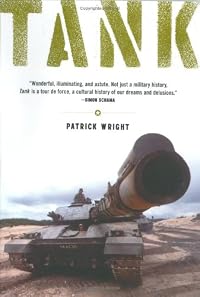
Tank: The Progress of a Monstrous War Machine
by Patrick Wright
On This Page
Description
When the first tanks lumbered onto the battlefields of the Western Front in 1916, they created an enduring myth and tapped into deep currents in the 20th-century mind: into ideas of unstoppable progress and of technological futurism. The tank, always more than the sum of its mechanical parts, is a social and cultural object, partly mythical, a curious compound of fact and fantasy, surrounded by legend.Tags
Recommendations

















Member Reviews
This is is what I call the "History of Beekeeping in Nova Scotia" school of history. Wildly entertaining and insightful. Lenin makes an appearance, for example -iconography, anyone?
ank is a rather bizarre book, a cultural history of the armored fighting vehicle in the 20th century, rather than a military or political history. It is often interesting and charming, and always scattered. Wright begins with the iconic image of "tank man" at Tiananmen Square: a single anonymous civilian facing down an armored column representing the full mass and might of an oppressive state.
He then leaps back to the origins of the tank in the First World War as a solution to the attrition of trench warfare. The Heavy Section of the Machine Gun Corps carried out the first tank attacks in 1916 at the Battle of the Somme, and the first successful attacks at Cambrai. The tank attracted immediate fascinating, being described as a great yet show more ludicrous beast by war correspondents, and then being used as the focal point of a nationwide war bonds campaign.
The first intellectual of armored warfare was the British officer J. F. C. Fuller, who envisioned a new kind of sweeping maneuver against the "horse-minded" stodges of the cavalry. Fuller was a fascinating figure, an early discipline of Alistair Crowley who in the 1930s became a leading British fascist. Strategic brilliance is not always coupled to good sense.
World War 2, the Bltizkrieg, and the Battle of Kursk is treated in a cursory and obligatory way, as if Wright is bored with the moment when the tank came of age. As many words are spent on the ambiguous status of the tank in post-Communist Poland as on the Second World War. A chapter spent with General Israel Tal, Israeli armored leader and designer of the Merkava, is more interesting. Yet for a cultural historian, Wright repeats entirely uncritically the mythos of the Israeli tanker in the Six Day War and Yom Kippur War. The book closes out with a visit to Fort Knox, and the optimistic futurism of the US military in the "end of history" years between the fall of the Berlin Wall and the World Trade Center.
It's hard to say exactly what Wright's thesis is, beyond "hey, look at all the diverse meanings that have been attached to tanks". There are lots of interesting pieces here, but the overall effect is less than the sum of its components. show less
He then leaps back to the origins of the tank in the First World War as a solution to the attrition of trench warfare. The Heavy Section of the Machine Gun Corps carried out the first tank attacks in 1916 at the Battle of the Somme, and the first successful attacks at Cambrai. The tank attracted immediate fascinating, being described as a great yet show more ludicrous beast by war correspondents, and then being used as the focal point of a nationwide war bonds campaign.
The first intellectual of armored warfare was the British officer J. F. C. Fuller, who envisioned a new kind of sweeping maneuver against the "horse-minded" stodges of the cavalry. Fuller was a fascinating figure, an early discipline of Alistair Crowley who in the 1930s became a leading British fascist. Strategic brilliance is not always coupled to good sense.
World War 2, the Bltizkrieg, and the Battle of Kursk is treated in a cursory and obligatory way, as if Wright is bored with the moment when the tank came of age. As many words are spent on the ambiguous status of the tank in post-Communist Poland as on the Second World War. A chapter spent with General Israel Tal, Israeli armored leader and designer of the Merkava, is more interesting. Yet for a cultural historian, Wright repeats entirely uncritically the mythos of the Israeli tanker in the Six Day War and Yom Kippur War. The book closes out with a visit to Fort Knox, and the optimistic futurism of the US military in the "end of history" years between the fall of the Berlin Wall and the World Trade Center.
It's hard to say exactly what Wright's thesis is, beyond "hey, look at all the diverse meanings that have been attached to tanks". There are lots of interesting pieces here, but the overall effect is less than the sum of its components. show less
Not simply a recitation of the mechanical facts, there's a lot in here about the perception and impact of tanks. My interest is in the very early stages and their use in WWI and perhaps I'd have like a bit more hard detail, but I can probably get that elsewhere.
A wonderfully eclectic biography of the tank: as constructed entity, as social icon, as symbol of the 20th century.
Too much human interest. Not enough sixty tonne steel beasts blasting chunks out of each oher.
That this book is listed as published by Penguin (Non-Classics) is not ironic in any sense of the word.
This book is boring on so many levels and it really should not be. The author wants to look at the psychological impact of tanks and the imagery of tanks over the last century. He just goes about his business in a very boring fashion.
This book is boring on so many levels and it really should not be. The author wants to look at the psychological impact of tanks and the imagery of tanks over the last century. He just goes about his business in a very boring fashion.
Ratings
Members
- Recently Added By
Author Information
8+ Works 417 Members
Patrick Wright is Professor of Modern Cultural Studies at Nottingham Trent University, U.K.
Classifications
- Genres
- Nonfiction, History, General Nonfiction, Technology
- DDC/MDS
- 358.1809 — Society, Government, and Culture Public administration & military science Air and other specialized forces and warfare; engineering and related services Artillery
- LCC
- UG446.5 .W75 — Military Science Military engineering. Air forces Military engineering Attack and defense. Siege warfare
- BISAC
Statistics
- Members
- 172
- Popularity
- 189,805
- Reviews
- 6
- Rating
- (3.45)
- Languages
- English
- Media
- Paper
- ISBNs
- 4
- ASINs
- 1