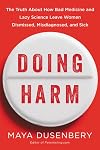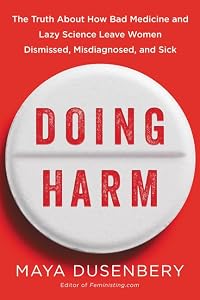
Doing Harm: The Truth About How Bad Medicine and Lazy Science Leave Women Dismissed, Misdiagnosed, and Sick
by Maya Dusenbery
On This Page
Description
"In this shocking, hard-hitting expose in the tradition of Naomi Klein and Barbara Ehrenreich, the editorial director of Feministing.com, reveals how gender bias infects every level of medicine and healthcare today--leading to inadequate, inappropriate, and even dangerous treatment that threatens women's lives and well-being. Modern medicine is failing women. Half of all American women suffer from at least one chronic health condition--from autoimmune disorders and asthma to depression and show more Alzheimer's disease--and the numbers are increasing. A wealth of research has revealed that women often exhibit different symptoms than their male counterparts, suffer disproportionately from many debilitating conditions, and may react differently to prescription drugs and other therapies. Yet more than twenty years after the law decreed that women be included in all health-related research and drug development, doctors are still operating with a lingering knowledge gap when it comes to women's health. And they're not immune to unconscious biases and stereotypes that can undermine the doctor-patient relationship. The consequences can be catastrophic: too often, women are misdiagnosed, poorly treated, and find their complaints dismissed as 'just stress' or 'all in your head.' Meanwhile, they're getting sicker. Maya Dusenbery brings together scientific and sociological research, interviews with experts within and outside the medical establishment, and personal stories from regular women to provide the first comprehensive, accessible look at how sexism in medicine harms women today. In addition to offering a clear-eyed explanation of the root causes of this insidious and entrenched bias and laying out its effects, she suggests concrete steps we can take to cure it. Eye-opening and long-overdue, Doing Harm is an empowering call to action for health care providers and all women"-- show lessTags
Recommendations















Member Reviews
This is an incredibly important book that should be read by all physicians, so of course they won’t. It boggles the mind how far the world has come in some regards, yet women are and have consistently been shortchanged in regards to their health. Take this infuriating read with you to the ER and any doctor appointment (oh and apparently take a dude too since doctors will listen more if you do—WTF?!).
While at times repetitive, Dusenbery delivers an eye-opening look at how women's health is often dismissed and diminished by the physicians and nurses that are supposed to help us. Dusenbery spends a lot of time on hysteria but later highlights specific illnesses that were also likely called "hysteria" by useless doctors. I didn't mind the repetition too much because I took my time reading, by the time I came to the truly repetitive chapters, I was in need of a refresher.
Unfortunately most of the health-related research focuses on men, white men at that. The symptoms of a heart attack differ in men and women, but women are often told they're having a panic attack instead of a heart attack.
Dusenbery does attempt to discuss the show more intersection of race and gender. One of the beliefs held by some doctors brought up by Dusenbery was also briefly discussed in White Fragility: Why It’s So Hard for White People to Talk About Racism : some doctors believe Black people do not feel pain. There are multiple research papers that discuss this belief despite overwhelming evidence that it simply isn't true. The bullshit that we (as a society) have allowed ourselves to be buried in is appalling. Do better, people. show less
Unfortunately most of the health-related research focuses on men, white men at that. The symptoms of a heart attack differ in men and women, but women are often told they're having a panic attack instead of a heart attack.
Dusenbery does attempt to discuss the show more intersection of race and gender. One of the beliefs held by some doctors brought up by Dusenbery was also briefly discussed in White Fragility: Why It’s So Hard for White People to Talk About Racism : some doctors believe Black people do not feel pain. There are multiple research papers that discuss this belief despite overwhelming evidence that it simply isn't true. The bullshit that we (as a society) have allowed ourselves to be buried in is appalling. Do better, people. show less
Very informative and eye opening on the gender bias in medicine and honestly so frustrating that medicine can be so egocentric and sexist . Being a medical student myself , I usually heard professors discrediting women's symptoms and saying that they are doing it for attention , after reading this book I think that a medicine curriculum revolution is really needed for professors that have sexism ingrained in them . I also learned a lot from it and honestly am grateful for having the chance to read it and hopefully I can become a good physician who actually LISTENS
Why the three stars then ?!
The writing .
It was so repetitive , you can delete certain paragraphs and it won't make a difference .. Sometimes I became so bored that I show more contemplated just reading a summary of the book or just dnfing it . Only the critical information presented in the book kept me reading . I think it needs a new edition and some good editing. show less
Why the three stars then ?!
The writing .
It was so repetitive , you can delete certain paragraphs and it won't make a difference .. Sometimes I became so bored that I show more contemplated just reading a summary of the book or just dnfing it . Only the critical information presented in the book kept me reading . I think it needs a new edition and some good editing. show less
This should be required reading for the whole of society - a very thorough and critical look at the history of "modern medicine" and its dismissal and gaslighting of suffering women for decades. Where did it all go wrong? One could argue it was when women were pushed out of their healing roles (herbalism, midwifery, etc.) by the "educated" and credentialed profession of doctoring by white males. Fibromyalgia, endometriosis, vulvodynia, interstitial cystitis, CFS/ME, heart disease and heart attacks in females - all dismissed as psychogenic hysteria. This long, painful history (herstory) will break your heart, but fire you up as well.
This is an important book on the gender gap in medicine. Maya Dusenbery identifies two main gaps: the knowledge gap and the trust gap. Medicine still lags in including women in clinical trials and in researching conditions that occur only in, more frequently in, or differently in women. Secondly, doctors distrust women, discount their reporting of their symptoms, and ascribe women's pain as psychological--despite data showing that women are not more emotional, are not drug seekers, and do not seek medical care more readily than men. This bias is compounded for women of color and women who are overweight, and it's not just in the US (the book is US centric, but there are multiple examples of the same behavior from other countries.
Most show more of this book is great, if enraging, but it's not perfect. In order to keep the book manageable, it's selective. Routine gynecological and maternity care is excluded, as is anything psychiatric. Dusenbery is aggressive on the history of hysteria and its transformation into somatoform disorder--the latter is largely dismissed as a new way to disbelieve women. Her interest is solely in the physical--her focuses are on heart disease, autoimmune disease, and pain disorders. She's so intent to believe that bias is the root of all evil that she sometimes gets into dicey territory on science. I have thyroid disease and I've seen the downside of aggressive patient advocacy for treatment--I wouldn't rely on Mary Shomon. Similarly, she treats the chronic Lyme controversy as solely a question of doctors refusing to believe women, and as someone who's followed that debate for years I'm less convinced. She doesn't criticize "Lyme literate" doctors who charge $12,000 for months of antibiotics that aren't proven to work and who prey on women in their own way. The problem with medicine being lousy is that the alternatives are worse.
Overall, though, a great read. show less
Most show more of this book is great, if enraging, but it's not perfect. In order to keep the book manageable, it's selective. Routine gynecological and maternity care is excluded, as is anything psychiatric. Dusenbery is aggressive on the history of hysteria and its transformation into somatoform disorder--the latter is largely dismissed as a new way to disbelieve women. Her interest is solely in the physical--her focuses are on heart disease, autoimmune disease, and pain disorders. She's so intent to believe that bias is the root of all evil that she sometimes gets into dicey territory on science. I have thyroid disease and I've seen the downside of aggressive patient advocacy for treatment--I wouldn't rely on Mary Shomon. Similarly, she treats the chronic Lyme controversy as solely a question of doctors refusing to believe women, and as someone who's followed that debate for years I'm less convinced. She doesn't criticize "Lyme literate" doctors who charge $12,000 for months of antibiotics that aren't proven to work and who prey on women in their own way. The problem with medicine being lousy is that the alternatives are worse.
Overall, though, a great read. show less
I know, I know. I've been on a bit of a medical kick lately.
Things I liked: It addressed some very real issues in medicine today.
1. There are many studies (code: medical experiments) that do not specify sex. Given the already proven differences between male and female physiology(heart attack symptoms, etc) there should be some way to note/measure that and separate the two. Also, did you know that studies older than the 1950s (and possibly later) didn't allow women to participate? Always look for your sources and prove that they're primary ones. Read [b:Lost Connections: Uncovering the Real Causes of Depression - and the Unexpected Solutions|34921573|Lost Connections Uncovering the Real Causes of Depression - and the Unexpected show more Solutions|Johann Hari|https://images.gr-assets.com/books/1500785858s/34921573.jpg|56184854] for more interesting info regarding studies. *
2. Women do tend to not be taken seriously. I've seen it. Possibly because physicians tend to not know that much about female problems. Case in point: I had PCOS when I was young. Dr. said that I should get better, the pain should just be for the one cycle, etc. 20 years of monthly pain later, a female DC (what would she know?) says go off sugar, white bread, and other starches. Brilliant. Now cramps are an abnormal occurrence.
Things I thought could have used more explanations:
1. Physicians are not perfect. At one point there is a complaint that it is the attitude of the physician that is the problem. Not quite. It might be the fact that we don't see a specialist, but instead see a GP. GP that know their stuff are quite rare (possibly for monetary reasons). True- they should be open to letting people see specialists and take pain seriously but they should not be completely to blame for not knowing the answers.
2. Sometimes the problem is anxiety/depression. Just thought I should point that out. While it definitely doesn't cause intestinal pain, it can cause symptoms similar to a heart attack. And, for what it's worth, I think Freud was right when he said that Trauma can cause physical manifestations of pain. Just ask any sexual abuse victim.
3. Just reading the history of medicine really can damage your belief in men as physicians. If you look at it, it was men doctors who poisoned people with mercury, men doctors who bled people to death, and men who didn't wash their hands. It was women who used herbs, gave largely free services, and compiled and shared knowledge with each other. And, for the most part, that knowledge is gone because the male counterparts that took over medicine (largely except for birth) for 200 years didn't ever have that information because they never trusted it (which is why it is largely gone except, again, with midwifes who have somehow stuck it out). Like it or not, trust plays a huge role in medicine.
4. This book struggles in matters of tone- trying to not seem whining, but also trying to present serious issues. It has good points, though.
*Also, if this is true, what does this mean for people who want to transition? I think it means more research should be done before just jumping into a mix of things we don't completely understand yet. If the problem is that women are only seen for their reproductive system shouldn't that say that there is much more to being female than having a reproductive system (at least, outwardly)? And I think Dusenbery should maybe have covered that inasmuch as there was a section pointing out the unavailability of adequate trans care. But maybe I read her wrong. show less
Things I liked: It addressed some very real issues in medicine today.
1. There are many studies (code: medical experiments) that do not specify sex. Given the already proven differences between male and female physiology(heart attack symptoms, etc) there should be some way to note/measure that and separate the two. Also, did you know that studies older than the 1950s (and possibly later) didn't allow women to participate? Always look for your sources and prove that they're primary ones. Read [b:Lost Connections: Uncovering the Real Causes of Depression - and the Unexpected Solutions|34921573|Lost Connections Uncovering the Real Causes of Depression - and the Unexpected show more Solutions|Johann Hari|https://images.gr-assets.com/books/1500785858s/34921573.jpg|56184854] for more interesting info regarding studies. *
2. Women do tend to not be taken seriously. I've seen it. Possibly because physicians tend to not know that much about female problems. Case in point: I had PCOS when I was young. Dr. said that I should get better, the pain should just be for the one cycle, etc. 20 years of monthly pain later, a female DC (what would she know?) says go off sugar, white bread, and other starches. Brilliant. Now cramps are an abnormal occurrence.
Things I thought could have used more explanations:
1. Physicians are not perfect. At one point there is a complaint that it is the attitude of the physician that is the problem. Not quite. It might be the fact that we don't see a specialist, but instead see a GP. GP that know their stuff are quite rare (possibly for monetary reasons). True- they should be open to letting people see specialists and take pain seriously but they should not be completely to blame for not knowing the answers.
2. Sometimes the problem is anxiety/depression. Just thought I should point that out. While it definitely doesn't cause intestinal pain, it can cause symptoms similar to a heart attack. And, for what it's worth, I think Freud was right when he said that Trauma can cause physical manifestations of pain. Just ask any sexual abuse victim.
3. Just reading the history of medicine really can damage your belief in men as physicians. If you look at it, it was men doctors who poisoned people with mercury, men doctors who bled people to death, and men who didn't wash their hands. It was women who used herbs, gave largely free services, and compiled and shared knowledge with each other. And, for the most part, that knowledge is gone because the male counterparts that took over medicine (largely except for birth) for 200 years didn't ever have that information because they never trusted it (which is why it is largely gone except, again, with midwifes who have somehow stuck it out). Like it or not, trust plays a huge role in medicine.
4. This book struggles in matters of tone- trying to not seem whining, but also trying to present serious issues. It has good points, though.
*Also, if this is true, what does this mean for people who want to transition? I think it means more research should be done before just jumping into a mix of things we don't completely understand yet. If the problem is that women are only seen for their reproductive system shouldn't that say that there is much more to being female than having a reproductive system (at least, outwardly)? And I think Dusenbery should maybe have covered that inasmuch as there was a section pointing out the unavailability of adequate trans care. But maybe I read her wrong. show less
I was interested in learning more about gender inequities in healthcare and chose this book because it seemed to be inclusive of more than cis women compared to other popular books on the same topic. The introduction especially addresses this, although there's not much more in the rest of the book, likely due to limited data.
I liked the book but I think it's longer than it needs to be and does get repetitive. I would recommend reading the introduction and select chapters based on your interest rather than the whole book.
I liked the book but I think it's longer than it needs to be and does get repetitive. I would recommend reading the introduction and select chapters based on your interest rather than the whole book.
Members
- Recently Added By
Lists

Top Five Books of 2018
802 works; 265 members

Books Read in 2019
4,052 works; 108 members
Author Information

1+ Work 306 Members
Maya Dusenbery is a writer and editor of the award-winning site Feministing.com. Formerly a fellow at Mother Jones magazine and a columnist for Pacific Standard magazine, she has also written for Cosmopolitan, Slate, The Atlantic, and Teen Vogue. Before becoming a journalist, she worked at the National Institute for Reproductive Health.
Awards and Honors
Awards
Distinctions
Common Knowledge
- Original publication date
- 2017
Classifications
- Genres
- Nonfiction, General Nonfiction, Sexuality and Gender Studies, Science & Nature
- DDC/MDS
- 613.04244 — Applied Science & Technology Medicine & health Personal health and Fitness Personal health of people by gender, sex, or age group Personal health of specific sex groups Females Adult women
- LCC
- RA564.85 .D88 — Medicine Public aspects of medicine Public aspects of medicine Public health. Hygiene. Preventive medicine
- BISAC
Statistics
- Members
- 304
- Popularity
- 104,968
- Reviews
- 10
- Rating
- (4.27)
- Languages
- English
- Media
- Paper, Audiobook, Ebook
- ISBNs
- 10
- ASINs
- 2