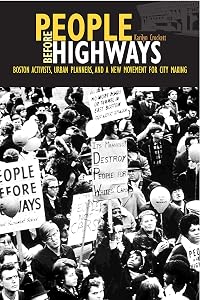
People before Highways: Boston Activists, Urban Planners, and a New Movement for City Making
by Karilyn Crockett
On This Page
Description
In 1948, inspired by changes to federal law, Massachusetts government officials started hatching a plan to build multiple highways circling and cutting through the heart of Boston, making steady progress through the 1950s. But when officials began to hold public hearings in 1960, as it became clear what this plan would entail -- including a disproportionate impact on poor communities of color -- the people pushed back. Activists, many with experience in the civil rights and antiwar protests, show more began to organize. Linking archival research, ethnographic fieldwork, and oral history, Karilyn Crockett in People before Highways offers ground-level analysis of the social, political, and environmental significance of a local anti-highway protest and its lasting national implications. The story of how an unlikely multiracial coalition of urban and suburban residents, planners, and activists emerged to stop an interstate highway is one full of suspenseful twists and surprises, including for the actors themselves. And yet, the victory and its aftermath are undeniable: federally funded mass transit expansion, a linear central city park, and a highway-less urban corridor that serves as a daily reminder of the power and efficacy of citizen-led city making. show lessTags
Recommendations
Member Recommendations
Member Reviews
Everything about the highways seemed inevitable. The 1948 Master Highway Plan for Metropolitan Area laid out the arterial routes for expressways entering Boston from every direction, connected by circumferential routes. The future of New Boston depended on increasing the capacity for motor vehicles in order to prevent traffic congestion. There's just one problem - those highways would cut through neighborhoods where people lived and worked. By the early 1960s, people in Boston and Cambridge were beginning to ask why their homes should be sacrificed for the highways, or should their property be spared, why they should live next to noisy, polluting cars speeding by.
Karilyn Crockett provides an in-depth account of the neighborhood show more activists, civil rights leaders, priests and pastors, civic-minded college students, and a new generation of urban designers and engineers who came together to oppose the Southwest Expressway and the Inner Belt. While initially coming together with modest proposals to reroute the highways, more and more people became determined that the highways should not be built at all. While Boston was not the site of America's first highway revolt, it was perhaps the most successful and one that had nationwide ramifications. In 1970, Governor Francis W. Sargent ordered a review of highway plans that lead to the cancellation of all the expressway plans within the 128 beltway.
This wouldn't have been possible without the work and activism of hundreds of people, and Crockett does a great job of finding and interviewing many of these people for their stories. She also discovered that many people kept personal and community archives of their antihighway work which provide valuable records for her research. The organization of numerous groups and individuals to stop the highways was a monumental task, but not the end of the story. Crockett documents the transformation of the Southwest Corridor over two decades into newly-aligned public transportation routes, an 8-mile long linear path connecting three neighborhoods, as well as more localized resources ranging from community gardens to a community college.
I've been knowledgeable of a lot of details of the highway revolt in Boston for some time, and indeed I've lived adjacent to the still-evolving Southwest Corridor for 18 years. Nevertheless, this book provided a lot of details and connections regarding the history of the movement that fascinate me. Did you know that the Police Headquarters in Roxbury stands on land once used by the Black Panthers outreach trailer? The book is a vital work for anyone studying Boston history for learning how we got to we are now. It is also an excellent work on community organizing, citizen-led planning, and the efficacy of popular democracy at its best.
Favorite Passages:
Karilyn Crockett provides an in-depth account of the neighborhood show more activists, civil rights leaders, priests and pastors, civic-minded college students, and a new generation of urban designers and engineers who came together to oppose the Southwest Expressway and the Inner Belt. While initially coming together with modest proposals to reroute the highways, more and more people became determined that the highways should not be built at all. While Boston was not the site of America's first highway revolt, it was perhaps the most successful and one that had nationwide ramifications. In 1970, Governor Francis W. Sargent ordered a review of highway plans that lead to the cancellation of all the expressway plans within the 128 beltway.
This wouldn't have been possible without the work and activism of hundreds of people, and Crockett does a great job of finding and interviewing many of these people for their stories. She also discovered that many people kept personal and community archives of their antihighway work which provide valuable records for her research. The organization of numerous groups and individuals to stop the highways was a monumental task, but not the end of the story. Crockett documents the transformation of the Southwest Corridor over two decades into newly-aligned public transportation routes, an 8-mile long linear path connecting three neighborhoods, as well as more localized resources ranging from community gardens to a community college.
I've been knowledgeable of a lot of details of the highway revolt in Boston for some time, and indeed I've lived adjacent to the still-evolving Southwest Corridor for 18 years. Nevertheless, this book provided a lot of details and connections regarding the history of the movement that fascinate me. Did you know that the Police Headquarters in Roxbury stands on land once used by the Black Panthers outreach trailer? The book is a vital work for anyone studying Boston history for learning how we got to we are now. It is also an excellent work on community organizing, citizen-led planning, and the efficacy of popular democracy at its best.
Favorite Passages:
"For civil rights groups and militant Black organizations alike, the anti-highway fight served as an ideological accelerator for a politics that had evolved through voter registration drives, lunch counter sit-ins, and rallies protesting police brutality. Honed in the North and the South, these tactics and their philosophical underpinnings now coalesced to yield a mature toolkit for battling state power and highways." - p. 40show less
"More than fights for military withdrawal abroad and racial integration at home, these social movements called for a new democratic order recommitted to the fulfillment of citizen-defined needs. Urban Planning Aid contributed to this activist agenda by bringing grassroots attention and leadership to the democratic use, development, and control of physical space." - p. 71
"When I learned the survival story surrounding these records, I was struck by yet another type of antihighway activism: the efforts of antihighway actors themselves to save materials documenting their story. Their attics, basements, personal address books introduced me to actions and actors that would have otherwise been virtually unknowable." - p. 78
"And, significantly, local control, once a controversial political idea brandished by white southern segregationists, emerged as Black nationalist creed and multiracial, region-spanning resident response to absent and abusive government authority."
Members
- Recently Added By
Lists

The War on Cars podcast
108 works; 1 member
Author Information
1 Work 16 Members
Karilyn Crockett is an independent scholar and director of Economic Policy Research for the City of Boston. She holds a PhD in American studies from Yale University.
Common Knowledge
- Original publication date
- 2018
Classifications
- Genres
- Nonfiction, History, Literature Studies and Criticism
- DDC/MDS
- 388.1 — Society, government, & culture Commerce, communications & transportation regulations Transportation Roads
- LCC
- HE355.3 .C58 .C76 — Social sciences Transportation and communications Transportation and communications Traffic engineering. Roads and highways.
- BISAC
Statistics
- Members
- 16
- Popularity
- 1,521,578
- Reviews
- 1
- Rating
- (4.50)
- Languages
- English
- Media
- Paper, Ebook
- ISBNs
- 2