On This Page
Description
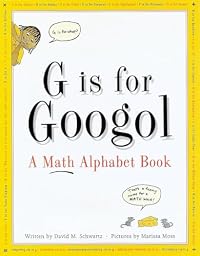
Explains the meaning of mathematical terms which begin with the different letters of the alphabet from abacus, binary, and cubit to zillion.Tags
Recommendations




Member Reviews
What a fun book! This book is notable for its organization. Math ideas are included in an alphabetical order. Each letter of the alphabet takes on a different topic and some letters are used more than once. Each topic gets a page or three. Some mathematical people will go nuts with the idea that the topics are not covered evenly, but neither are the concepts in Math class. Some ideas require more discussion than others.
This book is funny and lighthearted. If you don’t believe me, just turn to page 37 and read R is for Rhombicosidodecahedron. You can also see the author’s comical style in the D is for Diamond page. Yes, that’s right, diamonds do not belong in this book and they were put here just to let you know. See the picture of show more David Schwartz holding a huge bag of popcorn on the back jacket. He is making an excitedly goofy face that the reader would expect.
The book has a glossary in the back and a few sentences about the author and illustrator. This is the first book I have read that explains where the word Googol originated, but there is no reference. For accuracy, the author should include a bibliography. I would like to have seen a further reading section also.
This is a great book for adolescents with an interest in mathematics. show less
This book is funny and lighthearted. If you don’t believe me, just turn to page 37 and read R is for Rhombicosidodecahedron. You can also see the author’s comical style in the D is for Diamond page. Yes, that’s right, diamonds do not belong in this book and they were put here just to let you know. See the picture of show more David Schwartz holding a huge bag of popcorn on the back jacket. He is making an excitedly goofy face that the reader would expect.
The book has a glossary in the back and a few sentences about the author and illustrator. This is the first book I have read that explains where the word Googol originated, but there is no reference. For accuracy, the author should include a bibliography. I would like to have seen a further reading section also.
This is a great book for adolescents with an interest in mathematics. show less
An interesting alphabet book, this picture book takes on a whole new way of going over the alphabet. This is a smorgasbord of math concepts and trivia. It ranges from light-years to numbers found in nature, which tells the alphabet from the math perspective. The illustrations in this book are fun and inviting as well. This book will allow the teacher to introduce new concepts and words that students have not heard before.
Informational Nonfiction
Reading Level: 5.4
Informational Nonfiction
Reading Level: 5.4
An ABC book of math. I never thought I would enjoy reading math books so much. This and "How to be a Math Genius" are amazing books that work for children that already like numbers and for children like me that need a little motivation when it comes to this subject. Each letter introduces a math element or a mathematician a=with comics and funny pictures in the illustrations. I really enjoyed it
Great book for connecting math topics to everyday things in life. For example: How nature is connected to a math by use of the Fibonacci sequence of numbers. Pine needles come in groups or bundles is one way nature is connected to math. Each letter of the alphabet is associated with a math topic. In addition, in one corner of a page more math topics beginning with the letter are denoted. The explanations are short and precise and are not overwhelming to read. I will use this book in my classroom now when introducing a new topic. Exponent described on page 12 and 13 show jelly beans. I tried introducing exponents using jelly beans and it worked well in my classroom. The students enjoyed eating the jelly beans after the learning show more experience.
The author is interested in nature and is excited about math and wants to share his enjoyment of both with his readers. The glossary contained at the end of the book helps to give students a better understanding of the topic. show less
The author is interested in nature and is excited about math and wants to share his enjoyment of both with his readers. The glossary contained at the end of the book helps to give students a better understanding of the topic. show less
A math or math related term from A-Z. There is a term associated with each letter with an explanation of what that terms means and how it can be used. The author also adds more words off to the side for each letter and there are illustrations related to the main term.
I like what this book does because the terms the author decided to use are not the basic math terms that everyone may know or have heard of. The author chose a good variety of terms that I feel that readers can truly learn something new from reading the book. It also shows a slight different side of math and helps create relationships and many students find hard to do for math. I chose the audience as high school students as many of the terms are larger, hard to pronounce show more terms I feel are more at the high school level.
What I like the most about the book is the letter W. The author used the phrase "When are we ever gonna use this stuff, anyway?" as the term. The letter W will help high school students better relate to math and understand hwo the other terms are not just math terms but relate to every day life in some form. If I was presenting this book to my class, I would start the alphabet with the letter W! show less
I like what this book does because the terms the author decided to use are not the basic math terms that everyone may know or have heard of. The author chose a good variety of terms that I feel that readers can truly learn something new from reading the book. It also shows a slight different side of math and helps create relationships and many students find hard to do for math. I chose the audience as high school students as many of the terms are larger, hard to pronounce show more terms I feel are more at the high school level.
What I like the most about the book is the letter W. The author used the phrase "When are we ever gonna use this stuff, anyway?" as the term. The letter W will help high school students better relate to math and understand hwo the other terms are not just math terms but relate to every day life in some form. If I was presenting this book to my class, I would start the alphabet with the letter W! show less
This alphabet book is not for the young. It’s probably for about 3-5th grade. Each letter is a math concept with a long but understandable explanation of what that concept or person was. It was an interesting read if you are interested in math.
This is a really fun math education book. That can be a really tough thing to pull off, but this book does it. It explains a math term or concept with each letter of the alphabet. For example, A is for abacus, B is for binary, etc. It does it in a very easy to understand way. It would be great to use in a math class, or outside of a math class. It also has a glossary at the end to explain unknown terms. I was glad to see a book about math that was appealing to children.
Members
- Recently Added By
Lists

Best Alphabet Books
47 works; 3 members
Author Information

75 Works 17,787 Members
David M. Schwartz has brought his enjoyment of all things mathematical to millions with his award-winning books How Much Is a Million? and If You Made a Million. He speaks at more than 50 schools and conferences every year, generating more excitement about numbers and math than most people would think possible. David is also interested in nature show more and environmental issues, and he watches everything from stars in the night sky to birds in the rainforest. When at home, he can be found in Oakland, California. And yes, that's fewer than a googol popcorn kernels. show less
All Editions
Awards and Honors
Distinctions
Series

Classifications
- Genre
- Nonfiction
- DDC/MDS
- 510 — Natural sciences & mathematics Mathematics Mathematics / Graphs
- LCC
- QA99 .S36 — Science Mathematics Mathematics
- BISAC
Statistics
- Members
- 673
- Popularity
- 42,515
- Reviews
- 17
- Rating
- (4.32)
- Languages
- English
- Media
- Paper
- ISBNs
- 3
- UPCs
- 1
- ASINs
- 1