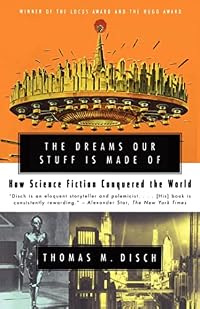
The Dreams Our Stuff Is Made Of: How Science Fiction Conquered the World
by Thomas M. Disch
On This Page
Description
From science fiction writer Thomas M. Disch comes The Dreams Our Stuff Is Made Of, a perceptive account of the impact science fiction has had on American culture. Disch provides a view of this world and its inhabitants, tracing science fiction's phenomenal growth into the multibillion-dollar global entertainment industry it is today. From the protoscience-fiction tales of Edgar Allan Poe, to the utopian dreams and technological nightmares of European writers H.G. Wells, Jules Verne, and J.G. show more Ballard, to American conservatives Robert Heinlein and Jerry Pournelle, liberals Joe Haldemann and Ursula le Guin, flakes William Burroughs and Philip K. Dick, and outright charlatans Ignatius Donnelly and various UFO "witnesses," Disch emphasizes science fiction's cultural role as both a lens and a medium for the very rapid changes driven by modern technology, highlighting its powers of prediction and prevarication. show lessTags
Recommendations





















Member Reviews
This is a rambling book about the history of science fiction and, especially, how it's affected life in America, by a very good SF writer and poet and critic. It's kind of a bleak picture; Disch didn't see much promise in the current state of SF, and he thought the Strategic Defense Initiative and the Heaven's Gate suicides were inevitable results of the American style of fantasy. But what he loved, he told about well, especially when talking about the '60s and '70s since he was there. Whether or not you agree with his readings of particular authors (skeptical admiration for Philip Dick; impatience with the politics of Delany and Le Guin; less about Theodore Sturgeon's books than about his sex life), it's heady reading, especially when show more he gets mad. (In particular, the chapters about right-wing SF, from Robert Heinlein to Jerry Pournelle to Newt Gingrich, for all their calm detail, read as if Disch had to keep stopping to laugh hysterically and throw things at the wall.) show less
This is an unusual history, linking together grand ideas with the live of the author, who very much "was there, and did that." The first chapters stumble in the dark, as Disch tries to establish the links of science-fiction to the very American tradition of the Big Liar, the confidence man who is so outrageous that we go along with the swindle gladly out of a sense of fun. The mostly forgotten Ignatius L. Donnelly, who's books on Atlantis and ancient aliens prefigured the New Age, is the leading figure of this era, while the populist/trash writers Edgar Allan Poe and Jules Verne are its perfection. This history of SF is interesting, if not particularly well balanced or supported.
Once the book gets into the period when Disch was most show more active, the late 50s through the 80s, it really takes off. He is a cutting cultural critic of the work that SF has done in making the atomic Armageddon livable, supporting the indefinite expansion of the military-industrial critic into space, and normalizing and familiarizating the 'office of the future', as epitomized by Star Trek. Sex, consumerism, war, and death are the major themes of the book. There isn't much on the Campbellian Golden Age, or on the Cyberpunk Movement, but other people have written about that. A fascinating, if partial look at my favorite genre. show less
Once the book gets into the period when Disch was most show more active, the late 50s through the 80s, it really takes off. He is a cutting cultural critic of the work that SF has done in making the atomic Armageddon livable, supporting the indefinite expansion of the military-industrial critic into space, and normalizing and familiarizating the 'office of the future', as epitomized by Star Trek. Sex, consumerism, war, and death are the major themes of the book. There isn't much on the Campbellian Golden Age, or on the Cyberpunk Movement, but other people have written about that. A fascinating, if partial look at my favorite genre. show less
... of course it's dour. Of course it's sometimes scabrous. It's Thomas M. Disch! Disch was a wonderful, intelligent writer in (at least, most often in) a genre that, untrue to appearances, often didn't value things like intelligence or -- especially -- good writing. He took his own life in 2008. *The Dreams Our Stuff is Made Of* is not precisely a love-song to science fiction ... as others have pointed out, it's way too judgmental and opinionated and cranky for that ... but if you *really* think Disch is dismissive of what sf can do, read what he says about Clement's *Mission of Gravity*.
Sure, it pissed me off in spots. I think Disch meant it to piss people off. I also read it in two days, transfixed. You are missed, TMD, at least by show more some of us.
I wish I didn't have to add that I heap scorn on Free Press for apparently not bothering with fact-checking or proofreading, because this book (as so many these days) is bursting with embarrassing and needless errors / typos. The author of *Last and First Men* and *Star Maker* is Olaf Stapledon, NOT Olaf Stapleton. Gene Wolfe's name is given correctly in a couple of places but mysteriously warps into "Gene Worle" at least once. And while I know this is a common gaffe (my own mother committed it sometimes), the First Officer in the original *Star Trek* series is named Spock -- sometimes "Mr." Spock but NEVER "Dr. Spock." Dr. Spock's first name was Benjamin, and he was a popular 1960s figure alongside the character played by Leonard Nimoy. C'mon Free Press, wtf? Authors deserve better than this. show less
Sure, it pissed me off in spots. I think Disch meant it to piss people off. I also read it in two days, transfixed. You are missed, TMD, at least by show more some of us.
I wish I didn't have to add that I heap scorn on Free Press for apparently not bothering with fact-checking or proofreading, because this book (as so many these days) is bursting with embarrassing and needless errors / typos. The author of *Last and First Men* and *Star Maker* is Olaf Stapledon, NOT Olaf Stapleton. Gene Wolfe's name is given correctly in a couple of places but mysteriously warps into "Gene Worle" at least once. And while I know this is a common gaffe (my own mother committed it sometimes), the First Officer in the original *Star Trek* series is named Spock -- sometimes "Mr." Spock but NEVER "Dr. Spock." Dr. Spock's first name was Benjamin, and he was a popular 1960s figure alongside the character played by Leonard Nimoy. C'mon Free Press, wtf? Authors deserve better than this. show less
I started reading this book as research for the sci-fi class I am teaching this semester, but I kept reading it because Tom Disch's writing is delightful. Erudite and opinionated, Disch had me laughing and nodding at some of the oddest things -- his perspective on Scientology is sharp and brilliant, for example, and his attitude towards Star Wars is something I can relate to. I did not agree with everything he had to say -- he harshes on some classics and some favorites -- but even when I found myself disagreeing, I thought his points were fair. Some were even enlightening. For anyone interested not only in science fiction, but in the impact of SF on the rest of the world, this is worth your time.
This is the first, but hopefully not the last, Thomas M. Disch book that I have read. I happened upon it in the literature section of my small public library by serendipity. I have only read a handful of science fiction books in the last 20 years or so, so my opinions are not those of a "fan". This is a book of one man's opinions and insights, smart and sassy. Disch is quite the cultural critic, and his vision is far reaching. The title may be a bit misleading, as Disch actually discusses SF via a broad pallet of cultural "fictions" that are loosely based on science ideas. As the cover states, this is "much more than a history of the genre". He rambles between subjects as far wide as celebrity lying to UFO cults to mass murder to the show more SDI of the 80's to feminism and so on, always citing specific people and events (mainly from America in the latter half of the 20th century) with the intention of relating these events to the subtexts of specific SF works. I can see why some reviewers disliked his analysis of the politically conservative subtexts in Robert Heinlien's work, but I found Disch's opinions very enlightening. I guess I have been one of those people who sometimes when reading a book get so caught up in the action that the underlying subtext doesn't immediately register in my conscious mind, but later I feel something unnamed was bothering me - like the racism in Lucifer's Hammer or the conformism inherent in Star Trek. A book is just a book, but Disch reminds us that stories reveal our hope and dreams, our fears and our political agendas. Is this a diatribe as one reviewer says? Well maybe. But though I didn't agree with everything Disch says, I for one like to have my ideas informed and challenged by the writing of a sharp and gifted thinker, and more so when the writing is both unflinching and humorous. show less
By turns, acerbic, witty, thoughtful, arrogant, vicious and sympathetic, this book is really more a collection of essays about various themes and issues related to the genre that Disch wants to talk about rather than a very coherent look at how science fiction has impacted the modern world. One doesn't always agree with what he is saying, and one can even be offended by some of his rather cutting remarks, and his tendency to be rather reductive in the way he presents a particular work, person or agenda that he has it in for, but at the same time, this can also be an engaging, entertaining and even insightful read.
Well, I've read Aldiss, Delany, Le Guin, Dick and others (Ellison, Moskowitz, Amis) on SF Lit/Crit and Analysis. Disch had the advantage of writing after all the above, but this is the most well reasoned, insightful and enjoyable one I've read. Feminists beware. Disch does not pull his punches.
Members
- Recently Added By
Author Information

165+ Works 8,116 Members
Thomas Disch was a popular & prolific poet, playwright, essayist, & novelist. He is the author of many works of science fiction & the poetry collections "Dark verses & Light" & "Yes, Let's: New & Selected Poems". (Publisher Provided) Thomas M. Disch was born in Des Moines, Iowa on February 2, 1940. He dropped out of the architecture program at show more Cooper Union, and then left New York University after he sold a short story entitled The Double Timer. His first novel, The Genocides, was published in 1965. His other novels include The House That Fear Built, 334, The M.D., The Priest, The Word of God: Or, Holy Writ Rewritten, and Clara Reeve written under the pseudonym Leonie Hargreave. He won several awards including the 1969 Ditmar Award for Camp Concentration, the O. Henry Award in 1975 for Getting into Death and in 1977 for Xmas, the 1980 John W. Campbell, Jr. Memorial Award for On Wings of Song, and the 1981 British Science Fiction Award for The Brave Little Toaster: A Bedtime Story for Small Appliances. He was also wrote poetry, opera librettos, plays, and criticism of theater, films and art. His collections of poetry include Here I Am, There You Are, Where Are We; The Dark Old House; Yes, Let's: New and Selected Poetry; and Dark Verses and Light. He won the 1999 biennial Michael Braude Award for Light Poetry for A Child's Garden of Grammar, the Locus and Hugo Awards for 1999 for The Dreams Our Stuff is Made Of: How Science Fiction Conquered the World, and the Puschcart Prize for The First Annual Performance Art Festival at Slaughter Rock Battlefield. His criticism appeared in several publications including The Nation, The New York Daily News, and The New York Sun. In 1987, he wrote a script for the television series Miami Vice. He shot himself on July 4, 2008 at the age of 68. (Bowker Author Biography) show less
Awards and Honors
Awards
Common Knowledge
- Canonical title
- The Dreams Our Stuff Is Made Of: How Science Fiction Conquered the World
- Original publication date
- 1998
- Dedication
- Dedicated to the memory of Glenn Wright
- First words
- (Intro)
There used to be a truism--I heard it from my then agent Terry Carr in 1964--that the golden age of science fiction is twelve, the age we begin to read SF and are wonderstruck.
(Chap 1)
America is a nation of liars, and for that reason science fiction has a special claim to be our national literature, as the art form best adapted to telling lies we like to hear and to pretend we believe. - Last words
- (Click to show. Warning: May contain spoilers.)Science fiction is that menu.
- Blurbers
- Bloom, Harold; Bradfield, Scott; Clute, John; Christopher, Nicholas
Classifications
- Genres
- Literature Studies and Criticism, Nonfiction
- DDC/MDS
- 809.38762 — Literature & rhetoric Literature, rhetoric & criticism History, description, critical appraisal of more than two literatures Fiction Genre Fiction Mystery and Speculative Fiction Speculative Fiction Science Fiction
- LCC
- PN3433.5 .D57 — Language and Literature Literature (General) Literature (General) Prose. Prose fiction Special kinds of fiction. Fiction genres
- BISAC
Statistics
- Members
- 516
- Popularity
- 57,562
- Reviews
- 12
- Rating
- (3.53)
- Languages
- English
- Media
- Paper
- ISBNs
- 3
- ASINs
- 1