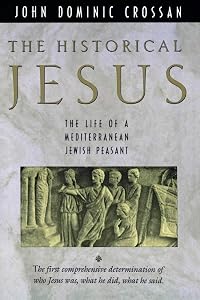
The Historical Jesus: The Life of a Mediterranean Jewish Peasant
by John Dominic Crossan
On This Page
Description
"He comes as yet unknown into a hamlet of Lower Galilee. He is watched by the cold, hard eyes of peasants living long enough at a subsistence level to know exactly where the line is drawn between poverty and destitution. He looks like a beggar yet his eyes lack the proper cringe, his voice the proper whine, his walk the proper shuffle. He speaks about the rule of God and they listen as much from curiosity as anything else. They know all about rule and power, about kingdom and empire, but show more they know it in terms of tax and debt, malnutrition and sickness, agrarian oppression and demonic possession. What, they really want to know, can this kingdom of God do for a lame child, a blind parent, a demented soul screaming its tortured isolation among the graves that mark the edges of the village?" -- from "The Gospel of Jesus," overture to The Historical Jesus The Historical Jesus reveals the true Jesus--who he was, what he did, what he said. It opens with "The Gospel of Jesus," Crossan's studied determination of Jesus' actual words and actions stripped of any subsequent additions and placed in a capsule account of his life story. The Jesus who emerges is a savvy and courageous Jewish Mediterranean peasant, a radical social revolutionary, with a rhapsodic vision of economic, political, and religious egalitarianism and a social program for creating it. The conventional wisdom of critical historical scholarship has long held that too little is known about the historical Jesus to say definitively much more than that he lived and had a tremendous impact on his followers. "There were always historians who said it could not be done because of historical problems," writes Crossan. "There were always theologians who said it should not be done because of theological objections. And there were always scholars who said the former when they meant the latter.' With this ground-breaking work, John Dominic Crossan emphatically sweeps these notions aside. He demonstrates that Jesus is actually one of the best documented figures in ancient history; the challenge is the complexity of the sources. The vivid portrayal of Jesus that emerges from Crossan's unique methodology combines the complementary disciplines of social anthropology, Greco-Roman history, and the literary analysis of specific pronouncements, anecdotes, confessions and interpretations involving Jesus. All three levels cooperate equally and fully in an effective synthesis that provides the most definitive presentation of the historical Jesus yet attained. show lessTags
Recommendations




Member Reviews
The two biggest things I took away from Crossan's book were his impressive scholarship and a strengthened conviction that people are faith are called to community with everyone. Everyone, especially "the nobodies" as Crossan calls them, sharing the same food and the same life.
The Historical Jesus: The Life of a Mediterranean Jewish Peasant is but one of a long list of controversial works that J. D. Crossan has produced. To be honest, I struggled through the first half of this 500 page study--Jesus is barely mentioned until chapter 11. Instead, Crossan spends the first ten chapters carefully laying the groundwork for his research. By the time I reached page 225, I had covered social relationships unique to the Mediterranean region, a variety of peasant responses to political and religious oppression (especially in Palestine during the first century C.E.), Jesus' philosophical and religious contemporaries (especially from the poorest in society). Crossan approaches his study of Jesus armed with show more anthropological, sociological, historical and literary tools, and focuses especially on where all of his tools converge.
Especially noteworthy is his approach to the documentary evidence of Jesus' words and deeds. He draws upon 200 years of New Testament exegesis and Christian Biblical studies to create "An Inventory of the Jesus Tradition by Chronological Stratification and Independent Attestation." I was probably more excited by this Appendix than by most of the book. The first stratum (30-60 C.E.) contains: several Pauline epistles; non-canonical gospels and fragments, including the Gospel of Thomas, and the Gospel of the Hebrews; and finally sources now embedded in the canonical Gospels, including the Sayings Gospel Q, the Miracles Collection and the Cross Gospel. The Gospel of Mark, which I had always considered one of the oldest sources, falls into the second stratum (60-80 C.E.), and Matthew, Luke, and John fall in the third stratum (80-120 C.E.) (along with many other documents/fragments in these strata). He then creates a hierarchy of sayings and stories based on the strata and the level of independent attestation. The lower the stratum (i.e. the closer in time to Jesus) and the greater the number of independent sources, the greater the weight/probability that Crossan assigns to that tradition.
Armed with all of these powerful tools, Crossan reaches the following conclusion about the original Jesus of history: Jesus was a "peasant Jewish Cynic." He preached and practiced radical egalitarianism symbolized by an open table at which the despised and outcast (including women) were welcome, and where he, though teacher and healer, was also a lowly servant. At some point he left rural Galilee for Jerusalem, and after creating a disturbance at the temple, was promptly crucified. The passion and resurrection stories were slowly built up from scriptural exegesis as scribal followers tried to make sense of what had happened to their master.
The Historical Jesus is heavy reading on multiple levels (regarding both faith and scholarship). If you haven't read anything yet on the historical study of Jesus, I highly recommend the approachable (and much, much shorter) Jesus: A Revolutionary Biography, which is a popularized and condensed version of The Historical Jesus. show less
Especially noteworthy is his approach to the documentary evidence of Jesus' words and deeds. He draws upon 200 years of New Testament exegesis and Christian Biblical studies to create "An Inventory of the Jesus Tradition by Chronological Stratification and Independent Attestation." I was probably more excited by this Appendix than by most of the book. The first stratum (30-60 C.E.) contains: several Pauline epistles; non-canonical gospels and fragments, including the Gospel of Thomas, and the Gospel of the Hebrews; and finally sources now embedded in the canonical Gospels, including the Sayings Gospel Q, the Miracles Collection and the Cross Gospel. The Gospel of Mark, which I had always considered one of the oldest sources, falls into the second stratum (60-80 C.E.), and Matthew, Luke, and John fall in the third stratum (80-120 C.E.) (along with many other documents/fragments in these strata). He then creates a hierarchy of sayings and stories based on the strata and the level of independent attestation. The lower the stratum (i.e. the closer in time to Jesus) and the greater the number of independent sources, the greater the weight/probability that Crossan assigns to that tradition.
Armed with all of these powerful tools, Crossan reaches the following conclusion about the original Jesus of history: Jesus was a "peasant Jewish Cynic." He preached and practiced radical egalitarianism symbolized by an open table at which the despised and outcast (including women) were welcome, and where he, though teacher and healer, was also a lowly servant. At some point he left rural Galilee for Jerusalem, and after creating a disturbance at the temple, was promptly crucified. The passion and resurrection stories were slowly built up from scriptural exegesis as scribal followers tried to make sense of what had happened to their master.
The Historical Jesus is heavy reading on multiple levels (regarding both faith and scholarship). If you haven't read anything yet on the historical study of Jesus, I highly recommend the approachable (and much, much shorter) Jesus: A Revolutionary Biography, which is a popularized and condensed version of The Historical Jesus. show less
Crossan presents "the life of a Mediterranean Jewish peasant" very convincingly. His thesis is that Jesus was killed by the Romans for political reasons and that he was a wisdom teacher. You may not agree with Crossan but he will make you reexamine some of your previous assumptions and doctrines.
An excellent and thorough examination of the Historical Jesus, in the line of the "Jesus Seminar". Beware ! This book is in some places very scholar, with lots of references, so it is not an easy reading. It is more a workbook than an introductory book on the subject.
A book which belies its reputation. Two principle criticisms: 1) The author's approach lacks balance. 2) He crudely applies historical archetypes without thought for justification or context. Bad theology but above all bad history.
Bleah. Take your academic-ese and sit on it.
Bleah. Take your academic-ese and sit on it.
Members
- Recently Added By
Lists

Mike's Theology Books
74 works; 2 members

To read
61 works; 1 member

r/AskHistorians' Recommended Books
1,068 works; 19 members
Author Information

73+ Works 11,349 Members
Considered by many to be the most learned scholar on the topic of Jesus Christ, John Dominic Crossan's adversaries question how he reconciles his Catholic faith with 20th century secular study. A former priest, Crossan is the author of The Essential Jesus: Original Sayings and Earliest Images, The Historical Jesus: The Life of a Mediterranean show more Jewish Peasant, Jesus: A Revolutionary Biography; The Birth of Christianity: Discovering What Happened in the Years Immediately After the Execution of Jesus, and The Cross That Spoke: The Origins of the Passion Narrative, among others. (Bowker Author Biography) show less
Common Knowledge
- Original publication date
- 1991
- People/Characters
- Jesus of Nazareth
- Important places
- Jordan River
- Dedication
- for Sarah, Frank, and Michelle
- First words
- In the beginning was the performance; not the word alone, not the deed alone, but both, each indelibly marked with the other forever.
Classifications
- Genres
- Religion & Spirituality, Nonfiction, History, General Nonfiction, Biography & Memoir
- DDC/MDS
- 232.901 — Religion Christianity Jesus Christ and his family Family and life of Jesus Life of Jesus
- LCC
- BT301.2 .C76 — Philosophy, Psychology and Religion Doctrinal Theology Doctrinal Theology Christology Life of Christ
- BISAC
Statistics
- Members
- 1,265
- Popularity
- 19,477
- Reviews
- 11
- Rating
- (3.83)
- Languages
- English, German, Portuguese, Spanish
- Media
- Paper, Ebook
- ISBNs
- 13
- ASINs
- 5